

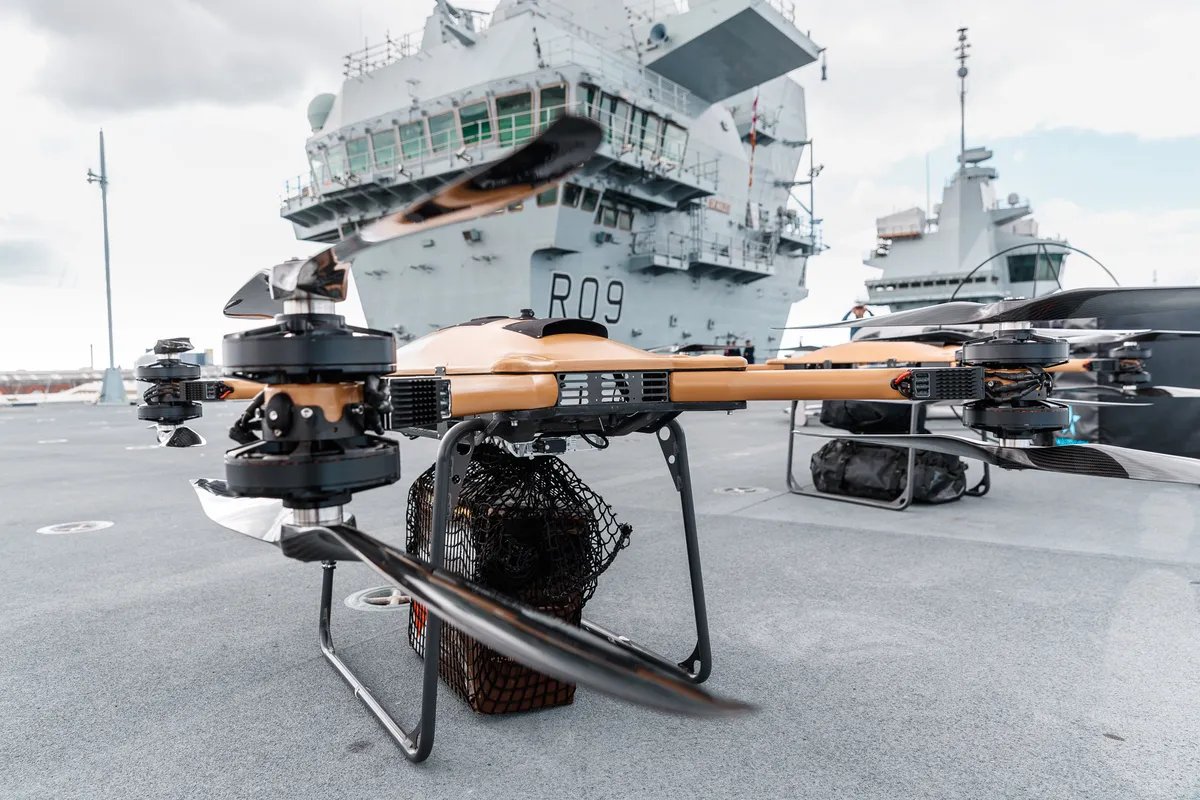
Defense Feeds, Troms — UK Malloy T-150 drone deployment in Arctic Norway marked a historic milestone when Royal Marines used autonomous heavy-lift logistics to resupply mortar teams and machine-gun positions in temperatures as low as -28°C. The system delivered ammunition, medical supplies, and equipment to dispersed positions across the Blåtinden ranges.
This operation demonstrated how autonomous resupply can sustain combat power in extreme environments while reducing risk to personnel and lowering the logistical burden on troops in the field.
The T-150 itself is an eight-rotor heavy-lift drone built by Malloy Aeronautics, now owned by BAE Systems. It can carry up to 68 kilograms, fly at speeds of around 60 mph for up to 40 minutes, and features autonomous landing, remote payload release, rechargeable batteries, and resistance to GPS jamming—making it well-suited for contested battlefield conditions.
Commando Fire Support Integration
UK Malloy T-150 drone operations directly supported Royal Marines from 40 and 45 Commando conducting fire support missions in Arctic terrain.
The system transported 81-millimeter mortar barrels, tripods, base plates, and ammunition across snow-covered positions, accelerating weapon displacement and shoot-and-scoot survivability.
The mortar remains the Commando Force’s primary organic fire-support system firing high-explosive, smoke, and illumination rounds to maximum range of 5,650 meters.
Machine-gun detachments utilizing the L7A2 General Purpose Machine Gun benefited from drone-delivered ammunition and tripod systems. The GPMG operates belt-fed at up to 750 rounds per minute across ranges to 1,800 meters and sustains crew fire-support missions requiring heavy ammunition loads.
Autonomous delivery removed physical burden from ground personnel, directly improving tempo and positioning flexibility across difficult Alpine and snow terrain.
Medical support proved equally critical during the Arctic trials. Royal Marines transported blood packs, medical stores, and bomb disposal robots via the T-150, expanding mission flexibility beyond pure ammunition logistics.
This multi-role capability consolidates fire support, casualty treatment, and engineering tasks onto a single autonomous platform, reducing personnel tied to traditional carrying methods and preserving combat mass at the forward edge.
Operational Deployment and NATO Arctic Strategy
UK Malloy T-150 drone achieved Release to Service with the Royal Navy and Royal Marines in September 2025 following more than two years of trials. Prior maritime operations demonstrated ship-to-ship delivery between HMS Prince of Wales and HMS Dauntless before Arctic ground deployment extended the platform into commando land warfare support.
The transition from naval experimentation to frontline commando logistics represents a significant doctrinal advancement for NATO Arctic operations.
The deployment aligns with UK strategic commitment to expand Arctic presence as part of NATO’s High North posture. London plans to double British troop deployments to Norway from 1,000 to 2,000 across three years supporting NATO Arctic Sentry activity under Joint Force Command Norfolk. Russia’s expanding military activity, China’s growing Arctic interest, and climate-driven operational changes drive NATO’s accelerating High North engagement strategy.

Contested Environment Logistics and Future Implications
The UK’s Malloy T-150 drone introduces a new logistics layer for distributed operations, enabling resupply across terrain where traditional methods are slow, exposed, and manpower-heavy. It can be unpacked and launched in under five minutes by a two-person crew, and operated either manually or autonomously using waypoint navigation.
Designed for flexibility, the platform can transition between maritime and land missions with ease. Its small logistical footprint allows units to sustain operations across dispersed positions without relying on vulnerable supply lines.
Arctic trials proved its real-world value, showing how autonomous logistics can directly boost combat effectiveness in extreme conditions. As NATO shifts toward dispersed operations in challenging environments, systems like the T-150 reduce risk to personnel while maintaining frontline firepower.
Looking ahead, the drone is expected to play a growing role in Arctic deployments. Its cold-weather reliability, autonomy, and multi-role capability position it as a key enabler for future operations—marking not just a technological step forward, but a shift in how modern forces sustain combat across vast, hostile terrain.
