

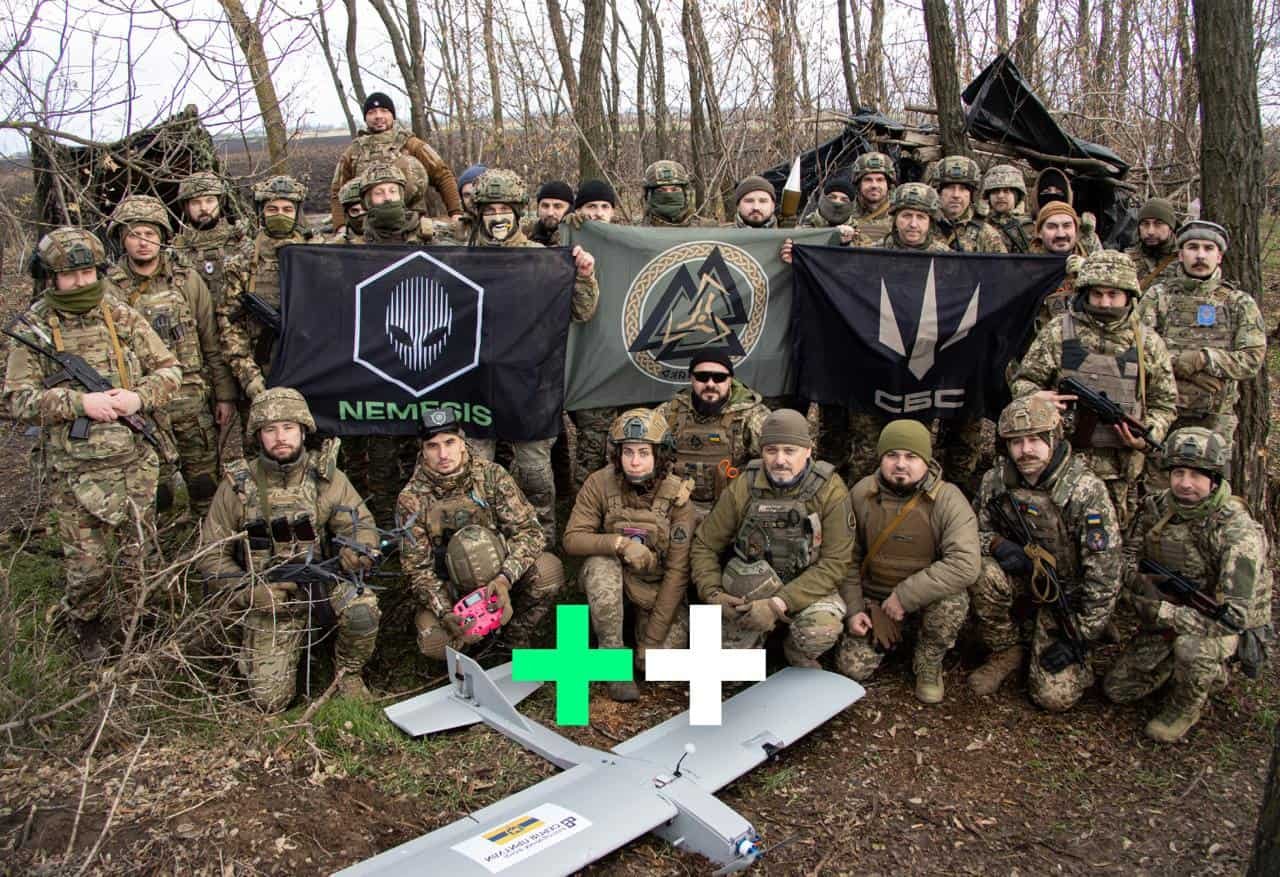
Abstract: The United States Army is undergoing the Transformation in Contact initiative to prepare for large-scale combat operations against peer and near-peer threats. The Secretary of the Army has prioritized integrating Unmanned Aerial Systems (UAS) into every echelon of the force. It is imperative to immediately establish a United States Army Unmanned Systems Command (USAUSC), drawing on lessons from Ukraine’s Unmanned Systems Forces (USF) and insights from an interview with an Ukrainian Special Operations Forces team that developed its regiment’s unmanned systems capability. While the Army is testing multiple short range-reconnaissance UAS, current fielding rates are insufficient for proper training and integration before the next conflict. To address this, the Army must tackle three foundational challenges: accelerate UAS acquisition through a bottom-up approach that empowers battalions to procure systems aligned with their mission-essential tasks, establish subject-matter expert cells and innovation labs at every battalion, and create a unified architecture using the Army Intelligence Data Platform (AIDP) to synchronize mission command, intelligence, and targeting across all echelons.
Forward
The future of warfare has evolved. At the onset of the Russo-Ukraine war, the Russian army possessed more expensive equipment, a larger army, and a better capability to fight effectively in the darkness. This did not dictate victory for Russian forces, however. The Ukrainian forces have employed thousands of drones to counter the larger and better-equipped Russian army. The future of warfare will feature affordable, semi-automated, long-endurance systems that serve as combat multipliers for small ground units, allowing them to take the initiative and gradually weaken the enemy’s capabilities. The U.S. Army must establish a USAUSC to strengthen current capabilities and innovate to stay ahead in great power competition.
Lessons Learned from Ukraine
The Russo-Ukraine war has demonstrated that unmanned systems are integral to modern tactics and an asset that commanders must plan for and plan against. Ukrainian forces have used commercial-off-the-shelf (COTS) drones since 2014 – primarily the $2,000 USD DJI Mavic – for intelligence, surveillance, and reconnaissance (ISR) as well as tactical-level targeting. In September 2024, President Volodymyr Zelensky signed legislation establishing the USF as a separate branch of the Ukrainian armed forces.
The USF emerged through a bottom-up approach, ultimately driven by end users actively engaged in combat on the frontlines. Before the USF’s establishment, operators communicated directly to develop the best tactics, techniques, and procedures (TTPs) for employing these systems in combat. This system did not allow for a shared understanding across the force, which degraded the common operating and intelligence pictures of the battlespace. This lack of shared understanding and situational awareness costs the lives of many soldiers across the battlefield.
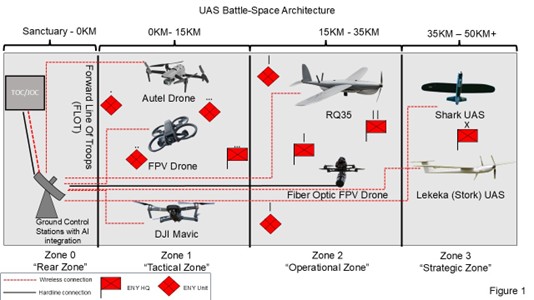
Figure 1: Example UAS architecture in all three zones in Ukrainian drone battlespace, listing assets by zone and connection medium to the TOC/JOC, CPT Peterson and UA SOF Officer created graphic
The USF has enabled UAS integration at every echelon from fire team to national agency to gain situational awareness across the battlefield. This integration is integral to developing common operating and intelligence pictures. There are three zones for the UAS operational battlespace: Zone 1 Tactical Zone, Zone 2 Operational Zone, and Zone 3 Strategic Zone. Zone 0 is behind the forward line of troops in a sanctuary area for the larger ground stations for strategic-level assets. Each zone has its own ecosystem of assets, specifically optimized and configured to maximize effectiveness in that area. All three zones feed data into one unified network that automatically updates the common operating picture (COP), common intelligence picture (CIP), and targeting systems. After artificial intelligence (AI) screens each feed for targets, human operators assess and verify AI-flagged targets before automatically placing them on overlays and target lists. This step helps prevent the misuse of autonomous processes and informs operators conducting missions in the area of operation of the target’s confirmed location (Figure 1).
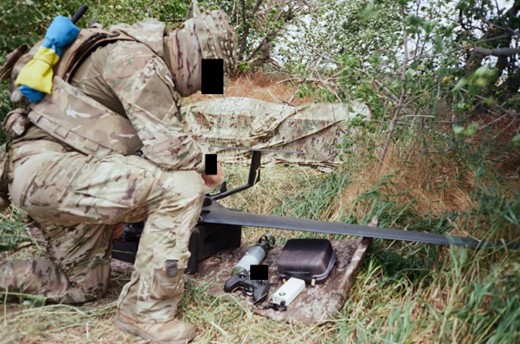
Figure 2: Ukrainian SOF Officer preparing a lone offensive UAS platform for attack in zone 2, from UA SOF Officer private collection
UAS operators typically operate in teams of at least two assets, with one asset acting as an observation platform and the other as an offensive strike capability. This is not a rule; when a better target of opportunity presents itself, offensive assets can act on their own (Figure 2). Personnel at the company level and below consist of crews of four to five specially trained personnel. At the battalion and above levels, there is a small research and development section that focuses on updating firmware, fielding new equipment, conducting recovery operations, and providing subject-matter expertise to troubleshoot problems end users might encounter (Figure 3). Senior leaders select the best operators from each company to serve at the battalion level as subject-matter experts.
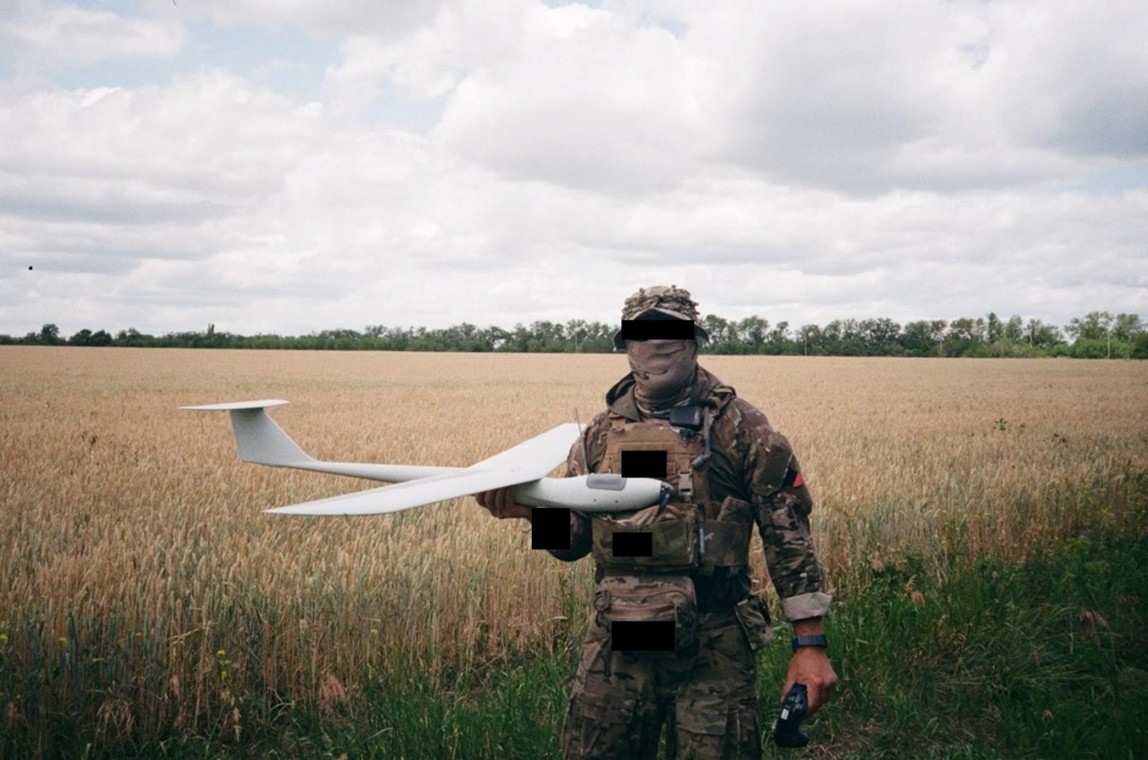
Figure 3: Ukrainian SOF Officer recovering a Lekeka (Stork) UAS in zone 2, from UA SOF Officer private collection
The 2026 Readiness Gap
The Army has a top-down approach to small unmanned aerial systems (SUAS) acquisition, testing systems at the XVIII Airborne Corps and its subordinate units. The resulting data will inform which systems are best suited for the mission set and force-wide deployment This process requires time and multiple iterations of testing to determine the best platforms. Currently, the Army is looking to field quadcopters and other vertical take-off and landing-capable UAS; however, this is subject to change based on test results.
This is not the Army’s first experience with pushing UAS down to small formations across the force. The Army fielded the Hornet SUAS in 2018 for squad-level sensors. This system is designed for close-quarters battle operations rather than for persistent observation, however. As of June 2025, the Army has begun testing short-range reconnaissance (SRR) UAS in transformation in contact brigades, such as the 2nd Brigade, 101st Airborne Division, and the 3rd Brigade, 10th Mountain Division. The Aviation branch currently manages the SRR program. However, these SRR platforms differ significantly from larger fixed-wing ISR platforms like the Grey Eagle and perform different missions based on echelon.
A possible solution currently utilized by the force is the Team Awareness Kit (TAK), however, it is only a partial solution to a complex problem set. Integration of this system will be critical to delivering real time situational awareness to the warfighter on the ground, but does possess limited bandwidth to process the amount of data required to inform higher echelons. The ability to transmit, process, and analyze real-time data rapidly is vital to developing a common operating picture. The US Army currently does not possess a unifying architecture that synthesizes all of the data and video feeds from these sensors on these platforms. This limits the tactical operation center, joint operation center, joint intelligence operations center, or similar command post’s situational awareness and negatively impacts both adjunct units and the overall mission. Each manufacturer has proprietary systems and methods for controlling and transmitting video to the operator, which must be integrated into the architecture on a case-by-case basis. The proposed USAUSC would assume responsibility for these platforms, integrating them into a unified command structure that interacts with existing frameworks and establishes a distinct chain of command to streamline operations.
The Possible Way Forward
To establish the USAUSC and achieve its modernization objectives for 2030 and beyond, the Army must address three foundational challenges. The first challenge the Army currently faces is the speed at which operators on the ground field and test new UAS systems. It is essential to implement a bottom-up approach to the acquisition and testing of UAS platforms. This approach involves enabling and empowering every line combat arms battalion to make their own decisions on SUAS by providing appropriated funds to purchase systems that align with their mission-essential task lists, or METL. Empowering the lowest levels to make these decisions and rapidly change direction as required will result in more effective, tailored, and long-lasting solutions in the ever-evolving battlespace.
The second challenge is the lack of subject-matter experts in UAS operations at the tactical level. To solve this problem, every battalion should have a subject-matter expert cell and an innovation lab working to improve TTPs, hardware, firmware, and test new systems. Recruiting subject-matter experts from UAS operators and maintainers, signal branch personnel, and intelligence personnel will drive innovation and increase effectiveness.
The third challenge is that the current architecture lacks comprehensive situational awareness across all echelons. An integrated architecture that synchronizes mission command, intelligence, and targeting is essential. The Army should identify a single standard operating system to support and seamlessly transfer data between these functions; AIDP should be the foundational structure for fusing these mission-critical components. Higher echelons should establish this framework and ensure modular software is deployable at the lowest levels to facilitate upward information flow. The U.S. Army could implement a similar structure to the Ukrainian zone model, tailoring the zones to U.S. operational needs. With this model, the U.S. Army can enhance situational awareness across echelons and integrate existing data systems for seamless operations. Scaling up this approach to accommodate the U.S. Army’s larger force structure ensures a cohesive strategy that leverages advanced AI and automation to unify mission command, intelligence, and targeting data efficiently.
Enabling the Army of 2030
If the Army addresses these issues and applies lessons learned from Ukraine, it will be in a much stronger position to counter peer and near-peer threats as it advances toward the Army of 2030 and beyond. Adversaries like China and Russia have already started down this path, and it is time for the U.S. to take the lead and become the dominant global power in all things UAS. Adversaries may develop countermeasures to U.S. UAS advancements, however. They could enhance electronic warfare capabilities to disrupt UAS communications and control or deploy counter-drone technology to neutralize UAS operations. A centralized drone corps would generate solutions to these challenges much faster than decentralized and de-linked ground-level innovation. These potential adaptations underscore that while establishing a USAUSC is not a comprehensive solution, it is a necessary first step toward maintaining dominance in great power competition.
