

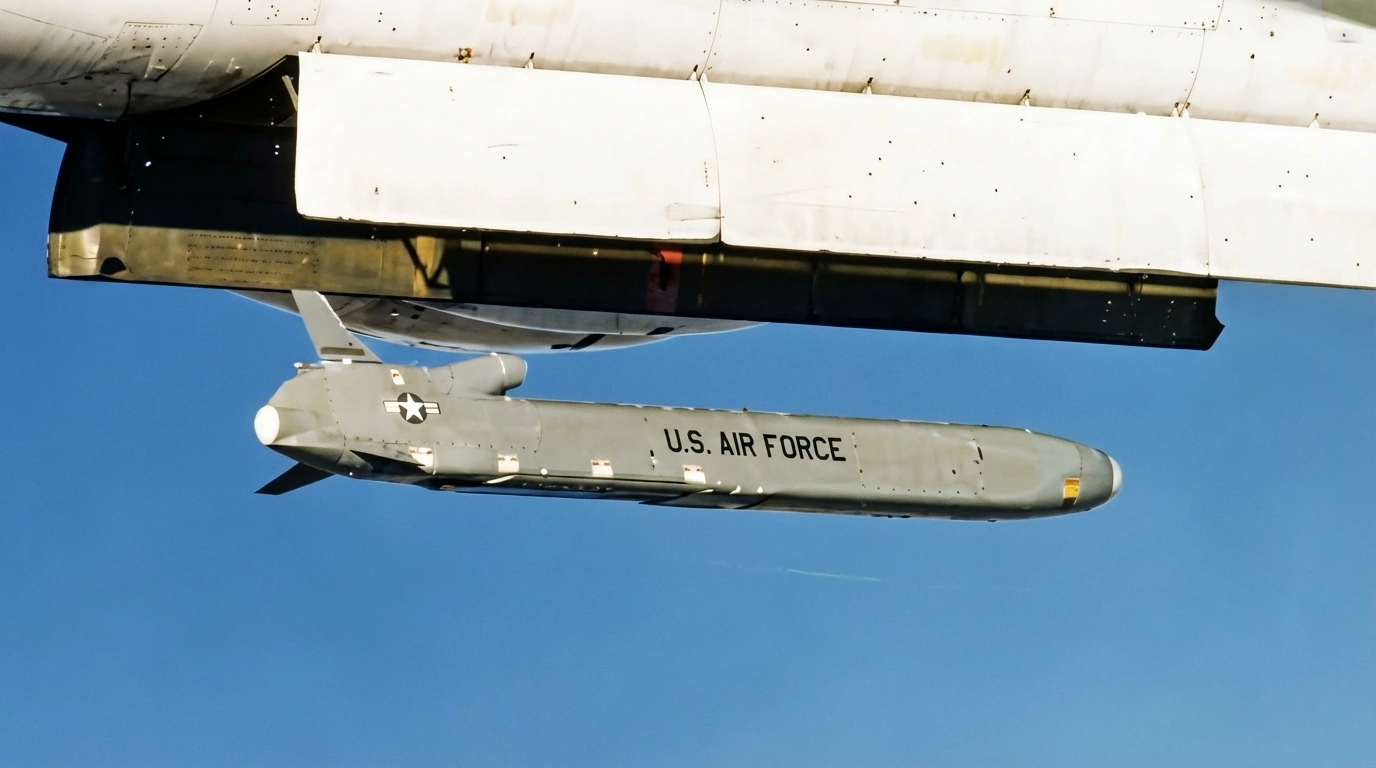
If you were designing a weapon meant to never be noticed until it’s too late, you’d probably end up with something like the AGM-86 ALCM.
It doesn’t roar across the sky like a ballistic missile. It doesn’t announce itself with dramatic speed or blinding heat. Instead, it slips in, low, quiet, deliberate, hugging the terrain like a shadow that refuses to be caught. And that’s exactly the point.
The AGM-86 ALCM (Air-Launched Cruise Missile) was built during a time when the world was balanced on a knife’s edge, the Cold War. Back then, the challenge wasn’t just striking a target. It was getting past layers of radar, interceptors, and defenses designed to stop you long before you got close.
So engineers flipped the problem: what if the missile didn’t fight the defenses… but simply avoided being seen at all?
What came out of that thinking is still flying today.
With a range of over 2,400 kilometers, the AGM-86 allows bombers like the B-52H Stratofortress to launch strikes from well outside enemy airspace. That’s not just convenient, it’s strategic. It means the aircraft, and its crew, stay far from danger while the missile does the risky part alone.
But here’s where things get interesting. The AGM-86 ALCM isn’t just one missile, it’s a family. Nuclear, conventional, bunker-busting variants… each tailored for a slightly different kind of problem. Think of it less like a single tool and more like a toolkit strapped under a bomber’s wing.
So why is a design from the early 1980s still relevant today? And how does it continue to shape modern military strategy in an era of stealth fighters and hypersonic weapons?
That’s what we’re about to unpack.
What Does AGM-86 ALCM Stand For?
Let’s decode the name first, because, oddly enough, it tells you almost everything.
AGM-86 ALCM isn’t just a label; it’s a compact description disguised as military shorthand.
- AGM = Air-to-Ground Missile
- 86 = Design number in the sequence
- ALCM = Air-Launched Cruise Missile
So, in plain language? It’s a missile launched from an aircraft, designed to travel long distances and strike targets on the ground with precision.
Now, that might sound straightforward, but there’s nuance here worth pausing on.

The “air-launched” part is what gives the AGM-86 ALCM its strategic edge. Unlike ground-based systems that are fixed (and therefore predictable), this missile starts its journey from a moving platform, typically the B-52H Stratofortress. That mobility complicates enemy defense planning. You don’t just defend territory, you have to anticipate where the launch might come from. That’s a much harder game.
And then there’s “cruise missile.” This is where things diverge from the cinematic idea of missiles blasting straight up and crashing down. Cruise missiles behave more like pilotless aircraft. They fly within the atmosphere, powered continuously, adjusting course mid-flight.
The AGM-86, in particular, uses terrain-following techniques, skimming hills, valleys, even man-made features, to stay under radar coverage. It’s less like throwing a spear and more like sending a hunter who knows how to stay hidden.
The naming system itself, AGM, is part of a broader U.S. military designation logic. You’ll see similar prefixes across other systems: “AIM” (Air-to-Air Missile), “BGM” (Surface-Launched Missile), and so on. Once you get used to it, you can almost read a weapon’s purpose without looking it up.
Still, names can be misleadingly simple. Because behind this tidy acronym sits a system built for one of the most complex challenges in warfare: penetrating defenses without being noticed.
And that’s where the story gets deeper.
AGM-86 ALCM Specifications That Actually Matter
Let’s get concrete for a moment. Specs can feel like dry numbers, until you realize each one reflects a design choice, a trade-off, a philosophy of how this weapon should behave in the real world.
Here’s a clean breakdown of the AGM-86 ALCM:
| Specification | Details |
| Type | Air-launched cruise missile |
| Range | ~2,400–2,800 km |
| Speed | Subsonic (~Mach 0.7) |
| Length | ~6.3 meters |
| Wingspan | ~3.7 meters (deployed) |
| Engine | Small turbofan |
| Launch Platform | B-52H Stratofortress |
| Warhead | Nuclear (W80) / Conventional |
| Guidance | INS + TERCOM + GPS (later upgrades) |
| Service Entry | 1982 |
At first glance, nothing here screams “cutting-edge.” Subsonic speed? That’s slower than many modern jets. But that’s deliberate.
Speed makes noise, radar noise, thermal signatures, attention. The AGM-86 trades raw speed for stealth-by-behavior. It flies low, often just tens of meters above the ground, weaving through terrain. Imagine a car choosing back roads instead of highways, not faster, but far less visible.
The range is where things shift from interesting to strategically powerful. At over 2,400 km, a bomber doesn’t need to approach enemy airspace at all. It can launch from a relatively safe distance, turning the missile into a kind of long arm extending far beyond the aircraft.

And then there’s the guidance system, a layered approach. Early versions relied heavily on TERCOM (Terrain Contour Matching), essentially comparing the landscape below with stored maps. Later upgrades added GPS, tightening accuracy even further. It’s like switching from navigating by landmarks to having a full digital map in your pocket.
One small but fascinating detail: the wings are folded during carriage and snap open after launch. A bit like a mechanical bird unfolding mid-flight. Not flashy, but elegantly efficient.
Put it all together, and the specs stop being just numbers. They tell a story, of a missile designed not to overpower defenses, but to quietly outthink them.
How the AGM-86 ALCM Was Born From a Problem
The AGM-86 ALCM didn’t start as a bold leap forward. It started as a nagging limitation.
Back in the late 1960s and early ’70s, U.S. strategic planners had a growing concern: bombers, especially the aging B-52 Stratofortress fleet, were becoming increasingly vulnerable. Soviet air defense systems were getting sharper, faster, and more layered. Flying straight toward a target was starting to look… outdated. Risky, even reckless.
So the question shifted. Instead of asking, “How do we protect the bomber?” engineers asked, “What if the bomber didn’t have to get close at all?”
That’s where the roots of the AGM-86 begin.

A Detour Through Decoys
Interestingly, the missile’s lineage isn’t purely offensive. It traces back to systems like the ADM-20 Quail, a decoy designed to confuse enemy radar by mimicking a bomber’s signature. Think of it as an early attempt at psychological warfare via electronics.
But decoys only go so far. Eventually, someone realized: why not build a system that looks like a decoy… but actually hits something?
That subtle shift, from distraction to destruction, changed everything.
From Concept to Reality
Development of what would become the AGM-86 kicked off in the 1970s, with a focus on long-range, low-altitude penetration. The idea was simple in theory: create a missile that could fly under radar coverage for thousands of kilometers.
In practice? Not so simple.
Engineers had to solve a weird mix of problems:
- How do you make a missile “read” terrain?
- How do you keep it stable flying just above hills and valleys?
- How do you ensure it doesn’t drift off course over long distances?
The answer became TERCOM guidance, a system that compares real-world terrain with preloaded maps, almost like a primitive GPS before GPS existed.
By 1982, the AGM-86B (the nuclear variant) officially entered service. And just like that, the strategic equation shifted.
Bombers no longer needed to punch through defenses. They could stand back, release a wave of low-flying missiles, and let those missiles do the dangerous work.
It wasn’t just a new weapon, it was a new way of thinking about airpower.
AGM-86 ALCM Variants: One Missile, Multiple Personalities
At a glance, the AGM-86 ALCM looks like a single, unified system. But that’s a bit misleading. Underneath that familiar shape sits a small family of missiles, each tuned for a different kind of mission. Same body, different intent.
It’s almost like swapping out the “purpose” without changing the “platform.”
AGM-86B: The Nuclear Backbone
This is the original, and still the most strategically significant, variant.
The AGM-86B carries a W80 thermonuclear warhead, making it a core component of the U.S. nuclear deterrent. Its job isn’t just to strike targets; it’s to exist as a credible threat. The kind that complicates an adversary’s calculations before anything is ever launched.
What makes it powerful isn’t just the payload, but the delivery method, low-altitude, long-range, hard to detect. In nuclear strategy, survivability matters as much as firepower.

AGM-86C: The Conventional Shift
Then came a subtle but important pivot.
The AGM-86C, often called CALCM (Conventional Air-Launched Cruise Missile), replaces the nuclear warhead with a high-explosive payload. Same flight profile, different mission: precision strikes without nuclear escalation.
It saw real-world use during conflicts like the Gulf War, where long-range accuracy mattered more than sheer destructive scale. A kind of “scalpel” version of the original design.
AGM-86D: Built for Tough Targets
The AGM-86D takes things a step further, designed specifically for hardened or buried targets. Think bunkers, reinforced facilities, and infrastructure meant to survive conventional attacks.
Instead of just exploding on impact, it uses a penetrating warhead to break through before detonating. Less spectacle, more effectiveness.

Why Variants Matter?
Here’s the bigger picture: these variants give commanders flexibility.
- Nuclear deterrence when stakes are existential
- Precision conventional strikes for tactical operations
- Penetration capability for hardened targets
Same missile family. Different conversations.
And that flexibility, that ability to adapt without redesigning from scratch, is a big reason the AGM-86 has remained relevant for decades.
Combat Use and Real-World Operations
Designing a missile is one thing. Letting it loose in an actual conflict, where weather, human decisions, and imperfect intelligence collide, is something else entirely. The AGM-86 ALCM has lived in both worlds, and the contrast is revealing.
Curiously, its most powerful version, the nuclear-armed AGM-86B, has never been used in combat. And that’s by design. Its value lies in deterrence, in the quiet pressure it exerts simply by existing. It’s the kind of weapon meant to shape decisions before any launch button is touched.
The conventional variants, though, have seen real action.
During the Gulf War, the AGM-86C stepped into the spotlight. Launched from B-52H Stratofortress bombers flying well outside Iraqi airspace, these missiles traveled hundreds, sometimes thousands, of kilometers to reach their targets. No dramatic dogfights, no last-second evasive maneuvers. Just quiet releases followed by long, calculated flights.
That moment mattered. It showed that you didn’t need to risk aircraft to hit defended targets. You could stay distant, almost detached, and still be effective.
In later operations, the missile’s role became even more subtle. Instead of overwhelming force, it offered precision at scale. A single bomber could deploy multiple missiles, each pre-programmed for a different objective. It’s a strange image when you think about it, one aircraft acting less like a bomber and more like a mobile launch platform, orchestrating a series of independent strikes.
What stands out isn’t just that the AGM-86 worked. It’s how it worked, quietly, predictably, without drawing attention to itself.
And maybe that’s the real takeaway. In a domain often obsessed with speed and spectacle, the AGM-86 proved that effectiveness can look… almost invisible.
Strategic Importance: Why the AGM-86 Still Matters
The AGM-86 ALCM remains relevant for one simple reason, it changes how wars are planned, not just fought.
Carried by the B-52H Stratofortress, it gives the U.S. a powerful standoff capability. Bombers don’t need to enter hostile airspace; they can launch from thousands of kilometers away. That reduces risk while maintaining reach, a rare combination.
But its real value is strategic pressure. For any adversary, defending against a low-flying, long-range cruise missile isn’t straightforward. It forces wider radar coverage, faster response times, and constant readiness. In other words, it stretches defenses thin.
There’s also a signaling effect. The AGM-86, especially its nuclear variant, reinforces deterrence without immediate escalation. It’s a quiet reminder that precision, or devastating force, can arrive without warning.
Not the newest system in the arsenal, sure. But in strategy, reliability and unpredictability often matter more than novelty.
