

USS Frank E. Peterson (DDG 121) and USS Michael Murphy (DDG 112) have become the first U.S. warships to transit the Strait of Hormuz since the start of the U.S.-Iran War, marking the opening phase of mine clearance and blockade operations, with additional forces en route.
Carter Jonhston story, additional reporting by Tayfun Ozberk and Xavier Vavasseur
The U.S. Navy is repositioning assets in support of upcoming mine clearance operations, moving the first two Arleigh Burke-class guided missile destroyers into the Persian Gulf, a move that CENTCOM describes as “setting conditions for clearing mines”.
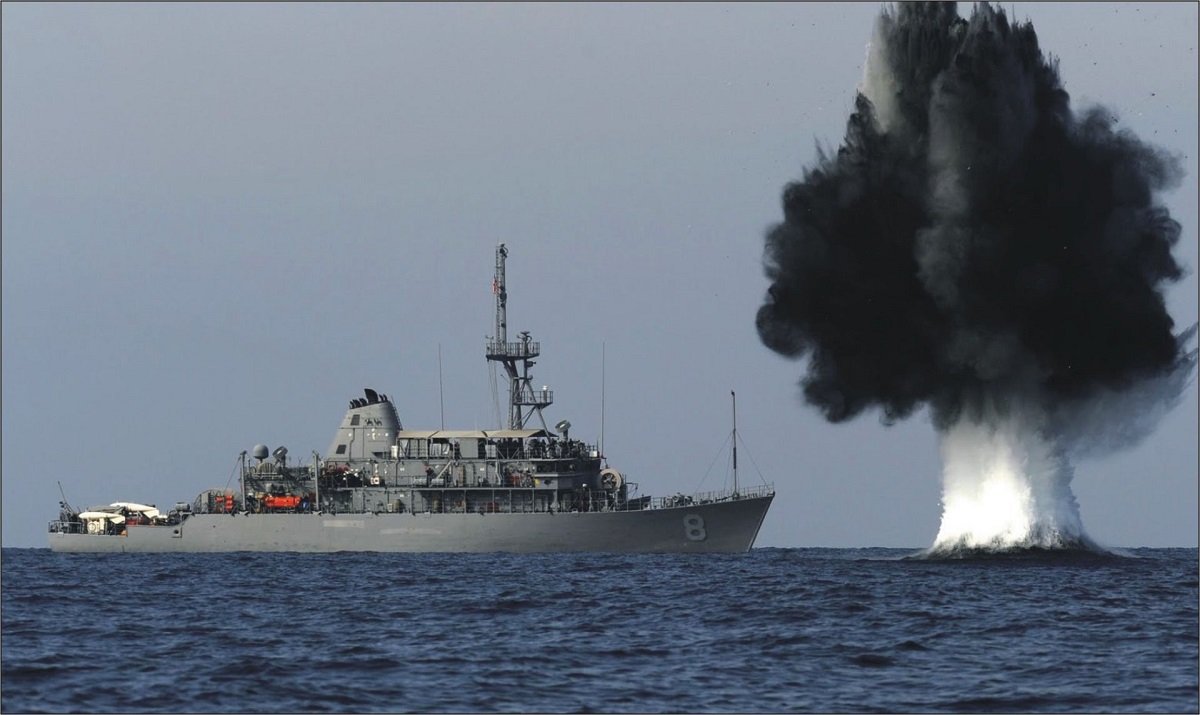
The first two destroyers transited the strait on April 11. Additional forces are being rushed to the region amid ceasefire discussions that ended abruptly between Iran and the United States, including Avenger-class minesweepers from Sasebo, Japan.
Unmanned Undersea Vehicles (UUVs) will also join the mine-clearing effort in the coming days in a move to reopen the Strait of Hormuz to commercial traffic. Less than a dozen ships transited without prior approval from Iran’s Islamic Revolutionary Guard Corps over the past week, with pre-war traffic exceeding 130 ships per day, according to the U.K. Maritime Trade Operations Center.

Supplementing deployed assets with UUVs will give Mine Countermeasures Mission (MCM) Littoral Combat Ships additional help in hunting and clearing Iran’s laid mines in the Strait of Hormuz. The MCM packages used on Littoral Combat Ships have been plagued with problems, in some cases making them combat ineffective. Naval News previously reported on the MCM mission packages and their limited utility in relevant Middle East scenarios.
Secretary of the Navy John Phelan authorized the rotation of older, purpose-built Avenger-class hulls with MCM-equipped Independence-class ships even with the clear concerns surrounding MCM mission packages.
Now U.S. forces are preparing to restart combat operations in the Middle East. President Donald Trump told his followers on Truth Social on Sunday that “[effective] immediately, the United States Navy, the Finest in the World, will begin the process of BLOCKADING any and all Ships trying to enter, or leave, the Strait of Hormuz.”
Sasebo-based USS Pioneer (MCM 9) and USS Chief (MCM 14) transited the Strait of Malacca northbound towards the Middle East on April 11. Bahrain-based USS Tulsa (LCS 16), an MCM-equipped LCS, transited on April 2. Other Bahrain-based Littoral Combat Ships USS Canberra (LCS 30) and USS Santa Barbara (LCS 32) are underway in the Indian Ocean and moored in Singapore, respectively.
Carrier Strike Group Reroutes as First Ships Test Blockade

The USS George H.W. Bush Carrier Strike Group is currently operating off southern Africa after diverting from its original route through the Red Sea, according to USNI News, which first reported the movement. The decision reflects continued concerns over Houthi anti-ship threats in the Bab el-Mandeb, effectively forcing U.S. naval planners to take the longer route around the Cape of Good Hope to reach the CENTCOM area of operations.
CENTCOM today issued the following statement and infographic:
More than 10,000 U.S. Sailors, Marines, and Airmen along with over a dozen warships and dozens of aircraft are executing the mission to blockade ships entering and departing Iranian ports. During the first 24 hours, no ships made it past the U.S. blockade and 6 merchant vessels complied with direction from U.S. forces to turn around to re-enter an Iranian port on the Gulf of Oman.
The blockade is being enforced impartially against vessels of all nations entering or departing Iranian ports and coastal areas, including all Iranian ports on the Arabian Gulf and Gulf of Oman. U.S. forces are supporting freedom of navigation for vessels transiting the Strait of Hormuz to and from non-Iranian ports.

