

Key Points
- West Point Cadet Alex Anteen spent three weeks working with DEVCOM Armaments Center engineers at Picatinny Arsenal on counter-drone targeting algorithms.
- The algorithms are in the simulation phase, testing engagement strategies against multi-axis drone swarm scenarios to reduce munitions depletion.
A West Point cadet has spent three weeks helping Army engineers solve a math problem that could determine how many enemy drones an American air defense system can shoot down before it runs out of ammunition.
Cadet Alex Anteen, a member of the U.S. Military Academy’s class of 2028, worked alongside scientists at the Army’s Combat Capabilities Development Command Armaments Center, the Army’s primary research and development hub for weapons and munitions headquartered at Picatinny Arsenal in New Jersey, to build new targeting algorithms designed to make counter-drone defenses smarter and more efficient, Eric Kowal of Picatinny Arsenal reported.
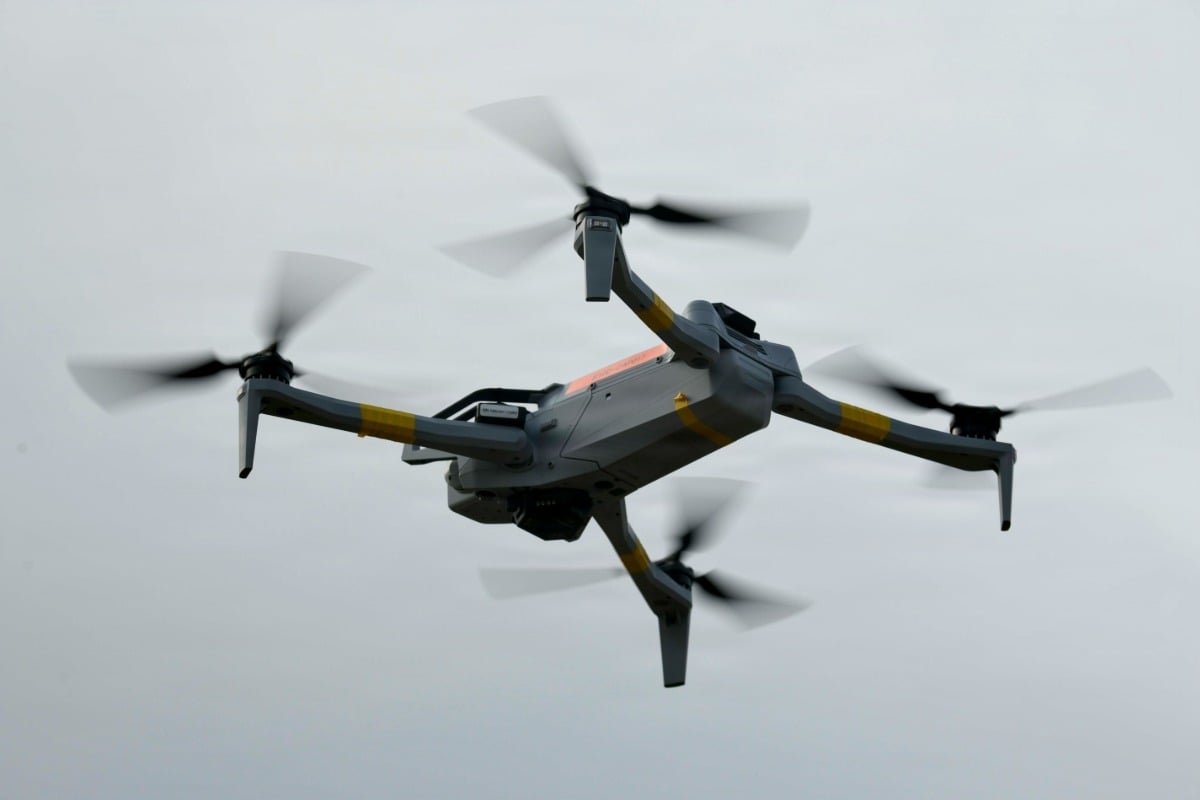
The problem Anteen worked on cuts to the heart of one of the most pressing challenges facing modern militaries, how to defend against swarms of cheap, commercially available drones without burning through expensive interceptor missiles one target at a time. Traditional air defense systems excel against larger, more sophisticated threats like fighter jets or cruise missiles, but they can become cost-prohibitive or tactically inefficient when a defender faces dozens of small drones at once, since firing a missile that costs tens of thousands of dollars, or more, at a device that might cost a few hundred dollars to build is not a trade any military can sustain for long. That imbalance has become one of the defining tactical problems of the current era, driven home by conflicts where inexpensive drones have repeatedly overwhelmed defenses built for a different kind of war.
– ADVERTISEMENT – CONTINUE READING BELOW –
Cesar Sosa, Team Lead for the Armaments Center’s Area Denial and Protection Analysis, Performance Analysis Branch, explained how Anteen’s work moves beyond the simplest possible defense strategy.
“Alex’s work and contributions look at moving away from simply targeting the nearest threat. Instead, it focuses on intelligently clustering targets and selecting engagement strategies based on the threat’s composition and our system/munitions’ capabilities. By factoring in multiple variables, the goal is to optimize the time spent engaging a mass of UAS threats to maximize UAS defeat with a single system,” said Sosa.
That shift matters because a system programmed to simply shoot at whatever drone is closest can waste time and munitions on low-value targets while a more dangerous threat slips past unaddressed. Anteen’s algorithms instead analyze incoming data, including a drone’s speed, altitude, payload capacity and how densely the drones are clustered together, to calculate which countermeasure fits each threat best. Depending on the situation, that could mean a kinetic interceptor, a physical projectile fired to destroy the drone directly, electronic warfare that jams or hijacks the drone’s control signals, or directed energy weapons that use lasers or focused radio waves to disable a target’s electronics, all with the goal of preserving expensive, high-value munitions for genuinely dangerous threats while handling lower-tier drones with cheaper options.
This work builds on years of Armaments Center research into exactly this kind of layered, cost-conscious drone defense. The Defence Blog has previously reported on the center’s parallel effort developing modular lethal payloads for the Army’s own armed drones, an initiative the center has pursued using design processes it originally built for the widely adopted Picatinny Rail, the mounting system found on rifles across the U.S. military and much of the world. The Armaments Center has also partnered with private industry on emerging counter-drone technology, signing a three-year research agreement with the company Auriga Space to develop electromagnetic accelerators, weapons that fire interceptors using magnetic force rather than gunpowder or rocket fuel, specifically to address what officials have described as a growing strain on America’s traditional missile stockpiles.
Anteen’s academic background positions him well for this kind of work. He is majoring in Operations Research at West Point, an interdisciplinary field jointly run by the academy’s Department of Mathematical Sciences and Department of Systems Engineering that trains cadets to apply quantitative methods, data science and mathematical modeling to optimize military decisions involving scarce resources. Cadets in the program take a demanding course load of advanced mathematics, statistics and engineering, and they gain hands-on experience translating real-world military problems into mathematical models through capstone research projects, exactly the kind of work Anteen completed and presented at the end of his three-week assignment at Picatinny Arsenal.
The algorithms remain in the simulation and modeling phase, according to the report, currently being tested against complex, multi-axis drone swarm scenarios designed to mimic how a real attack might unfold from multiple directions at once. Early results reportedly point to meaningful gains in how efficiently a defense system engages incoming threats, along with a reduction in how quickly localized air defense magazines, the limited stock of interceptor munitions a given unit has on hand, get depleted during an engagement.
