

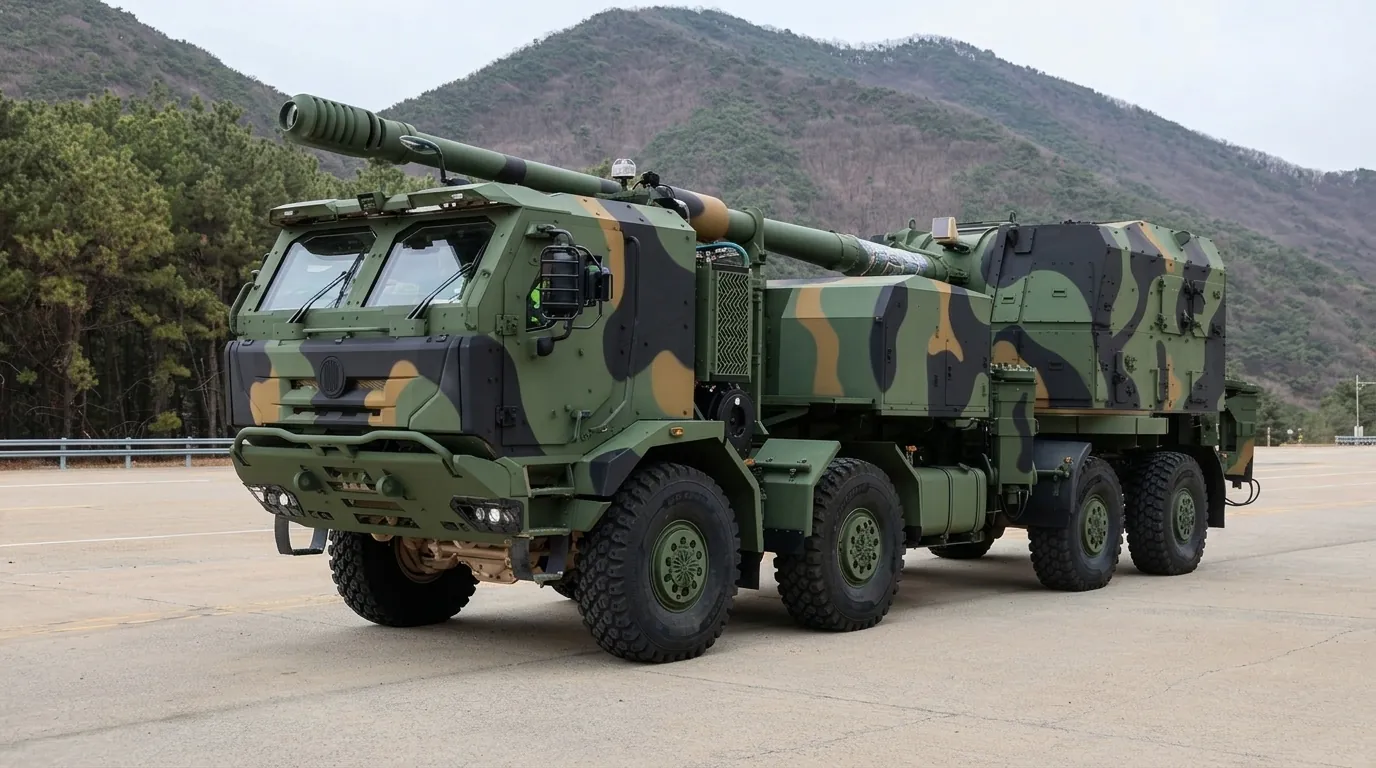
Artillery is changing. On today’s battlefield, having a powerful cannon is no longer enough. Military forces also need weapons that can move quickly, deliver sustained fire, and relocate before enemy surveillance systems identify their positions. The US Army is looking to address these challenges with a new system: the XM1776 Howitzer.
Officially designated the XM1776 Mobile Tactical Cannon (MTC), the system represents a new chapter in the Army’s artillery modernization efforts. Developed by Hanwha Defense USA, it is based on the South Korean company’s K9 Mobile Howitzer, a wheeled artillery platform designed around a 155mm main gun.
Its specifications are attracting considerable attention. The XM1776 Howitzer is reported to offer a maximum firing range of approximately 60 kilometers (37 miles), a firing rate of up to nine rounds per minute, and an automated loading system operated by a crew of just three personnel.
But its appeal goes beyond firepower. Unlike traditional towed artillery, the XM1776 Howitzer combines its cannon, ammunition-handling equipment, and mobility into a single vehicle. This allows the crew to operate from a protected cabin and relocate without requiring a separate towing vehicle.
The US Army unveiled the XM1776 Howitzer designation at the Association of the United States Army’s annual exhibition in October 2026. Hanwha also announced an order for nine prototype systems, with an option for nine additional units.
So, how powerful is this new artillery platform? And what makes its design important for the future of American ground forces? Let’s examine its specifications, firing capabilities, mobility, and technology to understand what the XM1776 Howitzer brings to the battlefield.
What Is the XM1776 Howitzer and Why Is the US Army Developing It?
The XM1776 Howitzer is part of a broader effort to modernize how the US Army delivers artillery support. Officially known as the Mobile Tactical Cannon (MTC), it is a 155mm wheeled self-propelled artillery system developed by Hanwha Defense USA, drawing on the South Korean K9 Mobile Howitzer design.
Its development addresses a practical problem. Many US Army formations still depend on towed artillery, which requires separate vehicles for transportation and additional time to establish firing positions. That arrangement can limit mobility when units need to move quickly across changing battlefield conditions.
The Mobile Tactical Cannon program aims to provide an alternative. By integrating the main gun, ammunition-handling equipment, and vehicle mobility into one platform, the XM1776 Howitzer allows artillery crews to operate more independently.
Why Did the US Army Choose the XM1776?
The program is closely connected to the Army’s requirement for improved artillery mobility, particularly among Stryker Brigade Combat Teams. These formations need supporting firepower that can keep pace with their ground vehicles without relying entirely on heavy tracked artillery.
Hanwha Defense USA was selected in August 2026 to develop Mobile Tactical Cannon prototypes. The initial agreement covered six systems, with options for additional units. Hanwha subsequently announced an order for nine XM1776 Howitzer prototypes, with an option for nine more.
The system received its XM1776 Howitzer designation during the Association of the United States Army (AUSA) annual meeting in October 2026. Its name references 1776, the year of American independence.
A Korean Artillery Design Adapted for American Requirements
The XM1776 Howitzer draws on Hanwha’s K9 artillery family, which has established an international presence with operators across several countries. However, the American program involves adapting the platform to meet specific US Army requirements.
This distinction matters. The XM1776 Howitzer is not simply an existing export system receiving a new name. It is being developed and evaluated for American operational needs.
For now, it remains a prototype program rather than an operational Army weapon. Its eventual adoption will depend on testing, performance evaluations, and the Army’s acquisition decisions.
XM1776 Howitzer: Technical Specifications and Firepower
The XM1776 Howitzer combines a large-caliber artillery gun with a mobile, automated platform. Its design focuses on delivering substantial firepower without requiring a large crew or a separate towing vehicle. At the center is a 155mm main gun, supported by an automated ammunition-loading arrangement and a wheeled chassis.
But what do these specifications actually mean? Here’s a closer look at its publicly reported technical characteristics.
XM1776 Mobile Tactical Cannon: Key Specifications
| Specification | Details |
| Official designation | XM1776 Mobile Tactical Cannon |
| Manufacturer | Hanwha Defense USA |
| Original platform | Hanwha K9 Mobile Howitzer |
| Main armament | 155mm howitzer |
| Barrel configuration | 52-caliber |
| Approximate barrel length | 8.06 meters |
| Maximum reported firing range | Up to 60 km (37 miles) |
| Maximum reported firing rate | Up to 9 rounds per minute |
| Crew | 3 personnel |
| Configuration | Wheeled self-propelled artillery |
| Loading system | Automated |
| Primary mission | Mobile indirect-fire support |
These figures describe the publicly reported configuration, rather than a complete US Army-certified specification sheet. Some performance details may change as prototype testing progresses.
A 155mm Gun Designed for Extended Range
The XM1776 Howitzer’s main weapon uses the widely adopted 155mm artillery caliber. This gives the system access to a broad family of NATO-standard ammunition, including conventional high-explosive and specialized extended-range projectiles.
Its reported 52-caliber barrel is another important feature. In artillery terminology, this means the barrel is approximately 52 times its internal diameter. For a 155mm gun, that translates to roughly eight meters.
A longer barrel allows propellant gases to accelerate a projectile over a greater distance before it exits the muzzle. Combined with suitable ammunition, this can contribute to greater muzzle velocity and extended firing range.

Automation and Firing Performance
The XM1776 Howitzer is also reported to achieve up to nine rounds per minute. That figure highlights the potential advantage of combining an automated loading system with modern artillery fire-control equipment.
Its three-person crew further demonstrates the platform’s emphasis on automation. Instead of requiring a large team to handle every loading task manually, the system is designed to reduce personnel demands while maintaining operational efficiency.
Together, these characteristics make the XM1776 Howitzer an interesting addition to the US Army’s artillery modernization efforts.
How Powerful Is the XM1776’s 155mm Artillery Gun?
A 155mm artillery gun is already a formidable weapon. But the XM1776 Howitzer takes this familiar caliber and combines it with a long barrel, modern fire-control equipment, and ammunition-handling automation. The result is a mobile cannon designed to deliver substantial firepower across extended distances.
The main gun uses a 155mm, 52-caliber configuration. In practical terms, its barrel measures approximately eight meters, providing a relatively long acceleration path for projectiles before they leave the muzzle.
Why does that matter? Artillery range depends partly on how much velocity a projectile gains inside the barrel. A longer barrel can allow expanding propellant gases to accelerate the ammunition for a greater distance, although actual performance also depends on propellant characteristics and projectile design.
What Types of Ammunition Can the XM1776 Howitzer Fire?
The 155mm caliber is widely used across NATO artillery forces. This gives the XM1776 Howitzer access to an extensive ammunition ecosystem, including several projectile types designed for different operational requirements.
These include:
- High-explosive projectiles: Conventional artillery ammunition designed to provide general fire support.
- Extended-range ammunition: Specialized projectiles designed to travel farther than conventional artillery rounds.
- Precision-guided ammunition: Guided projectiles that use onboard navigation technology to improve accuracy against designated targets.
- Smoke and illumination rounds: Specialized ammunition used for battlefield signaling, visibility management, and nighttime operations.
However, compatibility with specific ammunition types depends on the final XM1776 Howitzer configuration and its qualification testing.
Understanding Its Reported 60-Kilometer Range
One of the most notable figures associated with the XM1776 Howitzer is its reported maximum range of approximately 60 kilometers (37 miles). This places it in the extended-range category of modern 155mm artillery systems.
But there’s an important distinction. Maximum range does not represent the distance achievable with every projectile. Conventional ammunition generally travels shorter distances than specialized extended-range projectiles.
The firing distance also depends on propellant, projectile design, elevation, and environmental conditions.

Why Range Matters
Longer firing range gives artillery units greater flexibility when selecting their positions. They can potentially support forces across a wider operational area without moving as frequently.
For the US Army, this capability could be particularly valuable in large theaters where distances between formations, supply routes, and operational objectives can be substantial.
The XM1776 Howitzer’s firepower is therefore not simply about launching a heavy projectile. It’s about delivering artillery support while giving mobile units greater operational reach.
Why the XM1776 Howitzer Uses a Wheeled Chassis Instead of Tracks
A powerful artillery gun is only useful if it can reach the right position at the right time. That’s one reason the XM1776 Howitzer uses a wheeled configuration rather than relying on a traditional tracked chassis. Its design prioritizes road mobility, faster deployment, and the ability to relocate without requiring a separate towing vehicle.
The XM1776 Howitzer is based on Hanwha’s K9 Mobile Howitzer concept, adapted into a wheeled artillery platform for American operational requirements. This approach offers a different balance between mobility and battlefield protection.
Unlike tracked self-propelled howitzers, which use continuous tracks to distribute vehicle weight across difficult terrain, wheeled artillery relies on multiple rubber tires. The arrangement can provide better road mobility and reduce the mechanical complexity associated with tracked running gear.
Road Mobility and Rapid Deployment
One major advantage of a wheeled artillery platform is its ability to travel efficiently across established road networks. This can reduce dependence on specialized heavy transport vehicles when units need to move between operational areas.
For Stryker Brigade Combat Teams, that characteristic is particularly relevant. These formations are built around wheeled armored vehicles and emphasize rapid movement across large operational distances.
An artillery system capable of keeping pace with such formations can provide more consistent supporting fire without becoming a logistical bottleneck.
Wheeled vehicles can also offer lower rolling resistance on paved surfaces, potentially improving fuel efficiency and reducing maintenance demands compared with heavier tracked alternatives.

The Importance of Shoot-and-Scoot Operations
Modern artillery units face an increasingly dangerous environment. Reconnaissance drones, surveillance aircraft, and counter-battery radar can help opposing forces identify artillery positions shortly after firing begins.
This makes rapid relocation essential.
The XM1776 Howitzer’s self-propelled configuration supports the shoot-and-scoot concept. After completing a firing mission, the vehicle can leave its position and relocate before opposing forces organize a response.
Its integrated mobility is particularly useful here. The crew does not need to disconnect a towing vehicle or wait for another platform to move the cannon.
Mobility Still Has Trade-Offs
Wheeled artillery is not automatically superior in every environment. Deep mud, soft ground, and heavily damaged terrain can challenge tire-based mobility.
Tracked systems generally retain advantages when operating across difficult off-road conditions.
Nevertheless, the XM1776 Howitzer reflects a clear operational priority: giving mobile Army formations artillery support that can move with them rather than slowing their advance.
How the XM1776 Howitzer’s Automated Loading System Improves Artillery Operations
Operating a modern artillery gun requires more than a powerful barrel. Crews must handle heavy ammunition, manage loading procedures, and maintain a consistent firing rhythm throughout a mission. The XM1776 Howitzer addresses much of this workload through an automated ammunition-loading system.
This is one of the platform’s most important design features. Rather than depending entirely on personnel to load each projectile manually, the system uses mechanical assistance to handle ammunition and prepare the gun for firing.
The result is a more compact operating crew. The XM1776 Howitzer is designed around three personnel, significantly reducing the number of soldiers needed to operate the artillery platform compared with traditional manually loaded systems.
How Does the XM1776 Howitzer Automated Loading System Work?
The automated arrangement handles important ammunition-loading tasks, reducing the physical effort required from the crew. Operators can manage the system from within the vehicle rather than repeatedly working outside around the gun.
This matters because a 155mm artillery projectile is heavy. Depending on the ammunition type, the projectile alone can weigh approximately 43–48 kilograms, while the complete round also requires a separate propellant charge.
Handling these components repeatedly creates considerable physical demands, particularly during sustained firing operations.
Automation helps reduce that burden. It also supports a more consistent loading process, although actual firing performance still depends on ammunition availability, system condition, and mission requirements.

A Three-Person Crew Inside a Protected Cabin
The XM1776 Howitzer’s three-person crew configuration is another important aspect of its design. Fewer personnel are required to operate the platform, potentially simplifying crew organization and reducing manpower demands across artillery units.
The enclosed cabin also provides protection against environmental conditions and certain battlefield hazards. Operators can control the weapon while remaining inside the vehicle rather than working continuously around an exposed artillery position.
This becomes particularly relevant when artillery units operate under the threat of surveillance drones and counter-battery systems.
Why Automation Matters for Modern Artillery
Automation is not simply about reducing the number of soldiers. It changes how artillery crews manage their workload.
By handling repetitive ammunition tasks mechanically, the system allows personnel to concentrate more heavily on weapon operation, communications, navigation, and mission coordination.
There are still limitations. Automated equipment requires maintenance, reliable power, and trained technicians. Mechanical failures can also affect operational availability.
Nevertheless, the XM1776 Howitzer demonstrates how automation can make modern artillery more manageable, particularly for mobile formations that need substantial firepower without large operating crews.
Why the XM1776 Howitzer Matters for the Future of US Army Artillery
The future of artillery will not be determined by firepower alone. Modern armies must consider how quickly their weapons can deploy, how effectively crews can operate them, and whether they can survive in battlefields increasingly monitored by drones and advanced sensors. The XM1776 Howitzer reflects this changing approach to ground warfare.
For the US Army, the system represents an opportunity to improve artillery support for formations that prioritize mobility. Its wheeled configuration, automated loading system, and 155mm main gun combine several capabilities into a single platform.

Responding to Lessons From Modern Conflicts
The Russia-Ukraine war has demonstrated how dangerous artillery positions can become when opposing forces have access to persistent aerial surveillance. Small reconnaissance drones can identify firing positions, while counter-battery radar helps locate the origin of incoming artillery fire.
This environment places greater pressure on artillery crews to move quickly and avoid remaining in exposed positions.
The XM1776 Howitzer’s self-propelled configuration supports this requirement. Its ability to relocate without a separate towing vehicle could help artillery units maintain operational flexibility while supporting advancing ground formations.
However, mobility is only part of the equation. Effective artillery operations also require reliable communications, ammunition supplies, maintenance support, and accurate targeting information.
Supporting the Army’s Mobile Formations
One of the main objectives behind the Mobile Tactical Cannon program is improving artillery support for Stryker Brigade Combat Teams.
These formations rely on wheeled armored vehicles to move personnel and equipment across operational areas. A mobile artillery platform that follows the same general approach could provide more consistent fire support without relying entirely on towed systems.
The XM1776 Howitzer’s automated loading arrangement also offers potential manpower advantages. With a reported three-person crew, the platform could reduce personnel requirements while maintaining substantial artillery capabilities.
From Prototype to Operational Capability
Despite its promising characteristics, the XM1776 Howitzer still has important milestones ahead. Prototype testing must demonstrate that its gun, loading equipment, mobility, and supporting systems can meet the Army’s operational requirements.
The evaluation process will also help determine reliability, maintenance demands, ammunition compatibility, and suitability for actual military formations.
Domestic production is another important consideration. Establishing manufacturing and supply chains in the United States could strengthen long-term support while reducing dependence on overseas production arrangements.
Ultimately, the XM1776 Howitzer represents a broader shift in American artillery modernization. Its significance is not simply its reported 60-kilometer firing range. It is the combination of firepower, mobility, automation, and crew protection that could make artillery units more adaptable to future battlefield conditions.
Whether it becomes a widely deployed system will depend on how successfully it performs during Army testing. But its development highlights where US Army artillery is heading: toward more mobile, automated, and independently operating platforms.
