

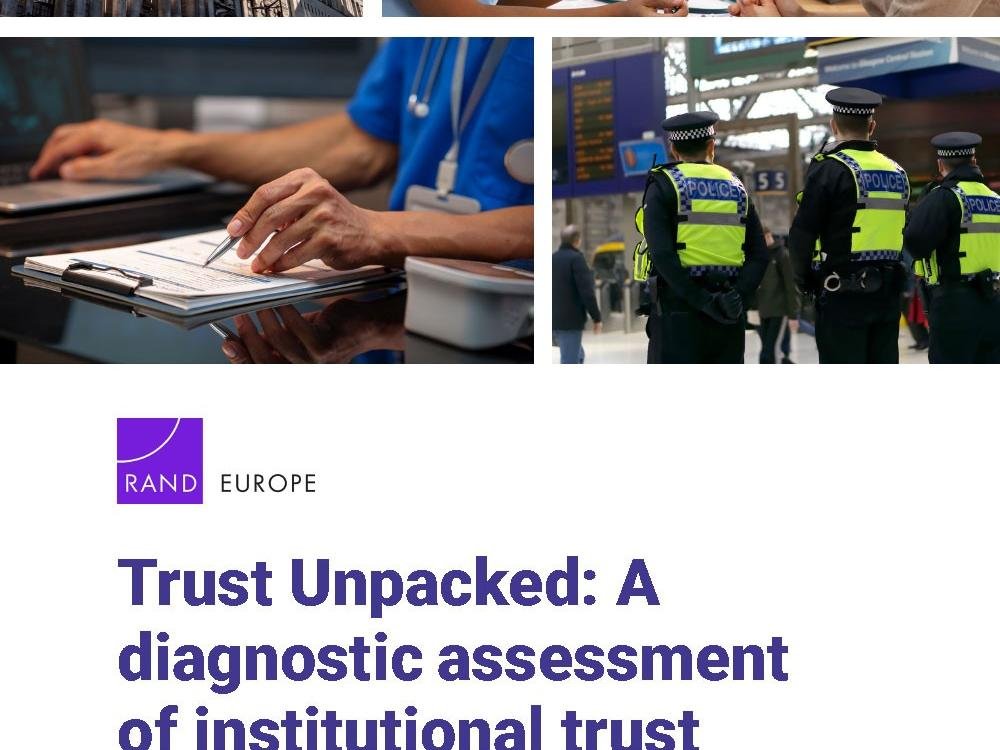
Trust in governmental and non-governmental institutions is central to their ability to function effectively. It can shape public behaviours towards institutions and act as a reservoir of support that sustains public cooperation during periods of uncertainty and crisis. However, there is sustained concern about declining trust in institutions across many democracies, including the UK, and the implications of this for policy delivery and the legitimacy of public institutions.
Drawing on a narrative review of academic and policy literature, alongside examples from the contemporary policy contexts of health-data sharing and policing, this report develops the conceptual and methodological foundations for a diagnostic assessment of perceived institutional trustworthiness.
The report argues that understanding institutional trust requires moving beyond measuring whether people trust institutions and towards understanding how they evaluate their trustworthiness. We consider trust to be an individual’s willingness to make themselves vulnerable based on their expectations of how an institution will act, and trustworthiness to be the qualities and characteristics of an institution that justify these expectations and make it deserving of trust. While institutions cannot guarantee public trust, they can take steps to become more trustworthy.
The report also explores existing methodological approaches that offer different insights into the multidimensional, situated, and dynamic nature of institutional trustworthiness, highlighting their strengths and limitations. We conclude that no single method can fully capture the nature of institutional trustworthiness, therefore demonstrating the need for developing a new diagnostic assessment.
Institutional trustworthiness is multidimensional, situated and dynamic
Judgements of institutions can reflect several dimensions of trustworthiness, including ability, benevolence, integrity and responsiveness. The relevance and configuration of these characteristics may vary across institutions and policy domains, while individual, social, political, economic and historical contexts can also shape assessments. Perceptions of institutional trustworthiness are not fixed and can evolve in response to institutional performance, crises, controversies and changing social conditions.
Existing methods provide only a partial picture of institutional trustworthiness
Existing approaches provide different insights into perceptions of institutional trustworthiness and how these vary across contexts and over time. Surveys offer valuable evidence on public attitudes and long-term trends but are less able to capture dynamic fluctuations around specific events or trust in practice. Behavioural experiments, qualitative research and administrative data can provide complementary insights, although attributing observed findings specifically to trust can be challenging. Computational methods may offer further insights into how institutional characteristics are perceived.
There is value in testing a diagnostic approach to trustworthiness
Measuring levels of trust alone cannot explain which institutional characteristics inform judgements about trustworthiness. The review therefore supports developing and testing a diagnostic approach to help policymakers understand which characteristics are associated with public trust and distrust, how perceptions vary across groups and settings, and how they change over time.
This publication is part of the RAND research report series. Research reports present research findings and objective analysis that address the challenges facing the public and private sectors. All RAND research reports undergo rigorous peer review to ensure high standards for research quality and objectivity.
This document and trademark(s) contained herein are protected by law. This representation of RAND intellectual property is provided for noncommercial use only. Unauthorized posting of this publication online is prohibited; linking directly to this product page is encouraged. Permission is required from RAND to reproduce, or reuse in another form, any of its research documents for commercial purposes. For information on reprint and reuse permissions, please visit www.rand.org/pubs/permissions.
RAND is a nonprofit institution that helps improve policy and decisionmaking through research and analysis. RAND’s publications do not necessarily reflect the opinions of its research clients and sponsors.
