

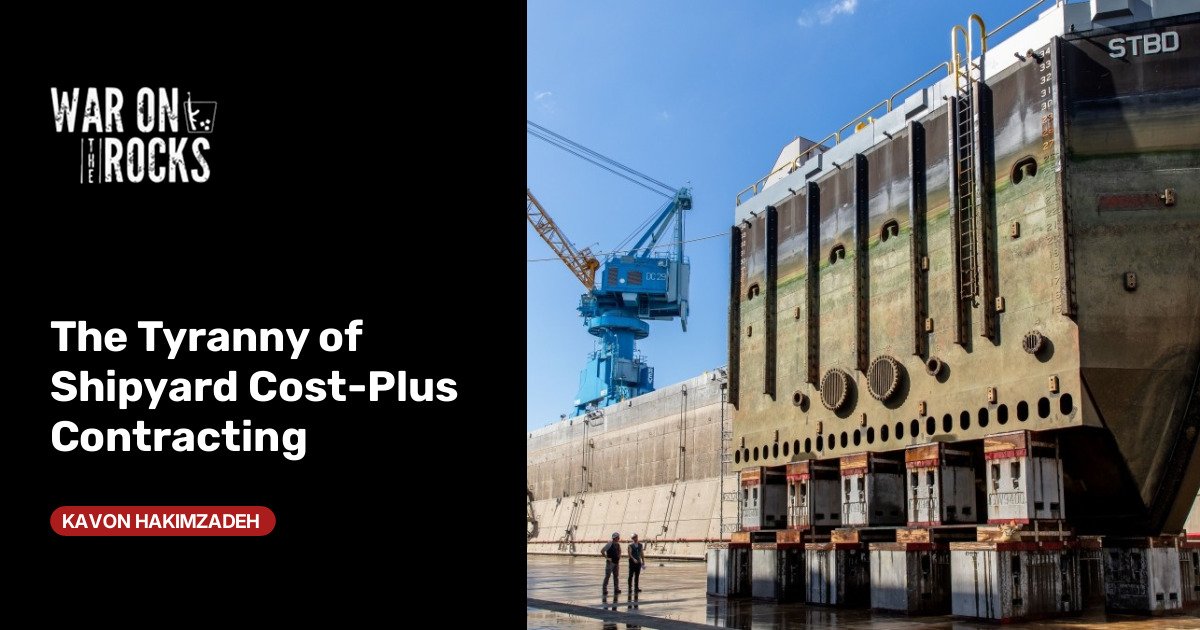
As a naval shipyard commander, my mandate from Navy leadership is straightforward: return warships to the fleet as quickly as possible. Neither my shipyard nor many other public and private shipyards are consistently fulfilling that mission.
Public shipyard availabilities — the scheduled periods during which nuclear-powered warships are taken out of operational service for maintenance, repair, or modernization — are often delayed well beyond their original timelines. A recent Government Accountability Office report highlighted that over the past 10 years, maintenance delays for attack submarines have resulted in 15,000 lost operational days and an estimated $3.4 billion in costs. This problem of maintenance delays has bedeviled the Navy for decades, and several causes are well known. These include aging hulls, complex systems, workforce shortages, material delays, and growing maintenance requirements. But another significant and underexamined bottleneck is how the Navy contracts for private sector ship repair work performed at its public shipyards.
Because of traditionally high volumes of work, public shipyards routinely rely on private sector partners to execute substantial portions of maintenance availabilities. For example, as of this writing, the Navy has contracted out half of an aircraft carrier availability and just over 30 percent of a submarine availability to private vendors at Norfolk Naval Shipyard.
It is important to emphasize that this is not a discussion about work on Navy warships at private shipyards, but rather private-sector work in public shipyards. When the Navy places a ship into an availability at a private shipyard, the planning and induction process typically ends with the award of a firm-fixed-price contract. For a variety of reasons — largely convenience — this is not the case for private-sector work at public shipyards. Those contracts are often structured as cost-plus or level-of-effort awards.
Cost-plus contracting reimburses contractors for allowable costs, plus a fee for profit, rather than paying a fixed price. Level-of-effort contracting pays a contractor for labor hours expended on a task, rather than for the finished outcome. Neither of these contracting strategies consistently aligns the private sector’s economic incentives with the operational imperative of returning ships to the fleet. Instead, they can reward labor consumption over timely completion.
The consequences of this misalignment are felt on the deckplates and demonstrate that contracting can serve as a powerful lever for shaping the capacity and productivity of the ship-repair industrial base. To avoid the tyranny of an indefinite public shipyard availability, the Navy needs to manage uncertainty deliberately, reduce it as quickly as possible, and then transfer appropriate performance risk to the contractor.
Sign Up for Our Newsletter
Cost-Plus on the Deckplates
Cost-plus contracting was designed to protect contractors from the financial risks associated with uncertainty, which is a common and meaningful feature of shipyard repair. Years of saltwater exposure, hard operational use, configuration changes, and aging systems mean that the Navy often cannot know the full extent of required repairs until sailors or contractors open and inspect shipboard spaces.
The problem, therefore, is not that cost-reimbursement contracting exists, but that the Navy too often allows a mechanism designed to manage uncertainty early in an availability to become the mechanism for executing remaining work after that uncertainty has been reduced later in the availability.
When that happens, particularly when cost-plus contracting is combined with level of effort work and poorly defined requirements, the Navy can inadvertently create incentives to maximize billable labor, encourage incremental changes, and allow schedule growth. The contract vehicle becomes part of the shipyard’s production system, and its flaws translate directly to operational delays.
The Perverse Math of the Fee
The concern on the deckplates is not that a contractor necessarily makes more profit when costs increase. In a typical cost-plus-fixed-fee arrangement, costs rise while the fixed fee remains constant, causing the contractor’s effective fee percentage to decline. The real problem is that, unlike under a fixed-price arrangement, the contractor generally does not bear the same degree of downside risk from cost growth: the government bears most of it. This takes away the contractor’s incentive to control costs and maintain schedule.
Consider a simplified example. A contractor is awarded a cost-plus contract for a repair effort at a public shipyard with an estimated cost of $10 million and a negotiated fixed fee of $700,000. If the contractor performs efficiently and completes the work for $8 million, they still receive the $700,000 fee. Their effective fee percentage rises to 8.75 percent. That is precisely the behavior the Navy wants to encourage.
But if the cost grows to $15 million, the contractor still receives the same $700,000 fixed fee. Their effective fee percentage falls to approximately 4.7 percent, but they have not absorbed the financial consequences of the additional $5 million in costs — the government has. The contractor may have made less profit on the job, but the government has paid the full bill for all the additional labor and overhead. The contractor remains financially whole because the Navy is effectively footing the bill to “keep the lights on.”
Conversely, under a fixed-price arrangement, the Navy does not provide a backstop for labor or schedule inefficiency, and cost growth directly threatens profit. This gives the contractor a powerful financial incentive to control labor and improve productivity.
Definitized Work vs. Level of Effort
Another important part of this discussion is the need to reward successful outcomes rather than simply paying for effort. That is best accomplished when work is definitized — that is, fully scoped, negotiated, and finalized. When the Navy contracts for a defined scope and measurable outcome — such as replacing a specific set of gears in the ship’s propulsion system at a negotiated fixed price — the contractor has a clear incentive to complete the work efficiently, because its profit is no longer directly tied to the number of labor hours consumed.
By contrast, level-of-effort contracts buy labor hours rather than completed outcomes. Such arrangements can be appropriate when the government genuinely cannot define the required maintenance result. For example, when a vessel has just returned from an extended deployment, and the Navy has not yet been able to place an assessment team on board. But level-of-effort becomes dangerous when it is used as a substitute for defining work through rigorous planning.
The real trap springs when growth work is discovered in the drydock. Growth work is additional work identified after the availability begins, including newly discovered or expanded repair requirements. Rather than pausing to scope and definitize the new requirement, the administrative “easy button” is to add funding to an existing level-of-effort structure. In practice, that means choosing the fastest and least administratively burdensome contracting path by authorizing more labor hours, rather than doing the harder but necessary work of defining the requirement, negotiating its scope, and tying payment to a measurable outcome. The ship continues to consume labor hours while the Navy continues to pay for effort without clearly linking those hours to progress along the ship’s critical path. Over time, this creates a black hole of accountability.
Critics may argue that this kind of rigor in definitizing work has itself slowed availabilities in the past. Once work is fully scoped and the contract is locked, even relatively small growth work may have to be elevated for leadership approval. From that perspective, the “easy button” can appear to save time by avoiding administrative delay. But that objection confuses contracting discipline with government process inefficiency. The purpose of contracting in an availability is to shape vendor behavior, not to compensate for slow internal decision-making. If the Navy wants outcome-based contracts to work, its contracting officers should be empowered to make timely decisions without running every change up the flagpole. In ship maintenance, all parties associated with an availability should treat time as an independent variable.
Contracting Is Industrial Base Strategy
Contracting consequences extend well beyond an individual ship’s availability. For much of the past decade, the Navy has sought to increase both competition and efficiency in ship repair. The Navy’s contracting model does more than allocate work. It helps drive efficiency by determining what the private ship-repair industrial base chooses to invest in, how it organizes its workforce, and how aggressively it pursues productivity.
If the primary economic driver for a contractor is the number of reimbursable labor hours it performs, adding workers can be more financially attractive than reducing labor demand through automation, process improvement, or advanced manufacturing. That dynamic holds true regardless of how much competition exists among contractors.
Consider a contractor that could invest $1 million in robotic welding or digital work instructions to reduce the labor required for a repair by $2 million. From the Navy’s perspective, that is an outstanding investment. But under a labor-driven reimbursement model, the technology reduces the very labor hours from which revenue is generated. Under an appropriately structured fixed-price or incentive arrangement, the contractor retains a portion of the savings, making productivity and long-term capital investments highly profitable.
This is critical as the Navy attempts to expand repair capacity. Simply adding more labor to an inefficient production model will not solve the capacity problem. If the Navy needs to push more ships through their yard periods, it should increase throughput per worker, per dock, and per dollar.
Breaking the Cycle
A more disciplined approach would use cost-plus or level-of-effort contracting deliberately and only temporarily during the early rip-out and inspection phases of an availability, when tanks are opened, interferences are removed, and engineers assess historically problematic areas. Contractors can be paid for the effort to inspect, test, and develop a reliable scope of work. But once the Navy understands the condition of the ship and the required repairs, it should rigorously definitize the work and transition as much of the executable requirement as practical to firm-fixed-price or fixed-price incentive structures. Put simply, the Navy should pay for uncertainty only while uncertainty exists — and stop paying for it once that uncertainty has been resolved.
The Navy should also consider breaking appropriate portions of public shipyard availabilities into logical, definitized work packages. Where the scope is sufficiently mature, work such as hull preservation or defined combat-system upgrades could be competed among qualified vendors using fixed-price or incentive-based task orders, shifting the focus from maximizing reimbursable effort toward completing a defined maintenance outcome.
The Single-Source Risk
The logic of breaking work into competed, fixed-price task orders begins to fall apart when there are too few vendors to compete. That has become less of a problem with the Navy’s implementation of multiple-award, indefinite-delivery, indefinite-quantity contracts, but it may still arise in specialized areas, such as submarine combat systems work. In a thin market, pushing maximum performance risk onto a single-qualified contractor through firm-fixed-price contracts is a recipe for poor outcomes. Without competitive pressure to sharpen their pencils, vendors will either price in large defensive risk premiums to protect themselves or decline to bid altogether, potentially accelerating their exit from the defense industrial base and worsening the nation’s capacity crisis.
In these single-source environments, the Navy should avoid the blunt tool of firm-fixed-price in favor of negotiated fixed-price incentive (firm target) structures. In a sole-source scenario, the contract should function as a structured partnership. By establishing a realistic target cost, a target profit, and clear sharing of overruns and underruns, both the Navy and the sole contractor become invested in the same goal of driving down labor hours. If the contractor innovates and beats the target, they make more profit — if they encounter inefficiencies, they share the financial pain up to a negotiated ceiling. This approach helps protect a fragile industrial base from catastrophic losses that could drive firms from the market, while ensuring the Navy no longer writes big checks for unstructured effort.
The Nexus of Risk — Why Change Is Hard
If transitioning from effort-based to outcome-based contracting is the clear solution, why hasn’t the Navy already done it? The answer lies in the intense competing pressures placed on the maintenance community. Both public and private shipyards lie squarely at the nexus of risk transfer between the Navy’s technical and operational communities.
On one side, the technical community frequently drives late-breaking requirements, delivering ship change documents and complex technical instructions long after planning windows have closed. On the other side, the operational community, driven by unrelenting global commitments, demands ever-shorter availabilities to get warships back to the fleet.
Caught in the middle of this interplay are the contracting officers and maintenance teams at the Type Commanders and Regional Maintenance Centers. To manage uncertainty deliberately and transition to definitized contracts, these contracting officers need time to inspect, scope, negotiate, and structure the appropriate fixed-price vehicles.
When late technical changes collide with compressed operational schedules, that time evaporates. Forced to choose between delaying the start of a maintenance availability to properly definitize a contract or relying on an overarching cost-plus or level of effort structure to get workers on the job immediately, the system frequently chooses the latter. It is the administrative survival mechanism for a workforce trapped between demands for technical precision and operational speed. If we expect contracting officers to manage risk effectively, the broader Navy enterprise should give them the breathing room to do so.
Readiness Through Accountability
The Navy should be clear-eyed about the secondary friction this transition creates. First, when contractors are asked to absorb execution risk, they will price that risk into their proposals, resulting in higher initial bids. Furthermore, the current ship-repair industrial base is fragile. Pushing too much downside risk too quickly onto companies unaccustomed to it could drive smaller, specialized vendors out of the defense market entirely, destroying the very capacity the Navy is trying to nurture.
The Navy should also aggressively manage the behavioral risks inherent in fixed-price models. When a contractor’s profit margin is threatened by a fixed ceiling, the temptation to cut corners on quality increases, requiring intense government oversight. Similarly, if the Navy attempts to fix-price work that is poorly definitized, the relationship could rapidly devolve into an adversarial, claim-driven environment. Instead of repairing ships, Navy project teams and vendors will spend their time fighting over technical interpretations and requests for equitable adjustment.
The discipline required to transition away from cost-plus dependency will be considerable. Port engineers, project managers, contracting officers, and shipyard leaders should do the hard work of defining requirements, establishing measurable outcomes, and transitioning from effort-based contracting to performance-based execution.
The objective is to minimize the time a warship is unavailable to the fleet, while building an industrial base capable of repairing the fleet the Navy will need tomorrow. When the Navy’s contracting strategies make that outcome economically rational, it may finally begin to break the tyranny of the forever shipyard availability.
Write for Cogs of War
Rear Admiral Kavon “Hak” Hakimzadeh has commanded Norfolk Naval Shipyard since August 2025. He previously commanded an E-2C Hawkeye squadron, the USS Mount Whitney (LCC 20), the USS Harry S Truman (CVN 75), and Carrier Strike Group 2.
The views expressed in this article are solely those of the author and do not reflect the official policy or position of the Department of Defense, the U.S. Navy, or the U.S. Government.
***Please note, as a matter of house style, War on the Rocks will not use a different name for the U.S. Department of Defense until and unless the name is changed by statute by the U.S. Congress.
Image: Shelby West via DVIDS.
