


By Graeme Forsyth, Counter-UAS Product Manager, Enterprise Control Systems.
The threat posed by unmanned air systems (UAS) is rapidly growing across civilian and critical infrastructure environments, with drones increasingly used for sabotage, espionage, and disruption. From interference with air traffic to the hostile surveillance of key infrastructure like military bases and refineries, the Middle East’s high-value hubs are being targeted by drones in ever more audacious ways.
As threats escalate, much of the region remains forced to watch drones transit overhead with limited ability to respond. The need for reliable and effective counter-UAS solutions has never been greater. With most malicious drones dependent on radio frequency (RF) links, demand for RF-based countermeasures has surged – yet a crowded market leaves operators navigating a complex mix of claims and capabilities.
As UAS threats grow faster, more mobile, and capable of operating at extended ranges, nations must move from passive observation to actively defending airspace around critical nodes such as airports, refineries and processing plants – where aircraft are most vulnerable at low altitude during final approach.
Counter-UAS measures
While directional jamming can now reach distances from 200 metres to beyond 10 kilometres, range alone is no longer enough. Counter-UAS systems must keep pace with increasingly agile platforms operating across a widening mix of frequencies, while also excelling in harsh conditions such as extreme heat, dust, and long sight lines. Longer-range systems, high spectral purity, directional beams, and the coverage are essential to defeating today’s UAS threats in the Middle East.
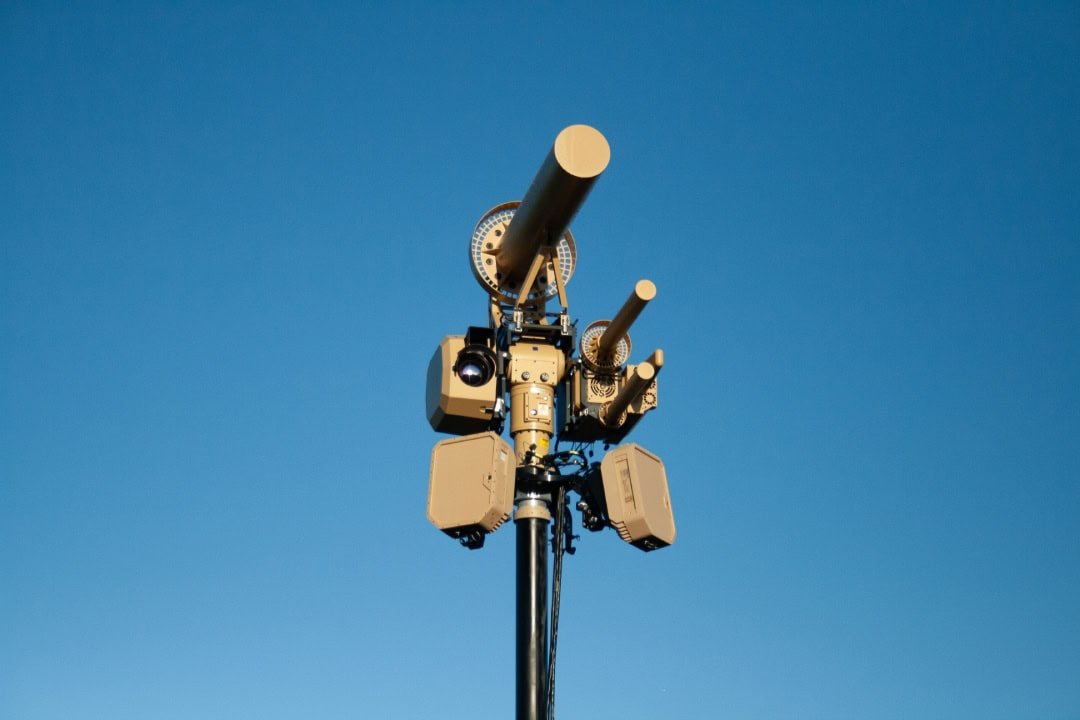
ECS, part of the SPX Communication Technologies Group, is at the forefront of counter-UAS innovation, continuously evolving to deliver next-generation solutions such as BLACKTALON – effectively detecting, locating, tracking, and neutralizing drone threats. Its Claw RF Inhibitor has been credited with more than 2,000 confirmed UAS defeats since its deployment during the 2017 Battle of Mosul and remains in active use globally across conflict zones and other high-risk environments.
Proven in the Middle East, BLACKTALON is capable of jamming all combinations of GNSS, command, control, and telemetry signals used by both commercial and military drones, while simultaneously protecting friendly RF systems from unintended interference – delivering a decisive operational advantage.
The more recent BLACKTALON Ecosystem provides an adaptable and modular approach to critical infrastructure defense by combining counter-UAS technology with a vendor-agnostic framework. This approach empowers operators to tailor configurations based on mission-specific needs like concepts of operation, threat profiles, user groups, existing capabilities, and budgets.
Intelligence gathering
By combining precise inhibition with a deep RF insight, operators can gain a clearer understanding of the threat environment and the confidence that detection, track, and defeat systems will perform as intended.
Further strengthening this capability are TCI’s latest RF Receivers, designed for continuous, real-time signal collection in support of Communications Intelligence (COMINT) operations. The 955 RF COMINT and Geolocation System and the 957 Rackmount RF COMINT and Independent Geolocation System deliver rapid detection, filtering, and geolocation of RF signals across congested spectrum environments.
Their rugged, rack-mounted design supports deployment across vehicles, fixed sites, and forward operating positions. Backwards compatible with BLACKTALON, both systems are built for mission flexibility, allowing operators to switch roles without reconfiguration – from counter-terrorism and border security to front-line combat. The 955 is optimised for single-unit or vehicle-mounted operations, while the 957 offers enhanced processing power for simultaneous tasking and networked, multi-sensor geolocation across dispersed teams.
A 72-hour look-back recording capability allows operators to retrospectively analyse spectrum activity as soon as a new airborne threat is identified, extracting valuable intelligence.
As UAS threats continue to evolve in scale, speed, and sophistication, defence and security organisations across the Middle East require established, adaptable solutions they can trust. By combining combat-proven countermeasures with flexible, future-ready architectures, ECS ensures operators in the region are equipped to detect, understand, and defeat drone threats – today and in years to come.
For more information, visit ECS at World Defense Show, 8-12 February 2026, stand H1-E33. Or visit www.enterprisecontrol.co.uk.
