

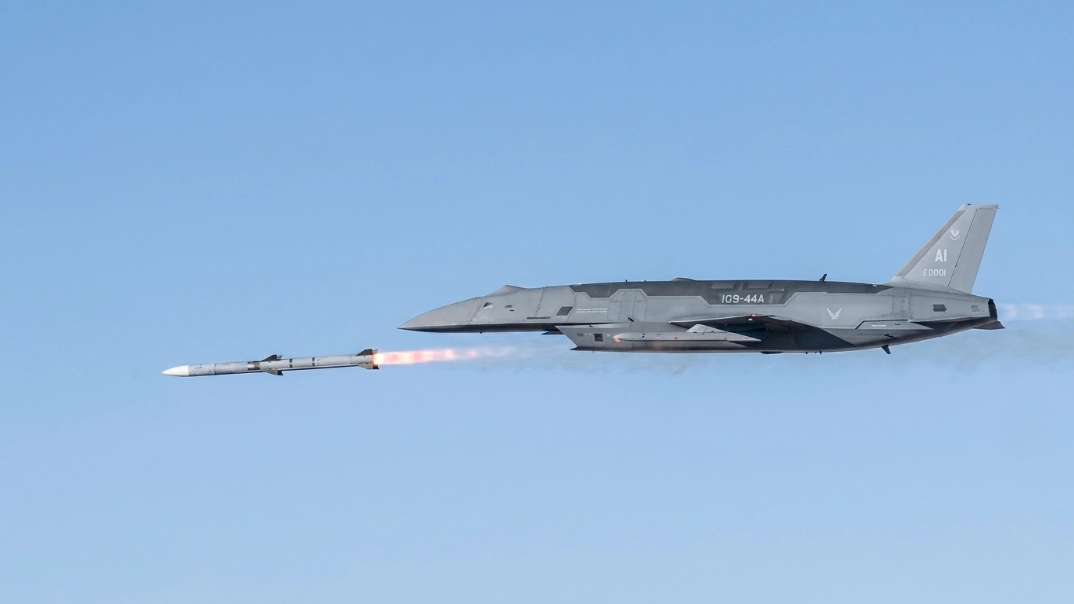
Defense Feeds, Washington, D.C. – Anduril rolls out first YFQ-44 Fury combat drone, marking an important milestone in the development of autonomous collaborative combat aircraft for the U.S. Air Force.
The completion of the first production-representative aircraft demonstrates Anduril’s progress toward manufacturing unmanned combat platforms at scale while supporting the service’s vision for integrating autonomous systems into future air operations.
The rollout highlights the growing momentum behind collaborative combat aircraft (CCA), which are expected to operate alongside crewed fighters to increase combat mass, extend operational reach and enhance mission flexibility in increasingly contested environments.
Anduril Rolls Out YFQ-44 Fury Combat Drone
The milestone in which Anduril rolls out YFQ-44 Fury combat drone represents the transition from aircraft development toward scalable production. Designed as an autonomous combat aircraft, the YFQ-44 Fury is intended to operate in coordination with crewed fighters while carrying out missions that may involve elevated operational risk or require persistent presence in contested airspace.
Unlike traditional unmanned aircraft designed for a single mission, collaborative combat aircraft are expected to perform a range of operational roles depending on mission requirements. These can include intelligence collection, electronic warfare, communications support and other missions that expand the effectiveness of crewed aircraft without increasing pilot workload.
The rollout also demonstrates Anduril’s emphasis on digital engineering and advanced manufacturing techniques intended to accelerate production timelines while enabling rapid capability updates throughout the aircraft’s operational life.

Collaborative Combat Aircraft Are Reshaping Air Operations
The YFQ-44 Fury is part of a broader shift in military aviation toward crewed-uncrewed teaming. Rather than relying exclusively on high-value manned aircraft, air forces are developing autonomous platforms capable of operating as force multipliers within larger networked formations.
These aircraft can extend sensor coverage, increase operational endurance and provide commanders with additional tactical options while reducing risks to aircrews. Their ability to perform missions independently or under human supervision offers greater flexibility across a wide range of operational scenarios.
As advances in artificial intelligence, secure communications and autonomous flight control continue, collaborative combat aircraft are expected to become an increasingly important component of future air combat doctrine.
Production Readiness Supports Future Force Expansion
Moving beyond prototype development into production-ready manufacturing is a significant step for any advanced military aircraft program. Establishing repeatable production processes enables manufacturers to deliver larger numbers of aircraft while maintaining consistent quality and supporting future fleet expansion.
For the U.S. Air Force, scalable production of collaborative combat aircraft is expected to play an important role in building a more distributed and resilient force structure. Fielding autonomous aircraft in meaningful numbers could increase operational capacity while providing commanders with greater flexibility during high-tempo operations.
The production-focused approach also supports faster technology insertion, allowing software improvements, mission systems and payloads to evolve throughout the aircraft’s service life without requiring entirely new platform designs.
Autonomous Airpower Continues to Evolve
The announcement that Anduril rolls out YFQ-44 Fury combat drone reflects the accelerating pace of investment in autonomous military aviation. Defense organizations are increasingly viewing collaborative combat aircraft as complementary assets capable of enhancing existing fighter fleets rather than replacing crewed platforms.
The program also highlights the growing role of non-traditional defense companies in delivering advanced aerospace capabilities through rapid development cycles and software-driven engineering. As autonomous technologies continue to mature, industrial approaches that emphasize scalability and continuous modernization are becoming increasingly important.
The fact that Anduril rolls out YFQ-44 Fury combat drone demonstrates how collaborative combat aircraft are progressing from concept development toward operational reality. As production expands and testing continues, autonomous aircraft such as the YFQ-44 Fury are expected to become a key element of future U.S. airpower, supporting more flexible, networked and resilient combat operations.
