

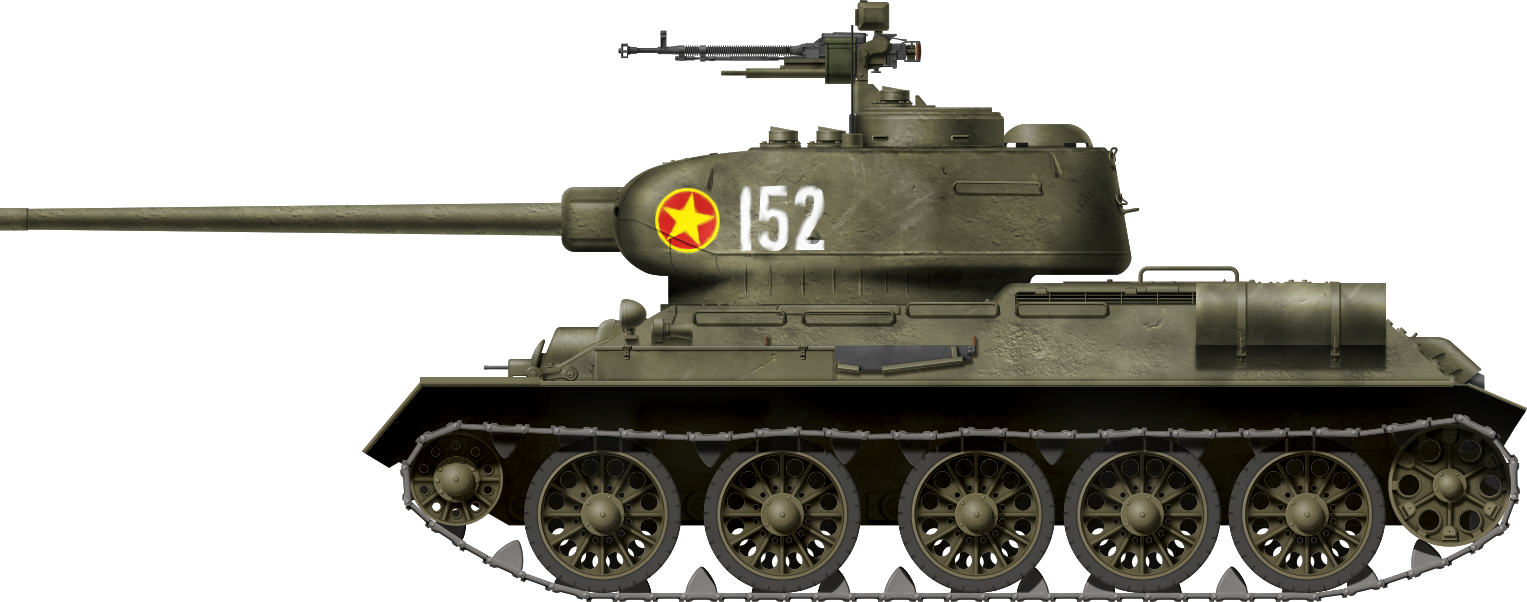
Democratic Republic of Vietnam/Socialist Republic of Vietnam (1960 – Present)
Medium Tank – Uncertain number Delivered to Vietnam
The Soviet T-34-85 medium tank was the first armored vehicle of its kind delivered to the Democratic Republic of Vietnam during the Vietnam War. While certain sources claim that more than 400 tanks were transferred to North Vietnam over the course of the conflict, a more conservative and likely accurate estimate suggests that between 200 and 300 T-34-85 tanks were delivered between 1960 and 1972. Initial shipments arrived via the People’s Republic of China, with subsequent transfers supplied directly by the Soviet Union.
Although the T-34-85 had demonstrated its utility in numerous post-World War II conflicts, by the time of its deployment in Vietnam, it was already technologically outdated. The Vietnam War, characterized by the deployment of increasingly advanced military hardware by both the United States and North Vietnamese forces, rendered the T-34-85 obsolete in frontline operations. Consequently, it was largely relegated to secondary roles, overshadowed by the more modern T-54, T-55, and Type 59 main battle tanks, as well as the PT-76 and Type 63 amphibious light tanks.
Despite its limited involvement in major battles during the Vietnam War, the T-34-85 continued to see combat use in subsequent regional conflicts, including the Vietnam-Cambodian War and the 1979 Sino-Vietnamese War. Remarkably, the tank remained in service as a training platform into the early 2020s, and continues to exist in a state of operational reserve. In some instances, T-34-85 turrets have been repurposed for coastal defense installations, particularly along Vietnam’s shoreline and in the contested Spratly Islands.
In Vietnam the T-34-85 is also known as Kiểu 2 “Con Báo Châu Á”.

Source: photo taken by Lương Nghĩa Dũng, colorization by facebook.com via ak.pk.3

🔥What’s inside?
✔ All 12 issues in one bundle
✔ Available in PDF and EPUB formats
✔ Enjoy instant access to articles prepared by our team of dedicated writers and illustrators, covering the history of armoured vehicles from the 19th century to the present day, in-depth armored warfare analysis, rare vehicles, prototypes, and much more.
👉 Visit our online store and grab your bundle for only $46, and save $12 off the regular price of $57.89!
Turbulent Century for Vietnam
In 1858, the Second French Empire launched the Cochinchina Campaign, marking the beginning of French colonial expansion into the territory of the Nguyễn dynasty in Vietnam. This military intervention laid the groundwork for the gradual annexation of Vietnamese territory, culminating in the full colonization of the country by 1887. That year, France formally established the Union Indochinoise (Eng. Indochinese Union), which unified Vietnam, Cambodia, and Laos under French colonial administration, collectively referred to as French Indochina. The imposition of colonial rule sparked widespread resistance among the Vietnamese population, giving rise to a series of nationalist and anti-colonial insurgencies. Among the most prominent of these were movements led by communist revolutionaries, who would play a central role in the struggle for independence in the decades that followed.

Source: X.com via @AnnQuann
In 1941, the Việt Nam Độc Lập Đồng Minh (Eng. League for the Independence of Vietnam), more widely known as the Việt Minh, was established as a national independence coalition composed of Vietnamese anti-colonial and revolutionary forces. Founded with the strategic support of the Chinese Communist Party, the organization was led by Hồ Chí Minh, future President of the Democratic Republic of Vietnam, and military commander Võ Nguyên Giáp, who would later serve as the country’s Minister of National Defense and chief strategist in multiple conflicts.
The Việt Minh initially focused on resisting the occupation of French Indochina by the Imperial Japanese Army, which had entered the region in 1940, following the fall of France in World War II. Though technically under Vichy French administration, Indochina was de facto controlled by the Japanese until their surrender in August 1945. Following Japan’s formal capitulation, Hồ Chí Minh seized the opportunity to declare independence on 2nd September 1945, establishing the Việt Nam Dân Chủ Cộng Hòa (Eng. Democratic Republic of Vietnam) in Hanoi.
However, the nascent republic was immediately plunged into armed conflict. On 23rd September 1945, just weeks after the declaration of independence, the Việt Minh faced a military counteroffensive launched by returning French colonial forces, supported by British troops and a number of former Imperial Japanese soldiers who, under Allied orders, had taken up arms to restore colonial order. This brief but intense conflict, known as the War in Vietnam (1945–1946), ended on 30th March 1946 with the withdrawal of Việt Minh forces from southern Vietnam, though it failed to extinguish the broader struggle for independence.
Shortly thereafter, the Việt Minh resumed hostilities in what became the First Indochina War (1946–1954), a protracted and bloody conflict against the French colonial army. The war culminated in the decisive Việt Minh victory at the Battle of Điện Biên Phủ in 1954 and the signing of the Geneva Accords, which led to the formal decolonization of Vietnam. The country was provisionally divided along a demilitarized zone (DMZ) at the 17th parallel, separating the Việt Nam Dân Chủ Cộng Hòa (Eng. Democratic Republic of Vietnam, DRV) in the north from the newly established Việt Nam Cộng Hòa (Eng. Republic of Vietnam, RVN) in the south. This division laid the groundwork for the geopolitical tensions that would soon erupt into the Second Indochina War, known globally as the Vietnam War.

Source: X.com via @AnnQuann
Peace once again proved elusive, and on 1st November 1955, the Vietnam War officially began. Initially perceived as a localized “Communist insurgency in South-East Asia”, the conflict gained a new dimension in 1958, when the direct involvement of the Democratic Republic of Vietnam was formally acknowledged. US military engagement followed after the Gulf of Tonkin incident on 2nd August 1964, during which the US destroyer USS Maddox was allegedly attacked by three motor torpedo boats of the Hải quân Nhân dân Việt Nam (Eng. Vietnam People’s Navy). The United States, already seeking a casus belli to justify intervention on behalf of the Republic of Vietnam, seized upon the incident as a pretext for war. This manipulation of intelligence became one of the most controversial elements of US entry into the Vietnam War.
History of the Vietnamese Armored Corps
Following the conclusion of the First Indochina War in 1954, the leadership of the Democratic Republic of Vietnam implemented a five-year military development program to transition the Việt Minh from a revolutionary guerrilla force into a regular army. This initiative culminated in the establishment of the Vietnam People’s Army (VPA), also commonly referred to by Western sources as the People’s Army of Vietnam (PAVN). The transformation was made possible through the military and logistical support provided by the Soviet Union and, increasingly over time, the People’s Republic of China.
By mid-1955, the General Command of the VPA began dispatching select officers and soldiers to specialized military schools to receive theoretical instruction on armored warfare. In August 1956, approximately 200 Vietnamese personnel were chosen to undergo intensive training in China.
The first cohort, composed of 55 soldiers led by Major Đào Huy Vũ, was trained to serve as officers for future armored units. A second, larger group of 147 soldiers received practical training in the operation and maintenance of tanks. This foundational training concluded in July 1959, when the Vietnamese trainees regrouped in the Chinese city of Guangxi, roughly 330 km northwest of Hà Nội (Hanoi).
One month later, in August 1959, the first batch of 100 T-34-85 medium tanks was officially handed over to the Vietnamese trainees. These vehicles were drawn from Chinese military depots and were used in joint exercises with infantry and support units to familiarize the newly trained tank crews with the fundamentals of combined arms operations.

Source: wikimedia.commons.com
To consolidate the newly trained Vietnamese armored regiment and for propaganda purposes, key figures, such as Nguyễn Nhân from the Vietnamese Technical Department, Nguyễn Mạnh Hùng, an officer from the Vietnam People’s Army General Staff, and Colonel Dương Đăng Giảng, were invited to visit a Chinese armored regiment barracks in Beijing. During the visit, there were plans to dispatch a group of Vietnamese tank officers to Canton (Guangzhou) for short-term training exercises with Chinese armored units. However, the implementation of this plan remains uncertain and may never have materialized.
The First Armored Training School
Around July 1959, Colonel Dương Đăng Giảng and Phan Văn Cẩn, an officer from the Operations Department, returned to Vietnam to report on the progress of the Vietnamese trainees in China and to consult with the Ministry of National Defense on the establishment of a dedicated base for armored units. Upon their return, the two officers debriefed the Minister of Defence, General Võ Nguyên Giáp, on the training achievements and logistical needs of the emerging armored force. They also conferred with General Thái Dũng, who assigned them to oversee the site selection for a future tank training facility.
Officers Đăng Giảng and Văn Cẩn proceeded to Vĩnh Yên Province (now known as Vĩnh Phúc Province), where they conducted an inspection of potential locations over several days. Ultimately, a site near the Đanh Mountains in Kim Long city, within Tam Đảo District, was approved by the Ministry of Defense. The area, encompassing 22,500 m2, was deemed suitable for hosting a comprehensive armored training installation.
In August 1959, the Vietnamese Ministry of Defense issued a directive to construct the nation’s first major training facility for armored forces, under the codename Công trường 92 (Eng. Building Site 92). Situated approximately 45 km northeast of the capital city, Hà Nội, the base would become a cornerstone of Vietnam’s developing armored capabilities.
Later designated Trường Xe Tăng số 1 (Eng. Tank School № 1), the facility featured extensive infrastructure, including multiple driving tracks measuring 4 km and 7 km, a school building with 20 classrooms, troop barracks, vehicle depots, repair workshops, a firing range, and a training stadium. In 1966, a tank dispersal area was added, complete with shallow, thatch-roofed dugouts to serve as protective shelters for armored vehicles in case of aerial attacks.

Source: Central Intelligence Agency
The 202nd Armored Regiment, the First North Vietnamese Armored Unit
On 3rd October 1959, Major General Trần Văn Quang visited the Vietnamese armored trainees and their newly acquired T-34-85 tanks in Guangxi, China. During his visit, he assured the soldiers that the formation of a dedicated armored unit within the Vietnam People’s Army was imminent. Just two days later, on 5th October 1959, Minister of Defence Võ Nguyên Giáp officially approved Decree № 449/ND, which sanctioned the establishment of Vietnam’s first armored formation.
The Trung Đoàn Xe Tăng 202 (Eng. 202nd Armored Regiment), codenamed H02, was thus formally created. This marked a significant milestone in the modernization of the Vietnamese military, laying the foundation for a mechanized force capable of engaging in modern warfare. Command of the regiment was entrusted to Major Đào Huy Vũ, a leading figure among the first generation of trained tank officers. Colonel Dương Đăng Giảng, one of the key architects of Vietnam’s armored development, was appointed as deputy commander, while Major Đặng Quang Long was named the unit’s political commissar, ensuring ideological cohesion and morale within the ranks.

Source: vnanet.vn
The 202nd Armored Regiment was theoretically structured to include:
- 3rd Tank Battalion
- 4th Tank Battalion
- 5th Tank Battalion
- a workshop company
- an engineer company
- a reconnaissance company
- 15th Training Company
- a communications and intelligence company
- a political platoon
- a logistical support unit
However, at the moment of its establishment, not a single armored vehicle had yet been assigned to the Regiment. From July 1960 onwards, following the arrival of the first batch of tanks from China, the Regiment began to populate the ranks of its battalions with operational vehicles.
Remarkably, prior to the arrival of the Soviet-designed T-34-85 medium tanks, training was conducted using the only remaining operational M24 Chaffee light tank, which had been captured from French colonial forces in 1954. This vehicle played a crucial role in providing early hands-on experience for the first generation of Vietnamese tank crews.
The creation of the Vietnamese armored forces on 5th October 1959 remains a key date in the nation’s military history and is commemorated annually as the official anniversary of the country’s armored corps. In the early training phase, recruits underwent extensive theoretical instruction, covering topics such as mechanical maintenance, battlefield tactics, and operational procedures. These sessions were supplemented by practical exercises using mock-ups of tanks, including driving simulators and combat compartment replicas crafted from bamboo, which allowed trainees to familiarize themselves with internal layouts before gaining access to real vehicles.
Arrival of the first T-34-85s
On 13th July 1960, at precisely 5:30 PM, a Chinese train carrying an undisclosed number of T-34-85 medium tanks and SU-76M self-propelled howitzers arrived at the railway station in Vĩnh Yên city. This marked the formal delivery of combat vehicles to the newly established armored force.
Although sources vary on the number of T-34-85 tanks delivered that day, some citing as few as 35, others up to 88, multiple accounts, including that of Lê Đức Chinh, a veteran of the 202nd Armored Regiment, support the highest figure of 100 units. This estimate aligns with the original number of tanks reportedly issued to Vietnamese trainees in China, enough to equip a full regiment. In a 2019 interview commemorating the 60th anniversary of the 202nd Armored Regiment’s founding, Lê Đức Chinh confirmed the arrival of 100 T-34-85s. However, neither his testimony nor official sources clarify how many SU-76M self-propelled guns were included in the shipment.
At 6:33 PM, the T-34-85 bearing the hull № 114 became the first Soviet-built tank to touch Vietnamese soil. It was driven off the flatbed railcar by officer Đào Văn Bàn, who led the armored convoy from the station to Tank School № 1. This symbolic moment marked the beginning of Vietnam’s era of mechanized warfare.

Source: qdnd.vn
From that day onward, the newly arrived tanks were stationed near Tank School № 1, which was still under active construction. In the initial months following its establishment, the 202nd Armored Regiment worked closely with the Ministry of Defense of the Democratic Republic of Vietnam to develop appropriate doctrines and tactical approaches for armored warfare in the challenging terrain of Vietnam. Recognizing the need to adapt traditional armored tactics to local conditions, characterized by dense jungles, rugged mountains, and limited infrastructure, the regiment undertook extensive combined training exercises with other units of the People’s Army of Vietnam.
Notably, from late 1960 through 1961, the 202nd Armored Regiment conducted joint training operations with the Sư Đoàn 308 and Sư Đoàn 312 (Eng. 308th and 312th infantry divisions), two of the most experienced and battle-hardened divisions of the Vietnam People’s Army. These exercises allowed the infantry and tank units to coordinate maneuvers and refine strategies for combined-arms operations. Live-fire drills were also conducted with Sư Đoàn 305, helping to evaluate the effectiveness of T-34-85 firepower in combat scenarios and to strengthen coordination between armored and supporting units.
On 26th September 1960, Colonel Đăng Giảng, vice commander of the 202nd Armored Regiment, traveled to Hà Nội to escort Minister of Defense Võ Nguyên Giáp and Chief of General Staff Văn Tiến Dũng to Tank School № 1. This visit marked the first official inspection of the new armored force and its still-developing training facilities by senior military leadership. During the visit, Minister Giáp delivered an address to assembled tank crews and military engineers working on the school’s construction, standing in front of the provisional thatched tank shelters. According to Vietnamese sources, Minister Giáp expressed deep satisfaction with the morale, discipline, and high standard of training achieved by the regiment in such a short time, offering personal praise to the officers and engineers involved.
New Units and New Tanks
Shortly thereafter, several T-34-85 medium tanks were allocated to newly formed independent battalions, including the 297th, 397th, and 198th independent tank battalions. However, it remains uncertain whether these battalions were fully equipped upon formation or received only limited numbers of tanks for training and familiarization purposes. Over time, the 297th Battalion transitioned to the more modern T-54 main battle tank, while the 198th Battalion was re-equipped with PT-76B amphibious light tanks, better suited for operations in Vietnam’s riverine and marshy environments. Of the three battalions, only the 397th Independent Tank Battalion retained its original full complement of 33 T-34-85 medium tanks throughout the conflict, maintaining a consistent role within the broader armored force structure of the VPA.

Source: ĐAQĐ
On 1st March 1961, the Democratic Republic of Vietnam established a training company, codenamed ‘C12’, tasked with preparing personnel for its nascent armored forces. The company was responsible for training:
- 172 soldiers for an armored unit designated for Sư Đoàn 308
- 164 soldiers for two mechanized companies
- 150 mechanics, and 10 officers
In late March 1961, the Soviet Union delivered 44 PT-76 amphibious light tanks to Vietnam, intended for transfer to the Pathet Lao communist movement in Laos. These tanks remained temporarily in Vietnam, where Soviet instructors trained Vietnamese crews on the new vehicle model before their eventual delivery to the Pathet Lao.

Source: X.com via @AnnQuann
On 29th February 1962, a subsequent shipment of Soviet tanks arrived via railway, comprising 19 PT-76 amphibious light tanks, 11 T-54 main battle tanks, and four T-34-85 medium tanks. These vehicles were allocated to equip VPA tank battalions with modern armored assets. Although the T-54 were new to Vietnam, crews had already received training for these models abroad or in Vietnam, ensuring operational readiness.
On 21st July 1962, Prime Minister Phạm Văn Đồng conducted a second official visit to the 202nd Armored Regiment and the newly completed Tank School № 1. The condition of other tank battalions during this visit remains undocumented, with only the 202nd Armored Regiment presented to the Vietnamese leadership.

Source: ĐAQĐ
By the end of 1963, the Soviet Union supplied an additional 72 T-34-85 medium tanks, 11 T-54 main battle tanks, and 31 PT-76 amphibious light tanks. This brought the VPA’s tank inventory to approximately 164 vehicles, including 76 T-34-85 medium tanks, 22 T-54 main battle tanks, 50 PT-76 amphibious light tanks, and 16 unidentified vehicles. This figure appears inconsistent, as reports indicate China may have delivered up to 100 T-34-85 tanks in 1959 for Vietnamese soldiers training in China, suggesting the 164-vehicle count may reflect only combat-ready units, excluding those under maintenance or assigned to training.

Source: X.com via @AnnQuann
On 22nd June 1965, the VPA formalized its armored forces through Decree № 101/QD-QP, establishing the Tăng Thiết Giáp (Eng. Armored Corps, TTG), and Decree № 100/QD-QP, creating the Trung Đoàn Xe Tăng 203 (Eng. 203rd Armored Regiment). The 203rd Armored Regiment, staffed by soldiers recently trained on T-54 tanks in the Soviet Union, comprised two provisional battalions: the 20th and 21st tank battalions. Major Đào Huy Vũ, Commander of the 202nd Armored Regiment, was appointed Commander of the Armored Corps, with Lieutenant Colonel Lê Ngọc Quang as political commissar and Major Dương Đằng Giang as Commander-in-Chief.
The Armored Corps conducted extensive combined exercises with infantry units across diverse terrains to enhance the operational proficiency of its tank battalions. Concurrently, personnel from the 202nd Armored Regiment were temporarily assigned to 37 mm anti-aircraft gun batteries in response to US bombing campaigns initiated after the Gulf of Tonkin incident on 2nd August 1964. During this period, construction of a tank dispersal area commenced, with anti-aircraft personnel returning to their units by mid-1967.

Source: vnanet.vn
By 5th August 1967, Vietnamese commanders deemed the armored units prepared for battlefield deployment. By this time, significant deliveries of PT-76 amphibious light tanks, T-54, T-55, and Chinese Type 59 main battle tanks had been received, relegating the Second World War-era T-34-85 medium tanks to secondary roles, primarily infantry support. While the T-34-85 achieved limited successes, it did not engage enemy tanks directly during the Vietnam War, Laotian Civil War (1953-1975), or early stages of the Cambodian-Vietnamese War (1978-1989). However, it played a primary role in the 1979 Sino-Vietnamese War due to the unavailability of more modern vehicles. Notably, the T-34-85 remained in service post-war, with approximately 60 units in the VPA inventory by 2000 and 45 still operational in the late 2010s for training, coastal defense, and as armored recovery vehicles.

Source: pinterest.com
Organization and Nomenclature
In the second half of the 1960s, the Vietnam People’s Army restructured its tank regiments to comprise four armored fighting vehicle battalions, including one Bộ Binh Cơ Giới (Eng. Mechanized Infantry) battalion equipped with BTR vehicles (BTR-40, BTR-50, and BTR-152) and three tank battalions. Typically, these tank battalions were equipped with distinct vehicle types: one with T-34-85 medium tanks, one with T-54 main battle tanks, and one with PT-76 amphibious light tanks. The number of tanks per battalion varied, generally ranging from 24 to 36, depending on tactical requirements, operational periods, and vehicle availability during war campaigns. Where feasible, the VPA adopted the Soviet tank battalion structure, which included three tanks for battalion command and three companies, each with 10 tanks (one for the company commander and three platoons of three tanks), totaling 33 tanks per battalion.

Source: clideo.com via QPVN
During the Vietnam War, the VPA established several independent tank battalions, including the 297th Independent Tank Battalion with 33 T-54 and T-55 main battle tanks, the 198th Independent Tank Battalion with 22 PT-76 amphibious light tanks, the 397th Independent Tank Battalion with 33 T-34-85 medium tanks, and the 24th and 26th Independent Tank Battalions.
A significant threat to these armored formations were US Air Force strikes, prompting the assignment of mobile 37 mm and 57 mm anti-aircraft batteries to armored regiments in the late 1960s. After 1972, these were supplemented with 9K32 Strela-2 man-portable air-defense systems (MANPADS) and ZSU-23-4 Shilka self-propelled anti-aircraft guns. While these measures mitigated losses from fighter-bombers and ground-attack aircraft, VPA armored units remained vulnerable to US Boeing B-52 Stratofortress strategic bombers throughout the conflict.
In 1973, the VPA reorganized its Armored Corps, transitioning from regiments to brigades. The 202nd and 203rd armored regiments were restructured into the 202nd and 203rd armored brigades, while a third brigade, the 201st Armored Brigade, was formed by integrating several independent tank battalions.

Source: VNMIG
Initially, the Vietnamese term for tanks was Tăng Thiết Giáp (Eng. Armored Vehicle), but during the Vietnam War, the term Tăng (Eng. Tank) became more prevalent, with Thiết Giáp (Eng. Armored) used to denote armored vehicles broadly.
The VPA Armored Corps employed an informal nomenclature for its tanks, primarily for training purposes among cadets and recruits:
- T-54, T-55, and Chinese Type 59 main battle tanks were designated Kiểu 1 or K-1 (Eng. Model 1)
- T-34-85 medium tanks as Kiểu 2 or K-2 (Eng. Model 2)
- PT-76 amphibious light tanks as Kiểu 3 or K-3 (Eng. Model 3).
Some sources suggest these designations reflected armor protection levels, with K-1 being the most armored and K-3 the least. Captured Chinese Type 62 light tanks and Type 63 amphibious light tanks, reused by Vietnamese forces in Cambodia, were designated Kiểu 62 or K-62 and Kiểu 63 or K-63, respectively.

Source: pinterest.com
According to some Vietnamese tank crew members veterans of the Vietnam War, the T-34-85 medium tank was nicknamed by the soldiers K-2 Con Báo Châu Á (Eng. K-2 Asian Panther), certainly a curious coincidence with the modern South Korean K-2 Black Panther main battle tank.
Design and Production of the Most Famous Soviet Tank
In 1943, following the capture and analysis of a Panzer VI Tiger, the Soviet Union identified the need for a medium tank with enhanced armament to counter this German heavy tank. In spring 1943, development commenced on an 85 mm long-barrel gun for the T-34. In May, Design Bureau № 9 in Sverdlovsk introduced the D-5T and D-5S guns, intended for tanks and self-propelled guns, respectively. In June, Artillery Factory № 92 in Nizhny Novgorod presented the S-53 gun.

Source: Artillerijskoe Vooruzhenie Sovetskih Tankov 1940-1945
Progress on the project was initially slow, as the turrets of the T-34 and KV-1 were too narrow to accommodate the new gun. However, the Battle of Kursk (July-August 1943) elevated the project’s priority, prompting Krasnoye Sormovo Factory № 112 to initiate development of a new turret. To expedite production, modifications to the original hull were minimized, with only the turret ring diameter increased from 1,450 mm to 1,600 mm.
Although the new tank (initially designated Object 135) was intended to be equipped with the 85 mm S-53 gun, delays in its production resulted in the initial T-34-85 models being fitted with the D-5T gun. In November 1943, Object 135 completed trials and was officially accepted into service as the T-34-85. Stalin personally mandated that production commence by February 1944.

Source: pinterest.com
Production of the T-34-85 began in January 1944, and until March, these tanks were equipped with the D-5T gun and a two-man turret (loader and combined gunner/commander). The introduction of the S-53 gun to the production line enabled the addition of a fifth crew member, separating the roles of commander and gunner. This coincided with a turret redesign, which repositioned the commander’s cupola more than halfway up the turret ceiling to enhance the gunner’s workspace and included an overhauled interior layout. On 15th March 1944, the Stalin Ural Tank Factory № 183 in Nizhny Tagil began producing the T-34-85 with the 85 mm S-53 gun, adopting certain production details from Factory № 112 to standardize the design. Standardization efforts included modifications to the superstructure’s handrails, fenders, and wheels. In summer 1944, production transitioned from the S-53 to the ZIS-S-53 gun, which, despite being identical in design, was manufactured by a different institution.

Source: armedconflicts.com
The T-34-85
The T-34-85 was equipped with a V-2-34 38,800 cm³ V12 diesel engine, delivering 500 hp at 1,800 rpm, enabling a maximum speed of 55 km/h and an operational range of 300 km with its 556-liter internal fuel tanks. The addition of five external 95-liter fuel drum-tanks increased the total fuel capacity to approximately 1,030 liters, extending the range to about 550 km. This configuration enhanced the tank’s mobility, crucial for sustained operations in varied terrains.

Source: QPVN
Soviet assessments revealed that the German Tiger I tank could penetrate the T-34’s armor at 2,000 m, whereas the T-34-76’s 76.2 mm F-34 gun could only defeat the Tiger I’s frontal armor at 150 m.
The introduction of the 85 mm ZIS-S-53 rifled gun, with a barrel length of L/54.6 (4,640 mm) and a weight of 1,150 kg (including the gun trunnion but excluding the mantlet), markedly improved the T-34-85’s anti-tank capability, allowing it to penetrate the Tiger I’s frontal armor at 1,000 m. The gun was paired with a TSh-16 telescopic sight, offering 4x magnification and a 16° field of view, which enhanced targeting accuracy.
| Performance of the 85 mm ammunition for the ZIS S-53 | |||||||||
|---|---|---|---|---|---|---|---|---|---|
| Name | Type | Muzzle velocity (m/s) | Complete round mass (kg) | Projectile mass (kg) | Fuzes | TNT filler (g) | Penetration of a RHA plate angled at 90° (mm) | ||
| 100 m | 500 m | 1,000 m | |||||||
| BR-365P | APCR | 1,030 | 11.42 | 5.00 | // | // | 187 | 155 | 122 |
| BR-365K | APHE | 792 | 16.20 | 9.34 | MD-5 or MD-7 | 75 | 143 | 126 | 105 |
| BR-365A | APHEBC | 792 | 16.00 | 9.20 | MD-8 | 165 | 133 | 134 | 113 |
| O-365K | HE-Frag | 793 | 16.30 | 9.53 | T-5 or KTM-1 or KTMZ-1 | 775 | // | // | // |
| BR-367* | APCBC-HE | 805 | 16.20 | 9.34 | MD-8 or DBR-2 | 75 | 162 | 155 | 143 |
| BR-367P* | APCR | 1,024 | 11.72 | 5.35 | // | // | 200 | 175 | 150 |
| Notes | * Introduced after the Second World War | ||||||||

Source: odkrywca.pl
The T-34-85 carried 55 rounds of ammunition, with 85 × 629 mmR casings, distributed as follows:
- 4 ready-to-fire rounds positioned on the turret’s right side
- 16 in a turret bustle rack
- 5 along the hull sides
- 30 stored in six metal boxes on the hull floor.
Secondary armament consisted of two 7.62 mm DT-29 medium machine guns, one coaxial with the main gun and one mounted on the hull’s right side, with a reserve of 1,890 rounds in 30 63-round drum magazines.
Armor thickness data, derived from a T-34-85 captured during the early stages of the Korean War and analyzed by the US Central Intelligence Agency (CIA) in a September 1951 report titled Engineering Analysis of the Russian T-34-85 Tank, detailed the tank’s protective capabilities, which balanced mobility and survivability.
| T-34-85 armor | |||||||||||||
|---|---|---|---|---|---|---|---|---|---|---|---|---|---|
| T-34-85 Armor | Hull armor | Turret armor | |||||||||||
| Front upper | Front lower | Driver’s hatch | Machine gun shield | Sides | Rear | Floor | Gun shield | Front | Sides | Rear | Cupola front | Roof | |
| Thickness and angle | 47 mm at 60° | 46 mm at 60° | 75 mm at 60° | 65 mm rounded | 46 mm at 40° | 48 mm at 45° | 20 mm at 0° | 90 mm rounded | 90 mm rounded | 75 mm at 20° | 52 mm at 10° | 90 mm at 0° | 20 mm at 0° |
| Brinell Hardness Number | 444 | 418 | // | // | 444 | 460 | 427 | // | 432 | 448 | 454 | // | 413 |

Source: tankarchives.ca
The crew comprised five members: a driver and a hull machine gunner positioned in the hull, and a gunner, a commander, and a loader in the turret. This configuration, facilitated by the redesigned turret, allowed for efficient division of labor, improving combat effectiveness.

Source: x.com via @DerHauptman12
The T-34-85’s suspension system, utilizing Christie-type coil springs, further contributed to its reliability across rugged terrains, while its relatively low silhouette enhanced its battlefield survivability against enemy detection. The Christie suspension system, employed in the T-34-85, offered advantages in mobility and reliability but had notable drawbacks by the 1960s. Its large coil springs, housed within the hull, consumed significant internal space, reducing room for crew and equipment and complicating maintenance. The system also provided limited vertical wheel travel, resulting in a rougher ride on uneven terrain compared to more advanced torsion bar suspensions, which were becoming standard in contemporary tank designs due to their superior shock absorption and compact design.

Source: mikesearch.com
Despite its strengths during the Second World War, the T-34-85 exhibited several deficiencies that became increasingly pronounced during the Cold War, rendering it rapidly obsolete. While its sloped armor and 85 mm ZIS-S-53 gun were effective against many wartime adversaries, these features were outmatched by the 1950s. The T-34-85’s armor offered inadequate protection against newer anti-tank weapons and the guns of emerging tanks, like the US M41 Walker Bulldog light tank, not to mention more formidable main battle tanks such as the US M47 and M48 or the British Centurion, which were widely adopted early in the Cold War. The T-34-85’s sighting complex, reliant on the basic TSh-16 optical sight, lacked the precision of newer optical and rangefinding technologies.
In conflicts like the Korean War (1950-1953) and the Suez Crisis (1956), the T-34-85 proved largely ineffective when facing adversaries with superior air dominance and more advanced, better-armed armored forces. Enemy air superiority, particularly from US aircraft, exposed the T-34-85’s vulnerability to airstrikes, while its gun struggled to penetrate the thicker armor of newer tanks. These shortcomings underscored the T-34-85’s obsolescence in modern warfare, where technological advancements in armor, firepower, and air support had surpassed its capabilities.

Source: The Sinai War
Post-War Upgrades
Soviet Upgrades
Following the conclusion of the Second World War, production of the T-34-85 ceased in 1950, though the tanks continued to serve in frontline roles with the Soviet Red Army until 1960. According to US analyses, many T-34-85 medium tanks manufactured during the initial production phase and supplied to North Korea before 1950 underwent extensive refurbishment. Worn out engines and guns were replaced with newly produced units to extend the tanks’ operational life, a practice likely applied to those remaining in Soviet service.
Post-war modifications included the addition of sapper tools (two shovels, a pickaxe, and a crowbar) mounted on the right side of the superstructure. With the introduction of the T-54 into Red Army service in 1947, the T-34-85’s original left-mounted headlight was replaced with the T-54’s FG-100 headlight in the same position.
In 1960, the first significant upgrade, designated Model 1960 or Obr. 1960, was implemented as T-34-85s were reassigned to training and secondary roles. This overhaul replaced the V-2-34 engine with the more powerful 520 hp V-2-34-M11, and incorporated new filters, cooling systems, and a crew heater in the fighting compartment. External modifications included additional stowage boxes on the fenders, enhanced optics, and an improved headlight. The Obr. 1960 upgrade was also retrofitted to T-34-85s operated by the East German Nationale Volksarmee (Eng. National People’s Army) and the Polish Ludowe Wojsko Polskie (Eng. Polish People’s Army). The Soviet Union did not supply Vietnam with many T-34-85 Obr. 1960 tanks, but Poland may have provided a batch of T-34-85M1 medium tanks, which were broadly comparable to the Soviet Obr. 1960 standard. In general, a few T-34-85 Obr. 1960 and T-34-85M1 were put in Vietnamese service. From photographic sources, it seems that less than 20 vehicles upgraded to both Soviet and Polish standards were in service during the whole T-34 saga in Vietnam.

Source: facebook.com via Zack Vincent Sex
The final Soviet upgrade, introduced in 1969 and known as Model 1969 or Obr. 1969, included an FG-102 infrared light mounted on the right side of the hull, enabling the use of infrared scopes for the gunner and driver, thereby enhancing night-fighting capabilities. A rectangular toolbox was added to the left side of the hull, forward of the external fuel tanks, and the original Second World War-era road wheels were replaced with new ‘Starfish’ type wheels. Contrary to common misconceptions, these wheels were not interchangeable with those of the T-54 or T-55, being smaller in diameter and featuring five mounting bolts instead of six. The T-34-85 Obr. 1969 was exported to the Vietnam People’s Army and various nations in the Middle East and Africa, seeing service in conflicts including the Vietnam War, Arab-Israeli Wars, Angolan Civil War, and Rhodesian Bush War.

Source: wwiiafterwwii.wordpress.com
The T-34-85 Obr. 1969 appears to have been the most prevalent T-34 variant in the Vietnam People’s Army. Photographic evidence of T-34-85s with the 1969 upgrade, predominantly from the 1970s, significantly outnumbers that of other models. Images from the 1960s are scarce, and T-34-85s lacking post-war upgrades were primarily used for training, with limited battlefield deployment compared to the higher-performing Obr. 1969. The scarcity of non-upgraded T-34-85s in combat and the limited photographic record from the 1960s contribute to the perception of the Obr. 1969 as the most numerous variant. However, of the 13 years of Chinese and Soviet T-34-85 deliveries to Vietnam, only those from 1969 to 1972 included the Obr. 1969, representing the final three to four years of supply.
Chinese Upgrade
The conclusion of the second phase of the Chinese Civil War (1945-1949), saw the Communist Party under Mao Zedong triumph over the Nationalist forces led by Chiang Kai-shek. It culminated in the establishment of the People’s Republic of China, the new regime sought to bolster its military capabilities. The People’s Liberation Army (PLA), tasked with consolidating communist control and defending the nascent state, initiated procurement of Soviet armored vehicles to modernize its forces.
Between 1950 and 1954, China purchased 1,837 T-34-85 medium tanks from the Soviet Union. Contrary to some reports, the T-34-85 was not manufactured in China under the designation Type 58, as the Chinese did not produce this tank under license, though they did manufacture certain spare parts.
The Type 58 refers to a Chinese upgrade package introduced in 1958, which included a second cupola for the loader, a 12.7 mm anti-aircraft heavy machine gun mount on the turret roof, and a turret-side support to secure the weapon when the tank was stored. Detailed specifications of the Type 58 upgrade remain limited, as Chinese authorities have not disclosed comprehensive information.

Source: Weibo
Evidence suggests that a small number of Vietnamese T-34-85 medium tanks were fitted with anti-aircraft heavy machine gun mounts on their turret roofs and corresponding turret-side supports to store it. These modifications may reflect the adoption of the Chinese Type 58 upgrade or represent improvised adaptations by Vietnamese crews to enhance the defensive capabilities of their T-34-85s against aerial and ground threats.

Source: X.com via @AnnQuann
The T-34-85 Around the World
Despite certain criticisms regarding its operational performance during the Second World War, the T-34-85 remains one of the most extensively produced and utilized armored vehicles in history. Between January 1944 and early 1950, the Soviet Union manufactured 44,380 units. An additional 3,185 were produced by the Czechoslovak Socialist Republic from 1952 to 1958, 1,980 by the Polish People’s Republic from 1953 to 1955, and 7 by the Federal People’s Republic of Yugoslavia after 1950, resulting in a total of 48,952 T-34-85 tanks. Approximately 95,855 vehicles were constructed on the T-34 chassis, encompassing earlier T-34-76 models, tank destroyers, and self-propelled guns such as the SU-100, which was also deployed by Vietnam.

Source: tankarchives.ca
The production figures are notable, yet the T-34-85’s service record is unparalleled. From 1944 to the present era, it has been a preferred choice in nearly every conflict involving belligerents with constrained budgets or limited capacity to train tank crews adequately. Its reliability, durability, ease of maintenance, and readily available ammunition and spare parts have ensured its presence in diverse and unexpected theaters of operation. The T-34-85 has been employed across regions including southern and northern Africa, the Middle East, Asia, Eastern Europe, and Central America, participating in conflicts such as the Korean War, the Arab-Israeli Wars, various African civil wars, the War in Vietnam, Cuba, the War in Cyprus, and, more recently, the Yugoslav Wars and the War in Yemen, where it was still observed in 2021.

Source: pinterest.com
As of 2021, seven nations continued to maintain T-34-85 medium tanks within their arsenals. Cuba retains an unspecified number in storage, while Guinea and Guinea-Bissau operate approximately 40 in active service. The Democratic People’s Republic of Korea and the Democratic Republic of Congo employ an undetermined number of these vehicles for reserve and training purposes. The Socialist Republic of Vietnam possesses 45 to 50 T-34-85s, utilized for training and as coastal defense batteries. Yemen maintains a limited but unspecified number of T-34-85s, serving both government forces and the Houthi rebel group.

Source: reddit.com u/AlternateRex_
The T-34-85 continues to be employed by numerous nations as a ceremonial vehicle, in military parades, during national holidays or as gate guardians and monuments at barracks and urban centers. Annually, it is prominently featured in Russian cities during the 9th May Victory Parade. In January 2019, Russia acquired 30 T-34-85s from the Lao People’s Democratic Republic, which maintained some in reserve at the time. These vehicles were refurbished to their original condition for use in parades and cinematic productions.

Source: RT
Arrival from Abroad
By late 1963, the VPA had received at least 72 T-34-85 medium tanks from the Soviet Union, supplemented by an unspecified number supplied by China in July 1960 (likely during a period of strengthened Sino-Vietnamese military cooperation). These deliveries formed the backbone of Vietnam’s early armored capabilities, supporting the nascent Armored Corps.
From late 1963 to early 1972, no additional tank deliveries were explicitly recorded, though evidence suggests further shipments occurred. In addition to Soviet contributions, China likely provided T-34-85s, including some upgraded to the Type 58 standard (featuring enhancements like anti-aircraft machine gun mounts), while the Polish People’s Republic may have supplied a limited number of T-34-85M1 tanks during the Vietnam War.

Source: Vietnamese Armored Corps Archive
The final confirmed Soviet delivery of T-34-85s to Vietnam occurred in 1972, motivated by geopolitical considerations.
In February 1972, US President Richard Nixon’s visit to China and meeting with Mao Zedong raised concerns among Vietnamese leaders about shifting regional alliances. In response, the Soviet Union, seeking to maintain Vietnam within its sphere of influence, donated approximately 400 tanks to the Democratic Republic of Vietnam.
While the majority were PT-76 amphibious light tanks and T-54 and T-55 main battle tanks, the shipment included sufficient T-34-85s to equip a battalion (approximately 30 tanks). This marked the last documented T-34-85 delivery to Vietnam.
Some sources estimate that Vietnam received around 400 T-34-85s between 1959 and 1973. However, this figure appears inflated when cross-referenced with known deliveries, battlefield deployment records, and surviving vehicles post-conflict. A more plausible estimate suggests between 200 and 300 T-34-85s were supplied by China, Poland, and the Soviet Union (reflecting logistical constraints and combat attrition). Other claims, such as a total of 687 tanks delivered to the VPA, including 400 T-54, T-55, and Type 59 main battle tanks, lack corroboration and are likely erroneous.

Source: X.com via T_90AK
Occasional references to Czechoslovak-produced T-34-85s in Vietnam’s arsenal have surfaced, but no photographic evidence supports these claims. In contrast, Czechoslovak-built T-34-85s were documented in Laos in 2019, suggesting possible confusion between deliveries to these South East Asian nations. Similarly, assertions that Vietnam received Czechoslovak T-34-85s are undermined by the absence of visual confirmation, indicating that such reports may erroneously refer to tanks supplied to the Lao People’s Democratic Republic in the 1970s (a period when Czechoslovakia actively exported surplus T-34-85s to Communist allies).
It is plausible that the T-34-85 Obr. 1960 and T-34-85M1 tanks in Vietnam People’s Army service originated from Chinese deliveries or were captured during operations in Laos and Cambodia. The notion that Poland supplied only a small number of T-34-85M1 tanks, or that the Soviet Union provided merely a dozen Obr. 1960 variants, appears unlikely given the strategic importance of Vietnam to both nations’ geopolitical agendas.
Service
Vietnam War
Until 1967, VPA tank units under the Armored Corps did not engage US or South Vietnamese forces. From 1963, only armored personnel carriers from mechanized units saw limited combat deployment. For seven years, Vietnamese tank crews focused on training and ancillary military tasks. During this period, the VPA’s armored inventory expanded significantly with the arrival of modern Soviet and Chinese tanks, including T-54, T-55, and Type 59 main battle tanks. This influx diminished the T-34-85’s role in frontline operations, relegating it to secondary duties, primarily due to its outdated design compared to newer vehicles.
Concurrently, as US involvement in the Vietnam War intensified, the Army of the Republic of Vietnam phased out from the first line its obsolete M24 Chaffee light tanks, replacing them with M41 Walker Bulldog light tanks. US forces, in addition to operating M41s, also deployed the more advanced M48 main battle tank.

Source: X.com via @AnnQuann
While the T-34-85 could theoretically compete with the M41, which had comparable armament but thinner armor, it was markedly outmatched by the M48’s thicker armor and 90 mm gun, rendering the T-34-85’s 85 mm ZIS-S-53 gun ineffective at typical engagement ranges. Furthermore, from 1964, the proliferation of modern anti-tank weapons, such as anti-tank rocket-propelled grenades, recoilless rifles and early guided missiles, exacerbated the T-34-85’s vulnerability, compounding its obsolescence in a rapidly evolving battlefield.
During the late 1960s, the rare instances when VPA T-34-85 medium tanks were deployed in combat involved supporting infantry assaults against lightly equipped South Vietnamese units, typically in scenarios where enemy armor or air support was minimal. These engagements underscored the T-34-85’s limited utility in modern warfare, confined to auxiliary roles due to its technological inferiority.
The New Decade
Between 8th February and 24th March 1971, the Army of the Republic of Vietnam, with US Army support, conducted Operation Lam Sơn 719 in Laos, aiming to disrupt the Hồ Chí Minh Trail (a vital logistical corridor supplying Việt Cộng forces in South Vietnam). In response, the Vietnam People’s Army launched the Route 9 Campaign, deploying five infantry divisions, three independent motor rifle regiments, and 88 tanks organized into three units:
- the 297th Independent Tank Battalion with 33 T-54 main battle tanks
- the 397th Independent Tank Battalion with 33 T-34-85 medium tanks
- the 198th Independent Tank Battalion with 22 PT-76 amphibious light tanks

Source: wwiiafterwwii.wordpress.com
The ARVN strategy involved infiltrating Laos via Route 9 to reach Tchepone, 34 km west of the Vietnam border, where, supported by helicopter units, they planned to attack two VPA bases, fuel depots, and logistical hubs. Additional ARVN forces, bolstered by US Air Force and artillery support, were to establish defensive positions to block North Vietnamese reinforcements from the north (a tactic intended to isolate VPA supply lines). The campaign commenced with a successful ARVN surprise assault, but a robust VPA counteroffensive halted their advance, forcing a retreat to South Vietnam while inflicting significant casualties on the North Vietnamese, though at considerable cost to ARVN cohesion.

Source: reddit.com u/redditnamesucks


Sources: ครูหนุ่ม ศนิโรจ ธรรมยศ and นักรบนิรนาม ๓๓๓
According to VPA sources, no T-34-85 medium tanks were lost during the campaign, attributed to their deployment primarily in reserve roles and as flank cover for other armored units (likely to minimize exposure to US air superiority). The VPA reported only 11 tanks damaged, contrasting sharply with US and South Vietnamese claims of 108 tanks destroyed, a discrepancy possibly reflecting inflated reporting or differing criteria for losses. The sole T-34-85 confirmed destroyed by US sources occurred in late February 1971, when the ARVN’s 8th Airborne Battalion, alongside armored units, operated along Route 92. Tasked with neutralizing enemy defenses and infrastructure, the South Vietnamese also destroyed a 23 mm ZSU-23-2 anti-aircraft gun during this mission.
Despite multiple encounters with VPA tanks during Operation Lam Sơn 719, no additional T-34-85s were specifically documented, as most armored vehicles were generically recorded as “tanks” without model identification (potentially due to the chaotic battlefield environment or reliance on aerial reconnaissance). The limited reported use of T-34-85s underscores their secondary role in the VPA’s armored strategy, overshadowed by more modern T-54s and PT-76s better suited to the campaign’s demands.

Source: X.com via @AnnQuann
Easter Offensive 1972
During the Easter Offensive (30th March – 22nd October 1972), the Vietnam People’s Army (VPA) launched a conventional invasion across the Demilitarized Zone into South Vietnam, deploying 14 infantry divisions and 26 independent regiments, totaling approximately 200,000 troops and 322 armored fighting vehicles. The majority of the armored assets, approximately 200 vehicles, were assigned to the 20th and 21st tank battalions of the 203rd Armored Regiment. The armored fighting vehicles deployed included:
- 136 T-54, T-55, and Type 59 main battle tanks
- about 60 T-34-85 medium tanks
- 54 PT-76 amphibious light tanks
- 24 ZSU-57-2 self-propelled anti-aircraft guns
- about 50 BTR-50 amphibious armored personnel carriers

Source: X.com via @AnnQuann
Marking a departure from the guerrilla tactics employed in prior operations, like the Tết Offensive of 1968, the Easter Offensive represented the VPA’s first large-scale conventional assault (reflecting a strategic shift to exploit perceived South Vietnamese vulnerabilities). The offensive, spanning the entire Demilitarized Zone, caught the Army of the Republic of Vietnam and US forces unprepared. While US intelligence anticipated a North Vietnamese offensive to strengthen their position in the Paris Peace Accords, the scale and coordination of the attack exceeded expectations.
Throughout April 1972, VPA forces pushed back ARVN troops, but by May, South Vietnamese defenses halted their advance. In June 1972, the ARVN launched a counteroffensive.

Source: X.com via @AnnQuann
Intense combat occurred in An Lộc, a strategically vital city north of Sài Gòn (Saigon, and since 1976, Ho Chi Minh City), between 13th April and 12th June 1972. As the last major city before the South Vietnamese capital, An Lộc offered a direct route for armored and mechanized units. VPA forces, spearheaded by T-54 main battle tanks and supported by infantry, repeatedly assaulted ARVN positions but were repelled by robust South Vietnamese resistance and overwhelming US air support, which prevented encirclement. By 12th June 1972, the VPA retreated from An Lộc, though skirmishes persisted until 20th July 1972. Approximately 40 VPA tanks, including some T-34-85s, were reported destroyed or damaged during the battle (likely exacerbated by US airstrikes targeting armored concentrations).

Source: reddit.com
In response to the offensive, the US Air Force initiated Operation Freedom Train on 6th April 1972 and Operation Linebacker (May – October 1972), deploying Boeing B-52 Stratofortress bombers that delivered 136,000 tonnes of ordnance. In one notable B-52 carpet-bombing mission, an entire VPA T-34-85 battalion (approximately 30 tanks) was reportedly destroyed at a refueling station, though neither US nor Vietnamese records specify the battalion’s identity. These bombing campaigns severely disrupted VPA logistics, stalling their advance, particularly due to supply chain interdiction. The Easter Offensive was primarily contested by ARVN forces, as US troop withdrawals from Vietnam were underway.

Source: clideo.com via QPVN
Despite VPA losses estimated at 40,000 to 60,000 casualties (killed, wounded, and missing) and 250 armored vehicles per US reports, the North Vietnamese inflicted significant casualties on ARVN forces. By October 1972, the VPA withdrew from several areas captured early in the campaign (partly due to unsustainable losses and logistical constraints), marking a strategic setback despite initial territorial gains. It was a massive propaganda victory for northern Vietnam.

Source: hinhanhlichsu.org
273rd Armored Brigade and the Last Stage of the War
On 3rd February 1973, Decree № 442 established the 273rd Armored Brigade under the Central Highlands Front Command, with Lê Ngọ appointed as regiment commander and Mai Sinh Giá as political commissar. The Brigade comprised three battalions equipped with T-34-85 medium tanks, T-54 and T-55 main battle tanks, and Chinese Type 63 amphibious light tanks, reflecting the VPA’s reliance on a mix of Soviet and Chinese-supplied armor to meet operational needs. Formed in Săng Lẻ, the brigade initiated military operations in early March 1973.

Source: wwiiafterwwii.wordpress.com
Between late 1973 and early 1974, the 273rd Armored Brigade conducted operations in Gia Lai and Kon Tum provinces, collaborating with units such as the 10th and 320th infantry divisions to expand North Vietnamese control (part of a broader strategy to weaken ARVN territorial dominance). During these engagements, the 273rd Armored Brigade captured key ARVN strongholds at Chư Nghé and Đak Pét, bolstering VPA influence in the Central Highlands.
The 273rd Armored Brigade played a pivotal role in the Central Highlands Campaign (4th March – 3rd April 1975), a critical precursor to the Spring Offensive that precipitated the Vietnam War’s conclusion. Tasked with liberating Buôn Ma Thuột alongside the 316th Infantry Division and other independent units, the Brigade’s T-34-85 battalion was held in reserve (likely due to the T-34-85’s obsolescence against modern anti-tank threats), while its 47 T-54 and T-55 tanks and 16 Type 63 tanks breached ARVN defensive lines.
Nevertheless, the T-34-85s were deployed during the subsequent Spring Campaign in April 1975, contributing to the VPA’s final offensive (underscoring their continued, albeit limited, utility in supporting infantry assaults).
Spring Offensive and the Fall of Sài Gòn
Following the Central Highlands Campaign, the Huế – Đà Nẵng Campaign (5th March – 2nd April 1975) aimed to capture the South Vietnamese cities of Huế and Đà Nẵng. The 203rd Armored Brigade deployed its full complement of tanks to support VPA infantry units. On 25th March 1975, all operational tanks were organized into battalions to assault Đà Nẵng. However, the specific role of the Brigade’s T-34-85 medium tanks remains unclear, as sources refer only to “tank battalions” without identifying vehicle types, likely due to incomplete battlefield documentation. VPA forces were assigned to four attack directions:
- North attack, comprising a tank battalion, the 325th Infantry Division (minus a regiment), and an artillery battalion, tasked with seizing the Republic of Vietnam Air Force’s 1st Air Division headquarters and Đà Nẵng airbase, advancing to Sơn Trà peninsula.
- North-west attack, including a tank battalion, a regiment of the 304th Infantry Division, an artillery battalion, and an air defense battalion, directed to overrun the ARVN 3rd Infantry Division at Phước Tường and reach Đà Nẵng airbase.
- South-east attack, involving the 2nd Infantry Division, an infantry regiment, a tank battalion, an artillery battalion, and an air defense battalion, ordered to capture Đà Nẵng city.
- South-west attack, conducted by infantry units without 203rd Armored Brigade tank support, possibly due to terrain unsuited for armor.
During the Hồ Chí Minh Campaign (3rd April – 30th April 1975), the final phase of the Spring Offensive, T-34-85 medium tanks, despite their obsolescence, supported VPA operations alongside more modern vehicles (reflecting their relegation to secondary roles due to inferior armor and firepower). T-34-85s were deployed by the 202nd Armored Brigade (1st Army Corps), 203rd Armored Brigade (2nd Army Corps), 273rd Armored Brigade (3rd Army Corps), and 26th Independent Armored Regiment (4th Army Corps).
The 273rd Armored Brigade participated in the Fall of Sài Gòn. Its 1st and 3rd tank battalions, equipped with T-54 main battle tanks and Type 63 amphibious light tanks, seized Tân Sơn Nhất Airport. The 2nd Tank Battalion, armed with T-34-85s, alongside the 28th Infantry Regiment, assaulted the ARVN chief of staff headquarters. Following intense combat at the airbase, the 2nd Tank Company of the 1st Tank Battalion detached and advanced to occupy Sài Gòn’s Independence Palace, marking the war’s conclusion.

Source: X.com via @AnnQuann
In 1976, the unification of the Democratic Republic of Vietnam and the Republic of Vietnam established the Socialist Republic of Vietnam. Official claims by the Socialist Republic of Vietnam assert that the Armored Corps, encompassing all tank types, participated in 14 offensives and campaigns during the Vietnam War, engaging in 211 battles. Reported outcomes include approximately 20,000 enemy personnel killed or captured, 2,000 enemy armored fighting vehicles (tanks, armored personnel carriers, and armored cars) destroyed, and 870 motor vehicles eliminated. Additionally, the Armored Corps claimed the destruction of 3,500 artillery positions, bunkers, and machine gun nests, the damaging or destruction of 18 river patrol boats and other vessels, and the downing of 35 aerial targets. Captured assets reportedly included 1,672 tanks, an unspecified number of armored personnel carriers, and 250 artillery pieces (figures that may reflect VPA efforts to quantify their battlefield impact, though potentially subject to exaggeration).

Source: Si So via kienthuc.net.vn
Despite being less frequently deployed within the Vietnamese Armored Corps compared to more modern tanks, the T-34-85 medium tank inspired a notable Vietnamese folk song, Năm Anh Em Trên Một Chiếc Xe Tăng (Eng. Five Brothers in a Tank), composed by poet Doãn Nho in 1970, while serving with the Vietnam People’s Army in Laos. The song includes the lines:
“Five brothers on a tank, / Like five flowers blooming from the same stem, / Like five fingers in one hand!”
While not explicitly naming the T-34-85, the reference to a five-man crew unmistakably points to this tank, as it was the only VPA model with such a configuration (underscoring its cultural significance despite its operational limitations).
For Vietnamese tank crews, training on the T-34-85 remains a point of pride among older veterans, while younger recruits occasionally operated these tanks during reserve vehicle driving tests (a practice preserving the tank’s legacy within the VPA). Former crew members note that the T-34-85’s nickname evolved from Con Báo Châu Á (Eng. Asian Panther) to Bà Già K-2 (Eng. K-2 Old Lady), reflecting both affection and recognition of its obsolescence in modern contexts (a testament to its enduring symbolic role in Vietnamese military history).

Source: wwiiafterwwii.wordpress.com
North Vietnamese Invasion of Laos and Laotian Civil War
The Vietnam People’s Army initiated its invasion of Laos in December 1958, occupying several border villages without resistance (marking an early move to secure strategic areas). On 23rd May 1959, the Laotian Civil War commenced between the Royal Lao Army and the Pathet Lao, with the VPA escalating its involvement in late July 1959.
Pathet Lao (Eng. Land of Laos) was the full name of a Communist political and military movement in Laos: Neo Lao Hak Sat (Eng. Lao Patriotic Front). The Pathet Lao was a communist guerrilla organization that played a central role in the Laotian Civil War (1959–1975), fighting against the Royal Lao Government and its Western allies, including the United States. Closely aligned with the North Vietnamese and supported by the Soviet Union and China, Pathet Lao sought to establish a Socialist state in Laos. After years of conflict, they successfully took control of the country in 1975, abolishing the monarchy and founding the Lao People’s Democratic Republic, which remains the ruling regime in Laos today.
The VPA’s objectives included expanding the Hồ Chí Minh Trail to supply Việt Cộng forces in South Vietnam and, in coordination with the Soviet Union, bringing Laos under Soviet influence (part of a broader Cold War strategy to counter Western presence in Southeast Asia).
In Laos, the VPA extensively deployed T-34-85 medium tanks, capitalizing on the Royal Lao Army’s limited anti-tank capabilities. These tanks were primarily operated in Xiêng Khoảng province (also known as Xiangkhouang), where, during the 1960s, the T-34-85 was the sole tank model used by Vietnamese forces. Often deployed without infantry support due to the terrain and tactical context, the T-34-85s performed effectively, with their robust design suited to the rugged Laotian landscape.

Source: Vietnamese Armored Corps Archive
In December 1971, the VPA launched Operation Z to seize the Plain of Jars, a strategically vital region. The operation involved T-34-85 medium tanks and Chinese-built YW531 (Type 63) armored personnel carriers from the 195th Independent Infantry Regiment. Participating units included the 195th Independent Tank Battalion, 335th Independent Infantry Regiment, elements of the 174th Infantry Regiment (316th Infantry Division), and the 27th Sapper Battalion. These forces targeted two Royal Lao Army guerrilla units, Groupement Mobile 21 (GM 21) and Groupement Mobile 23 (GM 23), while the 312th Infantry Division engaged Groupement Mobile 22 (GR 22) along Route 72. By late January 1972, VPA forces withdrew after sustaining heavy casualties, as did their adversaries.

Source: pinterest.com
Only in the late 1970s did VPA units in Laos receive PT-76 amphibious light tanks, with T-54 and T-55 main battle tanks deployed solely during Operation Lam Sơn 719 in 1971 (indicating a gradual modernization of VPA forces in the region). The Laotian Civil War concluded in December 1975 with the Pathet Lao’s capture of Vientiane, establishing the Lao People’s Democratic Republic, cementing Communist control and aligning Laos with Soviet and Vietnamese interests.
Cambodian-Vietnamese War
Cambodia, like Laos, served as a critical conduit for the Hồ Chí Minh Trail, facilitating Vietnam People’s Army logistics during the Vietnam War. From the 1950s to 1970, Prince Norodom Sihanouk, Cambodia’s Chief of State, tacitly permitted VPA activities despite their support for the Chinese-backed Khmer Rouge, led by Pol Pot (a policy reflecting Sihanouk’s delicate balancing act between neutrality and regional pressures). Khmer Rouge (Eng. Red Khmer) is a way to indicate the Communist Party of Kampuchea guerrilla members, matching the word Khmer, native inhabitant of Cambodia, and Rouge French for red.
On 18th March 1970, Prime Minister Lon Nol’s coup deposed Sihanouk, establishing the pro-US Khmer Republic. Lon Nol demanded VPA forces leave Cambodia within three days and launched a violent campaign against the approximately 400,000 ethnic Vietnamese in Cambodia, intending to use them as leverage to expel North Vietnamese troops. This policy backfired, triggering a brutal manhunt that killed thousands of Cambodian-Vietnamese civilians and alienated both North and South Vietnam (the latter a nominal ally of the Khmer Republic).
On 29th March 1970, the VPA invaded Cambodia at the behest of the Khmer Rouge and their allies, including the ousted Sihanouk.
On 29th April 1970, US and Army of the Republic of Vietnam forces entered Cambodia to bolster Lon Nol’s regime, achieving a tactical victory by July 1970, but failing to curb communist advances before withdrawing (a reflection of US strategic prioritization of Vietnamization). By June 1970, VPA and Pathet Lao interventions, combined with Chinese support, enabled the Khmer Rouge to control much of Cambodia, with VPA units engaging Khmer National Armed Forces (FANK) to secure areas subsequently administered by the Khmer Rouge.
US forces sustained FANK through extensive bombing campaigns, slowing Communist progress and indirectly aiding both Lon Nol and South Vietnam by diverting VPA resources to Cambodia (a tactic aligned with ongoing Paris Peace Accords negotiations). These efforts, however, were seen as increasingly futile by US policymakers, who prioritized equipping Lon Nol’s forces and avoiding direct involvement, a shift driven by the US’s desire to disengage from Southeast Asia.

Source: wwiiafterwwii.wordpress.com
On 17th April 1975, thirteen days before Sài Gòn’s fall, Phnom Penh fell to the Khmer Rouge. Pol Pot proclaimed Democratic Kampuchea, initiating mass deportations of urban populations to rural communes and enforcing universal military and agricultural labor. Over the next three and a half years, purges within the Khmer Rouge and draconian population control policies precipitated a genocide, resulting in an estimated 1.5 to 2 million Cambodian deaths (a catastrophic legacy of the Cambodian Civil War).
Relations between the Vietnamese and the Khmer Rouge deteriorated even before the fall of Phnom Penh in 1975. Pol Pot increasingly viewed the unified Socialist Republic of Vietnam as a threat rather than an ally, a sentiment echoed by China and the United States, who feared Vietnam’s Soviet-aligned expansionism across Indochina. While Vietnam pursued political influence in the region, notably in Laos, rather than overt military conquest, Pol Pot’s regime escalated hostilities in the mid-1970s by targeting ethnic Vietnamese in Cambodia and launching cross-border raids. Among the most egregious acts was the 1978 Ba Chúc massacre, where Khmer Rouge forces killed 3,157 Vietnamese civilians in southern Vietnam, intensifying bilateral tensions. These attacks, coupled with the broader Cambodian genocide under Pol Pot, prompted Vietnam to plan an invasion to dismantle the Khmer Rouge regime and extend its influence over Cambodia. On 25th December 1978, the Vietnam People’s Army launched a full-scale invasion of Democratic Kampuchea with 13 divisions totaling 150,000 troops.

Source: wwiiafterwwii.wordpress.com
The VPA’s Armored Corps deployed all Soviet and Chinese tanks used in the Vietnam War, supplemented by captured US-built vehicles. T-34-85 medium tanks and M41 Walker Bulldog light tanks saw limited use in the war’s early stages, overshadowed by more advanced T-54, T-55, Type 59, and captured M48 main battle tanks, which spearheaded operations due to their superior firepower and armor. On 7th January 1979, VPA forces captured Phnom Penh, and the following day, the pro-Vietnamese People’s Republic of Kampuchea was established.
By 1981, conflict escalated as a Khmer Rouge-led coalition initiated insurgent operations against the new regime and Vietnamese forces, prolonging instability. The T-34-85s were withdrawn from Cambodia by mid-January 1979, reassigned to Tank School № 1 for refurbishment and training purposes.

Source: VNMIG
Despite minimal losses, attributed to their secondary roles and the Khmer Rouge’s lack of effective anti-tank weapons, the T-34-85s were deemed obsolete, having been designed before the Second World War. The VPA’s access to advanced tanks, including T-55s, T-62s (received but not deployed in combat), M48, and M41 Walker Bulldogs, rendered the T-34-85 superfluous.
Remarkably, many T-34-85s delivered to Vietnam were Second World War veterans, serving in the Soviet Red Army until the 1960s, then extensively utilized by the VPA for training and combat until 1975. Their service until January 1979, 35 years after production began in 1944, underscores their durability despite technological obsolescence.
The VPA withdrew from Cambodia in September 1989, but the related Laotian conflict persisted until April 1998, when the Lao People’s Democratic Republic was consolidated, ending nearly three decades of civil war and solidifying Vietnam’s regional influence.

Source: pinterest.com
Sino-Vietnamese War
The deterioration of Sino-Vietnamese relations, evident in the early 1970s, following US President Richard Nixon’s visit to China, accelerated after the Fall of Sài Gòn in April 1975.
China’s attempts to maintain influence over Vietnam through ultimatums backfired, pushing Vietnam closer to the Soviet Union amid the Sino-Soviet Split. As Vietnam emerged as a regional power post-reunification, exerting influence over Indochina, China sought to counterbalance this by aligning with Pol Pot’s Khmer Rouge, who had established Democratic Kampuchea. The Khmer Rouge, fearing a Vietnamese invasion, relied on Chinese support, as China aimed to prevent Indochina, including Laos, from falling entirely under Soviet-Vietnamese control. China thus provided funding and reequipped the Khmer Rouge to bolster their regime.

Source: vnanet.vn
In December 1978, the Vietnam People’s Army invaded Pol Pot’s Republic of Kampuchea and the People’s Republic of China started its plans of retaliation.
On 17 February 1979, the People’s Liberation Army troops, with seven army corps, for a total of 21 first line divisions and nine reserve divisions, stormed the border with the Socialist Republic of Vietnam. Vietnam was caught unprepared, with the majority of its units in the south (19 divisions) and in Cambodia (four divisions). The Vietnamese Army quickly set up a defense with seven divisions and 15 independent regiments, including regular soldiers, border guards, and militias in the north.
In the first days of the war, the Vietnam People’s Army totally lacked modern tanks, all deployed in Cambodia or stationed in the south. For this reason, in the desperate defense of the Vietnamese troops, the majority of the armored fighting vehicles deployed were the T-34-85 medium tanks of the 407th Armored Regiment. These tanks, withdrawn from Cambodia in January 1979 and largely reassigned from frontline brigades to northern Vietnam, were rapidly deployed to counter the Chinese advance.

Source: reddit.com u/Snoo-23852
Contrary to PLA expectations of minimal resistance, Vietnamese troops and guerrillas inflicted significant casualties. The T-34-85s, used sporadically and often inappropriately due to their obsolescence, suffered notable losses but managed to damage or destroy Chinese Type 62 light tanks and Type 63 amphibious light tanks, marginally slowing the PLA’s advance. The conflict highlighted Cambodia’s role as a flashpoint, with Pol Pot’s regime, supported by China, serving as a catalyst for the war, exacerbating regional tensions rooted in Cold War rivalries.
The Chinese Type 62 light tank and the Soviet T-34-85 medium tank shared comparable 85 mm main armament, though utilizing different guns. Despite this similarity, the Type 62 surpassed the T-34-85 in key attributes, including speed and armor protection, owing to its lighter, more modern design tailored for reconnaissance and rapid deployment.

Source: facebook.com via @VietDefense
Following intense combat in Sa Pa, Lạng Sơn, Đồng Đăng, and Lào Cai, the People’s Republic of China declared on 5th March 1979 that it had “achieved its objectives”. Chinese forces nonetheless remained in Vietnam until 16th March 1979 (possibly to consolidate territorial gains or delay withdrawal for strategic posturing).
In the Sino-Vietnamese War, the T-34-85 medium tank, consistent with its performance in prior conflicts, proved entirely obsolete. Nevertheless, as the only armored vehicles available in northern Vietnam during the war’s opening days, T-34-85s of the 407th Armored Regiment were pressed into service. Many were swiftly destroyed by Chinese armor and anti-tank units, reflecting the T-34-85’s vulnerability to modern weaponry. However, some T-34-85s succeeded in delaying the Chinese advance, providing critical time for VPA forces to redeploy from southern Vietnam and Cambodia to Hà Nội (enabling a counteroffensive that halted the People’s Liberation Army’s progress).
A notable incident involved a T-34-85M1 of Polish origin, which was captured intact by the People’s Liberation Army near Lạng Sơn and displayed in Beijing as a war trophy. This capture substantiated the delivery of Polish T-34-85M1s to Vietnam, corroborating limited records of Poland’s military aid during the conflict. The war highlighted the T-34-85’s enduring, if limited, utility in desperate circumstances, despite its obsolescence against a more advanced adversary.

Source: pinterest.com
From the 1980s to the New Century
Following the Sino-Vietnamese War of 1979, the T-34-85 medium tanks remained in service with the Vietnam People’s Army throughout the 1980s, despite their obsolescence. The arrival of new Soviet-supplied T-55 and T-62 main battle tanks enabled the re-equipment of frontline armored brigades, relegating T-34-85s to secondary roles, such as rapid intervention reserves, training vehicles, and coastal defense duties (both mobile and static). This shift reflected the VPA’s need to maintain a versatile, albeit outdated, armored capability amid ongoing regional tensions, including the Cambodian conflict, where Vietnam’s occupation until 1989 strained relations with China and fueled insurgencies by the Khmer Rouge and other factions.

Source: X.com via @AnnQuann
In the late 1970s, several T-34-85s were deployed to the Spratly Islands, a contested archipelago in the South China Sea claimed by the Socialist Republic of Vietnam, People’s Republic of China, Republic of China (Taiwan), and Malaysia, with the Philippines and Brunei asserting sovereignty but maintaining no military presence. These tanks were tasked with defending Vietnamese-controlled islands against potential enemy landings. Given the small size of the islands, Thitu Island, the largest, spans 37.2 ha (0.372 km²), and Spratly Island 13 ha (0.130 km²), and the scarcity of spare parts, the T-34-85s were modified by removing their turrets. These turrets were repurposed into defensive bunkers, often mounted on bunker roofs and occasionally equipped with foldable shields to reduce visibility from enemy vessels. The turrets were intended to engage amphibious landing craft and armored vehicles attempting to reach Vietnamese shores, a practical adaptation given the limited scope for maneuver warfare.

Source: X.com via @EVostox
Although obsolete as tanks, the T-34-85’s 85 mm ZIS-S-53 guns, despite manual elevation and traverse, remained effective against amphibious armored personnel carriers, infantry fighting vehicles, and small landing craft, leveraging the gun’s proven penetration capabilities. The prevalence of T-34-based armored recovery vehicles in Vietnam in recent decades suggests that turretless hulls may have been repatriated for conversion, though this remains unconfirmed (potentially indicating a resourceful approach to sustaining legacy equipment). The continued use of T-34-85 components underscores their enduring utility in niche roles, even as Vietnam’s prolonged engagement in Cambodia highlighted the need for more modern armored assets to counter both internal resistance and external pressures from China.
The 2020s – Old as Uncle Ho
In 2000, four decades after their introduction to Vietnam and 56 years since production began, the Vietnam People’s Army maintained approximately 60 T-34-85 medium tanks, primarily assigned to coastal defense roles in the Spratly Islands and mainland Vietnam, as well as for training purposes (reflecting their transition from combat to auxiliary roles amid modern tank acquisitions). The Spratly Islands, a contested South China Sea archipelago, remained a focal point for Vietnam’s defense strategy, with Cambodia’s post-1979 stabilization under Vietnamese influence reducing regional threats but not eliminating maritime disputes.

Source: facebook.com
By 2021, spare parts shortages reduced the active T-34-85 fleet to 45, with others placed in reserve, converted, or cannibalized for components. After 2021, only those in the Spratly Islands remained in active service. Surviving T-34-85s, alongside T-34-based armored recovery vehicles and SU-100 tank destroyers, are stored in depots alongside thousands of other armored vehicles, including captured South Vietnamese equipment, maintained in operational condition through regular workshop maintenance and test runs, ensuring rapid reactivation if needed.
The vehicles are maintained in good mechanical condition, cyclically being taken to the workshop for general maintenance and a few test runs. The good condition of the vehicles would allow the Vietnamese to quickly put them back into service in case of an emergency, allowing the Vietnamese reserves to act quickly against any adversary.

Source: QPVN
No documented Vietnamese upgrades to the T-34-85 exist, but photographic evidence of reserve units shows the hull machine gun replaced with a steel shield, reducing the crew to four and lowering training and fuel costs (a pragmatic adaptation for static roles). Speculation persists regarding the integration of modern radio equipment and updated coaxial machine guns to replace obsolete models, though no confirmation exists.

Source: facebook.com
In 2025, a video posted on an unofficial VPA-affiliated X (formerly Twitter) account depicted a T-34-85 during a live-fire coastal defense exercise, likely an anti-landing drill. As of March 2022, some T-34-85s retired from training were reportedly prepared for deployment to the Spratly Islands to bolster defenses.

Source: facebook.com WarCommissar
Approximately 50 T-34-85s in reserve are assigned to the 952nd Armored Regiment, 3rd Military Region, near Hải Phòng.
The status of 85 mm ammunition production at Factory Z113 in Tuyên Quang remains uncertain, but VPA stockpiles are likely sufficient, supported by the continued use of 85 mm D-44 field guns for training (ensuring compatibility with T-34-85 ordnance).

Source: QPVN

Source: Author
Variants
Apart from T-34-85, both early and later production variants, Polish copies, and Chinese upgrades, the Armored Corps of the Vietnam People’s Army deployed other variants of the T-34.
Except for the SU-100 tank destroyer, the North Vietnamese utilized armored recovery vehicles (ARVs), T-34s converted as anti-aircraft platforms known as A24 or Type 63, and maybe also OT-34 flamethrower tanks.

Source: namu.wiki.com
T-34 Armored Recovery Vehicle
In the early 1960s, the Vietnam People’s Army received at least four Soviet T-34-T armored recovery vehicles (ARVs), though details of their operational history and subsequent deliveries remain undocumented. In recent decades, Vietnam’s improved relations with Western nations have facilitated the release of information and photographic evidence, providing valuable insights into its military assets. This transparency contrasts sharply with nations such as Cuba, the Democratic People’s Republic of Korea, the People’s Republic of China, and various African states, where military data are typically closely guarded, highlighting Vietnam’s unique openness within the context of post-Cold War geopolitics.

Source: X.com via @AnnQuann
Photographic records, made accessible through Vietnam’s cooperative stance, depict T-34-based ARVs during training exercises and at tank depots. These images reveal that the vehicles are not Soviet-manufactured T-34-Ts, but rather locally converted T-34-85 medium tank hulls, modified into ARVs between the 1980s and 2000s. The conversions likely utilized hulls damaged during the Vietnam War, the Cambodian-Vietnamese War, and the Sino-Vietnamese War, as well as turretless chassis repurposed from coastal defense roles in the Spratly Islands, a pragmatic response to spare parts shortages and the T-34-85’s obsolescence. The exact number of T-34-based ARVs produced remains unknown.

Source: X.com via @AnnQuann
A24/Type 63 Self-propelled Anti-Aircraft Gun
The A24 (also designated Type 63 or Type 65) represented a North Vietnamese adaptation of the obsolete T-34-85 medium tank, wherein the original turret was replaced with an open-topped turret mounting a twin 37 mm Type 65 automatic cannon. The vehicle retained the T-34-85’s core characteristics, including speed and range, and was operated by a crew of six: commander, driver, gunner, and three loaders. The ammunition capacity remains undocumented, and estimates of converted vehicles vary from two to eight (reflecting limited production due to resource constraints and the T-34-85’s declining role).

Source: facebook.com via T-34 Interest Group
Equipped with manually operated elevation and traverse, the A24 self-propelled anti-aircraft gun (SPAAG) proved ineffective against US jet aircraft and high-altitude bombers due to the 37 mm cannon’s limited range and tracking capability. However, it excelled against low-altitude, slow-moving targets, such as the Bell UH-1 Huey helicopter, Cessna A-37 Dragonfly, and Douglas A-1 Skyraider, which were prevalent during the Vietnam War. The 37 mm cannons also provided effective fire support against ground targets, bolstering infantry assaults (a versatile secondary role that compensated for its anti-aircraft shortcomings). The A24’s deployment was particularly significant in the context of Vietnam’s prolonged engagement in Cambodia, where air and ground threats persisted during the 1979 invasion and subsequent occupation to oust the Khmer Rouge.
During the Easter Offensive (30th March – 22nd October 1972), an A24 SPAAG was captured by the Army of the Republic of Vietnam and subsequently transported to Aberdeen Proving Ground, United States, for technical evaluation, offering Western analysts insights into Vietnamese modifications of Soviet-era equipment.

Source: AFV G2 Volume 5 Number 12
Unknown 57 mm Self-Propelled Anti-Aircraft Gun
Photographic evidence on the web reveals improvised self-propelled anti-aircraft guns (SPAAGs) developed by the Vietnam People’s Army, showcasing adaptive modifications of Soviet-supplied vehicles. The image depicts three vehicles: one based on an SU-76M self-propelled gun chassis fitted with a twin 23 mm ZSU-23-2 automatic anti-aircraft gun, another SU-76M-derived SPAAG equipped with a 37 mm M1939 (61-K) automatic anti-aircraft gun mounted in an enlarged armored superstructure, and a T-34-85 chassis modified with a 57 mm S-60 automatic anti-aircraft gun. The 57 mm S-60, capable of firing a 2.8 kg shell up to 5,000 m against aerial targets (6,000 m against ground targets), was stripped of its wheeled carriage, with its pedestal and front shield fixed onto a turretless T-34-85 chassis. Vietnamese technicians welded additional armored plates to the sides (and likely rear) of the pedestal, creating an open-topped turret that facilitated aerial target acquisition while offering protection against small arms fire and shrapnel.

Source: forum.warthunder.com
No further details about these vehicles, including the photograph’s date, are available, though it is estimated to have been taken in the mid-to-late 1960s (coinciding with heightened US air campaigns during the Vietnam War). The SU-76M self-propelled guns were first delivered to Vietnam in 1960, with some sources suggesting a single shipment of approximately 30 vehicles (marking their only recorded delivery to the Democratic Republic of Vietnam). The SU-100 tank destroyer, introduced in 1966, was significantly more effective, relegating the obsolete SU-76M to training roles. The three SPAAGs, including the T-34-85-based variant, were likely converted during this period to counter US low-altitude aircraft and helicopters, such as the Bell UH-1 Huey, amid limited access to modern anti-aircraft systems.
Mine Clearing Vehicles
Following the Vietnam War’s conclusion in 1975, the Vietnamese government initiated a comprehensive mine clearance campaign to address millions of landmines and unexploded ordnance, a process that persists on a smaller scale today. To enhance sapper efficiency, specialized vehicles were developed, including adaptations of the T-34-85 medium tank. One T-34-85 was modified by removing its turret and equipping it with a mine-clearing device that emitted high-frequency shockwaves, covering several hundred square meters. These shockwaves induced vibrations sufficient to detonate anti-personnel mines and small unexploded ordnance, though limited information suggests ineffectiveness against larger or anti-tank mines (reflecting the device’s niche application in post-war demining).

Source: X.com via @Milita1935
Another T-34-85 was converted into a breacher vehicle, with its turret removed and the hull roof fitted with storage for a linear demolition charge system and two large mortars mounted at the rear. Positioned before a minefield, the vehicle’s mortars launched the linear charge tens of meters forward, which, upon detonation by the crew, triggered a shockwave that cleared nearby mines, creating safe corridors. Although such vehicles are typically used by assault units to breach fortified minefields during combat, this T-34-based breacher was exclusively employed in post-war mine clearance operations (a pragmatic repurposing given the absence of active hostilities).

Source QPVN
Camouflage and Markings
Throughout their approximately 60-year service with the Democratic Republic of Vietnam and later the Socialist Republic of Vietnam, T-34-85 medium tanks retained their original camouflage scheme, the Soviet Protective Green 4BO. Adopted in 1938, this “Soviet green” was the standard color for Soviet tanks during the Second World War and remained so in subsequent decades (ensuring visual consistency across Soviet-supplied equipment). The Vietnam People’s Army did not apply alternative colors or camouflage patterns to their T-34-85 fleet, preserving the factory-applied 4BO finish, likely due to logistical simplicity and the paint’s adequacy in Vietnam’s forested and rural environments.
During the Vietnam War, US Air Force air superiority necessitated concealment measures for VPA supply columns and armored vehicles. To counter aerial detection, T-34-85s were frequently covered with bushes and camouflage nets, a practical adaptation to mitigate the threat of airstrikes, particularly in open terrain.

Source: wikipedia.commons.com
Most T-34-85s bore three-digit identification numbers painted on the turret sides, alongside the VPA roundel. This roundel featured a red circle with yellow borders, encasing a yellow star, symbolizing the Democratic Republic of Vietnam until 1976 and subsequently the Socialist Republic of Vietnam.

Source: Author
Conclusion
The T-34-85 medium tank in Vietnamese service played a role that was more symbolic than tactically decisive. By the time it was employed during the Vietnam War, the vehicle was already technologically outdated compared to Western counterparts and was highly vulnerable to modern anti-tank capabilities, especially under the constant threat of US air superiority.
Nevertheless, the T-34-85 stood out for its mechanical reliability and robustness, proving capable of withstanding the harsh Vietnamese climate and terrain without major technical issues. Its 85 mm gun, though originally designed in the Second World War, remained effective against enemy infantry and lightly armored vehicles. The tank achieved some battlefield successes, particularly when enemy anti-tank weapons were limited, managing to destroy numerous South Vietnamese M41 Walker Bulldog light tanks and M113 armored personnel carriers.
The most surprising use of the T-34-85 came during the Sino-Vietnamese War, where it was deployed despite its obsolescence. In this context of desperation, the tank demonstrated it could still operate in combat, though it remained vulnerable to virtually all forms of modern anti-tank weaponry.
In summary, the T-34-85 is remembered in Vietnamese service for its durability and symbolic value, yet its operational limitations were significant. From the Vietnam War onward, it was consistently outmatched by contemporary armored vehicles and rendered increasingly ineffective on modern battlefields.


| |
| Size (L-W-H) | 8.15 x 3.00 x 2.72 m |
| Weight, battle ready | ~ 32 tonnes |
| Crew | 5 (commander, gunner, loader, driver, and machine gunner) |
| Engine | 12 cylinders, diesel engine V-2-34, 38.8-liter, 500 hp at 1,800 rpm |
| Speed | 55 km/h |
| Range | 300 km (550 km with external fuel tanks) |
| Armament | 85 mm ZIS-S-53 L/54.6 with 55 rounds; 2x 7.62 mm DT machine guns. Optionally a 12.7 mm DSKhM anti-aircraft heavy machine gun |
| Armor | 47 mm hull front, 46 mm sides and rear 90 mm turret front, 75 mm sides and 52 mm rear. 20 mm roof and floor |
| Delivered | unknown, possibly between 200 and 300 |
Sources
Archival Documents
- Intelligence Memorandum, T-34-85 Tanks Vinh Yen Area, North Vietnam, Central Intelligence Agency, 13th July 1966. Code CIA-RDP7900849A000200010016-4
- Intelligence Memorandum, Communist Military Aid Deliveries to North Vietnam During 1968, Central Intelligence Agency, May 1969. Code CIA-RDP85T00875R001600020072-0
- Intelligence Memorandum, Communist Military and Economic Aid to North Vietnam 1970-1974, Central Intelligence Agency,
- Engineering analysis of the Russian T-34 85, CIA Information Report No. 00-T-00061, Central Intelligence Agency, September 1951. Code CIA-RDP81-01044r000100070001-4
Publications
- Theo Vết Xích Xe Tăng, Tập 1, Nhà Xuất Bản Hội Nhà Văn, 2002
- (Following the Tank Tracks, Volume 1, Writers Association Publishing House, 2002)
- Theo Vết Xích Xe Tăng, Tập 2, Nhà Xuất Bản Hội Nhà Văn, 2004
- (Following the Tank Tracks, Volume 2, Writers Association Publishing House, 2004)
- Pulham F., Kerrs W., T-34 Shock, The Soviet Legend in Pictures, Fonthill Media, 2021.
- Nguyen Duty Hinh, Indochina Monograph, Lam Son 719, US Army Center of Military History, Washington, DC, 1979.
- Willbanks, James H., A Raid Too Far: Operation Lam Son 719 and Vietnamization in Laos, Texas A&M University Press, 2014
