

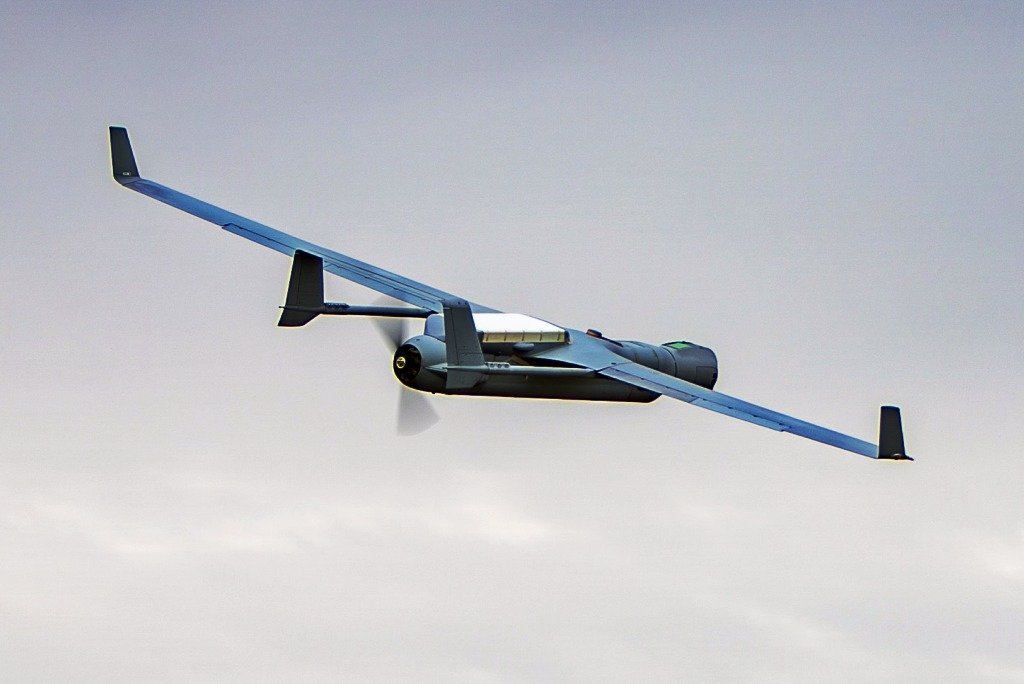
US-based Gogo Special Missions and Boeing subsidiary Insitu have completed the integration and testing of a high-speed, low-latency satellite communications capability for the Integrator uncrewed aircraft system (UAS). The development combines a customised Gogo Galileo HDX electronically steered antenna with Eutelsat OneWeb’s low-Earth-orbit (LEO) constellation, giving the Group 3 platform an ITAR-free, beyond-line-of-sight connectivity option for command and control, intelligence, surveillance, and reconnaissance (ISR) data transfer
The importance of the announcement lies not simply in adding satellite access to a tactical unmanned platform. It is about extending the operational reach of a system designed for persistent theatre-level missions, while enabling commanders to receive sensor information with much lower latency than conventional geostationary satellite links can generally provide.
A compact LEO link for a long-endurance UAS
The new solution centres on a modified version of the Gogo Galileo HDX terminal. Originally engineered for business aviation, the electronically steered antenna (ESA) has been adapted for the demanding size, weight, and power constraints of Group 3 UAS operations.
In its standard configuration, the HDX antenna assembly measures 609.6 mm in length, 299.72 mm in width and 53.34 mm in height, with a published mass of 9.8 kg. It uses a 28 V DC electrical supply and has a maximum power consumption of 165 W. The standard terminal is rated for downlink speeds of up to 60 Mbps and uplink speeds of up to 11 Mbps, with reported consistent download performance between 43 Mbps and 60 Mbps [1] and upload in excess of 5 Mbps, providing a high-capacity connection for transmitting video, imagery and other mission data.
For the Integrator application, Gogo has further optimised the antenna system for size and mass. The company has not released the revised UAS-specific dimensions or mass but has confirmed that the RF data rate performance is unchanged from the standard HDX configuration. Also, the HDX UAV system is supplied in a single line-replaceable-unit (LRU) configuration – an important detail for ease of aircraft integration and deployed operations, where reduced installation complexity and faster maintenance can have direct consequences for aircraft availability.
The terminal links to Eutelsat OneWeb’s global LEO satellite network. LEO constellations operate far closer to Earth than traditional geostationary satellites, reducing signal travel distance and thereby enabling lower latency. For an ISR aircraft, this can improve the responsiveness of sensor-data backhaul, support remote tasking and offer a timelier common operational picture to personnel located well beyond the aircraft’s radio line of sight.
Integrator gains a new mission enabler
Insitu’s Integrator is a Group 3 UAS designed for long-endurance, multi-payload missions. The aircraft measures 2.5 metres in length and has a maximum take-off mass of 79 kg. It can carry payloads of up to 23 kg and provides 500 W of onboard power for payload integration. Insitu quotes endurance of up to 27.5 hours and a range of up to 2,000 nautical miles, providing a useful platform for maritime surveillance, border security, land ISR and expeditionary missions.
The compatibility between the air vehicle’s endurance and the new satellite link is central to the programme. A UAS capable of remaining airborne for more than a day can cover vast areas, but the value of that persistence is constrained if it cannot reliably transmit intelligence, receive retasking instructions or maintain command-and-control connectivity at range. High-speed LEO SATCOM is intended to remove part of that constraint.
According to Insitu, the Integrator offers theatre-level range and capacity for several customer payloads. Its new SATCOM option is designed to support uninterrupted command and control while providing low-latency transfer of sensor data to users outside the immediate operating area. The ITAR-free nature of the offer may also be significant for international operators seeking advanced connectivity without the export-control constraints often associated with US-origin mission systems.
Designed for expeditionary deployment
Gogo and Insitu completed the installation and testing of the customised terminal on the Integrator in September, alongside Insitu’s FLARES (Flying Launch and Recovery System) vertical take-off and landing kit. FLARES allows the Integrator to be launched and recovered without a conventional runway or catapult-and-net installation.
The companies state that the combined capability requires minimal deck space, can be launched in high-sea conditions and gusting winds, and demands no modification to the aircraft. The latter point is particularly relevant: avoiding airframe changes reduces integration risk, simplifies fleet retrofit and potentially accelerates fielding for existing users.
For naval and littoral operations, this is a notable combination. A long-endurance UAS able to operate from constrained decks, carry multiple ISR payloads and maintain high-speed connectivity beyond radio range could strengthen maritime-domain awareness without requiring a large aviation detachment or a dedicated runway.
Beyond connectivity
The Gogo–Insitu partnership reflects a wider shift in the uncrewed systems market. Long-endurance platforms are no longer assessed solely by flight time, payload capacity or sensor quality. Their operational value increasingly depends on the speed, resilience and sovereignty of the data link connecting the aircraft to commanders and intelligence users.
The customised Galileo HDX solution does not turn the Integrator into a new aircraft. It does, however, add a potentially important communications layer: global LEO connectivity, simplified equipment architecture and a high-speed pathway for mission data. In an era in which the pace of decision-making is often as decisive as the sensor itself, that may prove to be a substantial enhancement.
Photos courtesy Gogo
[1] Download is of no relevance for UAVs, it is upload / transmit. They could say a reported consistent transmit performance in excess of 5 Mbps
