

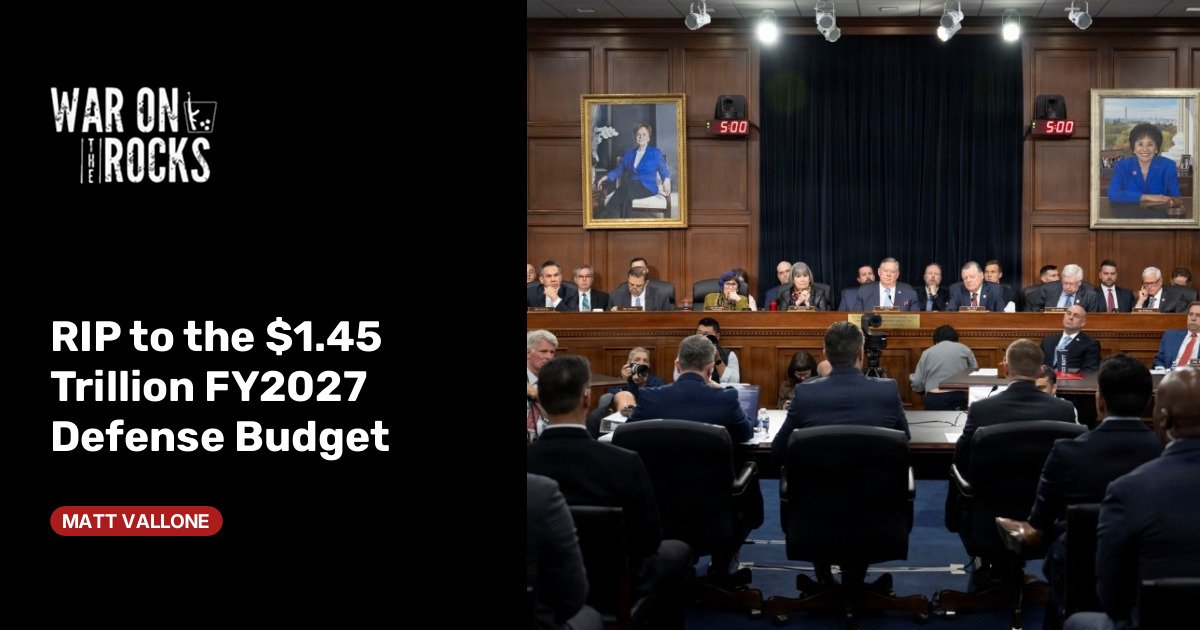
The 2026 Congressional midterms appear to have dealt a final death blow to the Trump administration’s prospective $1.45 trillion Fiscal Year 2027 Department of Defense budget request. While there remains a path forward to salvage the base budget request of $1.1 trillion, it is exceedingly difficult to envision a legislative pathway for the $350 billion reconciliation request. The reconciliation request has always faced considerable obstacles stemming from divisions within the Congressional Republican caucus, but the extent of the midterm defeat and limited legislative calendar make its prospects likely insurmountable. Senate Majority Leader John Thune and Speaker of the House Mike Johnson would face an incredibly demanding task to keep their respective caucuses together in the lame duck period to pass it. Johnson has announced that he is stepping down, further reducing his ability to whip votes. Even the Pentagon has begun to acknowledge the inevitable, with planning ongoing on how to salvage its priorities.
Once this has been accepted, there remains considerable uncertainty about what’s next. Looking at the defense budget and defense spending, there are four pressing questions: Whether Congress can agree on FY2027 appropriations; what can be moved from the reconciliation request into the base budget (and, relatedly, what is cut to accommodate it); whether there will be supplemental funding (either as a standalone bill or as part of a funding deal) to refill accounts drawn down by operations in Iran; and whether yet another continuing resolution will be passed kicking the can on funding until the 120th Congress can be seated.
This backlog will create obstacles to the Pentagon moving forward as quickly as it would like on its stated priorities and reassert the supremacy of Congress in the budgeting process.
Sign Up for Our Newsletter
Why a Lame-Duck Congress Won’t Take Up the Mantle
Defense spending has been in a period of rapid growth. Between base appropriations and the One Big Beautiful Bill passed in 2025, the Department of Defense expects FY2026 defense spending to exceed $1 trillion. This April, the FY2027 request came out even higher: Base spending would be $1.1 trillion, while an additional $350 billion was requested in another reconciliation bill. Defense spending would grow by almost 44 percent over the FY2026 level. A new age of defense spending was coming.
However, as my earlier writing for War on the Rocks made clear, Congress is the entity ultimately responsible for spending decisions, and the odds of passage for this sort of increase were always somewhat long. Congressional Republicans may be more favorable to increased defense spending, but they also count amongst their number a significant number of deficit hawks. As the price of their support for such an increase, deficit hawks would have demanded cuts to non-defense spending (either discretionary spending or mandatory spending such as Medicaid or Medicare) that more moderate Republicans would have opposed. The 2025 reconciliation bill finessed this through large tax cuts —something the entire caucus agrees upon — with increased defense and border security spending alongside significant cuts to discretionary and mandatory spending in areas the moderates accepted.
In an election year, when members are reluctant to take potentially controversial votes, an even larger defense increase ($350 billion, compared to last year’s $151 billion) was going to be a difficult lift. Even traditional defense hawks like former Senate Majority Leader Mitch McConnell had concerns about going through reconciliation for such a significant percentage of the defense budget. This is because reconciliation money, existing outside the normal appropriations process, is much harder for Congress to control and direct. Balking at the full reconciliation request, the House did begin the process for a smaller reconciliation package focused on funding combat operations in Iran, but it’s comprised of different funding than what was found in the FY2027 reconciliation request, and only has space for $60 billion in defense spending. It remains the only live vehicle for a potential lame duck push.
Now, after the 2026 midterms, the already challenging legislative math is complicated by two additional factors: the limits of the legislative calendar, and maintaining the focus of members who have been swept out of office. The already fine margins in the House (2 vote margin) and Senate (3 vote margin) during the 119th Congress will be sorely tested as members who have lost are swept out of their offices and begin to envision post-Congressional life.
The lame duck calendar is short, with only five scheduled legislative work weeks before the end of the 119th Congress. In that time, Congress will need to work through a range of must-pass and pending legislation including the National Defense Authorization Act, the farm bill, Iran operations funding, lapsed Foreign Intelligence Surveillance Act authorization, permitting reform, college sports reform, various other expiring authorizations (Export-Import Bank, highway funding), and the main one, the end of the current continuing resolution on Dec. 11. Failure to pass the last one would result in a government shutdown. The administration can push hard for a reconciliation bill, but it will be competing with these other issues for floor time.
Passing a full reconciliation bill takes time. First, both the House and Senate would need to agree to a budget resolution. In the Senate, that requires a potentially grueling “vote-a-rama” on a range of Democratic amendments. Then, the committees identified in the resolution must prepare and pass their pieces of legislation. Matching legislation must then pass both the House and the Senate. While none of this is subject to the filibuster, it will require Republicans in both chambers to stick together throughout. Given their narrow margins, the calendar would normally be the primary concern, but after the midterm results, there will almost certainly be attendance issues.
The full results of the 2026 midterm elections are still pending, but the high-level results are clear: Democrats will have picked up between eight and nine Senate seats and have flipped at least 40 House seats. These numbers also undersell the turnover. In the Senate, between 13 and 15 members will be departing when you include retirements and primary losses. In the House that number will almost certainly exceed 50, and may well rise above 60 departing Republican members.
It can’t be emphasized enough that members who have lost or are leaving office are going to be more difficult to whip in support of a bill. While Senators are given the decency of keeping their offices until January, this author knows from personal experience that the House of Representatives will typically kick members out of their offices by Dec. 1. Members who are looking for work or trying to decide what to do next will not want to hang around for something they may not feel passionately about. This is doubly so for those members who sleep in their offices and will now have to resort to hotels or other accommodations.
The combination of these issues makes it extremely difficult to see a path forward for the $350 billion reconciliation bill. Defense budget watchers should instead focus on the upcoming appropriations negotiations.
FY2027 Appropriations: What Can and Will Congress Authorize?
A realistic appropriations deal for FY2027 would see defense spending at $1.1 trillion alongside matching growth in discretionary non-defense spending. A $1.1 trillion base defense budget would still be an almost 10 percent increase over total FY2026 spending and would seem achievable should Congressional Republicans accept higher non-defense discretionary spending. Even if final appropriations are delayed until the 120th Congress next year, there will likely still be a spending deal, as Senate Democrats will not have enough votes to overcome a Republican filibuster.
Beyond funding levels, these negotiations will focus on policy riders and how Congress may respond to the administration’s use of pocket rescissions to undermine Congressional intent. Pocket rescissions are a novel technique employed by the Office of Management and Budget, whereby they request Congress to approve rescissions but with less time to the end of the fiscal year than required by statute for disapproval and then assume Congressional assent.
Questions for the Defense Industry
There are two major, unresolved questions with significant implications for the defense industry: What will get cut to accommodate the administration’s reconciliation priorities, and will Congress accept those cuts or impose its own preferences?
The administration put many of the Pentagon’s top priorities in the reconciliation budget, and now they’ll be at risk. Several large defense-wide programs exist almost entirely in the reconciliation request: the Defense Autonomous Warfare Group ($53.6 billion), Industrial Base Analysis and Sustainment ($40.6 billion), a sovereign AI Arsenal ($34 billion), Defense Production Act purchases ($30 billion), and the Office of Strategic Capital Loan Program ($20 billion). The reconciliation request also contained the bulk of the funding for Golden Dome, much of the money expected to drive the expansion of missile industrial capacity, and almost half of the F-35 spending for the year ($5 billion out of $11 billion).
In fairness, part of the appeal of using reconciliation funding is that the department has far more flexibility with money provided via reconciliation. Under existing budget law, money passed via reconciliation is considered “mandatory” spending and is therefore not subject to normal appropriations requirements. This lets the department have more flexibility with how the money will be deployed and reduces the ability of Congress to redirect spending. By moving this money into regular appropriations, those benefits will be lost, and the money will need to flow through your regularly structured budget request with all the oversight that then entails.
Many of these programs, like the major defense-wide programs listed above, have limited Congressional support and will likely face significant reductions. Conversely, many of the weapon systems programs have strong support and could see more limited reductions. Golden Dome and the Trump-class battleship (not funded via reconciliation) are two more controversial programs whose fate will largely be tied to Congressional negotiations.
The Fate of the Iran Supplemental Funding Request
In addition to the questions around the FY2027 defense topline and the fate of reconciliation, the Pentagon has also submitted a request for $87.6 billion in supplemental funding to offset the costs of the Iran war. Neither chamber has acted on this, though the House’s reconciliation bill pitched its $60 billion increase as aligned to the supplemental request (which contained funding for munitions, cyber, unmanned systems, and heightened operations and maintenance costs). Should Congress fail to migrate the munitions investment found in the reconciliation bill into the base budget, a supplemental could potentially help to offset those cuts. However, given the marked unpopularity of the Iran war and its impact on the midterms, the likelihood of a supplemental seems somewhat bleak. While there is likely bipartisan awareness of strained operations and maintenance accounts and the associated large reprogramming requests, it is hard to see a bill funding operations in Iran moving forward in the current political environment.
What Another Likely Continuing Resolution Would Mean For Industry
The most likely outcome of the lame duck negotiations is that there will be another continuing resolution carrying funding into calendar year 2027. Under the continuing resolution, the department will be able to continue funding existing programs at levels consistent with the FY2026 appropriations ($857.6 billion) and continue to disburse the $151.5 billion provided by the One Big Beautiful Bill. However, new programs are limited to those explicitly permitted by the text of the continuing resolution and spending ramps not previously appropriated will be put on hold. While the National Defense Authorization Act, which has been passed by both chambers’ armed services committees, will likely be passed before the holidays and may provide some insight into future FY2027 spending, it will not unlock any money without final appropriations.
The past few years have seen major investments by private capital into the evolving and expanding defense tech ecosystem, as the topline budget and the Pentagon’s priority list have grown. Now that the reconciliation budget is dead, industry and investors will have to confront that the U.S. defense market, while still likely to be growing significantly, will not see the rapid, hockey stick-type growth that some expected. This will create risks for many of these new entrants.
A good example of this is the fate of the Defense Autonomous Warfare Group program. In the budget request, it would receive a total of $54.8 billion in FY2027. Of that, $53.6 billion is in the reconciliation bill, and only $1 billion is in the base budget. If, as is likely, the program is significantly cut to fit under the topline, the size of the final contracts potentially available to the Drone Dominance program (which, under FY2027 is now run by the program) will be much smaller. Instead of the flexible pot of reconciliation money, the department will have to navigate the normal budget process under closer Congressional oversight.
FY2027 spending at the base budget level of $1.1 trillion would still be almost 10 percent year-over-year growth from FY2026. However, as I’ve noted previously, as prioritization of limited funding shifts from the Pentagon to Congress, the contents of the spending may skew more towards traditional prime and mid-tier providers than would have been expected based on the budget. The department will need to take care to make sure that the private investment that has been helping to expand the industrial base doesn’t react negatively to the slowing in topline spending. Otherwise, the next few years could see a round of consolidation as private investment potentially pulls back and smaller firms are unable to bridge the gap between their early development efforts and the ponderous budget process.
Write for Cogs of War
Matt Vallone is director of market intelligence at Renaissance Strategic Advisors, a leading specialist in aerospace, defense, and government sector strategy consulting and mergers and acquisitions advisory. In the past, he worked at Next Frontier Intelligence, Avascent, and Janes. Vallone has worked in the U.S. House and Senate and served as the legislative director for Rep. Carol Shea-Porter.
**Please note, as a matter of house style, War on the Rocks will not use a different name for the U.S. Department of Defense until and unless the name is changed by statute by the U.S. Congress.
Image: Petty Officer 1st Class Eric Brann via DVIDS.
