

Today, pessimism—almost fatalism—reigns in Washington about the United States’ ability to avoid a costly and dangerous arms race with China. Policymakers point to China’s increasingly aggressive policies toward Taiwan, its massive military buildup, and its resistance to engaging in some arms control measures as evidence that Beijing has accepted the inevitability of such a race or is even pursuing one. Worried by intellectual frameworks that emphasize the likelihood of war between rival great powers, Many U.S. leaders and analysts see little choice but for the United States to arm itself, too. But this thinking risks becoming a self-fulling prophecy. The major danger is that an unrestrained arms race increases the likelihood of war over Taiwan or even of a catastrophic nuclear exchange.
But the pessimism about averting an arms race is misplaced. A nuclear arms race, in particular, is not a foregone conclusion—and the United States has real opportunities to curb one. Avoiding a nuclear arms race will require a broader approach than the two-pronged one Washington has recently favored: building up U.S. nuclear deterrence and seeking to force concessions from Beijing by imposing restrictions on trade and technology transfers. American leaders should instead look beyond traditional deterrence, which falls short because its threat-based approach tends to provoke competition over arms, and strive to establish a more fundamental strategic stability through a process of reciprocal de-escalation and compromise. China is likely to be amenable to reciprocal de-escalation: it has a long tradition of moderation in nuclear matters and, ultimately, Chinese leaders do not want a war over Taiwan.
There are recent signs that even U.S. President Donald Trump, who has often boasted about his distaste for compromise, sees the value of engagement. After two U.S.-Chinese bilateral summits this year, in October he suggested that his November trilateral meeting in Shenzhen with Chinese leader Xi Jinping and Russian President Vladimir Putin should focus on “denuclearization.” But Washington will have to become much more consistent in its rejection of an arms race, including by modifying its support for Taiwan and incorporating China into global arms control leadership. A nuclear arms race with China becomes inevitable only if Washington continues to believe it is.
CHAIN REACTION
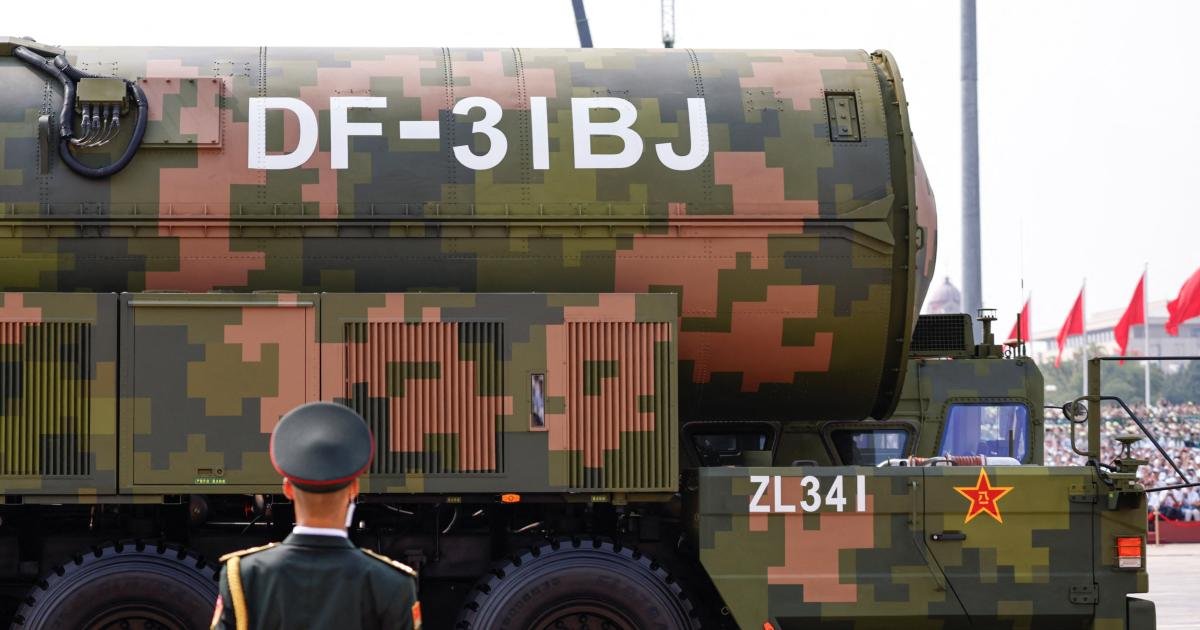
China is undoubtedly pursuing a military buildup, including investments in nuclear weapons. Between 2020 and 2025, China doubled the number of its nuclear warheads, from 300 to 600—a startling increase, although its arsenal remains small compared with the United States’ approximately 3,700 warheads. In 2021, researchers at the Federation of American Scientists announced that China was constructing 350 new nuclear missile silos in three vast sites in Xinjiang and Gansu provinces. Beijing is also pursuing substantial qualitative upgrades to its nuclear weapons, a push it showcased at an October 2025 military parade that unveiled a new sea-launched ballistic missile, two new kinds of intercontinental ballistic missiles, a new air-launched hypersonic missile, and a new long-range hypersonic cruise missile.
Then, this July, the Chinese navy tested a submarine-launched long-range ballistic missile that could carry nuclear weapons. This significant new capability will allow China to launch long-range nuclear strikes that can reach the United States from protected waters near its own coastline rather than having to sail out into the Pacific. A recent editorial in a leading Chinese foreign affairs newspaper took the candid yet disturbing step of explicitly linking China’s rapid nuclear buildup to its desire to exert sovereignty over Taiwan. “The great cause of national reunification,” it asserted, “must rest on a solid, realistic foundation. That foundation is, first and foremost, hard power.” Although such overt nuclear saber rattling remains rare, the link between Beijing’s nuclear forces and the Taiwan issue stretches back over three decades and is also supported by the scholar Tong Zhao’s detailed analysis of China’s nuclear buildup in Foreign Affairs in May.
As China builds up its military, the perception that it is on a collision course with the United States over Taiwan—one that inevitably includes the risk of nuclear escalation—has become widespread in Washington. Taiwan, of course, appears to be an obvious flash point. The United States has long committed itself informally to defending the island while China seeks to unify with it, by force if necessary. In October, Army General Ronald Clark, the head of the U.S. Pacific Command, affirmed that his forces are actively readying for a Chinese invasion of Taiwan that could come as early as 2027.
The Biden administration and both Trump administrations made some attempts to engage China over arms control and nuclear risk reduction. Trump proposed trilateral arms control talks that would include Russia, whereas the Biden administration pursued bilateral talks with China on strategic stability and nuclear risk reduction. But both presidents gave up after China consistently rejected engaging in sustained talks on nuclear matters. Beijing’s stance is that it has a small nuclear arsenal compared with the United States and Russia and that it is important to first establish trust and mutual reassurance about core interests.
Beyond China’s resistance to arms control, theories about power that are trendy in Washington reinforce the collision course mentality. Numerous realist scholars argue that a U.S.-Chinese rivalry and even a great-power war may be structurally difficult to avoid. The political scientist Graham Allison captured this pessimism in his influential 2017 book, Destined for War, which argued that a so-called Thucydides trap—when a rapidly rising power challenges the position of the dominant power, yielding war—would doom the United States and China to conflict.
China hawks, such as Undersecretary of Defense for Policy Elbridge Colby, increasingly advocate an aggressive focus on “preparing for World War III” with China as a way to avoid it. In a July New York Times interview, Colby argued that the United States must “deny” China “the ability to seize and hold the key territory” of Taiwan, by enhancing U.S. deterrence with a massive military buildup. The next month, speaking at a military conference, Colby specified that such a buildup ought to put a greater emphasis on tactical nuclear weapons and the ability to fight a so-called limited nuclear war. The enemy, Colby said, has “got to believe there’s some sense in which we would use” nuclear weapons. Toward this end, the United States is building a new intercontinental ballistic missile, a new air-launched cruise missile, and new nuclear-armed submarines and bombers, and accelerating the ambitious Golden Dome homeland missile defense project. Unlike earlier U.S. missile defenses, which were designed to intercept limited strikes by so called rogue states such as Iran and North Korea, the Golden Dome is intended to defend against massive Chinese or Russian attacks. But the prospect of losing its ability to retaliate against a U.S. first strike only gives Beijing more incentive to expand its nuclear arsenal.
A DANGEROUS MISUNDERSTANDING
Such a nuclear-heavy approach only prevents a war with China if nuclear deterrence succeeds. That puts a lot of eggs in the deterrence basket. And recent wars suggest that nuclear deterrence is becoming less effective. Russia’s nuclear threats have not coerced Ukraine into halting its strikes deep into Russian territory. Iran has proved willing to launch strikes against nuclear-armed Israel as well as U.S. bases and allies in the Middle East. What is most ominous, in May 2025, India and Pakistan crossed previous redlines and attacked each other’s homelands, something that mutual nuclear deterrence was supposed to prevent. Even if neither the United States nor China want nuclear war, a China determined to unify with Taiwan may not be intimidated by U.S. nuclear threats.
A recent study by Brown University’s Costs of War program found that the United States has already spent more than $3.4 trillion on its militarized rivalry with China over the last decade. Sustaining or ramping up this spending—which encompasses new warships, aircraft, long-range missiles, drones, base upgrades, forward deployments, large military exercises, research and development, and new nuclear weapons—is infeasible in an era of ballooning national debt and expanding domestic needs.
One of the tragedies of an arms race is that neither party may actually want to pursue one. Despite its current arms buildup, Beijing has a long record of moderation in military and nuclear matters. For many decades, it has maintained a minimal nuclear deterrent and a no-first-use policy, and it did not use major military force to achieve strategic goals. Although it has long had access to the relevant technologies, China appears not to have produced or deployed tactical nuclear weapons. Chinese diplomats played a substantial role in coaxing Iran to accept the Obama administration’s 2015 nuclear deal and supported the UN’s relatively stringent sanctions on North Korea. And in the fall of 2022, according to then Secretary of State Antony Blinken and reporting by the Financial Times, China likely intervened diplomatically with the Kremlin to help stop Russia from using nuclear weapons in Ukraine. More broadly, China has embraced international law when it comes to war, playing a constructive role, for example, in removing chemical weapons from Syria in 2013.
The United States has already spent more than $3.4 trillion on its militarized rivalry with China.
Beijing’s inclination toward restraint has not disappeared completely, even as it upgrades its military. In November 2023, U.S. President Joe Biden and Xi agreed to renew lines of communication between their countries’ militaries that had been severed after U.S. House Speaker Nancy Pelosi visited Taiwan the previous year. A year later, the two leaders affirmed that humans, not AI, must control the decision to use nuclear weapons. And in late 2025, Beijing released a white paper emphatically reiterating its support for nuclear arms control and has moved toward more transparency by publishing more information, including in English, about its military upgrades.
Chinese leaders clearly do not want a war over Taiwan. Publicly, they repeatedly emphasize that their goal is “peaceful unification” and “winning without fighting,” invoking the Chinese strategist Sun-tzu. Beijing’s longtime “one country, two systems” policy toward Taiwan—which would bring the island under Chinese sovereignty while allowing it substantial autonomy—leaves room for a negotiated solution. Last year, in an important analysis of China’s strategic ambitions, the scholars David Kang, Jackie Wong, and Zenobia Chan examined 12,000 articles and hundreds of speeches by Xi to argue that Beijing prioritizes regime stability and internal development over displacing the United States as a global military hegemon. Although China’s major, unannounced exercises around Taiwan earlier this month may constitute an exception, overall, Chinese military exercises near Taiwan over the last five years are consistent with this interpretation: many have reacted to perceived provocations, illustrate only medium-scale capabilities, and have generally had a performative quality, accompanied by extensive press coverage.
NONNUCLEAR OPTIONS
There is still an opening for the United States and China to de-escalate. To achieve strategic stability, the two countries will need to make a concerted effort to defuse their security dilemma—the dynamic in which each side perceives the other’s defensive measures as aggressive. First, U.S. and Chinese leaders need to revive superpower summitry. Biden held only three face-to-face meetings with Xi on the sidelines of regional economic meetings. Although the May 2026 Beijing summit between Trump and Xi yielded no major breakthroughs, the meeting did improve the two leaders’ personal relationship; today, U.S.-Chinese tensions are lower than they were between 2021 and 2025. This progress suggests the great value of holding a regular, annual, multiday bilateral summit with a significant focus on nuclear arms control. Such meetings would give expert working groups time to methodically develop measures to reduce the risk of conflict. Just as important, the summits need to be long enough to leave room for unscripted conversations. At their first summit, in Geneva in November 1985, U.S. President Ronald Reagan and Soviet leader Mikhail Gorbachev famously broke away from anxious bureaucrats and advisers for an impromptu walk—an encounter that helped establish a more constructive relationship.
The United States must also take concrete steps to reduce the chance of escalation in the Taiwan Strait. Above all, it should adhere more consistently to its “one China” policy—its position that Beijing is the sole legal government of China. More consistency would include limiting U.S. legislators’ trips to the island and downgrading U.S.-Taiwanese defense relations by, for example, holding meetings less frequently and at lower diplomatic levels. Washington should remind key allies such as Japan to proceed cautiously in terms of their rhetoric and military deployments. Such a restraint-oriented strategy would make it clear to Taiwan that independence is off the table, encouraging it to take a more accommodating approach that would lower the temperature with Beijing. If Washington were to agree to common-sense limitations on arms sales to Taiwan—such as refusing to sell Taiwan the surface-to-surface ballistic Army Tactical Missile System (ATACMS), which can reach across the strait to the Chinese mainland—Beijing would likely reciprocate by scaling back its military exercises and related military deployments around the island. There are real incentives for Beijing to de-escalate. Doing so could improve relations with neighbors such as Japan, free up focus for domestic priorities, lower military spending, and limit the chance of war.
The Pentagon needs to demonstrate Washington’s intent to avoid war over Taiwan by gradually decreasing U.S. warship transits through the Taiwan Strait. Even more important, Washington should also substantially reduce U.S. military deployments in the Luzon Strait between Taiwan and the Philippines and around Japan’s Ryukyu Islands. Such deployments only exacerbate the security dilemma.
Above all, Washington should adhere consistently to its “one China” policy.
Exhibiting restraint does not mean the United States would be giving Taiwan away. The United States can continue to provide Taiwan with defensive arms (such as missile interceptors, artillery, drones, and mines) and harden U.S. bases in the region to provide stabilizing deterrence. But even if U.S. leaders publicly abjure direct military intervention to defend Taiwan—a rational step that would lower the risk of nuclear war—China will prefer negotiating with Taipei on the island’s autonomy over a bloody military showdown with Taiwanese forces. For their part, Taiwan’s leaders will likely accommodate themselves to limited self-governance under Chinese overall sovereignty. In the end, China’s main goal is to get Taiwan out of the U.S. sphere of influence. Chinese leaders’ major fear is not so much Taiwanese autonomy as the prospect of the island serving as a U.S. forward base—in Chinese parlance, “using Taiwan to contain China.”
Another important step would be to seek a multilateral pledge by all nuclear-armed states to employ nuclear weapons only in retaliation against a nuclear attack. Such a policy would reduce the risk of miscalculation during a crisis. China has long embraced such a no-first-use policy, but U.S. leaders have traditionally opposed it, believing that it might expose U.S. allies to conventional attack. The U.S. nuclear deterrent for allies, however, increasingly lacks credibility because the costs of starting a nuclear war would vastly outweigh the benefits. And after the collapse of traditional nuclear arms control, a mutual no-first-use policy offers a promising area of common ground between the United States and China. It would reinforce the existing no-first-use policies of China and India and implicitly acknowledge their leadership in the area of nuclear restraint, a virtue when newer nuclear states are chafing under the old Cold War superpowers’ dominance of arms control. This approach could even entice Beijing into a wider, more comprehensive process of bilateral or multilateral nuclear arms control.
Beyond these three major initiatives, the United States and China should sign an agreement to notify each other about their ballistic missile tests. Washington could also consider giving Beijing a larger role in nonproliferation efforts, for instance by affording China leadership roles in negotiations and inspection regimes in future nonproliferation arrangements. The U.S. arms control agenda with China should focus not only on offensive nuclear systems but also on missile defenses and tactical nuclear weapons, as well as AI technologies. And it would help if the United States evolved its own nuclear posture in the direction of restraint by reducing its warheads, warfighting capabilities, and alert posture.
Ultimately, the United States needs to get serious about reining in an arms race with China before its perception that one is apace becomes a self-fulfilling prophecy. The two countries have a mutual interest in restraint. If Washington continues to overlook Beijing’s incentives to compromise—and the real signs that it is willing to do so—an arms race that, as of now, is mostly putative will become a reality. And a catastrophic war that could have been avoided could indeed become inevitable.
Loading…
