

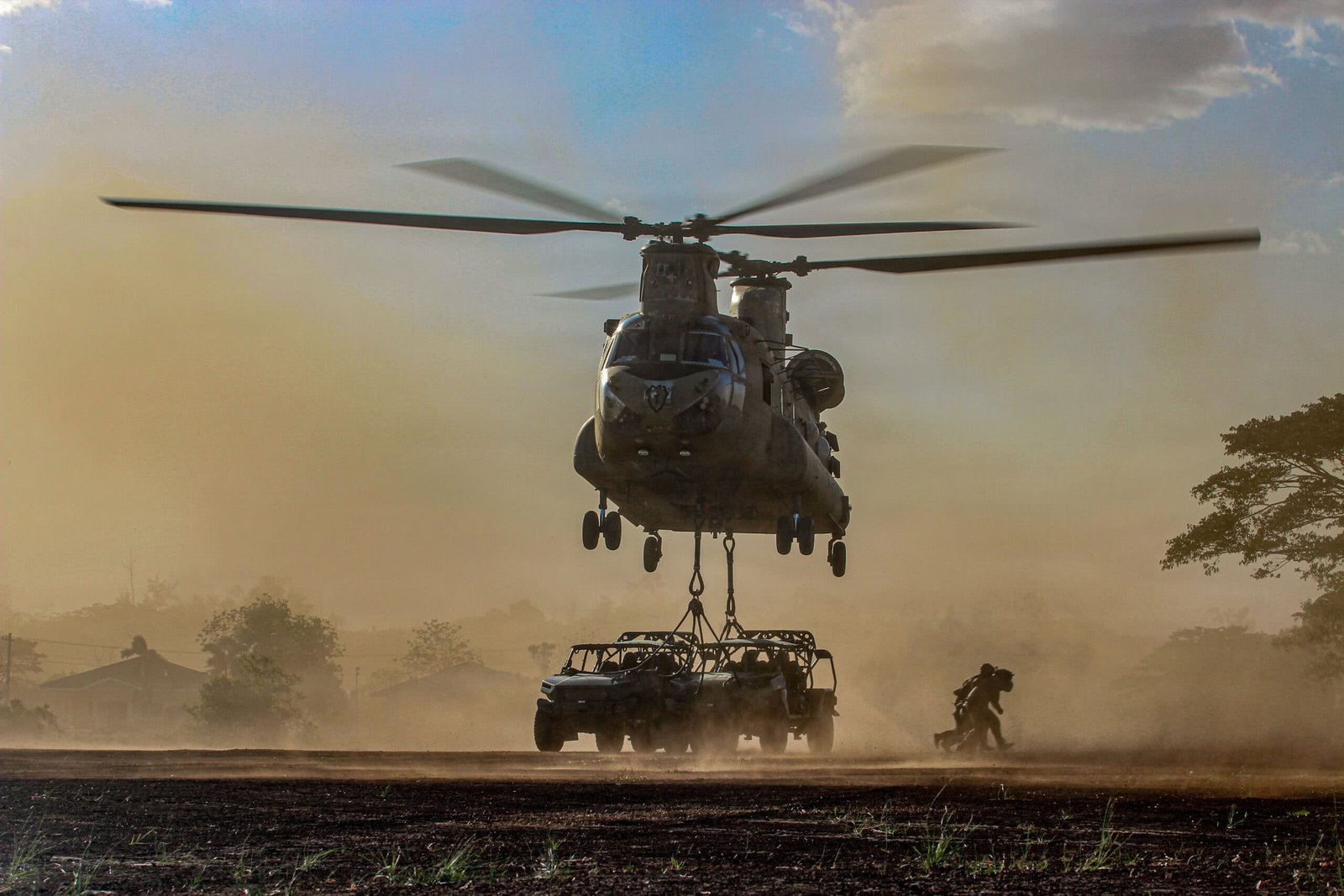
Boeing’s CH-47F Chinook is on the Philippine Air Force’s (PAF) shopping list, as it seeks to finally acquire a heavy-lift helicopter for troop and cargo transport suitable for both combat and disaster relief operations.
The Philippines has requested six new Chinooks, Philippine Defense Secretary Gilberto Teodoro Jr. confirmed on 26 November 2026.
The aircraft form part of a more than US$2 billion Foreign Military Financing (FMF) loan discussed when President Donald Trump met with the Philippine leader in Manila on 18 November.
“We made a request to the US government regarding the $2 billion financing for six Chinooks. That’s the only thing I can disclose out of that package,” Teodoro told reporters.
He said all six CH-47Fs could be delivered as early as 2029, but only if Washington DC prioritises the Philippine order and hand over helicopters originally allocated to the US Army. If this does not happen, Teodoro said delivery could take up to six years.
The defence secretary said, “A Chinook can carry about four times a Black Hawk, so it saves you time and it saves you logistical space.” A heavier transport capacity is important for archipelagic nations like the Philippines.
The pending contract will cover the helicopter acquisition, as well as integrated logistics support and training.
Asked whether the PAF wants more than six Chinooks, Teodoro responded, “If only we could. That is not enough, but of course that’s all we can manage,” in terms of finances.
This is an important win for Boeing, which has struggled to gain sales in the Philippines in the face of competition from both Bell and Sikorsky.
It also follows a misguided saga when former leader Rodrigo Duterte decided to buy 16 Mil Mi-171 helicopters from Russia. A contract was signed in November 2021 but it was soon cancelled due to fears of US sanctions. Along the way, Manila forfeited an initial payment to Moscow.

Elsewhere, the PAF formally inducted a second batch of Bell 412EPX helicopters on 15 September 2026. The air force now has in service four out of the eight on order.
In another potential win for Bell, there were media reports in September that the Philippines had approved the inking of a US$108.9 million Foreign Military Sale contract for 22 Bell 505 trainer helicopters. The US government had approved such a sale back on 5 May.
Distribution of the Bell 505s would be twelve for the PAF, six for the Philippine Navy and four for the Philippine Army. The air force currently uses MD 500 and MD 520 light attack helicopters for training with the 15th Strike Wing.
In other news, the PAF finally retired its Bell UH-1 Huey helicopters, the long-time workhorse of the air force, on 5 November 2026. Most of the once large fleet had already been withdrawn by then, but it was still using several upgraded Huey II and Super Huey helicopters for search and rescue and support roles.
Asked to explicate more about the US$2 billion loan from the USA, the Philippine Department of National Defense said the financing represents an intent and details are still to be discussed.
Teodoro declined to disclose what other military equipment is being sought from the USA under the US$2 billion FMF loan, but rumours abound that it perhaps covers M142 HIMARS, NMESIS anti-ship missile launchers, the Typhon Mid-Range Capability all the way to F-16V fighters. However, there has been no official announcement so these remain purely speculative.
The White House also mentioned US$400 million in FMF for the Philippine military “to expand its operational reach and deterrence capabilities in the South China Sea, including long-range fires, command and control, critical infrastructure and multi-domain drones”.
The Philippines also announced a US$37 million contract with an American firm for artificial intelligence (AI)-enabled mission support, plus another US$63 million contract to modernise its defence cloud infrastructure for AI use cases.
Finally, the Philippines and USA have agreed to upgrade the airstrip at Basco in the Batanes Islands north of Luzon. This runway less than 200km south of Taiwan has immense strategic value, since the Philippines and USA could site anti-ship missile launchers there to contain Chinese warships and prevent them from passing through the First Island Chain.
Precisely this tactic was rehearsed during this year’s Exercise Balikatan in the Philippines. Upgrade of the airstrip will allow larger aircraft to land there. “We really need to build resilience in Batanes,” Teodoro said. “The airport there is not an all-weather airport, and it has a very short runway.”
by Gordon Arthur
Source: asianmilitaryreview.com. Summarised by TBH Center; all rights to the original reporting remain with the publisher.
