

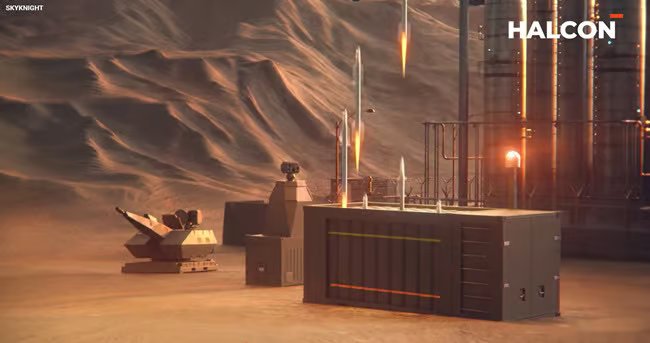
Edge unveiled the concept of its SkyKnight air defence system some time ago, but real-world events forced the UAE state-owned company to urgently develop a lower-cost missile system to deal with drones and loitering munitions flying across the Persian Gulf from Iran.
Edge is calling this system SkyLight, and Asian Military Review was present at a briefing about the new system whilst a guest of Edge in Abu Dhabi earlier this month.
The low-cost SkyLight interceptor missile emanates from Edge’s Halcon business, and Saif Al Dahbashi, President of Edge’s Missiles & Weapons cluster, explained that it is designed to counter the delta wing, Shahed-type drones that were attacking the UAE.
Al Dahbashi shared, “SkyKnight is a much bigger programme. It’s VSHORAD – a very short-range air defence system. It’s extremely capable and it’s a system of systems: very big, huge capacity, very strong performance in regards to engagement with a huge number of drones that are coming – artillery, air-breathing, aircraft, everything.”
Looking into the SkyLight
SkyLight, he pointed out, is a very different system. “We went to the practical approach of saying, ‘What do I have available?’” Thus, the SkyLight incorporates critical components from existing Edge products such as precision-guided munitions, including rear sections and flight control units from the same production line. The missile also employs a solid rocket motor from Edge subsidiary Lahab.
Al Dahbashi said Edge combined all these building blocks into a new counter-unmanned aerial system (C-UAS) solution in a matter of months. Work on SkyLight commenced only in March, but the system has already attained an initial operational capability.
The SkyLight system, employing Edge command-and-control software, depends on simple and agnostic four-panel radars such as those from EchoDyne or Elbit Systems. Threats flying 25km away in a 360° direction can be detected. As a drone gets closer, an electro-optic camera with a designator locks onto it. Once a target is within the engagement zone, a SkyLight missile is fired and follows the laser beam.
Al Dahbashi said SkyLight is thus resistant to GPS interference or jamming. “The missile itself will have no compromise when it comes to jammers and spoofers and things like that.” Possessing a range of 5km, the SkyLight missile features an outsourced semi-active laser seeker and a proximity sensor.
The Edge executive said SkyLight has not been used in anger, due to a subsequent ceasefire with Iran. However, Edge is building sets of SkyLight systems and is training UAE military operators on it. It’s ready to go when needed, declared Al Dahbashi.
Furthermore, he said, “What we’re doing today is we continue to improve it, we continue to fine-tune it, we continue to shoot it. I have two to three missiles that we shoot every week.” Missiles are being produced weekly, and he said software improvements are “preparing it for whatever is to come”.
“The idea is that I do not want a missile that’s overpriced against the threat that it’s dealing with.”
Edge continues to improve the weapon. A future fire-and-forget evolution of the SkyLight will have a cost-effective imaging infrared seeker, while another option is a radio frequency seeker of the type installed on the Shadow-3 interceptor drone.

SkyKnight and rocket motors
Al Dahbashi explained that the SkyKnight air defence system will have Block 1 and 2 variants that feature different warheads and seekers. The Block 1 missile should be ready in Q2 of 2027, whilst the Block 2 will take another eight months to get ready.
The 36kg SkyKnight missile has a 10km range, so double that of the SkyLight. He described the former as a “very complicated, very big programme,” which was why a lower-cost system was necessary in short order to deal with the threats the UAE suddenly faced after the USA and Israel attacked Iran.
Incidentally, Edge has moved strongly into the production of solid rocket motors, with pilot plants activated and completely operational since May. Solid rocket motors are a bottleneck for most weapon manufacturers around the world, so Edge sees great benefit in producing them itself and thus assuring a secure, sovereign supply chain.
Edge has a capacity to build 120-130mm rocket motors, as well as smaller 70mm ones. It also manufactures boosters and rocket-assisted take-off motors for drones.
Al Dahbashi would not disclose what quantities of solid rocket motors it is manufacturing, other than to say numbers “will continue to increase year after year”. In fact, in 2027 it will triple the rate of production compared to this year. “The solution that we have today is completely home-grown. Our solid rocket motors are 100% in house,” he stated.
He said there is an appetite from Europe and the USA to partner with Edge in such motors. “We’ve had discussions with many different key industry players.” Edge is currently buying propellant and energetics raw materials, but it is building a facility to produce hydroxyl-terminated polybutadiene.
by Gordon Arthur
Source: asianmilitaryreview.com. Summarised by TBH Center; all rights to the original reporting remain with the publisher.
