

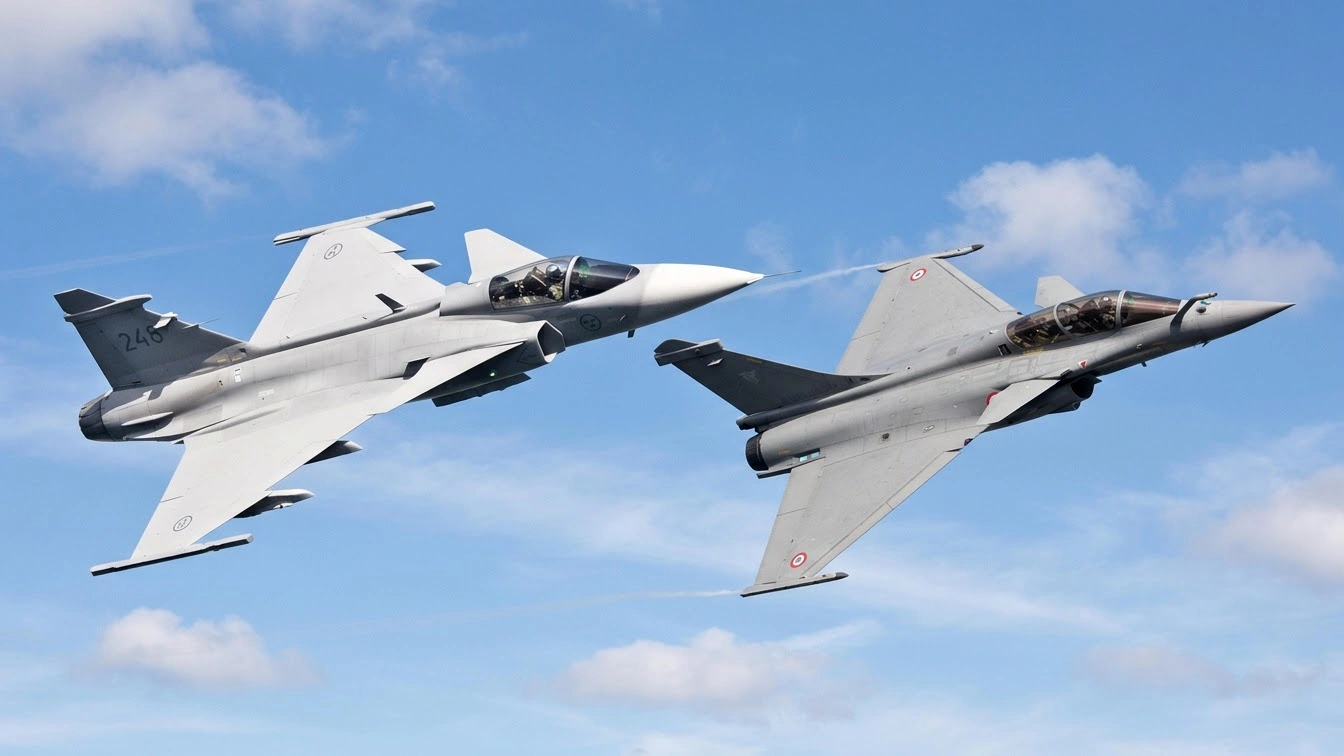
Imagine two European fighter jets approaching the same battlefield. One is designed to deliver tremendous firepower and handle almost any mission. The other is built to operate efficiently, move quickly between locations, and remain effective under demanding conditions. Both are formidable aircraft, but their approaches to modern air combat couldn’t be more different.
This is what makes the Gripen vs Rafale comparison particularly interesting.
Developed by Sweden’s Saab and France’s Dassault Aviation, the JAS 39 Gripen and Rafale represent two distinct philosophies of modern fighter aircraft design. Both belong to the 4.5-generation fighter category, combining advanced radar, electronic warfare systems, precision weapons, and modern avionics without relying entirely on stealth technology.
Yet their differences become apparent when examining their engineering.
The Gripen E, Sweden’s latest operational variant, emphasizes affordability, operational flexibility, and the ability to operate from relatively austere airfields. Its single-engine configuration and compact design reflect a military philosophy shaped by Sweden’s geographical conditions and defense requirements.
The Rafale takes a different route. Powered by two engines, it carries a larger weapons payload and supports an extensive range of missions, from air superiority and reconnaissance to deep strikes and nuclear deterrence. Its ability to operate from aircraft carriers also gives France additional strategic flexibility.
But which aircraft actually has the advantage in a Gripen vs Rafale matchup?
A larger weapons payload doesn’t automatically make a fighter more effective. Likewise, lower operating costs mean little if an aircraft cannot meet the demands of a particular mission.
To understand the real differences, we’ll examine their specifications, radar systems, weapons, combat performance, and operating costs. We’ll also explore how their respective design philosophies influence the choices available to modern air forces.
So, when comparing the Gripen vs Rafale, which European fighter offers the better overall package? Let’s take a closer look.
Two Different Approaches to Modern Air Combat
The Gripen vs Rafale comparison begins long before either aircraft enters the air. Their differences are rooted in two national defense philosophies, shaped by geography, military priorities, and available resources.
Sweden needed a fighter capable of protecting a relatively large territory with limited infrastructure. France wanted something different: a powerful, independent combat aircraft capable of supporting military operations across multiple environments. Those requirements produced two remarkably different machines.
The Saab JAS 39 Gripen: Built Around Operational Flexibility
Developed by Saab, the JAS 39 Gripen entered Swedish Air Force service in 1996. Its development focused on replacing several older Swedish combat aircraft with one versatile platform.
The original Gripen C/D introduced modern multirole capabilities in a relatively compact airframe. However, the newer Gripen E represents a substantial technological evolution.
It features a more powerful General Electric F414G engine, an advanced AESA radar, improved electronic warfare equipment, and increased fuel capacity. These upgrades give the aircraft greater flexibility across air-to-air and air-to-ground missions.
One particularly interesting feature is its ability to operate from dispersed road bases. Sweden developed this concept during the Cold War, when conventional airfields could become vulnerable during a major conflict.
Instead of depending entirely on large military airbases, Gripen crews can use prepared highway sections and relatively small support teams. This approach makes aircraft survival and operational continuity part of the design itself.
The Dassault Rafale: Designed for Mission Versatility
France approached the problem differently. Developed by Dassault Aviation, the Rafale was designed to replace several aircraft types while maintaining France’s independent military capabilities.
Its first flight took place in 1986, followed by operational introduction in 2001. Unlike the Gripen, the Rafale uses two Safran M88 turbofan engines, providing substantial thrust for a larger aircraft.
Its defining characteristic is its omnirole philosophy. Rather than focusing on a limited collection of mission types, the Rafale can conduct air defense, reconnaissance, precision strikes, and maritime operations.
The Rafale M adds another dimension. Designed for aircraft carrier operations, it gives France the ability to deploy fighter aviation far beyond its mainland territory.
The aircraft also benefits from continuous modernization. The F4 standard introduces improvements to connectivity, electronic warfare, weapons integration, and data processing, keeping the platform relevant against increasingly sophisticated threats.
Two Different Philosophies, One Competitive European Fighter Market
The fundamental difference in the Gripen vs Rafale comparison is how each aircraft approaches combat operations.
The Gripen prioritizes efficient deployment, relatively low operating costs, and the ability to maintain operations even when conventional infrastructure is unavailable. The Rafale emphasizes mission flexibility, greater payload capacity, and the ability to perform complex operations from land bases or aircraft carriers.
Neither philosophy is inherently superior. A country defending its territory with limited resources might value Gripen’s operating concept, while a nation seeking expeditionary capabilities and broader mission coverage could find the Rafale more attractive.
These differences become even more interesting when their technical specifications are compared.
Gripen vs Rafale: Specifications and Performance Compared
When comparing Gripen vs Rafale, specifications provide a useful starting point. They reveal how engineers approached speed, propulsion, payload capacity, and overall performance.

In the Gripen vs Rafale comparison, however, the numbers tell an interesting story: one aircraft prioritizes compact efficiency, while the other offers greater physical capacity and thrust.
The Gripen E and Rafale F4 represent the latest major configurations of their respective aircraft families. Both incorporate modern avionics and advanced combat systems, but their differences are immediately visible.
Gripen E vs Rafale F4: Technical Specifications
The following table highlights their principal specifications.
| Specification | Gripen E | Rafale F4 |
| Country | Sweden | France |
| Manufacturer | Saab | Dassault Aviation |
| Engine configuration | Single-engine | Twin-engine |
| Engine | GE F414G | Safran M88 |
| Maximum speed | Mach 2 | Mach 1.8 |
| Maximum takeoff weight | 16,500 kg | 24,500 kg |
| Radar | ES-05 Raven AESA | RBE2 AESA |
| External hardpoints | 10 | 14 |
| Maximum external payload | Approx. 5,300 kg | Approx. 9,500 kg |
Speed, Engine Power, and Flight Performance
Interestingly, the smaller Gripen E has a higher published maximum speed. Its lightweight airframe allows it to reach approximately Mach 2, compared with the Rafale’s Mach 1.8.
However, maximum speed doesn’t tell the entire story.
The Gripen E uses one General Electric F414G turbofan engine, producing approximately 98 kN of thrust with afterburner. The Rafale employs two Safran M88 engines, each generating approximately 75 kN with afterburner.
Combined, the Rafale produces approximately 150 kN of afterburning thrust. This supports its greater takeoff weight and substantial external weapons capacity.
Payload Capacity and Mission Flexibility
This is where the Rafale establishes a clear advantage. With 14 external hardpoints and approximately 9.5 tonnes of external payload capacity, it can accommodate a broader combination of weapons, fuel tanks, and mission equipment.
The Gripen E offers 10 hardpoints and approximately 5.3 tonnes of external payload capacity. Its smaller carrying capacity is balanced by efficient weapons integration and a compact operational footprint.
For the Gripen vs Rafale comparison, the distinction is straightforward: the Rafale carries more, while the Gripen prioritizes efficiency. Which matters more depends on the mission, available support infrastructure, and operational requirements.
Gripen vs Rafale: Radar, Avionics and Electronic Warfare Compared
Modern air combat is increasingly determined by what a fighter can detect, process, and share before an opponent even realizes it has been located. Speed and weapons remain important, but information can be just as valuable. This makes radar technology and electronic warfare particularly important in the Gripen vs Rafale comparison.
In the Gripen vs Rafale comparison, both aircraft feature advanced AESA radar systems, sophisticated sensor integration, and electronic protection designed to operate in increasingly contested environments. However, their approaches to gathering and managing battlefield information differ.

AESA Radar: ES-05 Raven vs RBE2
The Gripen E uses Saab’s ES-05 Raven active electronically scanned array (AESA) radar. One of its distinctive features is a repositionable antenna mounted on a mechanical repositioning system.
This arrangement provides a wider field of regard than many conventional fixed AESA installations. It allows the radar to look significantly away from the aircraft’s forward direction without requiring the entire fighter to turn toward its target.
The Rafale F4 uses the Thales RBE2 AESA radar. It provides simultaneous air-to-air and air-to-ground detection capabilities, supporting target tracking, threat identification, and precision engagement.
Both systems offer important advantages. However, actual detection performance depends on target characteristics, operating conditions, radar configuration, and electronic interference.
Electronic Warfare: SPECTRA vs Gripen’s Integrated Systems
Electronic warfare is another important distinction in the Gripen vs Rafale matchup.
The Rafale features the SPECTRA self-protection system, which combines radar warning, threat detection, electronic countermeasures, and other defensive technologies. It helps the aircraft identify potential threats and respond to hostile radar activity.
The Gripen E incorporates an advanced integrated electronic warfare suite, including Saab’s Arexis technology. Its architecture supports electronic surveillance, threat identification, and countermeasures against modern radar systems.
Sensor Fusion and Situational Awareness
Both fighters also integrate information from multiple sensors to improve pilot awareness. The Rafale combines radar, infrared sensors, and SPECTRA, while the Gripen E emphasizes network connectivity and information sharing.
The key takeaway: Neither aircraft has an automatic advantage in every electronic warfare scenario. The Rafale brings a mature, comprehensive self-protection architecture, while the Gripen E offers an advanced electronic warfare and sensor integration approach designed around flexible networked operations.
Gripen vs Rafale: Weapons and Firepower Compared
Weapons integration is another important factor in the Gripen vs Rafale comparison. Both fighters support advanced air-to-air missiles, precision-guided bombs, and long-range strike weapons.
However, the Rafale’s larger airframe provides greater payload capacity, while the Gripen focuses on flexibility and efficient weapons integration.
Air-to-Air Missiles: Meteor and Beyond-Visual-Range Combat
Both aircraft can carry the MBDA Meteor missile, one of Europe’s most advanced beyond-visual-range air-to-air weapons. Its ramjet propulsion maintains energy during flight, improving its ability to engage maneuvering targets at extended distances.
For shorter-range engagements, the Gripen supports IRIS-T and AIM-9 variants, while the Rafale integrates the MICA missile family.

Air-to-Ground and Maritime Strike Capabilities
The Rafale supports an extensive strike arsenal, including AASM Hammer precision-guided bombs, SCALP-EG cruise missiles, and laser-guided munitions.
The Gripen E can carry precision-guided bombs and the Taurus KEPD 350 cruise missile, providing meaningful long-range strike capabilities.
Their maritime weapons also reflect different operational priorities:
- Gripen: RBS15 anti-ship missile.
- Rafale: AM39 Exocet anti-ship missile.
Additionally, the Rafale supports France’s nuclear deterrence mission through its integration with the ASMP-A missile.
Which Fighter Has the Stronger Weapons Arsenal?
In the Gripen vs Rafale matchup, the Rafale holds an advantage in payload capacity and the breadth of its established weapons portfolio. Its larger airframe allows it to carry more weapons and fuel simultaneously.
The Gripen, however, remains highly capable, particularly with its Meteor integration and flexible weapons architecture.
Ultimately, the better choice depends on mission requirements. The Rafale offers greater carrying capacity, while the Gripen delivers a capable arsenal within a smaller operational package.
Combat Performance and Operational Capabilities
Technical specifications only reveal part of a fighter’s potential. Real operational effectiveness depends on mission flexibility, deployment conditions, pilot training, and the ability to sustain operations under pressure.
In the Gripen vs Rafale comparison, both aircraft offer strong capabilities, but their operational strengths are quite different.
Air Superiority and Beyond-Visual-Range Combat
Both fighters are designed to conduct air defense and interception missions. Their AESA radars, modern electronic warfare systems, and Meteor missile integration provide significant beyond-visual-range combat capabilities.
The Rafale benefits from its twin-engine configuration and larger weapons capacity. Meanwhile, the Gripen E combines advanced sensors with a compact design and strong network connectivity.
Neither aircraft has a guaranteed advantage in an air-to-air engagement. Detection conditions, missile employment, electronic warfare, and pilot training all influence the outcome.
Dispersed Operations vs Expeditionary Deployment
One of the Gripen’s most distinctive operational advantages is its ability to use prepared highway sections as alternative operating locations.
This capability reflects Sweden’s Bas 90 airbase system, developed to maintain aircraft operations even when conventional military airfields become unavailable.
The Rafale follows a different approach. Its larger operational ecosystem supports deployments from established airbases and aircraft carriers. The Rafale M, in particular, allows France to maintain fighter operations from its Charles de Gaulle aircraft carrier.

Combat Experience and Operational Record
The Rafale has accumulated considerable operational experience through French deployments in Afghanistan, Libya, Mali, Iraq, and Syria. These operations have demonstrated its ability to perform air defense, reconnaissance, and precision-strike missions.
The Gripen has a smaller combat record, but it has participated in international air policing and NATO-related operations, including deployments supporting the protection of allied airspace.
Which Fighter Performs Better in Real Operations?
The Gripen vs Rafale comparison reveals two different operational strengths.
The Gripen is particularly attractive for countries prioritizing dispersed basing, efficient maintenance, and territorial defense. The Rafale offers greater mission breadth, substantial weapons capacity, and established expeditionary and carrier-based capabilities.
Ultimately, operational performance depends on more than the aircraft itself. Maintenance infrastructure, available weapons, trained personnel, and logistical support can make an enormous difference.
Gripen vs Rafale: Acquisition and Operating Costs Compared
Buying a modern fighter jet is only the beginning of a country’s financial commitment. Training pilots, maintaining engines, purchasing weapons, and upgrading onboard systems can cost billions over an aircraft’s service life. This makes affordability an important factor in the Gripen vs Rafale comparison.
Acquisition Costs: Which Fighter Is More Affordable?
The Gripen is generally positioned as a more affordable alternative to heavier European fighters. Its single-engine configuration, compact design, and smaller infrastructure requirements contribute to its appeal.
The Rafale typically requires a larger procurement investment, reflecting its twin-engine configuration, extensive weapons integration, and broader mission capabilities.
However, actual contract prices depend on aircraft configuration, weapons packages, training, and support agreements.
Operating Costs and Maintenance
The Gripen’s single-engine design offers potential maintenance advantages, while its dispersed operating concept reduces dependence on large airbases.
The Rafale requires support for two engines and a larger airframe. However, its established maintenance ecosystem supports long-term operations across multiple military services.
Published flight-hour costs should be compared carefully because countries use different accounting methods.
Which Fighter Offers Better Financial Value?
In the Gripen vs Rafale debate, the Gripen generally appeals to countries prioritizing affordability and operational efficiency.
The Rafale offers a broader capability package, potentially justifying its higher financial commitment for countries requiring expeditionary operations, greater payload capacity, and extensive mission flexibility.
Ultimately, the better investment depends on a country’s defense budget, operational requirements, and long-term military strategy.
Gripen vs Rafale: Which Fighter Jet Is the Better Choice?
After examining their specifications, radar systems, weapons, operational capabilities, and costs, one thing becomes clear: the Gripen vs Rafale comparison doesn’t produce a universal winner. Both aircraft offer advanced capabilities, but they serve different strategic priorities.

Where the Rafale Has the Advantage
The Rafale stands out through its larger weapons payload, twin-engine configuration, and extensive multirole capabilities. Its ability to conduct air defense, deep strikes, reconnaissance, and carrier-based operations makes it particularly attractive to countries seeking a versatile combat aircraft.
Its established combat deployment record also provides valuable operational experience.
Where the Gripen Has the Advantage
The Gripen E offers a compelling alternative for countries prioritizing affordability and operational flexibility.
Its single-engine design, highway-based deployment concept, advanced electronic warfare systems, and Meteor missile integration make it a capable modern fighter.
For smaller air forces, its relatively compact operational footprint can be especially attractive.
Final Verdict: Different Fighters for Different Requirements
So, which aircraft wins the Gripen vs Rafale comparison?
The Rafale generally offers greater overall payload capacity and broader mission flexibility. It is particularly suitable for air forces requiring expeditionary capabilities and independent strategic operations.
The Gripen, meanwhile, provides an attractive balance of advanced technology, operational efficiency, and affordability. Its design makes considerable sense for countries emphasizing territorial defense and dispersed operations.
Neither aircraft is universally superior. The Rafale offers a more extensive combat package, while the Gripen delivers a different kind of advantage through efficiency and flexibility.
Ultimately, the better fighter in the Gripen vs. Rafale comparison is the one that best matches a country’s defense strategy, available resources, and operational environment.
Source: defensefeeds.com. Summarised by TBH Center; all rights to the original reporting remain with the publisher.
