

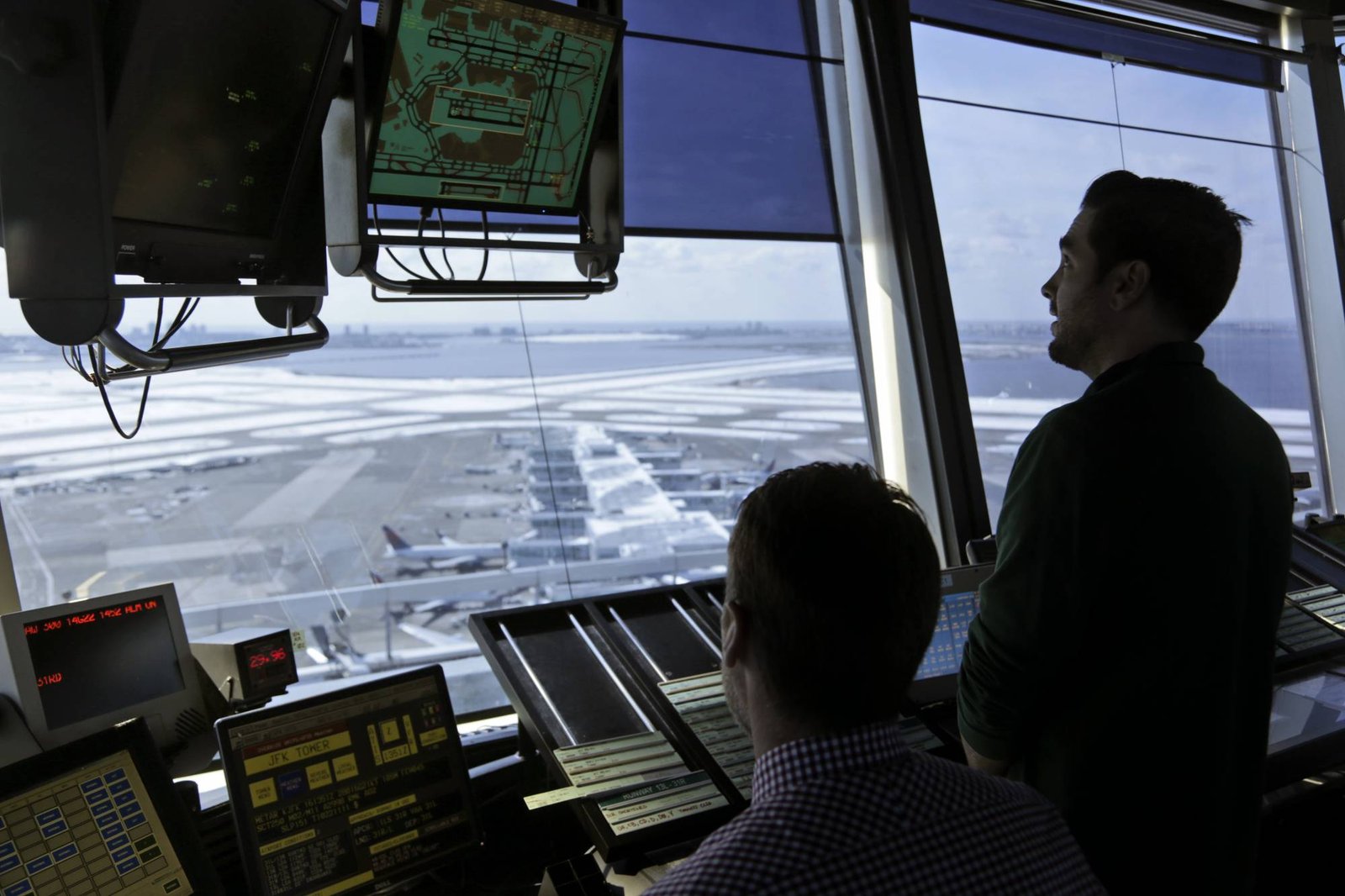
When a regional airliner hit a fire truck at LaGuardia Airport last March, the investigation naturally included what was going on in the control tower. Last month, the Federal Aviation Administration said it would fire two air traffic controllers who’d gone home an hour before their shift ended. That left the tower without backup help on a busy night. The controllers had done what the aviation industry calls an “early shove.”
The National Transportation Safety Board hasn’t yet determined whether the early shove contributed to the ground collision. An aviation management professor told Inc. that, under the apparently common practice, a supervisor would have permitted the early departure.
The FAA under Transportation Secretary Sean Duffy has been trying to end the early shove, which the agency considers time card fraud. Yet Duffy told the Wall Street Journal, “The vast majority of air-traffic controllers are great patriots—they show up for work, complete their full shift, and come back and do it all again.”
On this 25th anniversary 9/11, that most fateful aviation day, I remain personally grateful to those patriots in some 400 control towers across America. They showed not only personal skill, perseverance and courage, but also how government and commercial operations can ideally interact. That is, they showed the best in human organizational and industrial skill only moments after the worst had manifested itself.
Why personally?
Simply, I was on a westbound U. S. Airways flight from Charlotte, North Carolina to Phoenix to give a speech to the National Defense Industrial Association. I’d started out very early from Baltimore. A detail I recall is that my flight was also #175, the same flight number as one of the hijacked United Airlines planes was operation on.
It must’ve been an hour into the flight because the flight attendants had cleared the breakfast dishes. The pilot made an announcement, and I can hear his tone of voice to this day — one of grimness, determination and slight puzzlement.
“Ladies and gentlemen, we’ve gotten word that an airplane has hit one of the World Trade Center towers. And, well, we’re told we’ve got to land this plane!” he said. I put the exclamation point there because that’s how it sounded. Probably many of the other passengers had the same thought I did. If someone flew a Cessna or something into a skyscraper, why do we have to land?
In due time, we landed in Memphis, Tennessee, where U.S. Air did not normally operate. When we touched down, the place was directed to a gate far from the main terminal. I immediately turned on my Nokia cell phone and called one of my staff editors at the office. I could scarcely believe what she told me. In the concourse I remember seeing flight attendants weeping. When I made it to the main terminal, all was crowded chaos. I retrieved my bags four hours later, during which time I’d reached my wife at home and watched the televisions in the terminal.
About an out after that I’d made it to a chain motel in Southaven, Mississippi because all the airport and downtown Memphis hotels were booked. (A local church group made an enormous stack of bag lunches containing ham sandwiches and left them at the motel for what they thought would be a crowd of hungry flight refugees. I took one out of gratitude, but had dinner at an Outback Steakhouse across the highway from the motel.)
My flight was one of some 4,500 planes aloft over the continental U.S. that morning. The National Air Traffic Controllers Association maintains a time-lapsed video of the air traffic disappearing in the space of three hours. It was not until I plopped onto the sofa in my model room that I realized the enormity of what the FAA and its controllers had accomplished. No mid-air collisions, no crashes, no panic. Just an intense but orderly setting down of airplanes containing, by NATCA estimates, a million souls.
Using a Palm VII wireless device and a folding keyboard, I wrote a new editorial for the federally-focused technology newspaper of which I was editor. The staff back in the office, meanwhile, had to redo the front page while I was stuck hundreds of miles away.
Relations between the FAA and its controllers have varied widely over the years. I remember when the Reagan administration fired the entirety of the old PATCO workforce in 1981 because they’d illegally struck. The effect purely on aviation was as severe as that of 9/11.
Today the federal workforce generally feels under siege by the Trump administration, which Federal News Network reports has proposed a pay freeze next year. NATCA has unusually sour relations with FAA Administrator Bryan Bedford. The Washington Examiner reports that two Democratic senators “ripped into Bedford” for not implementing 2.8% of a promised raise. Bedford wants raises tied to performance metrics. Other published reports depict labor relations boiling over.
Confidence by the public in the government temporarily soared after 9/11. Now a generation has passed. My oldest grandchild is roughly the same age as my son (and her father) was on 9/11. So remembering that day won’t improve politics or federal labor relations. I don’t recall the temperature of labor relations at the FAA in 2001. Wherever it stood, controllers and management set it aside for a critical moment. Therefore, remembering can at least remind us of what is possible.
Copyright
© 2026 Federal News Network. All rights reserved. This website is not intended for users located within the European Economic Area.
