

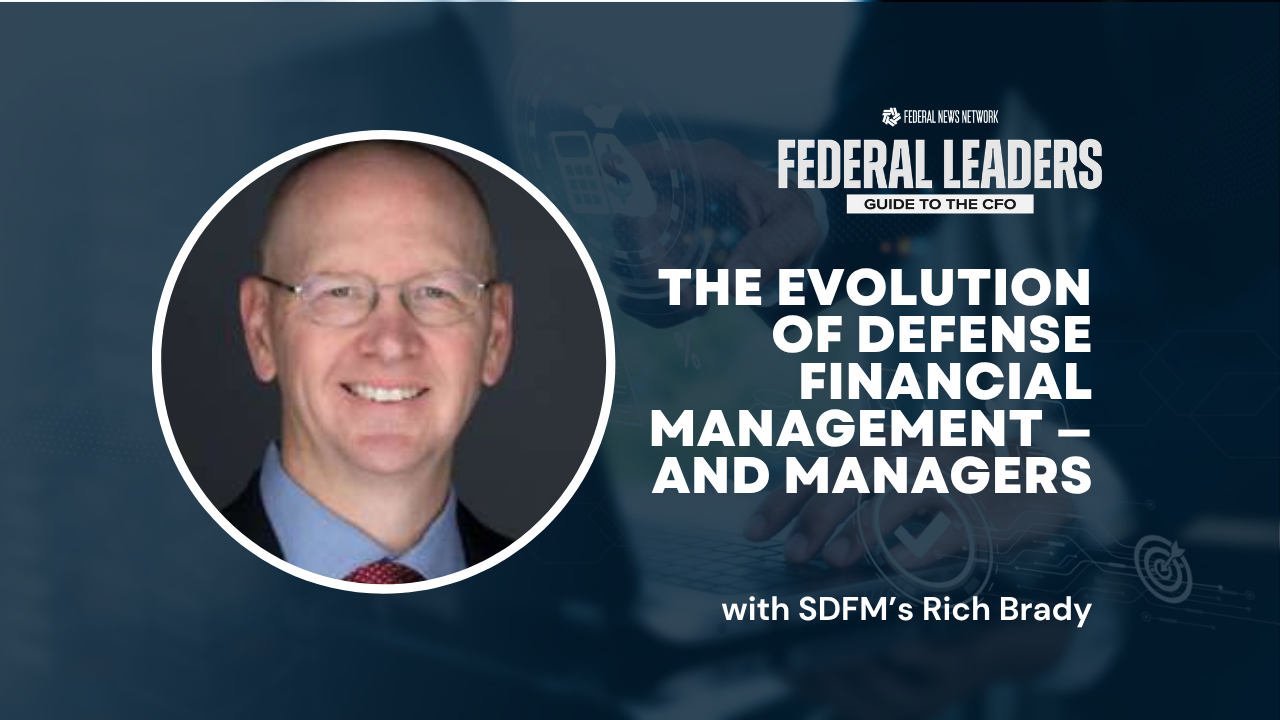
Ask Rich Brady about artificial intelligence and he starts talking about appropriations law.
That may seem like an odd response from someone leading a professional association at a moment when technology is dominating conversations about the future of work. But it reveals something important about how Brady sees the future of defense financial management.
As chief executive officer of the Society of Defense Financial Management (SDFM), Brady is not particularly interested in technology as a replacement for professional expertise. He shared during Federal News Network’s Federal Leader’s Guide to the CFO 2026. that he’s interested in what becomes possible when experts no longer spend so much time on routine tasks.
For most of the modern era, defense financial managers built their careers around mastering the mechanics of public finance. They learned the rules governing appropriated funds. They tracked obligations and expenditures. They made sure organizations complied with accounting standards and financial regulations. Their value rested partly in their ability to navigate a highly complex system.
Those responsibilities haven’t gone away. In fact, Brady argues that they’re more important than ever. Throughout a conversation that ranged from auditability to artificial intelligence, he kept returning to the same point: Before anyone worries about dashboards, machine learning or AI-enabled analysis, they still need to understand the foundations of the profession.
“When I started in the profession in the early ’90s,” Brady said, finance professionals were focused on “capturing, recording and reporting of financial information.” Today, much of that work is being handled by increasingly capable systems.
From keeping the books to shaping decisions
As fewer people need to spend their days producing financial information, more can spend their time interpreting it. The profession’s value is moving beyond reporting what happened and toward helping leaders understand what happens next. Brady is enthusiastic about that change.
One of his favorite observations comes from his years in the Marine Corps. Financial managers, he argued, create the most value when they start with the objective rather than the obstacle.
“There’s almost always a way to yes,” Brady said. “Our role in financial management is not to just sit back behind a desk and say, ‘No, no, no,’ and pull out regulations and tell people why they can’t do things. Understand what’s the desired outcome here, what are we trying to achieve?”
Rather than entering the discussion after a decision has been made, financial managers are increasingly being asked to help shape decisions before they are made. Leaders still need financial compliance and stewardship. But what they increasingly want is someone who can connect resources, risk and outcomes while options are still on the table.
That same perspective informs Brady’s thoughts about auditability. During the past 18 months, he said, senior Defense Department leaders have consistently treated audit as their top financial management priority. But he views audit readiness as part of a larger effort to create a shared understanding of the organization itself.
The military services and Defense agencies have spent decades developing different systems, different processes and, over time, different ways of describing the same thing. Brady said that common data standards and definitions matter at least as much as common software. As he put it, just because everyone has a dashboard doesn’t mean they’re looking at the same picture.
Reliable information is valuable to auditors. It is even more valuable to decision-makers. Once leaders trust the information in front of them, they can focus on priorities, risks, investments and outcomes. Those conversations naturally pull financial managers closer to the center of the organization.
Yet Brady consistently drew a distinction between using technology and relying on technology. Financial managers still need to understand appropriations law, budgeting, accounting and regulation. Even though the tools may change, the underlying responsibility does not, he pointed out.
“If you have garbage data to begin with, AI is not necessarily going to fix that,” he said.
Tomorrow’s CFO needs a broader perspective
Future financial executives, Brady said, will need broader experiences than previous generations. They will need to understand organizations beyond their own office, service or agency. They will also need to understand technology, not as specialists, but as leaders.
“CFOs of the future have to be technologists,” he said. “They don’t need to know how to do coding, but they need to understand what’s on the horizon of technology and how it can be leveraged.”
Brady is not describing a profession leaving its roots behind but one that is building on them. The fundamentals remain. The profession still exists to safeguard public resources and maintain accountability for them.
But as technology assumes more of the processing, reporting and transactional work, defense financial managers are finding themselves invited into a different set of conversations. Their value is no longer measured solely by whether they can account for resources. Increasingly, it is measured by how well they help leaders turn resources into outcomes.
Discover more Federal Leader’s Guide to the CFO articles and videos now on the Federal News Network.
Copyright
© 2026 Federal News Network. All rights reserved. This website is not intended for users located within the European Economic Area.
