

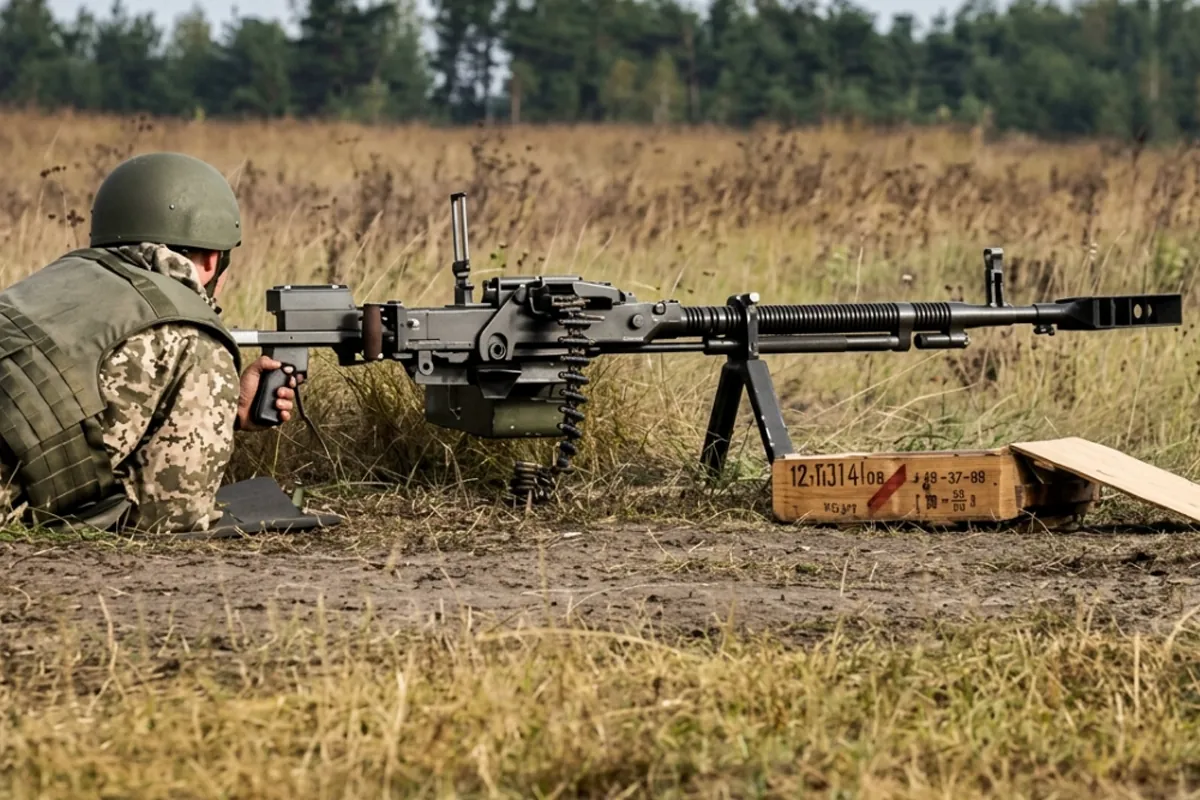
An 80-year-old machine gun probably shouldn’t have much to say about modern warfare. Yet the DShK Heavy Machine Gun keeps turning up where you’d least expect it; on armored vehicles, improvised technicals, defensive positions, and even in the fight against drones.
That sounds like a contradiction.
The modern battlefield is packed with thermal sights, loitering munitions, precision artillery and autonomous systems. Against that backdrop, a Soviet-era weapon firing a large 12.7×108 mm cartridge can look like yesterday’s technology stubbornly refusing to retire.
But here’s the interesting part: the DShK Heavy Machine Gun isn’t surviving because armies forgot to replace it.
It survives because the basic problem it solves hasn’t gone away.
A heavy machine gun can put substantial firepower onto ground targets, light vehicles, exposed positions and certain aerial threats without requiring the electronics, missiles or logistics associated with more sophisticated weapons.
The DShK Heavy Machine Gun’s enormous global footprint also matters. Decades of production and exports left huge numbers of these guns and their ammunition, in military inventories around the world.
That creates a peculiar kind of military longevity. A weapon doesn’t necessarily need to be cutting-edge if it remains powerful, available and useful enough.
The DShK Heavy Machine Gun is a perfect example.
Its original design belongs to the late 1930s, but the weapon evolved into the improved DShKM and spread far beyond the Soviet Union. Today, variants and derivatives remain recognizable across conflicts and military inventories worldwide.
So, is the DShK Heavy Machine Gun actually obsolete?
Technologically, there is little argument that newer systems are better.
Operationally, though, the answer is much more complicated and that’s where this old Soviet workhorse gets interesting.
Read also: 5 Most Powerful Machine Guns in the World Ranked
What Are the DShK Heavy Machine Gun Specifications?
The DShK Heavy Machine Gun fires the Soviet 12.7×108 mm cartridge and combines heavy firepower with a gas-operated, belt-fed design. Depending on the specific version and mounting, its characteristics vary, but the DShK/DShKM family generally weighs around 34 kg for the gun itself and can deliver roughly 550–600 rounds per minute.
Here are the core figures that help explain what makes this weapon so formidable:
| Specification | DShK/DShKM |
| Caliber | 12.7×108 mm |
| Operating system | Gas-operated |
| Feed system | Belt-fed |
| Typical belt | 50 rounds |
| Cyclic rate | Approx. 550–600 rounds/min |
| Gun weight | Approx. 34 kg |
| Overall length | Approx. 1.63 m |
| Barrel length | Approx. 1.07 m |
| Typical roles | Heavy machine gun, anti-aircraft, vehicle-mounted |
The numbers tell only part of the story.
The 12.7×108 mm cartridge is the real heart of the DShK Heavy Machine Gun. It gives the weapon considerably more reach and destructive potential than ordinary rifle-caliber machine guns, making it suitable against exposed personnel, light vehicles, equipment and certain low-flying targets.
But there’s a price for that punch. At roughly 34 kg before adding its mounting and ammunition, the DShK Heavy Machine Gun is not something an infantry squad casually throws over a shoulder and carries all afternoon. A complete fighting setup becomes substantially heavier.
The weapon’s rate of fire, around 600 rounds per minute on many references also gives it a useful volume of fire. The U.S. Air Force Museum lists a maximum effective range of about 1,100 yards for its DShK-1938/46 example, although actual useful engagement distance depends heavily on the mount, sights, ammunition and target.
That trade-off is central to understanding the DShK Heavy Machine Gun.
It was never meant to be light. It was meant to put a lot of 12.7 mm firepower exactly where the user needed it.
Why Was the DShK Machine Gun So Important During World War II?
The DShK Heavy Machine Gun gave Soviet forces a powerful way to engage targets that ordinary machine guns could not easily handle, particularly low-flying aircraft, light vehicles and fortified positions. Its 12.7 mm cartridge made it a useful middle ground: far more punch than an infantry machine gun, but considerably simpler than a dedicated cannon.
That mattered enormously during World War II.
Read also: KPV Heavy Machine Gun: From Anti-Tank Stopgap to Drone-Killer
The battlefield was becoming increasingly mechanized and airborne. Aircraft were attacking troops and logistics columns at low altitude, while armored and lightly protected vehicles were appearing everywhere. Soviet units needed a weapon that could respond to more than one of these problems without demanding an elaborate weapons system.
The DShK Heavy Machine Gun fitted that gap.
Mounted on a suitable anti-aircraft carriage, it could provide sustained fire against low-flying aircraft. On the ground, the same basic weapon could be used against exposed personnel, vehicles and other targets where its heavy ammunition offered a useful advantage.

The U.S. Army’s historical material identifies the DShK Heavy Machine Gun as a Soviet 12.7 mm anti-aircraft machine gun that could also be employed as a ground weapon, illustrating how deliberately multi-purpose the design was.
There is another detail worth remembering: the DShK Heavy Machine Gun was not trying to replace artillery or become a miniature tank gun. Its strength was accessibility.
A unit could move it, mount it and bring heavy machine-gun fire to places where larger weapons were impractical. That flexibility became even more valuable as the war expanded across enormous distances and increasingly difficult terrain.
In that sense, the DShK Heavy Machine Gun was less a specialist weapon than a battlefield utility tool.
And that may be the biggest reason its story did not end in 1945. Once soldiers had a weapon capable of delivering this much firepower in a relatively compact package, there were plenty of reasons to keep developing it rather than simply put it in a museum.
How Did the DShKM Make the Original DShK Better?
The DShKM made the original DShK Heavy Machine Gun more reliable and practical by replacing its troublesome rotary feed system with a simpler, more dependable belt-feed mechanism. That seemingly modest change helped turn a pre-war design into the version that became far more widespread after World War II.
The original DShK Heavy Machine Gun had a clever but complicated approach to ammunition feeding. It used a rotary drum mechanism to move cartridges into position, but the system could be difficult to manufacture and maintain. For a weapon expected to operate in muddy trenches, dusty vehicle positions and rough field conditions, complexity could become a liability.
The answer was the improved DShK 1938/46, commonly known as the DShKM.
The modernization introduced a belt-feed system that was easier to produce and more practical for sustained use. The change wasn’t glamorous, there was no futuristic sight or dramatic increase in caliber but it addressed one of the least forgiving parts of a machine gun: reliably getting ammunition into the chamber.

That mattered because the DShK Heavy Machine Gun’s value depended on keeping its 12.7 mm firepower available when needed.
The U.S. Air Force Museum identifies the 1938/46 version as an improved DShK Heavy Machine Gun, noting changes to the feed mechanism and describing the weapon as one that remained in widespread use internationally.
The DShKM subsequently became the form most people associate with the classic Soviet heavy machine gun. It was exported widely, produced under license or copied abroad, and adapted to different mounts and vehicles.
There is a useful lesson here.
Military longevity often comes from small engineering fixes rather than revolutionary redesigns. The DShKM did not need to reinvent the heavy machine gun. It simply made an already powerful weapon easier to operate and manufacture.
And once that improved version spread around the world, replacing the DShK Heavy Machine Gun family became a much bigger problem than designing something newer.
Where Has the DShK Heavy Machine Gun Been Used?
The DShK Heavy Machine Gun has been used across an extraordinary range of conflicts and military forces, spreading from the Soviet Union into Asia, Africa, the Middle East and beyond. Its global reach is one of the biggest reasons the weapon remains relevant today: there are simply too many DShK-family guns and derivatives scattered across the world for the design to disappear quietly.
The Cold War accelerated that spread.
The Soviet Union supplied the DShK and later DShKM to allied governments and military partners, while other countries developed their own versions. China, for example, produced the Type 54, a licensed version of the DShKM. Other variants and locally produced derivatives appeared across countries that had access to Soviet weapons technology.
That created an unusual legacy. The DShK Heavy Machine Gun stopped being exclusively a Soviet weapon and became part of a much broader 12.7 mm weapons ecosystem.

Its presence can be traced through conflicts involving conventional armies, insurgent groups and irregular forces. The weapon’s size and power made it particularly attractive for mounting on vehicles, where it could become a simple but formidable fire-support system. A pickup truck fitted with a heavy machine gun isn’t sophisticated but it can dramatically change what that vehicle can threaten.
The U.S. Army’s ODIN database continues to catalog the DShK 1938 and related variants, including Chinese derivatives, illustrating just how broadly the family has been distributed.
This widespread distribution creates its own kind of military inertia.
A country doesn’t necessarily need to manufacture a brand-new heavy machine gun if thousands of older examples already exist, ammunition is available and local troops know how to operate them.
That’s why the DShK Heavy Machine Gun’s history is more than a story about Soviet weapons design.
It is a story about how global proliferation can keep an old weapon useful long after the army that originally created it has moved on.
Is the DShK Heavy Machine Gun Still Used on the Modern Battlefield?
Yes, the DShK Heavy Machine Gun is still used on modern battlefields, despite its age. Its continued presence comes down to a simple equation: powerful 12.7 mm firepower, enormous existing stocks, familiar operation, and the ability to mount the weapon on vehicles and defensive positions.
The DShK Heavy Machine Gun’s survival becomes easier to understand when you stop judging it like a modern weapons program.
It doesn’t need to compete with the latest remotely operated weapon station. In many situations, it only needs to provide enough firepower at a price and availability that make sense.
That is particularly evident with vehicle-mounted systems. A DShK Heavy Machine Gun can be installed on a pickup truck, armored vehicle or fortified position, giving relatively mobile forces a weapon capable of threatening exposed personnel, equipment and lightly protected vehicles. The basic concept has changed very little since the Cold War.

Its continued use is not merely anecdotal, either. The U.S. Army’s ODIN database still catalogs the DShK 1938 12.7 mm Heavy Machine Gun and related variants, including the Chinese Type 54 derivative.
The weapon’s ammunition also helps explain its longevity. The 12.7×108 mm cartridge remains a substantial source of kinetic energy, and countries holding large stocks have little reason to discard an entire weapons ecosystem simply because newer designs exist.
There is, however, a catch.
Modern battlefields are much more transparent than those of the DShK Heavy Machine Gun’s youth. Drones can locate firing positions, thermal imagers can expose movement, and precision weapons can punish static gun teams. A heavy machine gun that once dominated a particular patch of ground can now become a very obvious target.
So the DShK Heavy Machine Gun survives with a different philosophy.
It isn’t surviving because it is the best heavy machine gun available. It’s surviving because, in the right circumstances, it remains a remarkably economical way to deliver heavy firepower.
What Are the DShK Machine Gun’s Weaknesses and Can It Still Fight Drones?
The DShK Heavy Machine Gun remains capable against some low-flying or relatively slow aerial targets, including certain drones, but its age creates serious limitations on a modern battlefield. Its biggest problems are weight, mobility, visibility and the growing ability of drones to locate and attack exposed gun positions.
Start with the physical reality.
The DShK Heavy Machine Gun itself weighs roughly 34 kg, before adding a mount, ammunition and other equipment. That makes it a serious burden for an infantry team. Once deployed, moving the complete system isn’t exactly a quick affair either.
Its size can become an even bigger problem once the shooting starts.
Modern surveillance drones and thermal imaging systems can help identify firing positions, while loitering munitions and precision artillery can strike those locations. A weapon designed in the 1930s was never built around the assumption that an inexpensive flying camera might be watching it from above.

Yet the DShK Heavy Machine Gun’s original anti-aircraft role hasn’t completely disappeared.
Its 12.7 mm ammunition and relatively high rate of fire can still make it useful against slow, exposed or low-altitude aerial targets. Ukraine’s Ministry of Defence has even referenced training with DShK Heavy Machine Gun and M2 heavy machine guns for engaging aerial targets, illustrating how machine guns remain part of the broader counter-UAS toolkit.
But there’s an important distinction: shooting at drones is not the same as having a modern air-defense system.
The DShK Heavy Machine Gun lacks the sophisticated sensors, automated tracking and specialized ammunition found on dedicated counter-drone systems. Against a fast, maneuvering or well-protected target, its chances become much less attractive.
So the DShK Heavy Machine Gun occupies an awkward middle ground.
It can still put serious fire into the sky, but on today’s battlefield the gunner may have to worry almost as much about the drone finding him as he does about hitting the drone.
Why Does the DShK Heavy Machine Gun Keep Surviving After 80 Years?
The DShK Heavy Machine Gun keeps surviving because its technology is old, but the job it performs remains useful. A powerful 12.7 mm cartridge, enormous global stockpiles, familiar operation and simple mounting options can make an aging DShK more practical than a newer weapon that is expensive or difficult to obtain.
That distinction matters.
Calling the DShK Heavy Machine Gun “obsolete” is easy if you compare its sights, ergonomics and weight with modern remotely operated weapon stations. But battlefield relevance isn’t awarded for having the newest engineering. Sometimes it comes down to a much less glamorous question: Can the weapon deliver enough firepower, and can the user actually get it?
The DShK Heavy Machine Gun often passes that test.
Its 12.7×108 mm ammunition remains powerful enough for roles beyond ordinary infantry machine-gun fire. The weapon can be mounted on vehicles, defensive positions and other platforms, giving users a relatively straightforward way to add heavy firepower.

Then there is the enormous legacy of Soviet-era production and international proliferation. The DShK and DShKM were exported widely, while derivatives such as China’s Type 54 expanded the family even further. The U.S. Army continues to catalog these systems, illustrating their enduring presence.
This creates an interesting economic advantage. If an army already possesses the guns, ammunition and trained personnel, replacing them isn’t automatically worthwhile.
The DShK Heavy Machine Gun does have clear limitations. It is heavy, relatively cumbersome and increasingly vulnerable to modern surveillance and precision attack. Against sophisticated aircraft or drones, it cannot offer the capabilities of a dedicated modern air-defense or counter-UAS system.
So the fairest verdict is a little less dramatic than “obsolete” or “modern.”
The DShK Heavy Machine Gun is technologically outdated but operationally relevant.
Its continued survival isn’t proof that Soviet engineering somehow defeated eight decades of military innovation. It’s proof that sometimes a brutally simple equation still works: enough power, enough ammunition, and a weapon that is already there.
