

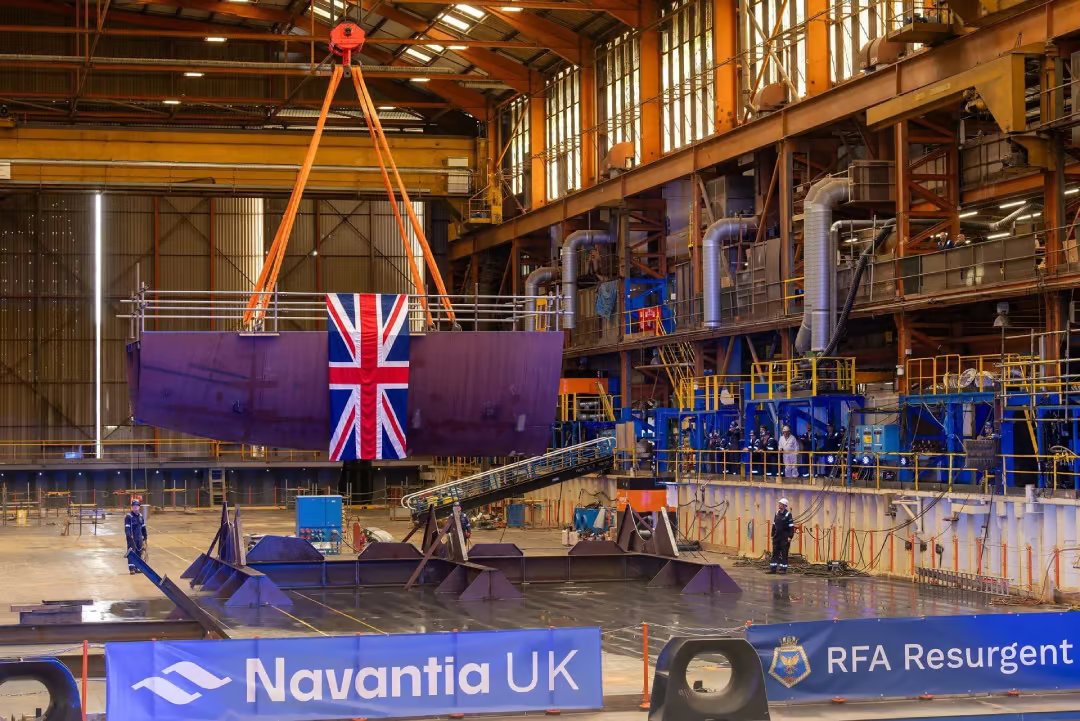

The keel has been laid on the first of three new Fleet Solid Support (FSS) ships the UK is building for the Royal Navy (RN).
The keel laying for the future Royal Fleet Auxiliary (RFA) vessel Resurgent took place on 3 September, at Navantia’s Appledore shipyard in the UK.
At the ceremony too, Commodore Sam Shattock – head of the RFA – revealed that FSS ships two and three will be named Reliant and Resourceful.
The keel laying is the next milestone in a programme that commenced formally with a contract award in January 2023 to Navantia, Harland & Wolff, and BMT (‘Team Resolute’, in the downselection process). The preliminary and critical design review milestones were passed in October 2024 and November 2025, respectively. Steel was cut on Resurgent on 3 December 2025.
In June 2026, the UK’s Defence Investment Plan noted that the FSS programme would receive GBP1.5 billion in investment over the next four fiscal years from 2026.
The UK’s three FSS ships are designed to provide munitions and other solid and liquid stores provisions for the RN’s fleet, primarily its two Queen Elizabeth-class aircraft carriers. The platforms will partner the four in-service Tide-class fleet tankers in providing the RN’s at-sea logistics backbone.
FSS ship sections are being built at three Navantia yards – Appledore, Cadiz (Spain), and Belfast (Northern Ireland). Belfast will integrate the sections.
Logistics support infrastructure onboard includes two cargo/container cranes and three replenishment-at-sea (RAS) rigs, plus space for up to 25 shipping containers.
The size and flexible onboard spaces of the 216 m, 39,000-tonne ships will allow them to support a range of navy operational requirements, the RN said in a statement. Operational output will be built around a core crew of 101 RFA sailors, augmented by up to 80 embarked personnel to perform specific roles and tasks as required.
The size of the flight deck and hangar spaces illustrates the capacity to support tasks, accommodating two Merlin or Wildcat helicopters, plus uncrewed aerial vehicles (UAVs), with ‘lilypad’ space for a Chinook helicopter.
The ships are also designed to embark landing craft vehicle personnel (LCVP) platforms, providing capacity to support various ship-to-shore operational tasks.
In addition, the ships will be fitted with a NATO Role 2 medical facility (encompassing capacity to conduct triage at sea, including in remote environments where the ships may be operating).
The Resurgent-class vessels are expected to enter service from the early 2030s.
by Dr. Lee Willett
