

Why has Russia’s senior military leadership been so bad at their jobs? The question is not an idle one, even if it is somewhat boldly stated. General Staff decision-makers and planning staff, as well as operational commanders, all share in responsibility for the failure to achieve strategic goals during the 2022 invasion, losing the Battle of Kyiv and badly retreating from their set task to achieve a pro-Russian regime change. Four years of inconclusive fighting later, and their goals have been narrowed to capturing the rest of the Donbas—which still eludes them to this day.
What is so striking about the failure of Russia’s strategic leadership is that at lower levels—tactical, logistical, technical, and military-industrial—the Russian armed forces have effectively learned many lessons and successfully adapted to the changing character of war. Much has been rightly made of the rapid advances in both the technology of unmanned systems as well as the iterative learning by Russia and Ukraine as both have innovated tactics, techniques, and procedures that apply these platforms in increasingly sophisticated ways on the battlefield. Similarly, lessons in the vital importance of a resilient and indigenous defense industrial base capable of mass production and speedy innovation cycles are gradually becoming clear.
Yet because the war quickly evolved into positional attrition, grinding, seasons-long assaults for little gain, and a test of deep and constantly shifting supply-line and infrastructure defense, insufficient attention has been focused on the importance of senior military leadership at the organizational level. And here, the story is very different—especially at the highest echelons of Russia’s strategic leadership.
Failed Commanders vs. Failed Strategists
Findings from a recent report by the Russia Studies Program at CNA provide unusual insight into a subject that is otherwise highly opaque and difficult to study from a Western vantage—and politically impossible within Russia’s authoritarian regime. Using a unique dataset containing all general and flag officers (i.e., one- to four-star senior officers) in the Russian Armed Forces over the last quarter century, as well as more granular career data on senior leadership posts, the report provides the most complete picture of contemporary Russia’s higher officer cadres ever conducted.
As a supporting addition to this comprehensive picture, the report also reviews all public dismissals of both general officers and senior Ministry of Defense officials since the start of the war through to the beginning of 2026. Among a variety of key findings reported elsewhere, we find something extremely notable: Russia has not failed to punish general officers for perceived poor performance in operational or service-level roles. In fact, waves of dismissals hit theater and service commanders in 2022 and 2023, followed by a steady trickle of dismissals, before finally slowing down closer to 2026. Similarly, the Ministry of Defense became the subject of a major purge starting in late spring 2024 that has shaken out nearly the entire bureaucratic senior leadership over the subsequent two years.
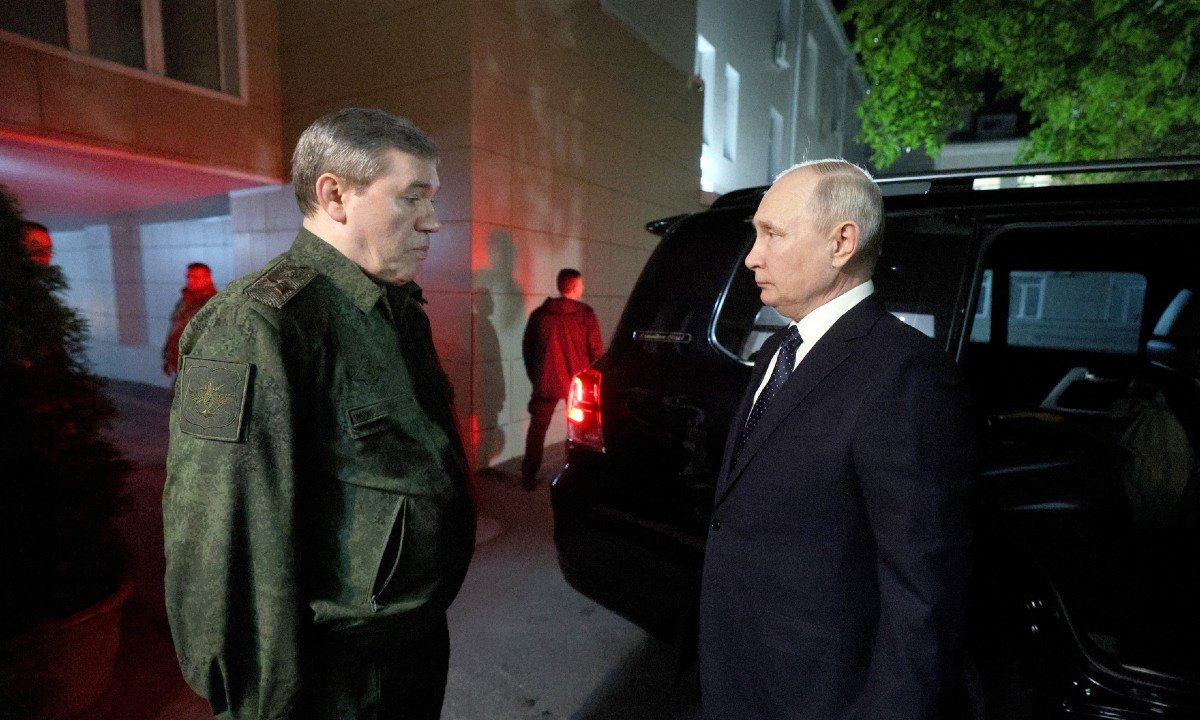
The major exception, however, may very well answer the question of Russia’s military failings: While operational commanders have been regularly punished, rotated out, dismissed, or in a few cases even jailed, not a single member of the General Staff has been dismissed in four years of a war that has largely failed at the strategic level. It may very well be that Russia’s chief of the General Staff, Valery Gerasimov, has turned out to be one of Ukraine’s very best friends. Connecting war performance to the highest echelons of military decision-making leads one to a reasonable hypothesis that Russia’s General Staff may just not be very good at their jobs, to Kyiv’s considerable benefit.
This data is of course suggestive, rather than determinative. General officer dismissals occur for a variety of reasons, battlefield performance being only one among other options. Some cases may be scapegoating, while others are for political or even personal reasons, rather than performance. The lack of public reporting on motivations or the assignation of blame means these questions will have to wait for future memoirs, interviews, and archival findings that may appear only decades later. Yet from what is observable, we find a clear and consistent ability for the Russian state to remove operational commanders and military bureaucrats while demonstrating a clear inability, or unwillingness, to do the same to the senior officers formally and explicitly in charge of conducting the war at its strategic level.
This pattern is in contrast to similarly understudied dynamics in Ukraine. Kyiv has gone through three overall war commanders. It is widely understood that General Valerii Zaluzhnyi’s sacking in winter 2023–24 both had political motivations and came during recriminations following the failed 2023 summer counteroffensive. The embattled and often-criticized General Oleksandr Syrskyi then held the position until summer 2026, but operational commanders are regularly rotated out from the field and Syrskyi’s staff has had significant turnover. And in summer 2026, Syrskyi himself was removed and replaced by Mykhailo Drapatyi to close out a chapter of intragovernmental dispute roiling Ukraine’s internal elite politics.
Civil-Military Failures to Punish
It is likely that the immunity of Russia’s General Staff from responsibility for war failures is tightly connected to Russia’s political leadership and the longstanding system of authoritarian political order built around Vladimir Putin. Unlike operational commanders, who sit firmly within the armed forces hierarchy and remain both separate from and subordinate to Russia’s civil-military pyramid of authority, the General Staff chief is a fusion position with a minor, but real political role, alongside the minister of defense.
Russia’s aging dictator has increasingly relied on what we can somewhat cheekily refer to as “securitized boomerism,” or the persistent preference for gerontocratic allies in senior national security positions, to maintain personalist control over the apex of regime decision-making. It took Putin a full year after Yevgeny Prigozhin’s rebellion to acknowledge the basic truth of Ministry of Defense incompetence that the Wagner warlord communicated in his quixotic armed negotiation and remove Defense Minister Sergei Shoigu, and he has yet to take the other half of that advice and finally retire Gerasimov.
What is perhaps most interesting is that there are scattered rumors that Gerasimov does not run the war in the way he did a year or perhaps even longer ago. Unsubstantiated reporting in untrustworthy Russian sources since 2025 have sometimes suggested that actual strategic command has devolved to General Andrei Mordvichev, who may or may not be the real joint operational commander of the war effort (in the same way Russia’s best general, Sergei Surovikin, had been for the latter part of 2022 before being purged for political reasons). Other unreliable reporting earlier in the war implied that General Mikhail Teplinsky may have been the brains behind the attrition campaign starting in 2023 and had de facto replaced Gerasimov as early as that summer. The mil-blogger rumor mill also raised the suggestion that General Aleskei Kim had done so instead. We will not know this until better sources emerge.
But whether or not this is true, it speaks to the bigger organizational problem—either the strategic-level decision-makers responsible for running the war into the ground continue to run it without punishment for repeated failures, or they have been de facto replaced without publicly communicating it, suggesting deep hesitance in Moscow to admit punishment for anything higher than an individual theater operation. If the latter, it is astonishing that whoever is commanding the war effort may not have formal access to the central hub of military decision-making, which still formally sits in the General Staff and would in principle have the infrastructure to actually develop new campaign strategies.
Lessons from Russia’s Strategic-Level Personnel Decisions
There may be good reasons we are not aware of why the Russian General Staff’s senior officers have been spared any consequences for their failures. One reasonable suspicion is that it all hangs on Gerasimov himself. So long as Putin protects his own military head, Gerasimov in turn will protect his deputies from dismissal in line with logics of patronage and protection. From a Western policy vantage, we can also be pleased by this fact, as it has likely aided the Ukrainian cause by preventing fresh ideas from reaching the strategic level of war—unlike at tactical, operational, and technical levels, where innovation clearly still lives within the sprawling service bureaucracy and operational command structures of the Russian Armed Forces.
Observers in the West would be wise to take heed of Russia’s failures to punish strategic-level military leaders. A core lesson of organizational research is that while quality personnel are extremely hard to find at senior levels, no one is individually irreplaceable—especially when the officer in question’s track record is far from sterling. Russia’s General Staff is no Napoleonic command, nor does it appear to be the learning organization that Germany’s equivalent was in the early twentieth century.
Gerasimov may fulfill an important political role that Putin views as critical, and it is beyond our current analytic access to suggest otherwise. But Russia’s poor performance in Ukraine is certainly correlated with an unbroken tenure of strategic control by a geriatric staff officer who has been repeatedly given exceptions to mandatory retirement ages and negative war outcomes four years in a row. For Ukraine and for the West, this has been an important opportunity.
Gerasimov turns seventy-one today. He’s spent a full 20 percent of those years in the same job. In any military organization, even with a strategically brilliant incumbent, there’s a reason for turnover that brings in new energy and fresh ideas. When the incumbent seems to be lacking in strategic wisdom, the decision to keep him makes little sense, especially if Russia’s leaders actually would like to see their strategic goals achieved on the battlefield. With time, we will learn more about the reasons for this failure. In the meantime, it may just be helping Ukraine stay in the fight.
Julian G. Waller, PhD is a research scientist in the Russia Studies Program at the Center for Naval Analyses (CNA Corporation) and a professorial lecturer in political science at George Washington University.
The views expressed are those of the author and do not reflect the official position of the United States Military Academy, Department of the Army, or Department of Defense.
Image credit: kremlin.ru (via Wikimedia Commons)
