

With the new US government’s defence focus moving away from Europe, Japan is set to play an expanding role to counter continued modernisation by an assertive China.
Japan’s Defense Build-Up Program saw the 2024 defence budget increase by 16.5% from the previous year, and it will rise to US$59.5 billion for 2025; this represents a further 7.4% rise. Also, the Japan Maritime Self-Defense Force (JMSDF) has launched a major reorganisation, which includes capability upgrades and expanded roles for escort flotillas with the conversion of two Izumo-class helicopter carriers to operate Lockheed Martin F-35B Lightning II fighters. Forty-two jets are on order, with first deliveries set for this year.
Japan’s Ministry of Defense plans to deploy the F-35B aircraft to the Japan Air Self-Defense Force’s Nyutabaru Air Base in Miyazaki Prefecture, located in the southeast of Kyushu on Japan’s Pacific coast. The military will establish a 110-man temporary F-35B squadron at the air base.
Interestingly, in February 2025 the first JMSDF converted helicopter carrier, JS Kaga, took part in an exercise codenamed Pacific Steller 2025 that had been hosted by France in the Philippine Sea. The ships participating were the US aircraft carrier USS Carl Vinson and French carrier FS Charles de Gaulle.

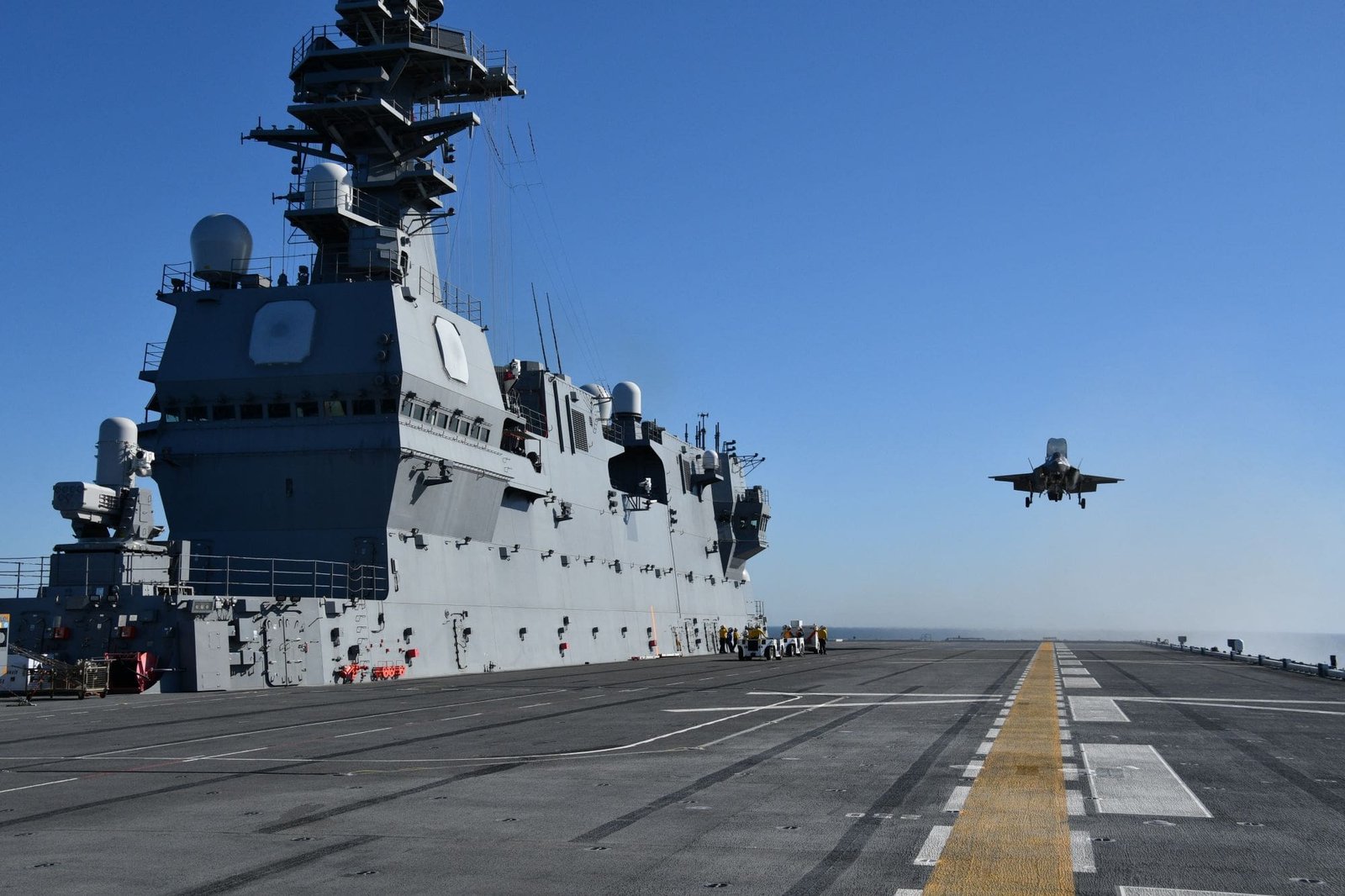
Earlier, in October 2024, the JMSDF sent the upgraded helicopter carrier JS Kaga to San Diego in the USA as part of its workup to eventually deploy F-35B fighters. During the trials, a US Marine Corps F-35B aircraft, flown by Royal Navy Lieutenant Commander Nick Baker, who was on an exchange programme with the US Patuxent River Integrated Test Force, conducted short take-off and vertical landing operations on the carrier. The operational tests of JS Kaga were being conducted as part of the deployment of the JMSDF’s 4th Surface Unit for the Indo-Pacific Deployment 2024.
“This test is essential for strengthening Japan’s defence capabilities and is of utmost importance. We will do our best to achieve good test results,” said Kaga’s commanding officer, Captain Shusaku Takeuchi. “This test does not merely enhance the capabilities of the Maritime Self-Defense Force, it also improves the interoperability between Japan and the United States, strengthening the deterrence and response capabilities of the Japan-US alliance.”
The previous month, in September 2024, the Italian aircraft carrier ITS Cavour docked at Yokosuka Naval Base, accompanied by other warships. Joint exercises involving Italian F-35As, Eurofighters, transport and early warning aircraft heralded what Rome’s envoy to Tokyo called a “new era” in bilateral relations.
A further example of the JMSDF’s global reach and international interaction with other navies took place in 2024 when two ships of the Japan Training Squadron undertook a six-month, 56,000km global training cruise that visited eleven countries. The ships were the 4,650-tonne JS Shimakaze, a former guided-missile destroyer converted into a training ship in 2021, and the 4,050-tonne JS Kashima, a purpose-built training ship commissioned in 1995.

The overseas training cruise began in May 2024, taking in Brunei, the Seychelles, South Africa and Senegal, before sailing to European waters where they exercised with NATO ships from Turkey, Italy, Spain and Germany. After departing Istanbul, the JMSDF training squadron conducted a passing exercise in the Mediterranean with ships from Standing NATO Maritime Group 2, including the Canadian frigate HMCS Charlottetown, Turkish frigate TCG Gaziantep and Spanish patrol ship ESPS Atalaya. During the exercise, the commander of the Japan Training Squadron, Rear Admiral Takahiro Nishiyama, sent a message saying, “The security of the Euro-Atlantic and Indo-Pacific regions are inseparable, so for the peace and stability in the region we will continue to contribute to maintaining international order.”
The two ships proceeded to visit the UK in September 2024 – JS Shimakaze went to Southampton and JS Kashima sailed up the River Thames to London. Whilst in London, Nishiyama outlined the aim of the cruise to Asian Military Review.
He said there were 190 newly commissioned officers on JS Kashima. “Some will go on to serve on surface ships, some as pilots, some as submarine officers and some in engineering roles. Regardless of their future roles, it’s essential that they all understand maritime operations and life on a ship at sea. Even if their future jobs do not involve being on ships at sea, they need the knowledge about life at sea, because they’re all navy officers. One of the tasks of this training squadron is to enhance cooperative relationships through port visits and joint exercises which help to strengthen and enhance our partnerships.”

After departing the UK, the squadron crossed the Atlantic to the US Navy base at Norfolk, Virginia, and then to Acapulco in Mexico via the Panama Canal. Next, they sailed to Pearl Harbor in Hawaii, before sailing back to Tokyo, where they arrived on 11 November.

More examples of international cooperative relationships include the impending 2025 visit to Japan by the Royal Navy flagship HMS Prince of Wales, details of which were discussed by UK Defence Secretary John Healey and his Japanese counterpart in January 2025. Healey met Japan’s Defense Minister Gen Nakatani in London against the backdrop of Exercise Vigilant Isles, army manoeuvres that saw more than 100 British troops deploy to Kyushu, Japan.
In another bid to strengthen defence ties between the two countries, the Royal Navy’s Carrier Strike Group (CSG), comprising the aircraft carrier HMS Prince of Wales, escorts and a full complement of RAF F-35B Lightning II aircraft, will make a port visit in Japan in the Northern Hemisphere spring as part of its wider Indo-Pacific deployment. It will also conduct a series of operations and exercises alongside the Japan Self-Defense Force and other partners “to help defend peace and stability in the Indo-Pacific,” according to a UK MoD statement. The UK defence secretary said: “There are many miles between our two nations, but the UK and Japan stand closer together than ever in support of peace and security across the globe.”
Midyear, the Royal Navy’s CSG will also be taking part in the eleventh iteration of Exercise Talisman Sabre, which are biennial, multinational and multi-domain military manoeuvres led by Australia and the USA.
Exercise Talisman Sabre 2025 will be the largest iteration yet, with invitations extended to 19 nations. It will encompass a live-fire exercise and field training exercises, including amphibious landings, ground force manoeuvres, air combat and maritime operations. Forces are expected to start assembling in Australian waters from mid-July.
However, at the forefront of Japan’s cooperative relationships is the USA. An important change to the command-and-control structure within the US alliance system took place in July 2024 when it announced it would upgrade US Forces Japan (USFJ) to a joint force headquarters with expanded missions and operational responsibilities. The new USFJ headquarters will work directly with the Japanese Joint Operations Command, which was to become operational in March. It will allow US Indo-Pacific Command officers to interact with their Japanese counterparts across a wide range of joint activities, operational planning and intelligence sharing.
Japan’s planned acquisition of domestic and foreign, mainly US-sourced defence capabilities, places a premium on improved coordination with the USA on the use of force. Apart from funding for further Kawasaki P-1 maritime patrol aircraft and F-35 Lightning II fighters, in December 2024 the JMSDF announced plans to acquire 23 General Atomics MQ-9B SeaGuardian remotely piloted aircraft for its long-endurance unmanned aerial vehicle (UAV) programme. This follows the JMSDF’s use of the SeaGuardian since May 2023 as part of trials to determine whether unmanned aircraft can supplant some of the missions currently accomplished by JMSDF manned aircraft. If the purchase contract is signed this year, SeaGuardian deliveries could begin in 2028.
In January, another US company, Shield AI, announced a contract to supply an undisclosed number of its V-BAT UAVs to the JMSDF. Shield AI said the UAVs will “provide advanced intelligence, surveillance and reconnaissance capabilities to JMSDF surface vessels”. They will primarily deploy on patrol vessels to enhance the service’s maritime domain awareness.
As part of Japan’s plans to acquire new standoff capabilities, including anti-ship missiles and ship-launched interceptors, the USA approved a US$900 million sale in January 2025 of up to 150 SM-6 Block I missiles to Japan, including launchers, spare parts and technical support. Produced by RTX Corporation, the Block I missile was developed as a fleet area air defence weapon intended to engage anti-ship cruise missiles and manned aircraft threats. The SM-6 missiles will be integrated into JMSDF Aegis-equipped destroyers to enhance Japan’s air and missile defence against regional threats.
by David Oliver
