

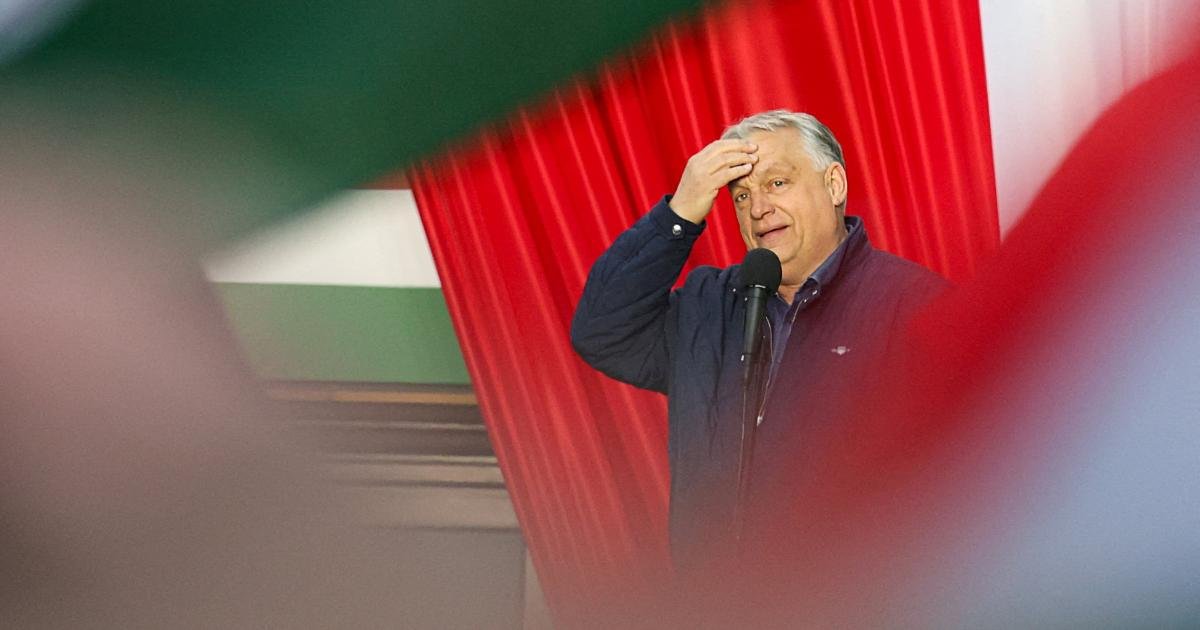
For years, Hungary has been a surprising front in the global battle between authoritarianism and democracy. It attracted outsize attention for a small, landlocked country because its longtime prime minister, Viktor Orban, provided a model of how a populist leader could transform a democracy into an electoral autocracy while enriching his backers and family members. Orban also offered a blueprint for how a government could remain a member of Western institutions such as the European Union and NATO yet still cultivate ties with the West’s strategic rivals such as Russian President Vladimir Putin and Chinese leader Xi Jinping. Orban became an icon for aspiring autocrats, including Slovakian Prime Minister Robert Fico, Serbian President Aleksandar Vucic, Brazilian President Jair Bolsonaro, and U.S. President Donald Trump.
Orban’s ouster from political power offers a playbook that is just as important—this time, for defenders of democracy around the world. His decisive defeat in April by an upstart Hungarian political party, Tisza, owes a great deal to the popularity and determined campaign of its leader, Peter Magyar. But Magyar could never have prevailed had other actors, mainly Europe’s center-right establishment, not made key moves that opened the door for his success. Pro-democratic leaders and citizens alike need to understand the real lessons of what happened in Hungary over the past 16 years to have a better chance of deterring or dislodging would-be autocrats in the future.
THE THREAT OF TOLERANCE
The first lesson from Hungary is a simple one: center-right parties are a crucial hinge of democracy. When the establishment center-right tolerates the authoritarians on its flank, it facilitates their rise. When the center-right instead takes a hard line against them, it can thwart their emergence. Orban’s ascent to power clearly illustrates this dynamic: Orban could build an autocracy inside the EU only because for years he enjoyed the political protection of the European People’s Party (EPP), the main alliance of democratic center-right parties in Europe, led for many years by German Chancellor Angela Merkel’s Christian Democrats. When these parties finally parted ways with Orban, they set in motion a chain of events that helped bring him down.
Prior to his defeat, Orban was widely seen as the leader of far-right populist movements in Europe. In 2024, he organized a new political group in the European Parliament, Patriots for Europe, that brought together far-right parties across the continent. But Orban did not start out as a poster child for the far right. His Fidesz party began in the 1990s as a liberal, pro-democracy youth movement that affiliated with liberal party alliances such as the European Liberal Democrat and Reform Party (which transformed into today’s Alliance of Liberals and Democrats for Europe). By the late 1990s, Fidesz had repositioned itself as a center-right party, and in 2000, it switched its EU-level affiliation to the EPP during Orban’s first stint as prime minister. Although Orban lost power in Hungary in 2002, he went on to serve as a vice president of the EPP from 2002 to 2012 and developed close ties with the alliance’s senior leaders, including Merkel and France’s Nicolas Sarkozy.
After Orban returned to power in 2010, Fidesz morphed into something dramatically different and unrecognizable from its origins: an illiberal, autocratic party that systematically dismantled democratic institutions. At first, the EPP may have simply been blind to the risks Orban represented to Hungarian democracy and to the EU itself. But as the 2010s wore on, his attacks on democratic institutions and the rule of law became public and unmistakable. Yet the EPP’s leaders mostly stood by silently as the Orban regime rewrote the country’s electoral rules to favor Fidesz, used state resources to support Fidesz’s campaigns and engage in vote buying, established party control over most of the judiciary and over 80 percent of the media in the country, corrupted state power to enrich oligarchs connected to Fidesz and to relatives of Orban, and systematically violated the fundamental rights of minorities.
As Orban’s regime transfigured Hungarian politics, his old center-right allies not only continued to tolerate him; they actively supported him. Essentially, Orban became a kind of “pet” autocrat of Europe’s mainstream center-right parties. Germany’s Christian Democrats and other EPP parties blocked the EU from sanctioning Orban for his blatant violations of EU laws and democratic norms. EPP leaders such as Manfred Weber, then the EPP’s leader in the European Parliament, even campaigned for Orban in Budapest a decade before U.S. Vice President JD Vance did. In exchange for the center-right’s support, Orban delivered votes to the bloc in the European Parliament and the European Council and offered German multinationals generous state subsidies and tax breaks to set up manufacturing in Hungary. Although Europe’s center-right leaders did not want Orban to dismantle the rule of law and democracy in Hungary, they were not willing to ostracize him for doing so.
THE CENTER MUST HOLD
Throughout modern democracy’s history, mainstream parties—especially on the center-right—have played a similarly key role in shaping the evolution of democracy. Although post–Cold War Venezuela’s backslide shows that threats to democracy can begin on the left, recent research shows that in contemporary Europe, democracy erodes mostly from the right. Likewise, in the nineteenth and twentieth centuries, center-right parties played a pivotal role in democratization. When conservative elites reconciled themselves to democratic institutions—as they did in Sweden and the United Kingdom—even when democracy appeared to threaten their economic interests or social status, democracy emerged and endured. But when conservative elites instead allied themselves with authoritarian forces to preserve their power, as happened, for instance, in Germany and Spain in the late nineteenth century, democracy failed.
This dynamic has even more surprising parallels in the United States’ own history. After the American Civil War, President Abraham Lincoln’s abolitionist Republican Party led the Reconstruction project to attempt to build democracy in the South. But after Reconstruction ended in 1877, the national Democratic Party tolerated autocratic Jim Crow governments in the South for nearly a century—what the political scientist Ira Katznelson calls a “Faustian” compromise. Southern Democrats, still dominated by the Jim Crow planter class, disenfranchised Black voters and sent representatives to Washington who voted with the increasingly liberal Northern Democrats in Congress. The national Democratic Party tolerated and even supported conservative southern Democratic Party–led governments in the South in exchange for votes from the “Solid South” in Congress in Washington, D.C. Local autocracies were protected by a broader federal level party that professed to stand for democratic values. The autocratic Jim Crow governments could be dismantled only when the national Democratic Party, pressured by the mid-twentieth-century civil rights movement, fully embraced a democratizing agenda.
Mainstream establishment parties, including center-right parties, can be a bulwark of democracy. Indeed, the lesson of Orbanism is that when the center-right finds its moral compass, it can help dislodge an autocrat. And in 2021, the EPP did exactly that: by finally parting ways with Fidesz, it set in motion the process—propelled, of course, by Hungarian citizens—that eventually unseated him. As the Orban regime’s attacks on the EU’s democratic and rule-of-law norms became more extreme, including attacks on LGBTQ rights and challenges to the primacy of EU law, European leaders finally took steps toward suspending some of Hungary’s EU funding. This provoked conflict between Orban and his EPP allies, some of whom finally began to see him as a political liability. In March 2021, Orban’s party exited the EPP to avoid the embarrassment of being expelled.
In contemporary Europe, democracy erodes mostly from the right.
When Orban lost the political protection of Europe’s democratic center-right, this opened the door for the EU to take enforcement actions. By 2022, the EU had suspended nearly $30 billion in funding from Hungary for rule-of-law violations. This contributed to economic stagnation in Hungary and starved the Orban regime of the funds it had been using to support its patronage network. By the time Magyar burst onto the scene in 2024, average citizens in Hungary were feeling the pinch, and Magyar made normalizing relations with Brussels and restoring the flow of EU funding pillars of his campaign. On the eve of the election, polls showed that more than two-thirds of Hungarian voters wanted their country to repair its relations with the European Union.
Magyar’s dynamic leadership, his ability to unite Hungary’s opposition groups, his anticorruption message, and his nationwide grassroots campaign were indispensable to his defeat of Orban. But none of what Magyar achieved would have been possible if Orban had continued to enjoy the political support of Europe’s center-right leaders and the billions of euros in EU funds that had flowed into his coffers. In 2026, the EPP took in Tisza as a member, now backing Orban’s opponent.
The role the EPP played in Orban’s downfall is still underappreciated in Europe. In mid-April, for instance, an editorial in Germany’s leading newspaper, the Frankfurter Allgemeine Zeitung, claimed that Orban’s fall showed that “democracies work—and do not need moral finger wagging from Brussels.” Nothing could have been further from the truth. Indeed, only when mainstream center-right parties finally allowed the EU to suspend funding to Orban did the democratic opposition in Hungary have a fighting chance.
WINNING AN UNFAIR FIGHT
The second key lesson from Hungary is an even more hopeful one. Even when an electoral autocratic regime has consolidated power and rigged the system in the ruling party’s favor, it can still be defeated at the ballot box. Many observers are treating the fact that Magyar was able to defeat Orban as proof that Hungary always remained a democracy. As the New York Times columnist Ross Douthat put it, “If your entrenched ruling party can lose everything in a wave election, you are not living in an authoritarian state.”
But such claims fundamentally misunderstand the nature of electoral autocracies like the one Orban built. These systems, also known as competitive authoritarian regimes, are not the kinds of coercive dictatorships found in Belarus, China, or Russia. They do not ban opposition parties outright or arrest their leaders. But this does not make them democratic. When, over many years, a ruling party abuses state resources to severely tilt the playing field in its favor, it departs from the core principle of fair competition, a hallmark of democracy. Features such as a level electoral playing field, an independent judiciary, and a diverse media landscape are not merely auxiliary institutions that enhance democracy. They are its constituent parts.
Although it is exceedingly difficult for the democratic opposition to dislodge the leader of an electoral autocracy, Hungary is a reminder that it is not impossible. Consider this analogy: in 2009, when the welterweight boxing champion Antonio Margarito fought Shane Mosley with illegally loaded gloves in 2009, Mosley still found a way to win. Officials confirmed that Margarito had cheated, and he was suspended from professional boxing, even though he lost the fight. Similarly, antidemocratic behavior doesn’t become acceptable just if it happens to be ineffective.
Magyar provided a remarkable example of how a democratic opposition can prevail even when an electoral autocrat such as Orban is fighting with loaded gloves. Unlike his predecessors, Magyar united almost all opposition forces, built a nationwide grassroots campaign, and offered a powerful anti-regime message that helped voters connect the decline in their living standards with the Orban regime’s corruption. Magyar got this message out to voters even though Hungary’s government did not allow him to appear on public television during the entire campaign. Ironically, Magyar’s Tisza Party ended up benefiting from aspects of Orban’s election rigging scheme. Orban had always expected that his party would be Hungary’s largest bloc and that the opposition would be divided. So he had redesigned Hungary’s election laws to give a huge advantage in parliamentary seats to the party that obtained the plurality of votes, particularly if it had a rural base. When Magyar united the opposition and attracted the most votes across Hungary, his party ended up benefiting from the system Orban had intended to serve his own party. This surprising development offered a useful reminder that even when an electoral autocrat has tilted the playing field severely, the system may still have vulnerabilities that the opposition can exploit.
For the global battle between democracy and authoritarianism, then, the Hungarian case is sobering and encouraging at the same time. It shows how, when centrists betray their democratic values for expediency, they foster the rise of autocrats. The first autocratic government in the EU, after all, was not the product of external meddling by China, Russia, or JD Vance; it was spawned by Europe’s own establishment center-right. But Orban’s defeat also suggests that electoral authoritarianism can be reversed peacefully at the ballot box—as long as the center-right takes a stand and joins forces with a broad, cross-partisan democratic opposition.
Loading…
