

When the United States and Iran announced their framework agreement on June 15, attention focused on the direct U.S.-Iran dimensions of the deal, including the reopening of the Strait of Hormuz, the lifting of the U.S. naval blockade, and the fate of Iran’s nuclear program. But the agreement also included a commitment to the “immediate and permanent termination of military operations on all fronts, including Lebanon.” Washington had spent months treating Lebanon as a separate issue in negotiations, even as the Israel-Hizballah conflict remained active under a nominal ceasefire in place since April 16.
It was ultimately this second front that nearly derailed the June 15 deal at the last moment. Hours before the agreement was concluded, Israel struck Beirut’s southern suburbs. With Iran on the verge of retaliating, President Donald Trump told Prime Minister Benjamin Netanyahu he had shown “no judgment.” Iran stood down, but only after extracting last-minute changes to the terms, including speeding up the end of the naval blockade. Lebanon, the front Washington had tried hardest to keep separate, had become central to the agreement itself.
That Lebanon ended up inside the agreement was not an accident. Newly compiled data on 1,155 Hizballah attacks between April 15 and June 14 — 540 drone strikes and 615 rocket, missile, and artillery incidents — drawn primarily from Hizballah Military Media statements and media reports, and closely tracking independent monitoring by the Alma Research and Education Center, points to the reason: a deliberate, calibrated pressure campaign designed to keep the southern front permanently on the edge of escalation to a wider war. By raising the costs of continued fighting and increasing the risk of a broader regional crisis, Hizballah gave Tehran leverage to insist that negotiations could not proceed while Israel’s offensive in Lebanon continued. That linkage, in turn, forced Washington to lean on Israel to de-escalate and ultimately accept Lebanon’s inclusion in the final agreement. But that agreement did not resolve Lebanon. Worse, it institutionalized the conflict as a source of Iranian leverage, giving Tehran another means of extracting concessions from Washington.
The United States is now trapped managing a conflict it cannot leave without jeopardizing the broader deal it seeks to conclude. As of July 9, the framework agreement meant to lead to that deal is coming apart. Iranian attacks on shipping in the Strait of Hormuz have set off two days of U.S. strikes and a declaration from Trump that the ceasefire was “over.” While the immediate trigger was the strait, Lebanon was never far from Tehran’s strategic calculations, particularly as Washington has continued to push to disarm Hizballah. Salvaging that deal will require Washington to use its leverage with Israel, restraining further escalation and pressing for a phased withdrawal from southern Lebanon.
Down, Not Out
Hizballah’s ability to wage a coercive campaign was far from assured at the outset. On March 19, Netanyahu declared that “Hizballah is not what Hizballah has been,” pointing to the destruction of much of the group’s missile arsenal. The November 2024 ceasefire had tightened scrutiny of border crossings, the fall of the Assad regime disrupted Hizballah’s main smuggling route through Syria, and the June 2025 Twelve-Day War degraded Iran’s ability to supply weapons. In February 2025, Lebanon further restricted Iranian flights to Beirut, curtailing the transfer of cash and weapons through the country’s only international airport. Hizballah’s precision strike capability — anti-tank guided missiles — had severely degraded, while its rocket arsenal, though still active, was too depleted to sustain the large-scale barrages that had defined previous conflicts.
But scarcity forced adaptation. Hizballah ran a two-track campaign, in which rockets and missiles remained the backbone, providing sustained pressure, while drones filled the precision gap left by depleted anti-tank missiles. For that role, Hizballah relied primarily on cheap, locally assembled fiber-optic first-person-view drones that were immune to the electronic jamming central to Israel’s counter-drone defenses. From May 12 to June 14, first-person-view drones accounted for 228 of 379 drone attacks. While rockets and missiles continued to make up the bulk of attacks, these drones allowed for a campaign whose intensity and targets could be carefully calibrated to Israeli actions rather than driven by stockpile availability.
What emerged was a risk strategy, in which escalation itself becomes a tool of coercion. As the strategist Thomas Schelling put it, a risk strategy exploits “the danger that somebody may inadvertently go over the brink, dragging the other with him.” Its power lies in what he called “the threat that leaves something to chance” — the possibility that escalation spirals beyond anyone’s control. Hizballah’s own leaders articulated the same logic. On May 24, Secretary-General Naim Qassem urged Lebanese authorities to abandon direct negotiations and instead pressure Washington. “Tell them: ‘Stop asking for anything.’” he said, “Then they will run to you and beg.” The drone campaign, he argued, had already made Israel “dizzy.” The campaign made the threat of wider crisis credible, raising the prospect U.S.-Iran negotiations would go over the brink alongside it. With a possible Iran deal within reach, that was not a risk Trump was prepared to run.
A Calibrated War Within a Ceasefire
From the first day of the April 16 ceasefire, Hizballah never allowed the southern front to stabilize. While Washington sought to manage two separate diplomatic tracks — a U.S.-Iran track to end the broader war and open nuclear negotiations, and a parallel Israel-Lebanon track to extend the ceasefire and begin talks over Hizballah’s disarmament and Israel’s withdrawal — Hizballah pursued a campaign of calibrated strikes to ensure the two tracks would not remain separate. Such a risk strategy depends on keeping danger constant but measured — too little, and the threat lacks credibility; too much, and escalation tips into full-scale war.
Image: Datawrapper
The pattern of Hizballah’s attacks reflected this logic. A surge on April 16 was followed by several days of quiet, then resumption. The campaign closely tracked Israeli actions, signaling that the level of violence responded to Israeli behavior. In early May, Israeli forces crossed the Litani River in a covert weeklong raid, announcing on May 12 they had achieved “operational control” over the area, including engineering work to make future crossings easier. The Litani had defined the limits of Israeli operations since 2006. Israel’s decision to cross the Litani — and push further north toward Nabatieh — produced an immediate response from Hizballah. Combined attacks surged again to 46 on May 19, as Israel resumed strikes hours after the May 15 announcement of a 45-day ceasefire extension, rising by more than 50 percent overall. During that surge, drone attacks more than doubled, from 10 to 21, targeting Israeli assets on the move.
The drone campaign target set expanded in parallel. During and after the Litani crossing, which began around May 4, Hizballah sharply increased attacks on Israeli personnel, military vehicles, engineering equipment, and fixed military positions. Strikes on the bulldozers and earthmovers constructing security zone infrastructure rose from four before the crossing to 37 afterwards — a ninefold increase — while attacks on Israeli positions increased from 14 before the start of the crossing to 92 afterward. These shifts coincided with the growing lethality of the drone campaign, which was responsible for 8 of the 12 Israeli soldiers and civilians killed during the ceasefire. Those attacks reached senior Israeli officers, with Hizballah claiming a strike on a vehicle used by the commander of the 300th Territorial Brigade on May 18, and two days later, seriously wounding the commander of the 401st Armored Brigade.
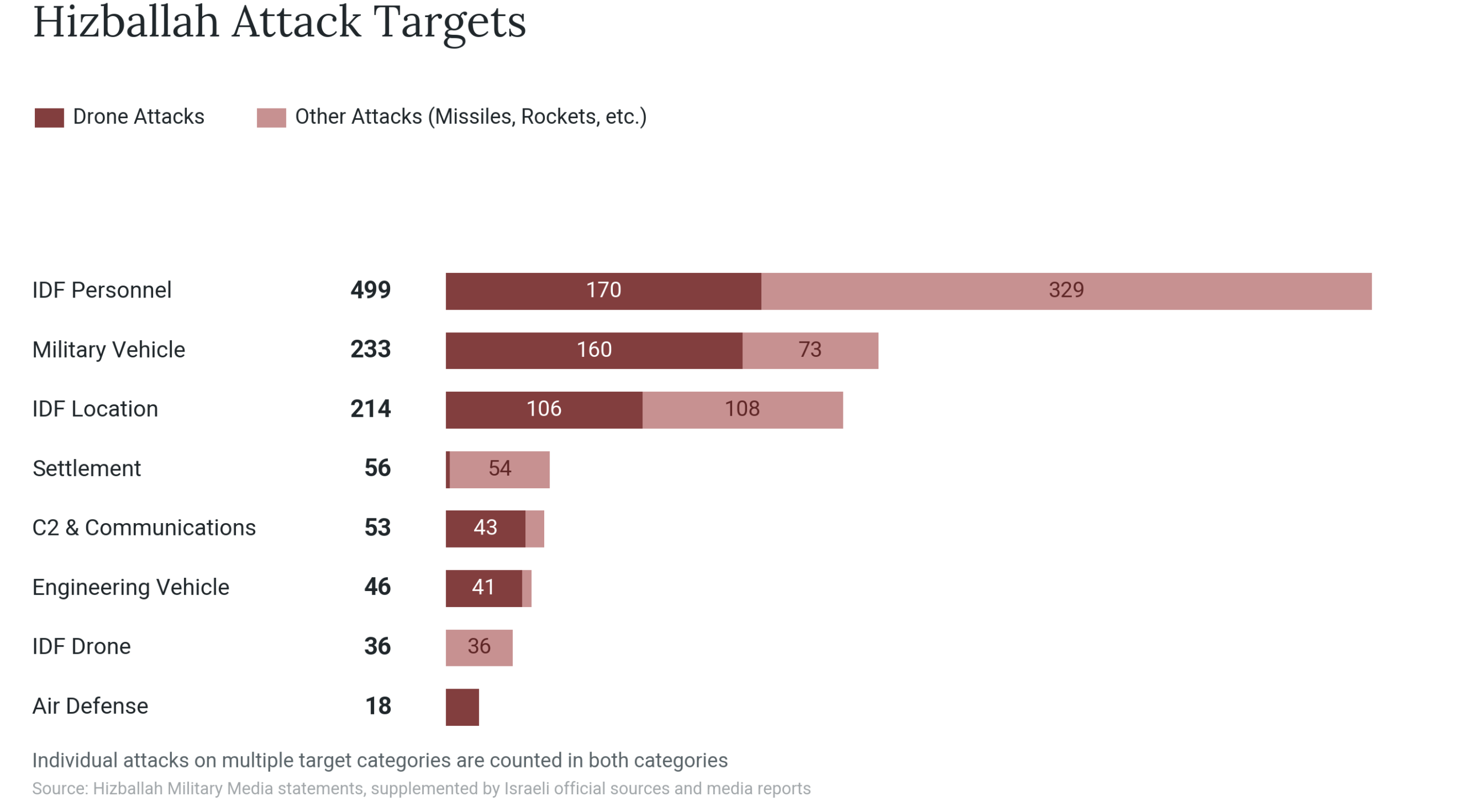
Image: Datawrapper
These attacks generated mounting political pressure on Prime Minister Benjamin Netanyahu. Schools in northern border communities closed while the Israel Defense Forces reduced its footprint in parts of southern Lebanon to limit exposure to drone attacks. The effect was a form of tactical air denial, in which Israel lacked the air superiority needed to protect its forces from Hizballah’s drones operating at lower altitudes, forcing troops indoors, thinning deployments, and constraining ground maneuver. In response, Netanyahu scrambled to convene a special counter-drone team, telling them, “However much it costs, it costs.” A late May poll found 60 percent of Israelis wanted the fight against Hizballah intensified. Hizballah was raising the cost of every dimension of Israeli presence — the human cost, the construction cost, and strained U.S.-Israeli relations.
At the same time, Hizballah’s drone campaign began targeting not only Israeli forces and equipment but also the systems Israel uses to intercept incoming attacks and maintain control over what crosses into its territory. Drone strikes against Israeli command and control nodes more than doubled after the Litani crossing, slowing decision cycles and degrading battlefield coordination. Air defense systems became a sustained target in the final two weeks, peaking at five strikes on May 23. Degrading them raised the probability that future exchanges would produce casualties or damage that neither side anticipated. Of the 162 combined strikes into northern Israel, 60 occurred in the final 10 days of May, when U.S.-Iran negotiations were the most intense and the threat of going over the brink mattered most.
Taken together, these patterns reflect the logic of risk strategy operating across three audiences simultaneously. Against Israel, it generated domestic political pressure and disrupted efforts to consolidate a security zone. For Iran, it kept the risk of uncontrolled escalation credible, giving Tehran leverage to deploy at the negotiating table. For Washington, it turned continued Israeli operations into a liability for a president eager to make a deal.
Iran would almost certainly have linked Lebanon to broader negotiations regardless, given its stake in preserving Hizballah as the cornerstone of its forward-defense doctrine relies on proxies to strengthen Iranian deterrence by threatening coordinated retaliation against U.S. and Israeli targets. Hizballah’s position on Israel’s border is central to this doctrine, giving it the ability to credibly threaten retaliation against Israel and deterring strikes on Iran. In this sense, support for the group is a strategic necessity Iran could not easily negotiate away.
As important, Tehran was in a position to press its demands more forcefully, having survived U.S. and Israeli strikes, sustained the closure of the Strait of Hormuz, and retained Hizballah as its most capable remaining proxy on Israel’s doorstep. From the April ceasefire onward, Iran insisted that Lebanon be included in broader negotiations. But without a documented, escalating cost on the ground, Washington could have dismissed Iran’s demands as rhetorical. Hizballah’s campaign changed that calculation. Every casualty, every rocket siren, every failed intercept transformed Lebanon from a peripheral theater into a demonstrable risk to broader diplomatic negotiations.
That risk tracked closely with Iran’s diplomatic demands, revealing a pattern too consistent to be coincidental. On April 9, hours after Trump declared that Lebanon was “not included” in the ceasefire between Iran and the United States, Iranian Foreign Minister Abbas Araghchi responded that the United States must “choose between a ceasefire or continued war via Israel,” rejecting Washington’s attempt to separate the fronts from the outset.
Iran’s own media made this logic explicit. A May 9 article in Voice of Iran, published by the Supreme Leader’s office, argued that “Hizballah is not a non-Iranian resistance group, but rather the essence and nature of part of Iran’s national interests” and that “the tool of pressure on the Strait of Hormuz… just as it is used for Iran’s national interests, can also be used to defend the proud Lebanese resistance.” Iran coordinated that strategy with Hizballah.
On June 1, Supreme Leader advisor Mohammad Mokhber met with Hizballah’s envoy to Iran, Abdullah Safi al-Din, and stated that any ceasefire that failed to include Lebanon would be meaningless. That coordination also extended to the operational level. Some 100 Iranian Revolutionary Guard Corps officers arrived in Lebanon after the November 2024 ceasefire to help rebuild Hizballah’s command structure and, according to one Lebanese security official, pace its attacks. Iranian statements and political-military cooperation with Hizballah reflect a broader strategic logic in which Iranian diplomacy and the Lebanese front formed a single integrated approach, with Iran operating at the negotiating table and Hizballah executing in the field.
The attack data bear this out. On April 16 — the day of the initial ceasefire — Hizballah launched 71 combined attacks, the highest of the entire campaign, before standing down almost entirely once the truce took effect, with no attacks launched between April 17 and April 20. Attacks remained minimal following the three-week extension of the ceasefire on April 23, before resuming as Israeli operations continued. When the third round of direct Israel-Lebanon talks produced a 45-day ceasefire extension on May 15, but Israel struck that day and combined attacks surged to 186 over the next seven days, peaking at 46 on May 19. And on June 1, when Araghchi warned that a “violation on one front is a violation of the ceasefire on all fronts,” combined rocket and drone attacks hit 36 — the second highest single-day total since April. Rockets hit deeper civilian targets, including Tiberias and Krayot, signaling the threat of broader escalation.
The following day, as Trump stepped in to contain the escalation, attacks fell to 17. Hizballah, having forced Trump’s hand, turned down the pressure. Each surge made Lebanon’s threat to torpedo broader negotiations credible, and each stand-down came when that demonstration had registered at the diplomatic table.
Israeli escalation then played into that dynamic, forcing Trump to broker a ceasefire agreement between Israel and Lebanon on June 3 that sidestepped both Hizballah’s disarmament and Israel’s withdrawal. The June 3 agreement, however, proved unstable from the outset. Qassem rejected the agreement outright, calling it a roadmap to “annihilation.” Days later, a Hizballah strike on a northern Israeli town triggered Israeli retaliation against Beirut’s southern suburbs; Iran responded by firing missiles at Israel, and Israel struck Iran in return. The fighting continued, and when Israel struck Beirut again on June 14, that escalation backfired, forcing Washington to make last-minute concessions to Iran and accept Lebanon’s inclusion as the price of closing the deal. Hizballah’s risk strategy had achieved its objective. Qassem called it “a great victory” and thanked Iran for “linking the Lebanese arena” to the framework agreement.

The Price of Linkage
For Washington, Hizballah’s success came at a cost, entangling it in two distinct problems. The first is that Lebanon is now structurally linked to any broader Iran agreement — a linkage Hizballah forced, and Washington cannot undo. Within days of the signing, Israeli strikes prompted Tehran to warn that continued fighting “calls the entire agreement into question,” and Iran’s delegation arrived in Switzerland with Lebanon as its top priority. Now that Lebanon is inside the agreement, Washington’s broader objectives depend on containing a conflict it had no stake in starting but can no longer afford to ignore.
More fundamentally, in trying to manage Lebanon through two separate tracks, Washington pursued agreements whose underlying rationales directly contradict each other. The Israel-Lebanon track aims to strengthen Lebanese sovereignty and disarm Hizballah, but the U.S.-Iran framework agreement tacitly accepts the Iranian influence in Lebanon that sustains the group. The contradiction surfaced most directly when Washington passed messages through intermediaries to Hizballah — the same group its Lebanon strategy seeks to dismantle — asking it to stop attacks Washington otherwise could not stop. That leaves Washington with no clean way out, as progress on one track now risks undermining the other.
The second problem concerns the U.S.-Israel alliance. America’s core interests — ending the war, reopening the Strait, and reaching a nuclear deal — now run through Lebanon, because Iran has made those interests contingent on an end to the fighting in Lebanon. Israel’s core objectives — eliminating Hizballah’s military presence, holding southern Lebanon, and maintaining freedom of action — work directly against the stability the agreement now demands. The 60-day negotiating period gives Israel time to disrupt what it could not stop at the negotiating table. Netanyahu has vowed to keep Israeli forces in southern Lebanon “for as long as necessary,” but that puts Israeli interests on a collision course with Washington’s.
Neither problem has an easy answer because both ultimately depend on resolving the Hizballah conflict in Lebanon itself. Doing so would remove a source of Iranian leverage in future negotiations and create the security conditions for Israel to withdraw from southern Lebanon south of the Blue Line, the de facto border, as envisioned by the November 2024 ceasefire. Short of that, Washington is stuck managing symptoms on two tracks rather than addressing the underlying cause of either. What it can do in the near term is work to prevent escalation from derailing the broader diplomatic process. That will require restraining further Israeli escalation and pressing for a phased withdrawal from southern Lebanon.
Washington has the leverage — it provided the bulk of Israel’s missile defense during the war, as Vice President JD Vance recently reminded Jerusalem. Washington may ultimately need to exercise that leverage — through reduced diplomatic cover, restricted arms transfers, or withdrawn missile defense support — to directly pressure Israel to begin a phased withdrawal. If Washington cannot hold the line with Israel, the agreement — already fraying over the Strait of Hormuz — will not survive.
Kelly A. Grieco is a senior fellow with the Reimagining U.S. Grand Strategy Program at the Stimson Center and an adjunct professor of security studies at Georgetown University.
Georges Saade is an intern with the Reimagining U.S. Grand Strategy Program at the Stimson Center.
Hunter Slingbaum is a research associate with the Reimagining U.S. Grand Strategy Program at the Stimson Center.
Image: Tasnim News Agency reporter via Wikimedia Commons
