

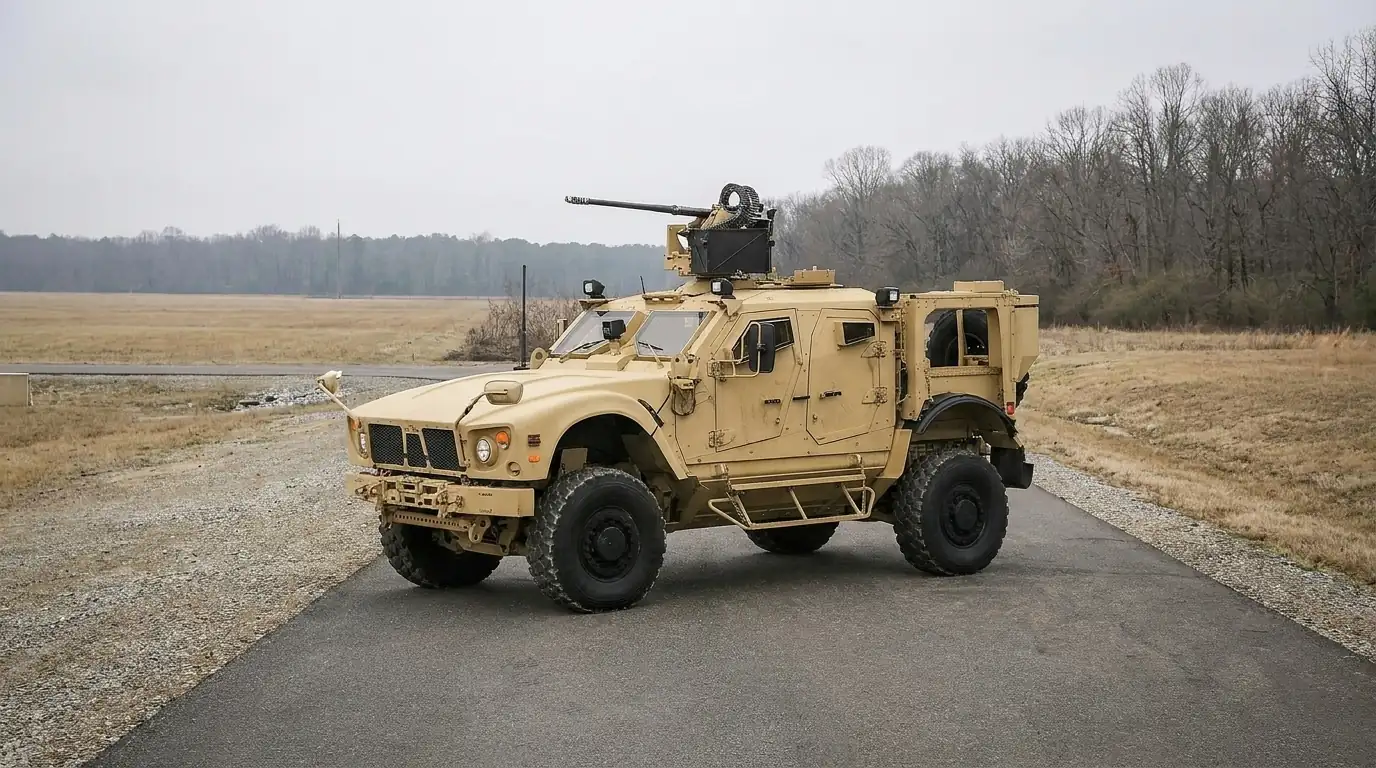
Imagine driving through a narrow Afghan mountain pass when an explosion erupts beneath your vehicle. The ground shakes, dust fills the air, and the force of the blast threatens everyone inside. In that moment, the vehicle’s design can make a critical difference.
That’s the challenge the Oshkosh M-ATV was built to address. Developed for demanding military operations, this mine-resistant vehicle combines specialized underbody protection, armored construction, and off-road mobility to improve the chances of its occupants surviving attacks from improvised explosive devices (IEDs).
But its protection goes beyond simply adding thicker steel. The shape of the hull, the arrangement of the crew compartment, and even the seats contribute to how the vehicle manages explosive forces.
The M-ATV also had to solve another problem. Afghanistan’s rugged terrain made it difficult for some larger mine-resistant ambush-protected vehicles to navigate narrow roads and uneven ground. Soldiers needed protection without sacrificing the ability to move across challenging landscapes.
So, how does the Oshkosh M-ATV protect troops from IEDs? Its answer lies in several interconnected design features, each addressing a different part of the threat.
Understanding those features reveals why the M-ATV became an important vehicle in modern military operations, and why no armored vehicle can guarantee complete protection against every explosion.
What Is the Oshkosh M-ATV and Why Was It Developed?
The Oshkosh M-ATV emerged from a hard lesson learned on the battlefields of Afghanistan: a heavily protected vehicle isn’t much use if it struggles to reach the troops who need it.
During the wars in Iraq and Afghanistan, roadside bombs became a serious threat to military personnel. Conventional tactical vehicles offered mobility, but their designs did not always provide sufficient protection against powerful explosions beneath the chassis. The military needed something different.
The solution was the Mine-Resistant Ambush-Protected All-Terrain Vehicle, better known as the M-ATV. Developed by Oshkosh Defense, it combined mine-resistant construction with the ability to travel across rough terrain.

Why wasn’t a conventional MRAP enough?
Mine-Resistant Ambush-Protected (MRAP) vehicles were designed to improve crew survivability against mines, roadside bombs, and other battlefield threats. However, many traditional MRAP designs were large and heavy, making movement across narrow roads, steep slopes, and uneven ground more difficult.
Afghanistan presented a particularly demanding environment. Mountain passes, rocky tracks, and poorly maintained roads could restrict vehicle movement. A vehicle that offered substantial armor but struggled with the terrain could limit a patrol’s options.
The M-ATV addressed this challenge by pairing mine-resistant protection with a chassis and suspension designed for off-road travel.
What makes the M-ATV different?
Key characteristics of the vehicle
| Feature | Purpose |
| Mine-resistant hull | Helps protect occupants against underbody blasts |
| Armored crew compartment | Provides a protected space for personnel |
| Independent suspension | Improves movement across uneven terrain |
| All-terrain design | Supports operations beyond paved roads |
| Multiple mission configurations | Allows the vehicle to support different operational roles |
These features work together rather than independently. Armor helps shield the crew, while mobility allows the vehicle to operate in terrain where heavier platforms may face restrictions.
One important detail is the vehicle’s weight. The U.S. Army reported an approximate weight of 25,000 pounds (11.3 metric tonnes), including standard equipment and fuel, considerably less than some earlier MRAP vehicles.
That difference mattered. A vehicle had to absorb dangerous forces while remaining practical on Afghanistan’s challenging routes.
The M-ATV was never designed to make soldiers invulnerable. Instead, it brought together protection and mobility to improve their chances in a dangerous environment.
And one feature sits at the heart of that protection: the V-shaped hull, engineered to help manage the force of an explosion beneath the vehicle.
How Does the M-ATV’s V-Shaped Hull Deflect IED Blasts?
An explosion beneath a vehicle creates a brutal engineering problem. The blast can push upward against the floor, damage structural components, and transmit violent acceleration into the crew compartment. The Oshkosh M-ATV’s V-shaped hull helps address this threat by changing how explosive energy interacts with the vehicle’s underside.
Picture a flat metal tray sitting over a firecracker. Much of the force pushes directly upward against the tray. Now imagine replacing that flat surface with two angled panels forming a V. The geometry changes how the force interacts with the structure.
That is the basic principle behind a V-shaped hull, although real explosions involve complex pressure waves, fragments, and ground interactions.

How the V-shaped hull works
Rather than presenting a broad, flat underbody to an explosion, the angled surfaces of a V-shaped hull help redirect some blast energy outward. This can reduce the amount of energy transmitted directly upward into the vehicle’s occupied space.
The design also helps create separation between the lowest part of the vehicle and the crew compartment. That distinction matters because an explosion can damage both the vehicle’s structure and the people inside it.
The hull’s shape is only one part of the solution. Its structural strength, armor arrangement, and integration with the rest of the vehicle determine how effectively the complete system manages a blast.
Why hull shape alone isn’t enough
A V-shaped underside cannot absorb or redirect every part of an explosion. Blast pressure, flying debris, ground conditions, and the location of the detonation all influence the outcome.
That’s why the M-ATV combines its hull geometry with a fully armored crew capsule and blast-attenuating seats. These components help manage different parts of the same threat, reducing reliance on any single protective feature.
Think of it as a series of protective layers. The hull helps manage the blast from below, the armored compartment shields occupants, and specialized seats help limit the forces transmitted to their bodies.
The result isn’t invulnerability. It’s a coordinated engineering approach designed to improve survivability when an explosion occurs beneath the vehicle.
How Does Its Armor Protect the Crew From Explosions?
The hull helps manage an explosion from below, but what happens when the blast sends fragments flying or damages the vehicle’s outer structure? That’s where the Oshkosh M-ATV’s armored crew compartment becomes essential.
Rather than relying on one thick metal barrier, the vehicle uses an integrated protection approach. Its armored structure helps separate occupants from external hazards, including fragments, small-arms fire, and some effects of nearby explosions. The exact protection level depends on the vehicle’s configuration and installed armor.
Inside the M-ATV’s armored crew compartment
Think of the crew compartment as a protective shell surrounding the people inside. Its purpose is to preserve a survivable space while the vehicle’s exterior encounters dangerous conditions.
Armor plating forms a major part of that shell. Depending on the threat and configuration, protective materials and structural components work together to resist penetration and limit damage reaching the occupants.
The windows matter, too. Ballistic glass allows drivers and crew members to see outside while maintaining protection against specified ballistic threats. However, transparent armor is not indestructible, and its resistance varies according to its design and rating.
This distinction is important: protection against bullets, fragments, and underbody blasts involves related but different engineering challenges.
Why layered armor matters
An explosion can produce several hazards simultaneously. Pressure waves can damage structures, fragments can penetrate vulnerable surfaces, and rapid vehicle movement can injure occupants even when the compartment remains intact.
The M-ATV’s protection therefore depends on how its components work together, not simply how thick its armor is.
| Protective element | Main purpose |
| Armored hull | Helps resist external threats and underbody blast effects |
| Protected crew compartment | Maintains a barrier around occupants |
| Ballistic glass | Provides visibility with specified ballistic resistance |
| Reinforced structural components | Help the vehicle withstand operational stresses |
Can the M-ATV’s armor be upgraded?
Yes. The vehicle was designed to accept additional protection kits, allowing its armor configuration to be adapted to changing battlefield threats.
In January 2011, Oshkosh Defense announced an order for 800 additional M-ATV protection kits. Earlier contracts also covered specialized armor against explosively formed penetrators (EFPs), a type of shaped-charge threat.
This adaptability matters because threats evolve. A configuration suitable for one mission may require additional protection for another, although extra armor can also increase weight and affect mobility.

The key takeaway? The M-ATV’s armor is not simply a thick outer shell. Its protected crew compartment, ballistic barriers, hull design, and potential upgrades form a coordinated system intended to improve survivability.
Even so, the vehicle’s protection has limits, and the next layer of defense addresses a less obvious danger: the forces transmitted directly into the occupants’ bodies during a blast.
How Do Blast-Resistant Seats Reduce Injuries?
An armored vehicle can remain largely intact after an explosion and still leave its occupants seriously injured. Why? Because protecting the vehicle is only half the challenge. The other half is protecting the human body from sudden acceleration and violent movement.
Inside the Oshkosh M-ATV, blast-attenuating seats help address this problem. These specialized seats are designed to reduce some of the forces transferred to occupants when an explosion beneath the vehicle causes rapid upward movement. Their role complements the protection provided by the hull and armored crew compartment.

Why ordinary seats aren’t enough
Imagine standing inside an elevator that suddenly shoots upward. Even without hitting anything, your body experiences a sharp change in acceleration. An underbody explosion can produce an even more violent and unpredictable movement, potentially throwing occupants against interior surfaces.
A conventional seat may transfer much of that movement directly to the occupant. During a severe blast, the resulting forces can contribute to injuries involving the spine, pelvis, and lower body.
Blast-attenuating seats are engineered to help manage those forces. Depending on their design, they may incorporate energy-absorbing mechanisms that allow controlled movement under extreme loading. Proper restraints also help keep occupants positioned within the protective space.
The objective isn’t to make the blast disappear. It’s to reduce the portion of its effects that reaches the human body.
How the M-ATV’s seating system helps
Oshkosh Defense identifies blast seats for the driver, commander, and rear seating positions as part of the M-ATV’s crew-protection system.
Some early M-ATV descriptions also explain how suspended seating helps isolate occupants from forces transmitted through the vehicle’s floor. Energy-absorbing foot supports can provide another layer of protection, particularly for rear passengers.
This is a useful distinction: the vehicle doesn’t just need to survive an explosion. It needs to manage how the resulting movement reaches the people inside.
Blast-attenuating seats cannot prevent every injury, especially in severe explosions. But combined with the V-shaped hull and armored crew capsule, they address a critical weakness that armor alone cannot solve.
How Does the M-ATV’s Suspension Improve Battlefield Survivability?
Armor can help protect soldiers when an explosion occurs, but survivability also depends on where a vehicle can travel and how well it handles difficult ground. That’s where the Oshkosh M-ATV’s suspension system becomes important.
Afghanistan’s terrain presented a demanding mix of rocky tracks, steep slopes, loose soil, and narrow mountain roads. A vehicle built primarily for paved surfaces could struggle in these conditions, restricting movement and limiting route choices.

Oshkosh addressed this challenge with its TAK-4 independent suspension system. The design helps each wheel respond to uneven terrain, improving wheel contact and allowing the vehicle to maintain mobility across rough surfaces.
The M-ATV also features approximately 16 inches (406 millimeters) of ground clearance, according to Oshkosh Defense’s published vehicle information.
That clearance helps the vehicle negotiate obstacles without its underbody striking the ground as easily. It doesn’t make the vehicle immune to mines or roadside bombs, of course. Ground clearance and blast resistance solve different problems.
Mobility features that matter in the field
The TAK-4 suspension provides more than a comfortable ride. Oshkosh reports that the M-ATV was designed for a 70% off-road duty cycle, reflecting its intended use across demanding terrain.
The vehicle also has a cruising range of nearly 310 miles (500 kilometers), according to the manufacturer’s specifications.
| Mobility feature | Published specification |
| Suspension | TAK-4 independent suspension |
| Ground clearance | Approximately 16 inches (400 mm) |
| Cruising range | Nearly 310 miles (500 km) |
| Off-road duty cycle | 70% |
These features don’t directly neutralize an IED. Instead, they help the vehicle traverse difficult ground and maintain mobility in environments where conventional roads may be limited.
There’s an important distinction here. Better suspension and ground clearance can support vehicle mobility, but they don’t guarantee that a route is safe or that a vehicle can avoid a concealed explosive.
The M-ATV’s real advantage comes from combining mobility with its armored hull and protected crew compartment. Each addresses a different vulnerability.
That balance is crucial: a vehicle must withstand dangerous conditions while remaining capable of moving through them.
How Effective Is the Oshkosh M-ATV Against IEDs?
The Oshkosh M-ATV was developed to address a dangerous battlefield problem, but how well does its protection work in practice? The answer requires looking beyond the vehicle’s armor and examining its testing, operational performance, and design limitations.
The U.S. Government Accountability Office reported that the M-ATV met crew-protection and vehicle-survivability requirements during ballistic testing before production vehicles entered service.

In a June 2010 assessment, the Director of Operational Test and Evaluation also found the vehicle operationally effective for providing armored tactical mobility across Afghanistan’s terrain.
These findings matter because they go beyond promotional descriptions. They show that the vehicle was evaluated against defined military requirements rather than judged solely by its appearance or specifications.
What does battlefield experience tell us?
The M-ATV’s design combines several protective features: a V-shaped hull, an armored crew capsule, blast-attenuating seats, and mobility suited to rough terrain. Each addresses a different part of the threat, helping improve the chances of occupants surviving an attack.
However, passing specified tests does not mean a vehicle can withstand every possible explosion. IEDs vary considerably, and the outcome depends on factors such as the blast’s intensity, where it strikes, and the vehicle’s configuration.
The historical record also shows that protection requirements can change. The Department of Defense procured an Underbody Improvement Kit to enhance blast protection across the M-ATV fleet, illustrating that even a purpose-built mine-resistant vehicle needed further improvements as requirements evolved.
Why there is no universal measure of protection
A vehicle’s survivability cannot be reduced to a single explosive-yield figure. Tests examine specific threats under controlled conditions, while real-world incidents involve variables that are difficult to reproduce precisely.
| Factor | Why it matters |
| Blast location | Determines which parts of the vehicle experience the greatest forces |
| Vehicle configuration | Armor kits and equipment can affect protection |
| Structural damage | Can compromise the crew compartment or vehicle systems |
| Occupant position | Influences exposure to acceleration and interior impacts |
The important distinction is between improving survivability and guaranteeing survival. The M-ATV was designed to reduce risks, not eliminate them. Its layered protection makes it better suited to dangerous environments, but its effectiveness still depends on the threat encountered.
That brings us to the other side of the equation: the limitations that remain even when a vehicle has been engineered specifically to resist IEDs.
