

The recent operations in Ukraine and Middle East, where Allied and friendly forces were and are involved in neutralizing thousands of aerial and surface drones, missiles and platforms, together with the need to enhance the air defence capabilities of NATO, European and friendly nations against hybrid threats, have pushed customers to select the MBDA Mistral 3 and its launcher systems or augment their inventories of the same combat proven weapon system. “The latter continues to demonstrate its capabilities in both the mentioned theatres of operations,” Paul-Henri Moulin, MBDA Technical Advisor in the Naval Segment, said during the Euronaval media tour
With more than 50 customers worldwide, the latest model of the Mistral family was selected and procured by 25 customers. French Armed Forces and 10 NATO countries, among which Spain, France, Belgium, Denmark, Estonia, Hungary, Romania, Croatia, as well as European nations, Austria, Ukraine, Serbia, and Cyprus, have in use or are awaiting delivery of the Mistral 3. Four more undisclosed countries worldwide also field the Mistral 3, while Finland, Norway and a third country are still using a previous generation Mistral. The increasing number of operators and orders pushed MBDA to augment the production rate of the Mistral 3 missile, while the weapon system was enhanced to cope with hybrid threats.
With a 1.88 metres length, and a mass of less than 20 kg, the high supersonic missile is equipped with a 3 kg warhead coupled with laser proximity and impact fuse; it has a manoeuvrability up to 30 g, an interception range and altitude of respectively 8,000 and 6,000 metres, while minimum interception range is 500 meters. Being the first VSHORAD missile fitted with an IR matrix imager, developed by Safran, according to MBDA the combat proven Mistral 3 comes with a homing guidance characterized by advanced image processing capabilities enabling the engagement of low-thermal signature targets such as small UAVs and turbojet-powered missiles, in addition to being immune to all known IR countermeasures.
MBDA has conducted fire trials campaigns to enhance the capabilities against low signature targets as UAVs and small fast and agile boats respectively in 2024 and 2025, explained the MBDA representative.
SIMBAD-RC 2 and 4

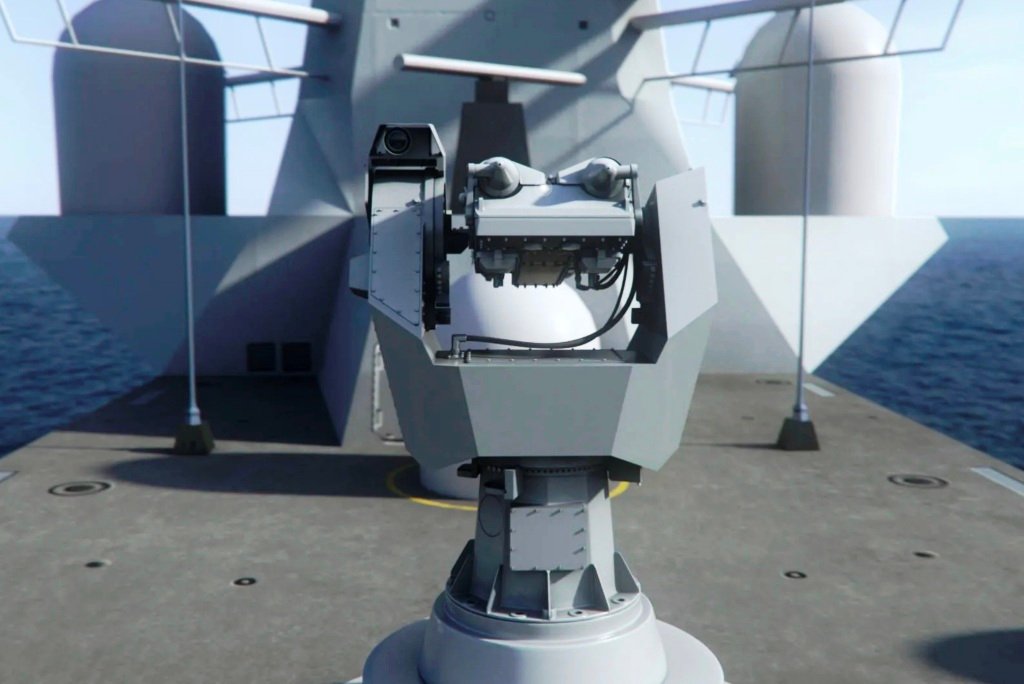
To cope with the increased need to provide a protection at closer range among the Naval Forces, MBDA launched at Euronaval 2024 a new generation of SIMBAD RC naval launchers with respectively two (RC 2) and four (RC 4) missiles, both under production to be delivered to customers in 2027, according to the MBDA representative. The all ITAR-free new versions feature a turret provided by Cegelec Défense with a new design characterized by a common pedestal capable to accommodate respectively a single two-missile pod (RC2) or two pods (RC4). The turret is equipped with a Safran Electronics & Defense MATIS SP dual field-of-view mid-wave band cooled thermal camera. The latter is installed on top of the right arm on the RC2 model, while on the RC 4 version, as a development introduced more recently, it is positioned underneath the right two-missile pod.
The latest announced customer of the SIMBAD-RC is the Spanish Navy, which in September 2026 signed a landmark framework agreement with the European missile group for the procurement of three SIMBAD-RC 2 systems, introducing a dedicated close-in protection capability against both aerial and surface threats, which the service previously lacked and opening the way to further procurements to equip other platforms. Although no information was released, it is understood the systems will be installed at least on F-80 frigates currently undergoing modernization.
Under a comprehensive contract to enhance the short range defence of French Armed Forces, awarded in January 2025 to national industry, the Marine Nationale has installed the SIMBAD-RC on board the new replenishment and logistic support vessels (BRF, Bâtiments Ravitailleurs de Forces) and is going to arm the new seven Offshore Patrol Vessels (Patrouilleurs Hauturiers), the first of which was launched by French Piriou shipyard on February 2026 and is expected to be delivered in 2027. According to the updated multi-year defence programming law (LPM 2024-2030) which was approved by the French Parliament and promulgated in August 2026, the components of Aquitaine-class FREMM and Forbin-class FDA frigates are expected to receive a very short-range surface-to-air system or SATCP (système surface-air à très courte portée), which term identified, so far, the MBDA Mistral-equipped system. According to the same programming document, the French Navy is expected to receive 26 SATCP systems by late 2030, which will increase to 42 by 2035, with a significant boost to the protection of the French fleet.
SPIMM

Unveiled in its first prototype iteration during the Navdex 2019 exhibition, the MBDA Self-Protection Integrated Mistral Module (SPIMM) concept is back on the company’s agenda in a more capable version, today being developed under a cooperation agreement between MBDA France and Danish Terma. Responding to media questions on the joint programme developments, an MBDA representative confirmed that the industrial team “is working on a demonstrator to be showed to the customers and we expect to have a product fully developed by 2030.”
Conceived and proposed as a fully autonomous self-protection system with command, control, sensors and deeper magazine based on the MBDA Mistral 3 surface-to-air missile, “the SPIMM is offered as a stand-alone comprehensive plug-and play solution to protect any vessel, being it military without a self-protection system and combat management system (CMS), namely support ships, or merchant ships, alongside critical infrastructures at sea, such as oil rigs, or ashore installations”, he continued. The recent crisis and military operations in the Middle East, Mediterranean, Baltic and Black Sea, highlighted the need to protect both military support vessels and high value civilian shipping such as liquefied natural gas vessels sailing in choke points such as the Hormuz or the Bab el-Mandeb straits.
The new SPIMM suite is based on an ISO standard 10-foot platform with corner twist-locks attachments featuring a forward lower structure with folding footbridge to maintain the upper-based SIMBAD RC-4 launcher for Mistral 3 missiles. “The underneath module is divided into two compartments served each by side access doors respectively for electronics and ammunitions storage, the latter being capable to accommodate up to eight munitions,” he explained. The rear and higher structure of the container has been designed to host a command-and-control compartment for two operators with side access, and an elevated superstructure to accommodate surveillance sensors. Terma provides the C2 and the sensors suite while the two operators consoles, one devoted to weapon control and the other to surveillance and tracking, reuse the SIMBAD-RC ones with interfaces and dedicated screens for C2 and surveillance. “The sensors suite is centred on a surveillance and tracking radar being a Saab Sea Giraffe 1X or Terma equivalent radar which can be sided but not necessarily by EO/IR systems,” the MBDA representative added. Power supply and communication interfaces are needed to operate the system and provide audio connection with the bridge.
Photos and graphics courtesy MBDA
