

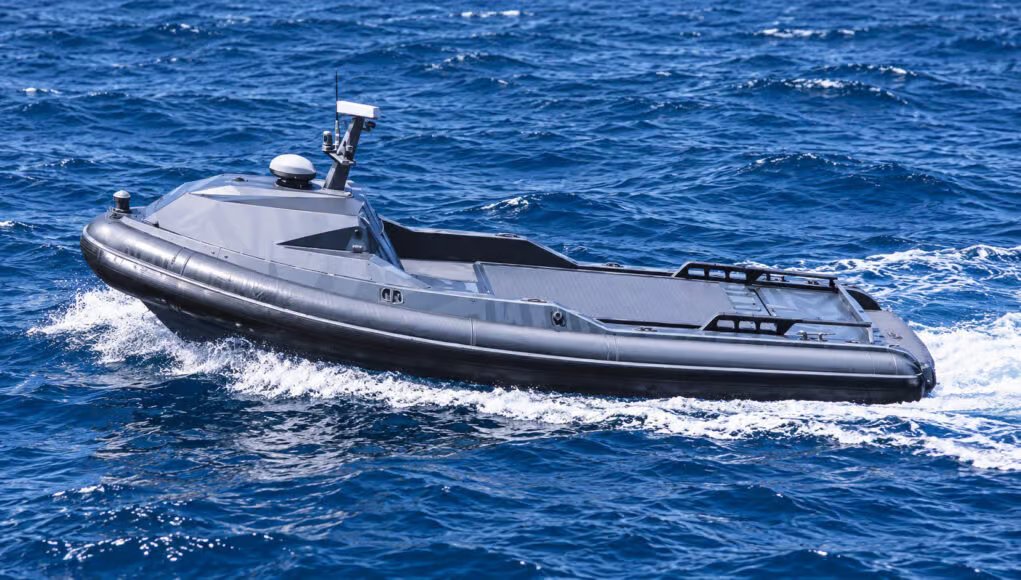

The UK company Seeing Systems has launched an uncrewed surface vessel (USV) designed to carry, launch, and recover up to 100 strike drones.
The Reaver 101 combines the strike power of drones with the endurance of a USV, with a single command-and-control (C2) layer covering both sea and air for the entire mission. With a maximum range of 2,000 nautical miles, it operates far from shore without a support ship and can be transported by road or flown in a C-17 to wherever it is needed.
The four payloads cover littoral strike against targets ashore, anti-surface strike against enemy vessels at sea, reconnaissance drones pushed out ahead of the force, and offshore air defence using interceptors against one-way attack drones. Reconfiguration is quick, and when the threat changes, the payload changes. Autonomy allows one team to set the vessels’ routes and the drones’ tasks from a single interface. The waters a Reaver would operate in will be jammed, spoofed and hostile. Navigation continues when GPS is denied, using inertial dead reckoning cross-checked against radar. When communications degrade, the system steps down through defined levels of autonomy, so the mission continues until the link is restored.
Open architecture and standard drone protocols allow the integration of new airframes and sensors without redesigning the vessel, including Kraken, which the company already produces and delivers to the Royal Navy, as well as drones from the company’s own lines.
Ukraine used British Kraken K3 Scout USVs during an attack on a Russian ship in the port of Sochi on 3 September. One breached the port’s defensive perimeter and damaged the ship’s port side. The second failed to reach its target and was destroyed. The 8.4m K3 Scout has a maximum speed of 55 knots and a payload capacity of up to 600 kg. The K3 Scout’s 650-nautical-mile range at 25 knots is sufficient to cover the distance from Odessa to Sochi.

Saab UK and Kraken are developing an experimental autonomous drone seeker USV which will integrate Saab’s Giraffe 1X radar with a K3 Scout to create a rapidly deployable counter‑UAS system. At the same time, the company is testing alternative methods for delivering the boats to remote areas; during trials under the Royal Navy’s Project Beehive, the US aerial delivery systems company Capewell airdropped a K3 Scout from an A400M aircraft.

by David Oliver
