

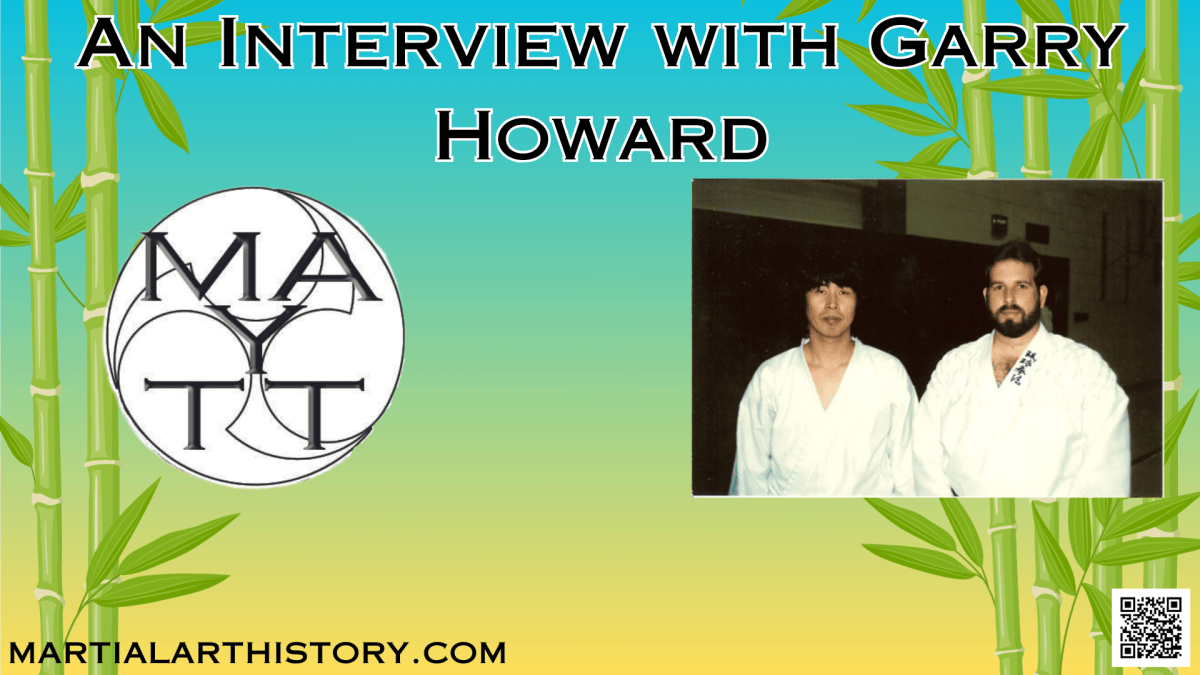
After training in karate for the better part of two decades, Garry Howard came across Steven Seagal’s film Above the Law. Through a series of events stemming from a complimentary phone call, Howard found himself in front of the man himself and secured consistent instruction from Haruo Matsuoka, who made an annual trip to the small town of Brazil, Indiana. In this interview, Howard provides perspectives on both Seagal and Matsuoka, the growth of the latter, and how practitioners continue to refine their understanding long after the moment of “knowing” has passed. All images provided by Garry Howard.
MAYTT: You mentioned this awakening Matsuoka with Abe, Kuroda, and Kono. Would it be a bad description to call his aikido Tenshin Aikido 2.0 or is it something so far removed from Tenshin Aikido?
GH: I think Matsuoka Sensei truly began his own movement after separating from Seagal Sensei. This is just my thinking, and I could be a hundred percent wrong, but I believe Matsuoka Sensei was looking for something, even if he didn’t yet know exactly what it was. After he and Seagal Sensei split, and perhaps after his injury – which I do think may have had some influence – he began searching more deeply. Matsuoka Sensei was always very careful not to hurt students. In all the years he’s come here and put hands on people as uke, he’s never even come close to harming anyone. My feeling was that he was searching for a better understanding, and through spending time with different masters in Japan, he began finding it.
One of the biggest influences, as far as I could tell, was Kono Sensei. Kono Sensei was deeply involved in full-body natural movement – not external muscular force, not projecting aggression or fighting energy, but simply movement. I really think that exposure changed Matsuoka Sensei’s perspective. Even while he was living in Okinawa for those two years, we stayed in communication. I’d tell him what was happening here, and he’d tell me what was going on there, what he was learning, his time with Abe Sensei, and how David Ralsein, one of my students, was helping him.
Around late 2000, Larry Reynosa contacted me. He was restarting Tenshin and wanted to come to Indiana and essentially take Matsuoka Sensei’s place. As I’ve said before, Larry and I simply had different views on interacting with students. I’m sure he’s a great martial artist and has tremendous knowledge, but I want someone’s philosophy to align with my own before I get involved with them. I told Matsuoka Sensei that Tenshin was starting up again and that I’d been invited to participate. I told him I had declined. His response was, “Maybe it’s time for me to return to America.” And then he did. In 2001, he came back. That same year we had a seminar scheduled at Irvine College. Abe Sensei was supposed to attend as well, but after 9/11 he wasn’t permitted to leave Japan because he was considered a national treasure. I still have several pieces of Abe Sensei’s artwork in the dojo: one fan-shaped piece he created specifically for our dojo, one featuring the ki symbol that I received when I first met him in 1991, and another that Matsuoka Sensei presented to us after Abe Sensei’s passing.
When Sensei informed us that Abe Sensei would not be attending, I think we had around ten students there. But honestly, my biggest concern back in 1998, when Matsuoka Sensei returned to Okinawa after his injury, was that he might quit. I was afraid he might walk away from martial arts altogether. I remember thinking, “Please don’t. You have so many gifts and so much to share.” Thankfully, that didn’t happen. The rest, as they say, is history. Today we have the Aikido Doshinokai Association, recognition from Aikikai, and everything that has grown from his return in 2001. Looking back over the last twenty-five years, it’s really remarkable.
What’s interesting is that I don’t see much of a Tenshin footprint in what Matsuoka Sensei does today. Everything now revolves around kuzushi and kokyu dosa. Once you truly understand those concepts, you’re moving without resistance or struggle. You’re simply moving to and through the uke. It’s difficult to explain through a Zoom call. If we were together, I’d have you grab katate dori and I’d show you exactly what I mean. But if you’re already working with those ideas and beginning to incorporate them into your own waza, then I’m very happy for you, because I will make a prediction: if you continue down that path for another five years, it will absolutely blow your mind. Your interaction with uke changes completely. You’ll find yourself saying, “I didn’t even know this was possible.” You’re not fighting. You’re not forcing. You’re simply moving. You stand up from a chair, take a step, maybe not even a full tenkan, and suddenly the technique is there. You find yourself thinking, “I didn’t even do anything.” And if you ever have the opportunity to train directly with Matsuoka Sensei, you’ll understand exactly what I mean. I remember telling people, “If Sensei ever puts hands on you, you’re going to walk away saying, ‘Holy crap, what was that?’” And then it happens. Whether you’re grabbing him, throwing a tsuki, delivering a mae geri – it doesn’t matter. The moment you interact with him, you’re left wondering what just happened. You know something occurred, but you can’t quite explain it. I genuinely hope you get the opportunity someday. It’s an experience that’s very difficult to put into words.
MAYTT: How has Matsuoka’s Aikido Doshinokai Association grown?
GH: Well, I don’t know how much you know about Canada, but about a year ago we picked up an affiliate dojo there. Then, of course, we’re here in Indiana, and Sensei has groups in New Mexico and California. I’m trying to think where else statewide, but I think that’s basically it in the United States right now. What has really been exciting is seeing things begin to expand internationally. There are now connections in Italy, Spain, Belgium, Switzerland, and other places here and there. He’s really starting to spread across the planet, which is wonderful to see.
More than anything, though, I hope you have the opportunity, someday, to meet and train with Matsuoka Sensei personally. I think it would be a very positive experience for you. He’s just something else. I’ve had the honor of training with a lot of martial artists over the years, and some of them – well, their attitudes were a little rough for me.
But from the very beginning, Matsuoka Sensei and I seemed to share the same focus and the same mindset. For me, I have to feel comfortable with someone before I can truly be part of what they’re doing. I want to believe in the same things they believe in when it comes to how students are treated, how people are interacted with, and what the purpose of training is. That’s always been important to me, and it’s one of the reasons I’ve appreciated my relationship with Sensei all these years.
MAYTT: Besides kokyu dosa and kuzushi, what do you feel is the most impactful lesson from Matsuoka that has helped you understand aikido?
GH: Kokyu dosa. I know I’ve already mentioned it, but here’s the thinking. On this point, Matsuoka Sensei and I are exactly of the same mind. He believes, and I believe, that kokyu dosa is the foundation of all movement and all waza. That’s it. It’s our base for everything we do, whether it’s bokken, jo, tanto, or empty-hand techniques. It doesn’t matter what we’re doing on the mat, kokyu dosa is the foundation. The beauty of it is that we live in kokyu dosa probably ninety-five to ninety-eight percent of every day. Getting dressed, having a meal, walking, sitting, or even having a conversation like we’re doing right now – we’re both executing kokyu dosa. We’re relaxed, breathing naturally, and moving naturally. There’s no external involvement, no creation of tension, no signaling.
For me, we’ve been working on this for years now, and if you asked me to rate my knowledge and performance of kokyu dosa on a scale of one to ten, I’d probably put myself at about a minus two. That’s honestly where my mind is. The more I study it, the more I realize how much I don’t understand. Rarely does a class go by where we don’t spend time working on kokyu dosa. Whether standing, seated, in seiza, it doesn’t matter. In fact, I’ve even started applying it to ground fighting. I don’t know if you do any grappling or ground work in your training, but we do. Whether you’re on your back, on your stomach, in someone’s mount, in a guard position, or wherever you find yourself, kokyu dosa is still applicable. Full-body natural movement is full-body natural movement regardless of your position. It just is.
One of the things I try to help students understand is the idea of moving to and through uke. What I often see is students connecting first and then moving. They intercept, stop, and then decide to move. Instead, we should be moving at the moment of connection. That’s where kuzushi begins. That’s where balance is already being affected. A lot of beginning students struggle with that concept. They’ll intercept first and then move, rather than moving as the interception occurs. But that’s a huge distinction. So, I hope that doesn’t completely take away from the original question, but when people ask me what the most important thing is, that’s my answer. Kokyu dosa.

Matsuoka Sensei and I have had many discussions about it, and we’re completely aligned in our thinking. That’s always gratifying for me because I have such a high regard for him. If my little pea brain happens to agree with him on something this important, then I’m a pretty happy guy. Now, I certainly don’t see it the way he sees it. I’m still down here at my minus two, and he’s operating on an entirely different level. But I keep seeking, because to me that’s what this journey is all about. Every day is a continuation of seeking. If we stop seeking, we stop growing. It’s impossible to grow otherwise. That’s something I tell my students all the time. Someday, when they begin teaching, they’ll be amazed by how much they learn from teaching itself. Whenever I say that, I usually get a few funny looks from students, but it’s true. Some of the greatest lessons I’ve learned have come from trying to help someone else understand what I’m still trying to understand myself.
Do you teach yourself?
MAYTT: More on an individual level than a class-level.
GH: Okay, well then, you understand. When you’re trying to help a student face a challenge and overcome it, you’ve got to go deep to help them figure it out. It’s not just you figuring something out anymore – it’s you trying to help somebody else figure it out from their perspective. I learn so much every night when I teach. I tell students that, and I kind of get those crazy looks, like, “Yeah, but when I’m a teacher, then I’ll have everything figured out.” And I’m going, “Time out. Hold on here. You’ll see when you get there.”
Because again, you’re trying to help somebody understand something, and you’re trying to look at it from their perspective. You’re helping them overcome a challenge within their strength level, their flexibility level, and their cognitive appreciation of the waza. All of those things come into play when you’re trying to help somebody else accomplish something. To me, I always learn when I teach. Always. People ask me, “Is teaching rewarding?” And I say, “Yes, for me.” The reason it’s rewarding is because I learn. Every time I teach, I learn something. Whether it’s about the waza, about communication, about the student, or about myself, there’s always something there.
That’s one of the great gifts of teaching. You think you’re the one sharing knowledge, but a lot of the time you’re the one receiving it. The deeper you try to understand something so that another person can understand it, the more you realize there is to learn. So, yes, teaching is very rewarding for me, because I learn while I teach.
MAYTT: What does kokyu dosa teach you?
GH: I think it teaches us how to be even more natural than we tend to be, because for some reason when you’re under threat you want to fight instead of moving. So, in the dojo we always say: fighting is bad, not moving is good. That’s what we try to hang on to – not always successfully, but that’s the idea. Just move. Be natural. Don’t fight. Don’t let external muscles come into play because we don’t need it.
Once students start working that idea, we usually begin with katate dori, then move on to katatetori, ryotetori, munedori –whatever it is. It really doesn’t matter. And it doesn’t matter what the relative position is between uke and nage either, because full-body natural movement is just that. It’s not dependent on position.
We do this all day long. So, I try to tell students: what you already do naturally out there in daily life, let’s bring that onto the mat. You already know how to move naturally. And I’ll give them a few examples. First, we’ve all reached out to grab something and been bitten, cut, or burned. That hand comes back at warp speed, and usually the other hand comes up to check on it. No thought process, just natural reaction. Second, you think you’re home alone and your partner is actually there. They step out of the bathroom, and you get startled; “I thought you were gone.” Again, immediate reaction, no thinking, just movement. Third, you’re working at a computer and something starts to fall. You move to catch it. Whether you catch it or not isn’t the point – the body just moves. No preparation, just response. Those three things we do subconsciously all the time.
I believe we can bring those same abilities into the conscious training space and allow ourselves to move very quickly and very dynamically without preparing to move. Most people – ninety-nine percent of people – prepare to move. They’ll come up into a guard, tense up, then go. Instead of just moving. Don’t prepare, just move. That’s when we are most natural. And I think aikido reflects that, if you look at O Sensei. If you’ve ever watched footage of him, especially the old material, you don’t see preparation. In suwari waza, for example, you often see people begin a small forward shift, a kind of wind-up, and O-Sensei is already there. He’s already on them. It’s like he’s already having their lunch before they even finish the motion.
That’s the idea: when they start to move, you respond immediately to their movement, essentially attacking the attack itself. And that’s it. Once you see it, you understand how immediate it can be. There was never really an “option” in it.
MAYTT: Going back to Matsuoka; what do you think is his greatest contribution to the American Aikido community?
GH: His spirit is really what stands out. And if you ever have the chance to be with him in person, you understand it immediately. His spirit is calm, open, and deeply oriented toward sharing – truly seeking to help you understand. It’s just… amazing. I’ve had the honor of being with a lot of martial artists over the years, a lot of world-class people, and that kind of presence is rare.
Another person who had that same quality was Wally Jay. The first time I met him, it was at the YMCA in Terre Haute, Indiana. I was waiting for Professor Jay to arrive, and this older guy walks in with his ball cap pulled down, shirt untucked, kind of shuffling in. In my mind I’m thinking, “Get out of the way, I’m waiting for Professor Jay.” Then I hear everyone behind me: “Professor Jay! Professor Jay!” and I realize that was him. That was my first lesson. He picked up on my attitude immediately, too. Mr. Ignorant got adjusted that day, no extra fee. After the seminar he asked me for a pencil and paper, had me write down my name, address, and phone number. After that, he started sending me postcards from all over the world: “Garry, keep up the good work. Garry, don’t stop training.” Then one day he calls me: “Garry, it’s Wally.” I’m just stunned. He asked me to video one of his seminars and send him a copy. I asked him why he wanted it, and he said, “So I can see my mistakes and correct them before I teach again.” And I said, “Professor Jay, I don’t see you making any mistakes.” He just laughed and said, “Well, Garry, I do.”

That humility stayed with me. I called myself Mr. Ignorant because I was. But I learned from him in a very direct way. And I believe we still use a lot of Small Circle waza in our aikido today. If you ever get the chance, it’s worth studying; his joint locks and manipulations are just incredible. Have you ever seen “The Dance of Pain”? That’s exactly what I’m talking about. He could take someone apart with finger locks and just walk them around the room while calmly talking like nothing was happening. And I’ve been on the receiving end of that, what I call the Dance of Pain. The first day I met him, I didn’t realize what I was seeing, and I learned very quickly. So yeah… if you ever get the chance, look up Wally Jay and his work. And his son Leon carries it on now too, and he’s very good. But Professor Jay himself – there was only one of those.
MAYTT: I appreciate the comparison. Taking a step back to the larger, general aikido picture in America, do you feel that Seagal’s association with aikido today is a hindrance to the art or does he not have any bearing on the art all?
GH: I’ll give you some personal things I’ve experienced regarding that. Since he has kind of renounced America and gone to Russia, I’ve had students – some of them from the original Tenshin group – express a lot of disappointment and frustration. From their perspective, he’s kind of turned his back on America. I don’t follow it closely enough to really say, but that’s what I’ve heard from multiple people who were there in those earlier days. My sense is that the enormous positive influence he once had in America is basically gone. Again, this is coming from original folks from the Tenshin era – pre-Above the Law, pre-1988, and into the ’90s – before things shifted into country music, Buddhism, and aikido being placed more on the back burner. That’s fine, that’s his decision. More power to him. But I don’t see it as having a positive impact anymore, at least not in the same way it once did.
Every once in a while, someone sends me a video of him doing work in Russia and asks what I think. My answer is simple: that’s his thing, his path. Good on him if he’s still active, because he’s one year older than I am. He turned seventy-four in April this year, and I turned seventy-three in March. So, we’re basically the same generation. His movement is still there, but obviously it’s not what it was in the earlier years. And age catches all of us. He can’t really go into seiza anymore, which I understand completely. I’ve had two knee replacements myself – left in 2014, right in 2016 – so I know exactly what that means. I showed my orthopedist things like seiza and ukemi, and he just kept saying no. Eventually he told me, “I’m not saying you can’t do it, I’m saying if you do, instead of twenty-five years on the knee replacements, I’ll see you in six months.” That was enough for me. So yeah, no more seiza, no ukemi the way I used to. I miss it. You don’t really appreciate it until it’s gone. When you’ve done it for so long and then suddenly it’s not there, you feel it in a different way. But I also don’t want to go through more knee surgeries, so that’s just reality.
As for him, and others from that generation, I think whatever influence remains in America now is pretty negligible at best, based on what I’ve heard. But for me personally, it doesn’t really change anything. I chose to be with Matsuoka Sensei back in ’97 when paths diverged, and I’ve stayed there ever since. And ultimately, what Seagal Sensei does is his life. Same as anyone else. I’ve been with the same woman for fifty-three years; I don’t make those kinds of changes; that’s just not my path. Everyone has to be responsible for their own life and direction. I can’t see myself ever leaving America, but he did. Hopefully he’s happy with where he is.
But as far as influence on American Aikido now? I’d say negligible at best.
MAYTT: Final question; what do you think the future holds for aikido in the next ten to fifteen years?
GH: This is my personal belief. I think as Matsuoka Sensei continues to expand, we’re going to see more growth in America. Just last year when Sensei was here, we had quite a few people from the St. Louis area interested in becoming affiliate dojos. We also had a gentleman from Texas wanting to get something started down there with Sensei’s name on it, and some people from the Chicago area as well. So, I think it’s going to continue to grow, and a lot of that comes from more people becoming familiar with Matsuoka Sensei and what he’s actually doing, especially the concentration on kokyu dosa and how the waza continues to evolve. That applies whether we’re talking about empty-hand work or weapons like bokken and jo. Even the weapons movement is changing because of kokyu dosa.
From what I continue to see and hear, this is just going to keep evolving. As Sensei grows worldwide and more dojos are allowed to come in, the reach is expanding. Just last year we picked up an affiliate in Canada, and the gentleman from Canada actually came to our seminar. We also had a woman from the Poland affiliate come to Brazil, Indiana for training. And honestly, that still surprises me. If you had told me someone was coming from Poland to Brazil, Indiana to train with Sensei, I would’ve said, “What?” Or that someone from Canada would be coming down for the same reason – I’d have had a hard time wrapping my head around it. But it shows how important Sensei is becoming to people, and the time, money, and effort they’re willing to invest to be there. We even had people coming in from Ukraine. To me, that says a lot about the level of belief people have in what he’s doing. And I just see it continuing to expand. Maybe someday – God willing – there’ll even be something like a Matsuoka Sensei dojo an hour west of Philadelphia. It could happen. Stranger things have happened.
If you’d told me that the Canadian gentleman would end up starting an affiliate dojo after training here, meeting Sensei, and having those conversations, I probably would’ve been skeptical. But that’s exactly what happened. On seminar weekends we also go out to dinner with Sensei, and I try to make it possible for people to have some personal time with him. You can’t have everyone get ten minutes each or we’d be there for two days, but I try to let those who are willing and comfortable approach him and speak. And honestly, I was very surprised when I heard Eric had gone on to become an affiliate dojo in Canada after that visit. But again, you never know.
My belief is that in the next ten to fifteen years, what we’re seeing now on the worldwide stage with Sensei could easily double or triple. Easily. He just finished a seminar in Belgium last weekend with people from Spain, Italy, Switzerland, Poland, and even some students from America, including Orange County. I saw pictures; it looked like maybe forty to fifty people on the mat. A huge group. It’s unbelievable. And as Matsuoka Sensei would say “Shinjirarenai,” unbelievable.
MAYTT: We do hope there is a positive growth for Matsuoka. Is there anything else you would like to add before we wrap up?
GH: There’s a photo I have: me and Seagal Sensei, and me doing a roundhouse kick to his head. It’s a pretty good one. It was taken at the ranch in Montana in 1994. You can see me mid-kick, wearing a white gi and a white belt. And people always ask about that. They’ll say, “Why are you wearing a white belt?” And I’ll tell them, just ask him; he’ll explain it. People come up to me and ask, “Are you the sensei for these folks?” I say yes. Then they ask again, “Why are you in a white belt?” And I tell them, all of my black belts are in white belts when they train with me. We’re here to learn. No preconceived notions. No status. We come in as open vessels. I’m not here to show anybody my rank in karate or taekwondo or anything else; I’m here to learn aikido. And that applies to everyone with me. Everybody is in a white gi and white belt. Period. It’s about respect, and coming in empty so you can actually be filled.
Most people look at that and don’t quite know what to do with it. I had one person say, “My waza is better when I’m already amped up.” And I said, “That’s fine.” But I also told him, my waza is the same whether I’m in a gi, a white belt, or standing here in a bathing suit. It doesn’t change what I’m doing. A lot of people don’t understand that. They think what you wear changes what you are. I understand the exuberance of youth – when you put on a hakama for the first time and think, “Now I am something,” because you can look in the mirror and see it. But I don’t feel any different from the day before I tested for shodan to the day after. There wasn’t some big download of knowledge or ability. I’m still the same guy I was yesterday. The only difference is, I might look a little cooler.
MAYTT: This has been a great conversation! Thank you for joining, Garry Sensei!
GH: I was great to be here!

