

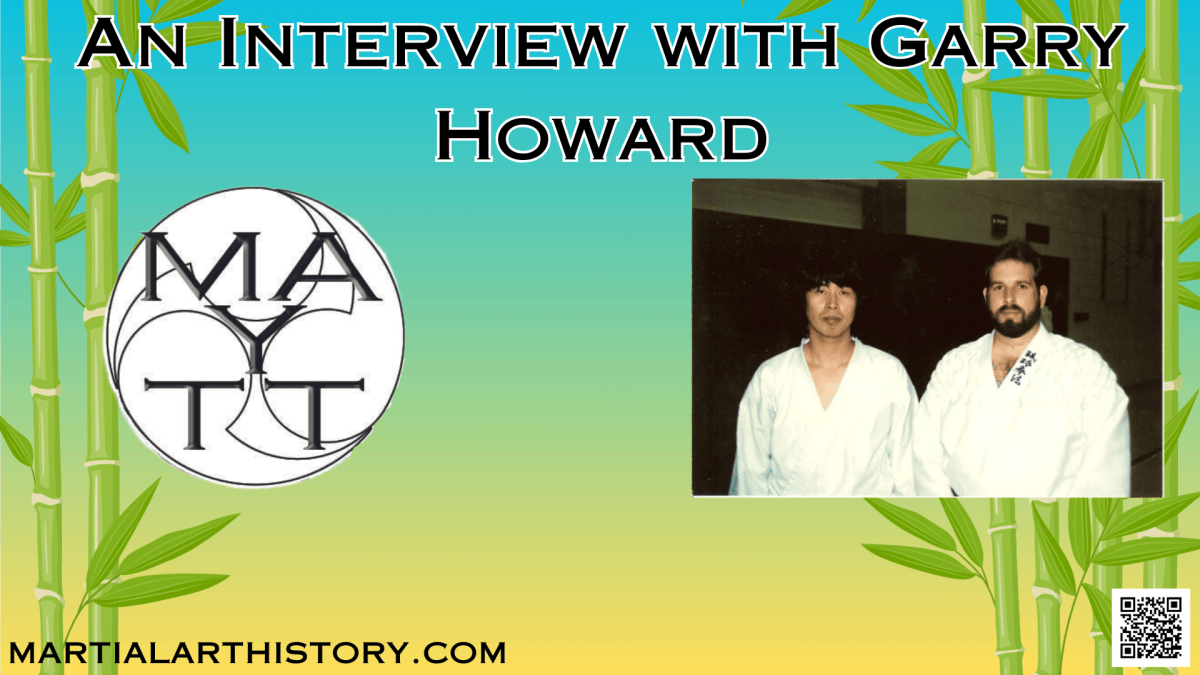
After training in karate for the better part of two decades, Garry Howard came across Steven Seagal’s film Above the Law. Through a series of events stemming from a complimentary phone call, Howard found himself in front of the man himself and secured consistent instruction from Haruo Matsuoka, who made an annual trip to the small town of Brazil, Indiana. In this interview, Howard provides perspectives on both Seagal and Matsuoka, the growth of the latter, and how practitioners continue to refine their understanding long after the moment of “knowing” has passed. All images provided by Garry Howard.
Martial Arts of Yesterday, Today, and Tomorrow: Welcome Garry Sensei! Thank you for joining us today!
Garry Howard: I am glad to be here!
MAYTT: After training in the martial arts for roughly twenty years, you met and began training under Steven Seagal, doing aikido after you did karate for many years. How did that meeting happen and then what made you want to pursue aikido from that point on?
GH: Well, in 1988 I saw the movie Above the Law, with Steven Seagal. In that film, Seagal Sensei did two waza I was already familiar with. One was the solar plexus shot on a bigger guy that knocked him out, which is a valid waza that I knew and had used myself. The second was the elbow release at the end of the movie, which was also a legitimate waza. There was also a third element in the film that, to me, was legitimate. He goes in to speak with a young Japanese woman in what looked like a secured environment, and there’s a piece of paper with a top-secret code word on it. From my own history, I recognized that at one time that kind of thing had actually been a real code protocol. So overall, in my humble opinion, somebody had gone to school to make a very realistic martial arts film.
Most martial arts movies I’d seen up to that point were just punching, kicking, maybe a standard wrist lock or joint lock here and there. But Seagal Sensei was doing those kinds of waza, and then when that code word came in, it made me pause. I thought, I need to talk to this guy a little bit. So, I called Los Angeles from Indiana and spoke with Patrick Gorman, one of his senior people. I told him I had just seen Above the Law, that I really enjoyed it, and I wished Seagal Sensei the best going forward. He kept asking what I wanted, but I said I didn’t want anything – I just hoped he could pass that message along. Eventually he asked for my name and number.
Several months later he called back and said that in the spring of 1991 – this was still 1990 – Seagal Sensei and Abe Sensei would be doing training in Eagle Rock, California, at Occidental College, and he invited me. In the meantime, I had some discussions with Haruo Matsuoka Sensei and others about my background. At that point I had trained with George Dillman, Seiyu Oyata, and Professor Wally Jay, and I was very deep into the pressure point world. I was asked to send a video, so I did – showing different points on the body, angles and directions, and the results of strikes or manipulations depending on the situation. When I arrived, I met Matsuoka Sensei. The gi I was wearing at the time had belonged to Seiyu Oyata and said Ryukyu Kempo in Japanese. When Matsuoka Sensei saw me, he basically said, “Oh, pressure point guy.” And I just kind of acknowledged it.
That’s really how it all started. I had done some research after an article came out in Black Belt Magazine and found Seagal Sensei’s school in Los Angeles. I was impressed with his on-screen presence, especially the opening dojo scenes where he was doing irimi nage and other techniques with Matsuoka Sensei and Larry Reynosa.
I ended up being affiliated with Seagal Sensei until 1997. At that point, he and Matsuoka Sensei went in different directions, and I chose to stay with Matsuoka Sensei. Larry Reynosa had also contacted me and asked me to join him along with Tim Chan and others, but I declined. Matsuoka Sensei had gone back to Okinawa by then, but one of my students – who had an Okinawan wife and had moved there – helped him and Midori-san get settled when they returned. So, I’ve had deep connections with Matsuoka Sensei since 1991. In fact, this year marks about thirty-five years together.
My understanding is that I was the first person to have Matsuoka Sensei come out on his own to teach in 1991. After that training, I went up to Seagal Sensei and asked if there was any way I could do long-distance training. He said, “Yeah, sure, just a minute,” then called Matsuoka Sensei over. Next thing I know, Seagal Sensei speaks to him in fluent Japanese, sends him over to me, and says, “He’ll take care of you.” I was just standing there thinking, “Okay… I guess that’s happening.” That year, Matsuoka Sensei came out, and from then on, we stayed connected.
As for why I went to aikido, it really came out of everything I had already done. I wrestled when I was younger, boxed, did full-contact karate, pressure point systems, and I trained with a lot of people like Joe Lewis and others in that world. But when I saw Seagal Sensei and that approach, it connected to something I was already developing: close-range work, joint manipulation, blending, and becoming one with the attack instead of just striking hard. I had also been in law enforcement since 1978, retiring after forty-three years in 2021. So, a lot of what I trained in had to work in real situations – non-compliant individuals, arrests, all of that. You learn quickly what holds up under pressure. Looking back, I think I had been looking for aikido all along, I just didn’t know it yet. It wasn’t until I saw it and experienced it that I recognized what I had actually been searching for.
MAYTT: To clarify, in 1991, you traveled to California for a seminar and from there, you started learning from Matsuoka. What was your first impression of Seagal as a teacher and how did that compare with Matsuoka when he came out later?
GH: It was very similar from the standpoint of a very humble way of connecting with a student and trying to do the best they could to help you understand what they were doing. The only real difference I saw was that Seagal Sensei was much more secure in his teaching and sharing, whereas in the beginning Matsuoka Sensei wasn’t quite at that same level of confidence. That’s not a criticism – don’t get me wrong, he did a fantastic job – but that was just the main difference I noticed at the time. And I understand that was more the early period of Matsuoka Sensei going out on his own, even though Seagal Sensei had already told him, “You’re good for this, don’t worry about it.”
I want to say at that time Matsuoka Sensei was yondan, fourth degree, I believe. So, he was very skilled, and his explanation and teaching methodology were excellent. It just felt like, in the beginning, he didn’t quite have that same full confidence in himself yet. But again, if you’ve never been in that situation before – going from California all the way to Indiana, working with people you don’t really know – that’s a big shift. And shortly after that, it wasn’t very long before he became very comfortable here. He became part of our family, knew all the kids, and my wife and him got along very well. That was really it.

Please understand, I don’t mean that in any disrespectful or demeaning way toward Sensei. It was simply an observation from those early years. As he continued coming each year, you could see him settle in more and more. He started to think, “Okay, it’s okay. I can do this. I feel comfortable teaching now.” From there, he just continued to grow as an instructor – his ability, his confidence, and his connection with students all developed steadily. Over time, that expanded even on a wider, almost worldwide basis as his teaching continued to evolve.
MAYTT: Focusing on Matsuoka, at what point did you notice him evolving or changing his aikido from Seagal?
GH: That did not happen until their split in 1997. There was never an ounce of difference Between the two before the actual split, and I don’t know what you actually know about that. But if you give me an idea of what you may have, and knowledge about that, then I may share some things with you.
MAYTT: From the interviews I have done, Seagal wanted to do more with the movies and did not want to be tied to the dojo. Matsuoka wanted to continue the dojo and they split because of difference in desires.
GH: Okay… we’ll leave that where it is, and I’ll add a few things if I may.
The last time I trained with Seagal Sensei was 1997. Half of the training was Buddhism, and half of the training was aikido. I have no problem with that whatsoever. The only issue, from my standpoint, was that I was there for aikido.
I’m a Christian. I believe that Jesus Christ died upon the cross to save my soul – that’s what I believe. And if someone else has a different religious view, that’s fine. More power to them. Everyone has to follow their own path; that’s just my thinking. We’re not all the same, we’ll never be the same, and we don’t all agree on everything – and we never will. That’s just part of life. You agree to disagree and move on. It’s okay.
But where this also became more relevant was around a situation where Seagal Sensei had contacted Matsuoka Sensei to go do a demonstration with him. During that demonstration, Matsuoka Sensei got hurt – pretty severely, from my understanding. After that, there was more of a division that developed between aikido and Buddhism in the way things were being structured, although Matsuoka Sensei himself is a Buddhist. That’s not in question. He is very devoted – he has Buddhist study sessions in his home and so on. But his main focus was always aikido. His thinking was essentially: if we’re going to do Buddhism, then let’s do Buddhism. If we’re going to do aikido, then let’s do aikido. But don’t mix them together, because then you end up in situations where you have people present who are not of that belief system. So, his preference was clarity – if people come to train aikido, then we do aikido; if people come for Buddhism, then that’s something separate. And I think that incident, and what followed afterward, was part of what ultimately created some of the split.
Even in 1997, though, we were still together. That was a seminar in California. I had spoken with Matsuoka Sensei about it because I had maybe thirteen students at the time, and some of them were asking if we were required to attend. I asked Sensei directly, and he said, “No, no, no – free will. If you want to attend, attend. If you don’t, don’t attend.” So, I passed that along to my students. A few of them went, but most did not. And I told them, that’s fine – it’s your decision, not mine. That’s what Matsuoka Sensei conveyed: free will.
So, it was really a combination of factors, but I never really got the impression from Matsuoka Sensei that there was a fundamental disagreement about the direction of waza or teaching itself. That was never really how it came across to me.
MAYYT: Thank you for clarifying. In 1997, with the split occurring, was there also a fracturing of the American Tenshin Aikido community?
GH: I believe it was, because my understanding is that after Matsuoka Sensei left the dojo in Los Angeles, the dojo itself actually closed. Seagal Sensei was extremely busy at that time; he was doing a lot with films, a lot with music, and a lot with Buddhism. From what I understood, he was functioning in a fairly high-level role within the Buddhist religion as well. I’m not completely familiar with the exact terminology, but he had a lot going on across different areas. In that period, Matsuoka Sensei was really the one holding down the dojo and keeping things running. So, when he eventually went back to Okinawa, my understanding is that Tenshin more or less dissolved after that.
A bit later on, Larry Reynosa stepped in and tried to carry things forward, and he contacted me wanting to essentially take Matsuoka Sensei’s place in that structure. I declined. I had worked with Larry before, and our philosophies on teaching and approach were a little different. That’s not to say anything negative about him; he’s undoubtedly a very accomplished martial artist. But I’ve always had to feel comfortable with the person I’m associating with, especially in terms of how they treat students and how they carry themselves in a teaching environment. We just didn’t align well in that regard, so I’ve always been careful about who I choose to work with.
And I’m sure you know some martial artists who are, for lack of a better term, very happy with themselves – very self-assured, and if someone doesn’t agree with them, they’ll make sure you know how confident they are. I don’t know if you ever trained with or knew Joe Lewis, but that’s the kind of world I’m referring to when I talk about different personalities in martial arts circles.
MAYTT: I did not train or know Joe Lewis personally.
GH: Joe Lewis was very much like that. He actually came to my home – besides my commercial location, I also have a private studio in my house – and he trained here one evening. During that session, he asked me about pressure points, so I demonstrated a knockout pressure point on one of our students. He then asked if something like that could be applied to shoot fighting, and I told him it could be applied to anything. As he was leaving that evening, he said, “You have my number?” I said, “Yes, sir.” And he told me, “Give me a call. I want to get with you and we’ll start doing things.” That was in 1993.
After that, I called Matsuoka Sensei because I was a little troubled by it. I didn’t feel fully comfortable working with Mr. Lewis in that kind of private setting. I had been in similar situations before, but always in open, more commercial environments – not one-on-one like that – and I had also never demonstrated waza for him before. When I explained everything to Matsuoka Sensei, he told me, “Be very careful who you share things with. You have a lot of information that I don’t think you fully realize you have.” And I said, “Thank you, Sensei. That’s all I needed to know.” And I never called Mr. Lewis back. That was the end of it.

But the part that really stood out: my wife was making dinner for us, and she came into the studio to ask if we were almost finished so she could time things. At that moment, Joe Lewis looked over and said, “Woman, food, now!” My wife did not find that amusing. And I don’t know if you’re married, but if your significant other is preparing a meal, comes out to check timing, and the person training suddenly yells “FOOD NOW!”, that’s not going to land well. So, after that, my wife made it very clear I wasn’t going to be doing anything further with him. And honestly, I was already in that mindset even before I was “coached” in that direction.
MAYTT: Since we are on the topic of Tenshin Aikido practitioners, during the 1990s, who were some of the more notable individuals teaching Tenshin Aikido?
GH: Really, those were the only three people I was aware of at the time, because they all had that California connection, and California was where Seagal Sensei’s home base was. Back then, things hadn’t really reached a point of widespread proliferation. The organization and the teaching network simply hadn’t expanded that much yet. As the movies continued to come out, however, and as Seagal Sensei became more popular, more people became interested, much the same way I did. They would see a movie, become intrigued, reach out, and then begin their own training journey. That’s when things really started to grow. Then Seagal Sensei and others began traveling and teaching more extensively. My understanding is that Matsuoka Sensei was injured in 1997 while they were preparing for or conducting a demonstration. After that, things began to change, and that was more or less the end of that particular period. So, up through 1997, those were the main three individuals I was familiar with, aware of, and had direct experience with. I’m sure there were probably others involved along the way; I’m simply not aware of them.
MAYTT: From your experience, what makes Tenshin Aikido unique to other styles of aikido?
GH: Well, I don’t know how much knowledge you have of aikido, but I can only speak to what I personally experienced with Seagal Sensei between 1991 and 1997. Before that and after that, I can’t really say. What I can say is that I was very impressed with his movement and with the hands-on training I received from him.
Even the first time I met him in 1991, he spent quite a bit of time working directly with me, and I was very appreciative of that. What stood out most was that his aikido was very hard, very fast, and very debilitating – very dominating of the threat, if you will. Over the years, I’ve had many people reach out to me from different aikido backgrounds, and some of those styles are much softer. “Flowing” isn’t quite the right word, but in some systems, it seems like uke is already thrown almost before contact is even made. That’s fine. For the people who enjoy that approach, I wish them well. It just wasn’t what I was looking for. I think a lot of that comes from my real-world experience. When you’re responding to a call at three o’clock in the morning, breaking up a domestic violence situation, dealing with a bar fight, or handling any number of unpredictable encounters, your focus tends to become quick and effective neutralization of a threat. That was always my primary concern, regardless of what martial art I was studying.
For me, that journey began in 1968. This is my fifty-eighth year in the martial arts, and truth be told, I still don’t really know what I’m doing, but I keep trying. Every day I hope to gain a little more understanding so I can perform a little better waza. That’s always been my focus. Back in those Tenshin days with Seagal Sensei, I appreciated that hard, fast, overpowering approach. From a threat-neutralization perspective, it made a lot of sense to me. But over the years, my understanding has evolved.
I don’t know if you’re familiar with the terms kokyu dosa and kuzushi. For me, kokyu dosa has become the foundation of all movement – full-body natural movement performed within a normal breathing rhythm. Kuzushi is the disruption of an opponent’s balance and strength at the moment of contact. Where I once focused on forceful application, I’m much softer now. Today I’m more interested in the manipulation of energy, movement, and balance. Have I changed since the 1990s? Absolutely. Quite a bit. Now I try to help students understand that kokyu dosa is something we already use every day. We use it when we get dressed, eat a meal, walk up and down stairs, or get in and out of a vehicle. It’s simply natural human movement. In my view, kokyu dosa is the foundation of everything we do.
I didn’t understand that for a long time, and honestly, I’m still working to understand it better. But if you asked me which approach I think is more effective today, I would say the way we train now. The reason is simple: you can control, manipulate, and neutralize someone much more efficiently without causing significant damage. You may create discomfort, certainly, but to me there is a difference between discomfort and damage. Someone might be uncomfortable for a few minutes after a waza, but they’re not going to the hospital because we broke a wrist, dislocated an elbow, or caused some other serious injury.
So yes, a great deal has changed for me over these fifty-eight years. And even now, I still have a tremendous amount to learn. Every morning I wake up knowing I’ll never learn everything I want to know, but I keep trying anyway. I remember the first time I trained with Seiseki Abe Sensei in 1991. It was a joint seminar featuring both Seagal Sensei and Abe Sensei. Are you familiar with Abe Sensei at all?
MAYTT: A little bit, yes.
GH: Okay. In 1991, Abe Sensei did a waza that I still remember to this day. I will never forget it, and I still have no idea how he did it. He was probably eight to ten feet away from the uke. He told the uke to come forward, and all Abe Sensei did was some kind of movement, almost like a ki projection or something. I honestly don’t know. But whatever he did, I felt it. I felt the uke take the shot. I felt him take a body shot, and I remember standing there thinking, “What?” Even now, all these years later, I still come back to that moment from time to time and wonder about it. And then there was the experience of actually putting hands on him. Good grief.
I had one of my students with me, a bricklayer named Jim. He was an absolute beast – about 6’2″, no body fat, just solid. You could try to manipulate him, apply pressure points to him, do whatever, and he would just stand there looking at you as if to say, “Was that supposed to do something?” That was Jim. It was like swatting at a fly. Abe Sensei got hold of Jim and was moving him around like a ragdoll. I stood there watching and thinking, “I have no idea what he’s doing, but I sure wish I did.”

Then I saw that no-touch demonstration. The uke was still several feet away, and yet I felt the impact. I don’t know how else to explain it. I felt the guy take the hit. To this day, I still don’t understand it. If somebody understands what happened there, please let me know, because I feel like I’m missing something. Honestly, I worry I’m going to leave this world before I ever get even an inkling of what Abe Sensei was doing or how he was doing it. I understand ki. I understand the concept of ki projection. I understand that we all have energy, that we all have life force, and that through movement and interaction we can affect another individual. That part I understand. But what I witnessed that day was something beyond my understanding. Even now, when I think back on it, it still blows my mind.
MAYTT: With ki and aiki, it becomes difficult to define. After the split between Matsuoka and Seagal, how would you characterize Matsuoka’s expression and interpretation of Aikido compared to his time under Seagal?
GH: I would say that Matsuoka Sensei experienced an awakening. I don’t know if you’re familiar with Henry Kono Sensei or Tetsuzan Kuroda Sensei in Japan, or even Ambassador Han Jin, but after the split, Matsuoka Sensei really began searching. He started traveling to Japan and spending time with a number of these masters to deepen his own understanding of aikido. That’s when he began seeing things in a completely different light. Rather than focusing primarily on the external application of waza – which was very much the approach I associated with Seagal Sensei – he started moving toward a more internal understanding based on natural, full-body movement. I believe Kuroda Sensei and Kono Sensei, in particular, were instrumental in that awakening. His waza began to change, and honestly, it continues to change even today.
Over the years, when Matsuoka Sensei would come to Indiana, I would pick him up at the airport, and he would stay in our home. From the moment he got off the plane until the moment I put him back on it, we were together. We would spend ten or twelve hours at a time simply talking, sharing ideas, and discussing training. Through those conversations, a great deal of information was exchanged. One thing that always impressed me was something he told me about how he approaches new ideas. Whenever someone shares a new concept or method with him, he works on it himself for two years before he ever begins teaching it to students. I found that remarkable. A lot of people see something new, get excited because they understand a small piece of it, and immediately want to teach it. Matsuoka Sensei doesn’t operate that way. He works with it personally, tests it, refines it, and explores it deeply. My impression is that he often doesn’t even tell students what he is working on. He simply incorporates it into his practice and tests it through techniques, whether it’s katate dori or any other waza. Only after he feels confident in his understanding, his ability to execute it, and his ability to communicate it does he begin sharing it with students. Then we are fortunate enough to be part of that process when he comes each year and introduces those developments.
We’re very fortunate. I live in Brazil, Indiana. There are about 8,000 people in town and maybe 13,000 in the entire county. It’s a small community, not a wealthy area by any stretch of the imagination, and we’re a small dojo. For years, I honestly thought Matsuoka Sensei would eventually come to his senses and decide he wasn’t coming back. I imagined him saying, “Thanks for inviting me, but I don’t think I’m coming to Indiana anymore.” And if he had, I would have understood. We’re small. We’re not famous. We’re not anybody special. I would have wished him well and thanked him for all he had done. But that never happened. In fact, 2004 turned out to be one of the most meaningful years of my life. About five months before Matsuoka Sensei’s visit, my father had committed suicide. By that point, Matsuoka Sensei and I had known each other for thirteen years. We were sitting at the kitchen table – my wife, Matsuoka Sensei, and myself – when he said, “Garry-san, I have something very important to discuss with you.” Immediately, I thought, “Well, this is it. This is the conversation I’ve been expecting. He’s going to tell me he’s done coming to Indiana.” Instead, he said, “I have been having conversations with Abe Sensei regarding you.” I said, “Oh, okay.” Then he continued, “He agrees with me. We would like to promote you to shodan in aikido.” I just sat there thinking, “What?” He explained that Abe Sensei agreed that I should be promoted, and so my first aikido rank was actually signed by Abe Sensei.
Even now, Antonio, I’ll be honest with you. Do I have rank in aikido? Yes. Do I feel I deserve it? No. I’ve never been one for formal testing, and in my own mind, I’m not particularly good at aikido in the traditional sense. My perspective is different because I incorporate so many other influences into what I do. If you watched me deal with an attack, you might see a little bit of aikido in there, but you’d also see Tuite, Kyusho Jitsu, Small Circle Jujitsu, and a lot of other things that have accumulated through decades of training. That process has been growing since 1968. Add to that my years in the military and my years in law enforcement, and my focus has always been threat neutralization.
So even though I hold the rank I do today, I still don’t feel like I deserve it. But I accept it for a simple reason. Sometimes I have students who don’t believe in themselves. I can see things in them that they can’t yet see in themselves. I recognize their gifts and abilities before they fully appreciate them. At some point I realized I needed to apply that same thinking to myself. If Matsuoka Sensei saw something in me that I couldn’t see, then perhaps I needed to trust his judgment. And he’s not a person who simply hands out rank. He doesn’t believe in that. So, I’m appreciative. I’m very happy with where I am in the aikido world, even if I still don’t feel worthy of it. There are plenty of people I think deserve rank more than I do. But I’m certainly not going to argue with Sensei. When he comes to me and says he would like to promote me, my response is simply, “Hai, Sensei. Okay, Sensei.”
Part two coming soon!

