

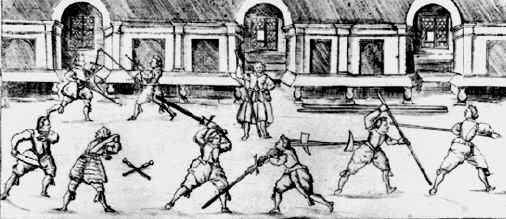
Connor Wood first started learning to sword fight when he was a child and that ultimately led him to join the Society for Creative Anachronism. In pursuing the historical sources, he soon crossed over in Historical European Martial Arts and saw a myriad of overlaps between the two movements. Today, Wood discusses the evolution of HEMA and the SCA, the cultural tensions that have developed between the two communities, and the ways tournament structures shape martial practice, along with mentorship, pedagogy, ranking systems, competitive incentives, and the ongoing debate between specialization and cross-training.
MAYTT: There was not a real question. But since we are here, how does the SCA approach rattan combat as opposed to cut and thrust with the longsword?
CW: This is the question I’ve been waiting for. There are really two big answers to it. The first concerns how the organizations and cultures approach the activity, and the second concerns what I personally do within those spaces.
The very broad answer – and this certainly isn’t universally true – is that, culturally speaking, you have people in the SCA who are interested in history for a variety of reasons and in a variety of ways. They engage in activities connected to those interests, whether that’s historical costuming, blacksmithing, fighting, or something else. Some of those people pursue historical research in order to better understand and perform those activities. Others are simply interested in participating in the activity itself without necessarily diving deeply into the historical techniques or sources behind it. You see this a lot in rattan combat because it’s a fun, sportive martial activity. People participate casually, and that’s perfectly fine. You also have highly competitive participants who are very invested in the sport itself but have little interest in the historical basis of sword fighting. They’re interested in the SCA version of combat as a sport.
Those are really two different things. You have the SCA sport of rattan combat, which is different from SCA cut-and-thrust combat, which is different again from SCA rapier combat. Each of those activities develops its own culture, but also its own competitive meta. By “meta,” I mean the generally accepted understanding of the most efficient or effective ways to succeed within a given ruleset or environment. You see the same thing in HEMA. Under the conventions that have evolved around a typical longsword tournament, certain actions tend to be more effective than others. Every activity develops its own form of sportification, and that’s true on both the SCA and HEMA sides of the line.
Then you have people like me, who I like to think are trying to stay connected to the original roots of how HEMA emerged out of the earlier WMA movement. I participate in both HEMA and the SCA, but the reason I do either of them is to practice, understand, and test my interpretation of a particular martial tradition – specifically Kunst des Fechtens, the Liechtenauer tradition, or what people often call the German Art of Fighting. I say “German” with very large air quotes, but that’s the common shorthand.
For me, HEMA and the SCA provide different environments in which to experiment with and explore Kunst des Fechtens. Whether I’m in a HEMA tournament or an SCA tournament, I’m fundamentally trying to do the same things, as closely as the environment allows. Obviously, fighting with rattan weapons while wearing one type of protective equipment produces different results than fighting with steel simulators while wearing a fencing mask and modern HEMA gear. The weapon simulators behave differently, the equipment affects movement and tactics, and the goals of the environment influence how people fight. All of those factors shape the experience.
At the same time, both environments can provide valuable information about what sword fighting is and how it works. Each offers a different lens through which to test ideas and refine understanding. I would say that most people involved in either activity are primarily interested in the activity itself rather than the underlying historical question that originally gave rise to it. They’re often more invested in doing the thing than in exploring the deeper roots of why that thing is done the way it is. If that makes sense.
MAYTT: It does. You described, at least what you do, is a very intrinsic and deeper level of student of the source material and swordsmanship.
CW: Yeah, and I’m not trying to suggest that I’m unique in pursuing things this way. There are any number of approaches to these ideas, and the particular path I’ve taken – having a foot in both of these communities – has created some interesting tensions for me over the years. Less so now, largely because of a lot of deliberate effort on my part, but especially in the earlier years, people in HEMA spaces would often identify me as “the SCA guy,” while people in the SCA would identify me as “the HEMA guy.” At a HEMA event, I was recognized as an SCA person in a HEMA space, and at an SCA event, I was recognized as a HEMA person in an SCA space. It has taken a lot of time and effort to help people understand that, in both environments, I’m pursuing the same underlying goal: a deeper understanding of historical swordsmanship and the martial traditions that surround it. Yes, I am a HEMA practitioner, and yes, I am an SCA participant. But the important thing, at least for me, is that I’m involved in both of those communities for exactly the same reason.
MAYTT: You brought up the hostility between the two groups. When you first started cross-playing and cross-training, how did each organization or each group of people view the other?
CW: Yeah, amazing question. The short answer is: antagonistically. Things are somewhat better now, but they’re still not great.
There are a lot of different points of tension between the SCA and HEMA, not least of which is the simple reality that there are only so many people in the world who want to do swords. Those people only have so much time and money, and each organization has a vested interest in attracting them. So that, by itself, creates a point of tension. But there’s also a deeper divide over what is considered the “right” way to do swordsmanship. People debate everything from whether fighting in historical clothing is beneficial or detrimental, to how different kinds of protective equipment – whether historical armor or modern sports gear – affect the way people fight. There are valid arguments on all sides regarding how clothing, armor, and safety equipment influence movement, tactics, and outcomes. There is no universal agreement on which approach is correct, and there probably never will be.
My own philosophy, and really the reason I do what I do, is that more fighting is more better. The more different kinds of experiences you can have, the closer you get to a holistic understanding of the thing at its core. There are people who specialize in one particular area, and that’s completely understandable. Those people will almost always be better at that specific thing than someone who divides their attention across multiple disciplines. Earlier, I mentioned cross-play and cross-training. They’re related concepts, but they aren’t exactly the same thing. Someone who cross-plays in two different activities is not necessarily cross-training, and vice versa. You can cross-train by attending a HEMA club and going to the gym. That’s cross-training because you’re using two different activities to improve performance in a single pursuit.
For me, HEMA study, SCA participation, HEMA tournaments, teaching classes, competing in SCA tournaments, and teaching historical swordsmanship within the SCA are all forms of cross-training toward understanding Kunst des Fechtens. So, I’m both cross-playing and cross-training at the same time. Because of that, I’ll never be as good at the standard HEMA longsword tournament format as someone who focuses exclusively on that. Likewise, I’ll never be as good at rattan armored combat as someone who dedicates all of their time to that discipline. Those specialists are usually cross-training too – maybe they’re doing their sword sport and also spending time in the gym – but they aren’t dividing their practice across multiple forms of swordsmanship. Splitting your time between different systems can create challenges. There are certain detrimental effects, and you have to account for them in both training and execution. But I do think it makes me a more well-rounded and generally more competent Kunst des Fechtens practitioner. And I use the word “swords” very loosely. When I say, “doing swords,” I’m also talking about spears, poleaxes, daggers, messers, wrestling, fighting in armor, and fighting out of armor. It’s a very generalist approach. “Swords” is really just a catch-all term. I like to think – and I have at least some evidence to support the idea – that I’m better at a wider range of the things that make up Kunst des Fechtens than someone who specializes in only one aspect of it. So that’s really my philosophy: do more of it, and you’ll understand more.
MAYTT: Doing more does help learning! In your experience, how does a SCA longsword fighter compare to a HEMA longsword fighter?
CW: Oh, absolutely. But they are two completely different sports, even though they’re both, quote-unquote, sword fighting. When we talk about the meta of each sport – the broader understanding of how the activity is pursued – both reward similar qualities: footwork, timing, hand-eye coordination, and all of those foundational skills. But the specific things you are actually doing are different.
There’s a stereotype that exists on both sides. In reality, the two communities are much more alike than they often realize. You have the stereotype of the SCA rattan fighter as a somewhat cumbersome, clumsy person walking around with a big shield and wiggling a stick. On the other side, you have the stereotype of the HEMA practitioner as someone who is very bouncy, flighty, and lacking structure or power. Both of those stereotypes are probably true at the extremes. There are certainly people who do each activity poorly. But the people who are really successful in competitive environments are succeeding for a reason. Usually, that reason is that they are doing something very well, whether that is executing complex techniques or simply possessing an exceptional understanding of timing and distance. Those qualities are present in both spaces. They just look different. If you’re not familiar with how those skills are expressed – or with what the participants are actually trying to accomplish – it can be difficult to recognize.
For example, seeing two people in a longsword tournament rush at one another with large, explosive movements can look chaotic from the outside. But it is actually an incredible expression of athleticism, timing, distance judgment, and technical skill. A tremendous amount is happening in that moment. Likewise, two people standing in front of each other with shields and rattan weapons, making tiny adjustments, contorting around defenses, coordinating multiple tools at once, and predicting angles of attack are also demonstrating an extremely sophisticated level of skill. It just looks completely different.
At their roots, though, both activities are about the same fundamental things: timing, distance, experience, recognizing opportunities, and understanding the likely angles and trajectories of attacks and responses. That’s why it’s frustrating to me that so many people on both sides – especially among intermediate and higher-level practitioners – don’t see how similar the two activities really are. They are often trying to accomplish many of the same things, even if they go about them in different ways. So, hopefully that answers your question, at least a little bit.
MAYTT: It does. No matter how similar both SCA and HEMA are, they are two different outlooks.
CW: Now, I’ve been talking largely about rattan combat in the SCA for two reasons. First, it’s the area in which I hold a title and have the most direct qualifications. Second, it’s the part of the SCA that is both the most visible and, in some ways, the most infamous when people think about SCA sword fighting. That said, there are two other forms of sword fighting in the SCA: rapier and cut-and-thrust. They are an entirely different animal.
In many ways, part of the reason I haven’t talked much about them yet is because those activities actually have a lot more in common with HEMA. That’s where you see much more of the cross-play happening. People who participate in both rattan combat and HEMA are relatively rare, but people who do SCA rapier and HEMA rapier are much more common, percentage-wise. The activities are much closer in terms of equipment and technical execution. There are still significant differences – SCA rapier combat operates under different rules than your average HEMA rapier tournament – but the overlap is much greater.
Ironically, that similarity can create its own problems. The differences between the two systems are subtle enough that people can easily forget them, especially if they are not actively practicing in both spaces. A common situation is that a HEMA practitioner comes to an SCA practice and, for lack of a better word, reverts to their HEMA training. The people in the SCA space, who are operating under different rules and expectations, become frustrated. The reverse happens as well. Someone from the SCA comes into a HEMA environment and falls back on habits developed under SCA conventions, forgetting that they are now operating under a different ruleset and culture. That creates tension, and it’s one of the major tension points between the two communities: people practicing very similar but subtly different versions of the same activity.
The classic example is a HEMA practitioner coming to an SCA practice and hitting someone too hard. SCA rapier generally uses a lighter calibration and less protective equipment. Even when someone has no intention of doing anything wrong, it only takes a moment for ingrained training to take over. A person lunges a little harder or faster than they intended, and suddenly there is a problem. The reverse can happen as well. SCA practitioners may attend a HEMA class or tournament and deliver actions with less intensity than their opponents expect. That mismatch in expectations can leave one person – or both people – frustrated.
There are also rules differences that can create confusion. For example, in some forms of SCA rapier combat, if your hand is struck, you may continue fighting but can no longer use that hand. In many HEMA tournaments, the exchange would simply end upon a valid hit. Likewise, many SCA rapier formats operate on something very close to a first-blood principle, where a valid touch ends the exchange. These cultural and procedural differences often lead to misunderstandings, even among well-intentioned participants. And then, of course, you have people entering one space or the other trying to prove something – either about themselves, about their preferred organization, or about which approach to swordsmanship is supposedly better or more correct. That tends to exacerbate all of the existing problems.
MAYTT: Since we discussed a lot about rattan combat, what is a parallel within the HEMA community for rattan combat?
CW: This is the question I’ve been waiting for. There are two big answers to this. The first is how the organizations or cultures approach the thing, and then there is the question of what I do personally.
The very big-picture answer – which is not universally true by any means – is that, generally speaking, you have people in the SCA who are interested in history for whatever reason and in whatever way, and they participate in activities related to those interests, whether that’s historical costuming, blacksmithing, or fighting. Some of those people pursue historical study in order to better understand and perform those activities. A lot of people, though, are more casually involved in the activity itself without necessarily delving deeply into the historical techniques behind it. This is very common in Rattan combat because it’s a fun, sportive martial activity. People participate at a casual level, and you also have people competing at a very high level who have little interest in the historical basis of sword fighting but are very interested in the SCA sport itself.
Those are two different things. You have the SCA sport of rattan combat, which is different in every way from SCA Cut-and-Thrust combat, which is different again from SCA Rapier combat. Each of those activities develops its own culture and its own sportive “meta,” if you will – the generally accepted understanding of the most effective ways to pursue that activity.
You see the same thing in HEMA. Under the evolved guidelines of what an average longsword tournament looks like, certain actions become more effective than others. Every activity develops its own unique form of sportification, both in the SCA and in HEMA. Then you have people like myself who are trying to stay connected to the original roots of how HEMA developed out of the Western Martial Arts movement. Yes, I participate in HEMA, and yes, I participate in the SCA, but I do both because I want to practice, understand, and test my understanding of a particular thing: Kunst des Fechtens, or the Liechtenauer tradition of fighting. I say “German” with huge air quotes, but that’s the shorthand people generally recognize. For me, HEMA and the SCA provide different environments in which to experiment with Kunst des Fechtens. Regardless of where I am – whether I’m in a HEMA tournament or an SCA tournament – I’m trying to do the same things as closely as that particular environment allows.
Obviously, fighting with rattan weapons while wearing one type of protective equipment will affect how sword fighting works differently than using steel swords while wearing a fencing mask. The weapon simulators are different, the protective equipment is different, and the goals and methods can differ as well. But both experiences provide useful information about what sword fighting is and how it functions.
I would say that most people participating in either activity are primarily interested in the activity itself rather than the underlying historical roots that inform it. If that makes sense. I’m not trying to say that I’m unique in this pursuit. There are plenty of people who approach these ideas in different ways. The fact that I have a foot in both organizations has created some interesting tensions for me. Less so now, after a lot of deliberate effort on my part, but especially in the early years, people in HEMA spaces would recognize me as “the SCA guy,” while people in the SCA would recognize me as “the HEMA guy.” It took a lot of time and effort to help people understand that, in both places, I’m pursuing the same goal: understanding historical swordsmanship. Yes, I am a HEMA practitioner and an SCA participant, but I am both of those things for the same reason.
MAYTT: Throughout this whole discussion, there has been many instances where the SCA and HEMA influence each other to some degree. Looking towards the future, in the next fifteen years or so, how do you think the SCA and HEMA will come closer together?
CW: So, I have hopes and aspirations for this. Very briefly, without getting too sidetracked, one of the big reasons I chose to become a Master of Arms instead of a Knight in the SCA was to emphasize my connection to, and pursuit of, historical swordsmanship. Because of that, I actively try to be an ambassador for both spaces. I make a conscious effort to represent the opportunities that each space provides to the other. For example, if you’re in HEMA and you’re really interested in wearing the big puffy pants and other historical clothing associated with sword fighting, there’s a place where you can do even more of that. Likewise, if you’re in the SCA and you’re really enjoying learning how to fight with a rapier, and the people teaching you have some historical basis for their knowledge, there’s an entire community dedicated almost exclusively to that kind of study if you want to go deeper. The important thing is that I’m not trying to convince people to choose one over the other. I want people to do both, because they’re both valuable and they’re both fun.
My hope is that more people will realize they can gain something from each space without losing the other. I hope that’s the direction things move. But one of my concerns is that each activity may simply double down on being uniquely its own thing and not recognize – or even be interested in pursuing – the value of versatility, for lack of a better word. HEMA has always had, and continues to have, people pushing for a fully standardized and codified sport: an officially sanctioned version of HEMA with standardized tournament rules, perhaps even something that could eventually fit into the Olympic model. Every generation of HEMA practitioners seems to revisit that conversation. In many ways, that approach is antithetical to how I view things. For me, the fact that every HEMA tournament is a little different is a good thing. It means you’re practicing different skills and learning to achieve different results. If I attend a continuous-fighting longsword tournament and then a stop-and-go format tournament, I have to fight those events differently. Learning how to do both makes me a better swordsman overall. It may not make me the absolute best at one specific format, but it broadens my understanding and capability.
HEMA and the SCA each have particular things they are deeply invested in, and there will always be people who believe their preferred approach is the most important, the most correct, or sometimes the only proper way to do it. One of the SCA’s challenges stems from the way the organization is structured. As I mentioned earlier, the people who succeed often end up in positions of influence. In some cases, there are tournaments every six months, and the person who wins becomes responsible for a great deal during that period. Naturally, people who have achieved success within a particular system often have a vested interest in preserving the system that rewarded them. They may not be eager to see it change into something different. You see a similar dynamic in HEMA. Even if the rewards are less formal, people still receive recognition – whether that’s tournament trophies, invitations to teach workshops, opportunities to travel, or simply respect from their peers. Those incentives can encourage people to promote their own methods as the officially recognized or preferred way of doing things. As a result, there is a constant tension between forces pulling everything toward one standardized model and forces pulling outward toward niche interests, experimentation, or more generalized approaches like my own. I don’t expect that tension to ever disappear.
I’m always concerned about things becoming too solidified into one particular form. The increasing role of money, especially in equipment manufacturing and marketing, can also push things in that direction. If a certain type of gear becomes the most popular, accessible, or affordable option, and that equipment is designed around a particular style of fighting, it inevitably influences the culture. That happens in both HEMA and the SCA. So, it’s an issue in both spaces. But I’m going to keep encouraging people to do all of it. That’s my approach, and that’s what I’m trying to accomplish.
MAYTT: I hope more people do both to find the same positivity you have found.
CW: And something I didn’t mention earlier is that I’ve also done Olympic fencing and LARPing. There are other types of sword fighting out there that I actively participate in and think are valuable. I encourage people to pursue them as cross-play, cross-training, or even as their primary pursuit. I think all of them have value, and I’ve done a lot of them over the years. Every one of them has taught me something. That said, you were particularly interested in talking about HEMA and the SCA, and those are also the two areas where I’m the most invested and feel the most qualified to speak. But those other activities are out there, and they’re worth mentioning because they can offer valuable experiences and perspectives as well.
MAYTT: Is there anything else you would like to add before we finish?
CW: I will always have more I want to say on this topic, I suppose, but we’ve covered a lot of the things that I think are really important. We haven’t even touched on the stuff that I’m truly passionate about, which is executing Kunst des Fechtens and how that differs in each space. Because it is different in every space you go to, but you can always try to execute the core philosophies regardless of what you’re doing, where you’re doing it, or what tools you’re using. That’s really my special interest. That said, it’s not necessarily immediately relevant to your interests regarding the HEMA movement versus the SCA movement, beyond the fact that I maintain that one of the big reasons HEMA exists – even though the modern HEMA tournament scene has largely taken on a life of its own and now exists for its own purposes – is to test understanding.
For me, the reason I started doing HEMA tournaments was to test my understanding of Kunst des Fechtens and to demonstrate that understanding so that people would listen to what I had to say. Just as importantly, I wanted to make sure that when I opened my mouth about historical swordsmanship, what I was saying actually had some validity behind it. That’s still why I do HEMA tournaments today, beyond the fact that I enjoy hitting people with sticks and spending time with friends who are interested in the same things. The reason I go to tournaments is to make sure that when I’m telling one of my students, “This is what you should do, and this is how you should do it,” I have some basis and evidence for that advice.
Furthermore, when one of my students goes to a tournament, their performance is, in some ways – though certainly not entirely – a reflection of whether what I’m teaching is valid and whether the methods I’m using are effective. In a lot of ways, that’s how HEMA got started. Tournaments emerged because people wanted to test the understanding they had developed through study and practice. That remains a big part of the activity for me. The fact that tournaments have now taken on a life of their own and, to greater or lesser degrees, reward their own competitive meta rather than the historical sources isn’t necessarily a bad thing. Those environments have their own inherent value. They’re just a different experience, depending on what you’re trying to achieve.
MAYTT: Thank you for this great conversation!
CW: Thank you for giving me the chance to talk about something I love.
