

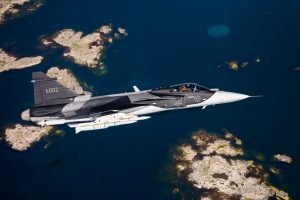
In his briefing to the Swedish Air Force Fan Club, on the eve of the Farnborough Airshow, Major General Jonas Wikman, the Chief of the Swedish Air Force, said that the 100th Anniversary of its founding on 1 July 1926 was a time of unparalleled change. He added that changing from being alone to being defensive with a conflict it had not planned for, with no offensive capability, with no long range strike after joining NATO was a big challenge
“The focus is on the here and now. We have taken part in 200-300 scrambles and been involved in two policing and an air defence deployment in the last 18 months and we now have to plan for a long conflict in Ukraine.”
He said that training with NATO is not a problem as they had been doing it for a long time from when Sweden was member state of NATO’s Partnership for Peace programme. He added that a single organisation for training, production and operations was being formed as a wartime training unit. “We cannot rely on the Air Force only for air defence of the country, we have to have access to sensors, communications and space from all domains. The advanced sensor suite of the first squadron of Gripen Es will be part of these multi-domain operations soon to be equipped with MBDA Taurus cruise missile,as will the GlobalEye AEW&C aircraft, three of which have been ordered to operate in the land, sea and air domains. They will replace the S-100D Argus aircraft that will be donated to Ukraine. There is also a planned Nordic Air concept with a C2 structure that will become a Joint Nordic Command.
“We are also increasing our dispersed operations, that are already the best in NATO. The concept is of a quick turnaround of combat aircraft by small teams of air ground personnel, often conscripts, in under 15 minutes at one of the several hundred landing sites that include public highways. We now need to carry out hot refuelling and re-arming at the dispersed sites in no more than 10 minutes”.
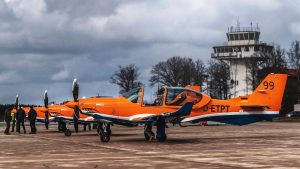
At the same time the Swedish Air Force is undertaking a comprehensive programme a re-equipment. Witman said that 13 Grob G120TP basic trainers had been delivered and that advanced training was under review. The result of the first fast jet pilots trained at the International Flight Training School (IFTS) in Italy on the Leonardo M346 are being analysed. Another option may be to join Finland that is looking for the Hawk replacement.
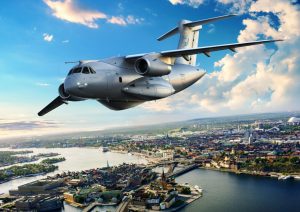
Four Embraer C-390 Millenium transport aircraft have been ordered to replace the air force’s C-130 Hercules fleet from 2027, which Maj Gen Litman said were the first to be delivered in Europe and “would be sorely missed”. The Swedish Air Force will receive a comprehensive training package from Embraer, including a Full Flight Simulator (FFS), a Cargo Handling Station Trainer (CHST) developed in partnership with Rheinmetall, and a Computer-Based Training (CBT) solution developed with ETI. Along with other European C-390 operators Austria and the Netherlands, Sweden will share spares supplies and engineering services. Sweden is a member of the NATO Multinational Multi-Role Tanker Transport Fleet (MMF) equipped with Airbus A330 MRTT aircraft, although Maj Gen Wikman said that the C-390 could become a KC-390 if equipped with the air refuelling kit. For strategic transport, Sweden is also a member of the Strategic Airlift Capability (SAC) equipped with C-17 Globemaster IIs.
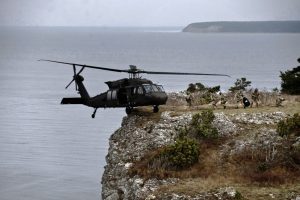
The Swedish Air Force is also taking delivery of 12 Sikorsky UH-60M Blackhawk helicopters in addition to 15 already in service. Wikman also confirmed that its NH90 fleet would be replaced at some time in the future and it is looking for a light helicopter to replace its A109E fleet.
The Swedish Air Force has a fleet of 96 Gripen C/Ds and two Gripen Es while it has requirement for 60 C/Ds and 60 Es. Asked would he be prepared to delay deliveries of Gripen E to the Air Force for some to be diverted to Ukraine, Maj Gen Wikman said “No!”
As for the future he said that the operations of both manned and unmanned platforms “are coming quicker then we saw, by 2030”, and that the manned Gripen will remain in service until 2045 by which time it will part of a package that will include Collaborative Combat Aircraft (CCA). As for a 6th generation fighter aircraft, GCAP will be watched for the future, but there is no active Swedish Air Force programme on the subject.
At the same briefing, he introduced Rear Admiral Anders Sundeman, the Swedish Chief of Space. He began by saying the space was an operational domain and Sweden launched its first operational military satellite on 4 May, 2026 from a SpaceX Falcon 9 rocket from Vandenberg Space Force Base in California. The satellite carrying an optical payload was provided by US company Planet Labs. As Sweden looks to increase its space assets, it will need to rely on US launch providers which are being constrained by military and commercial demands for new satellites.
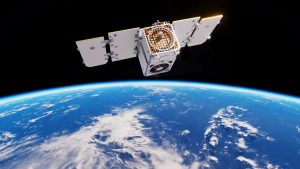
Admiral Sunderman said that later this year, the country plans to launch a Finnish-made Iceye satellite fitted with a synthetic aperture radar. In total, the military aims to have 10 operational satellites on orbit in the coming years. Sweden has also been working for five years to turn its main space-research centre into a launch pad for orbital missions.
“That’s the reason why we are keen on the launch facility in Esrange in Sweden to succeed,” Sundeman said. SSC Space, formerly known as the Swedish Space Corporation, is owned by the country’s government and is European Union’s first mainland spaceport. The facility will host its first orbital satellite launch, aboard Texas-based Firefly’s Alpha rocket, in 2028.
As the Swedish Air Force looks to expand its operations in space, Russia has been reportedly degrading GPS in the region, Sundeman said the main focus has been on its initial space assets which don’t have offensive capabilities but are as “robust” as possible. When asked about defending its country’s growing fleet, he said that the protection of Sweden’s satellites will be in co-operation with other nations. Large numbers of satellites are protection by itself.
The Swedish Air Force has survived and thrives in its first hundred years and expects to serve its nation well in the century to come.
Photos courtesy Embraer, D. Oliver, Planet Labs, Saab and Swedish Air Force
,
The post FIA 2026 – Swedish Air Force: a Century and still counting appeared first on EDR Magazine.
