

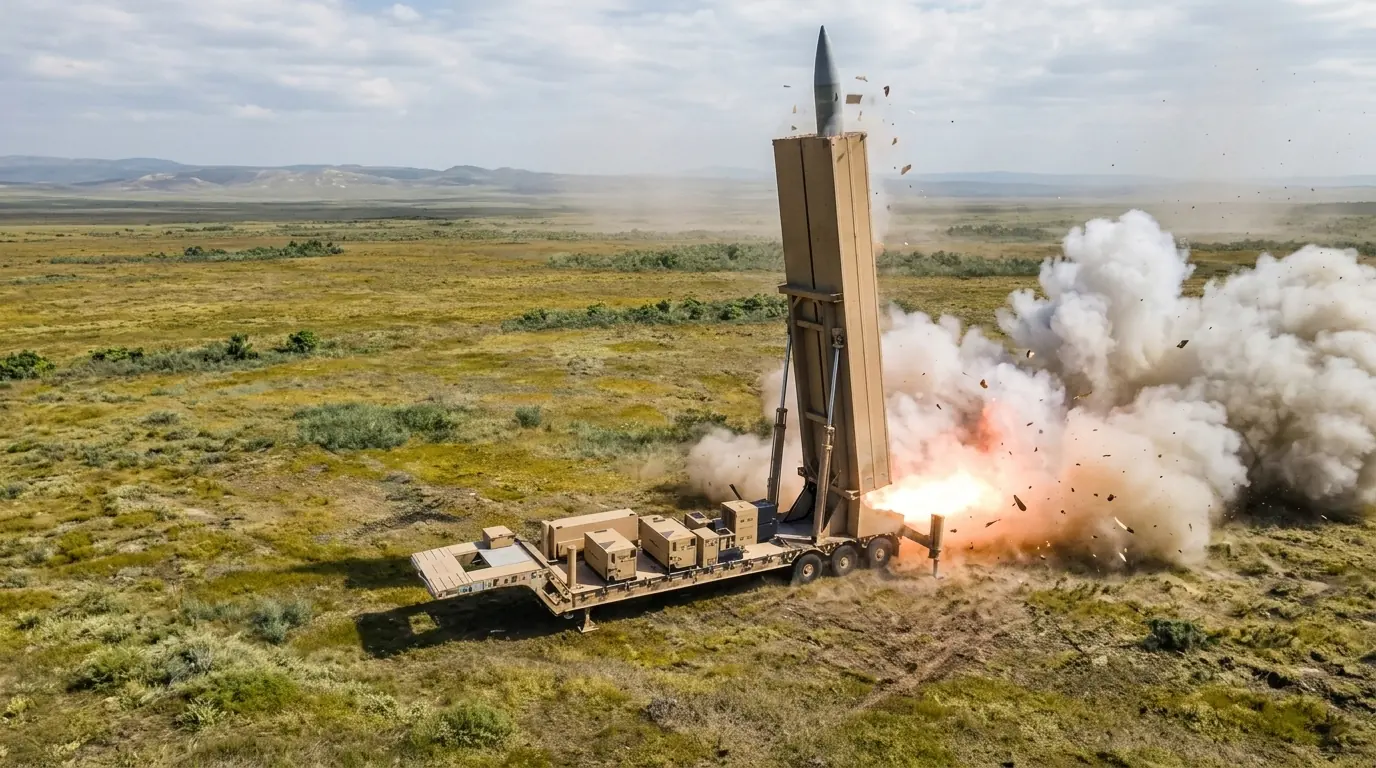
The Dark Eagle missile could give the U.S. Army a way to reach targets nearly 1,725 miles away without relying on conventional aircraft strikes. That’s a serious capability. But its real value depends on more than speed or distance.
Designed for long-range conventional strikes, the Dark Eagle missile aims to reach important military targets even when enemy air defenses make access difficult. Its hypersonic flight profile can shorten warning times and complicate interception, giving military planners another option during a crisis.
The timing matters. The United States faces growing challenges in the Indo-Pacific, where long distances, advanced missile systems, and contested airspace can limit how quickly forces respond. A weapon that can threaten distant targets from ground-based launchers could help address some of those problems.
Yet there’s a difference between a weapon’s intended performance and what it has demonstrated in operational service. Hypersonic missiles remain technically demanding systems. Testing, production, targeting intelligence, and deployment all affect whether their advertised capabilities translate into real military advantages.
Dark Eagle missile also raises a practical question: how much does this capability change the battlefield when each missile and its supporting equipment require substantial investment?
The answer isn’t simply that faster is better. A weapon becomes strategically useful when commanders can deploy it reliably, identify suitable targets, and achieve results that justify its cost.
What Is the Dark Eagle Hypersonic Missile?
The Dark Eagle missile is the U.S. Army’s answer to a growing military problem: how to strike critical targets at long range when conventional weapons may arrive too late or face strong defenses.
Its official program name is the Long-Range Hypersonic Weapon (LRHW). The Army adopted the name Dark Eagle to distinguish its system as it moves through development and fielding. The program also shares key technology with the U.S. Navy, including the Common Hypersonic Glide Body (C-HGB).
Why does that matter?
Developing a new class of missile is expensive and technically demanding. Sharing core components allows the two services to draw on common research while adapting their systems to different launch platforms and operational needs.
The Dark Eagle missile is designed for conventional long-range precision strikes. Rather than relying on an aircraft to fly deep into defended airspace, Army units could launch the weapon from a ground-based system positioned hundreds or even thousands of miles from a target, within the missile’s operational reach.
The Indo-Pacific is a major part of the strategic picture. Distances across the region are vast, and potential opponents have invested heavily in air defenses, long-range missiles, and systems intended to restrict an adversary’s freedom of movement.
Dark Eagle missile offers U.S. commanders another way to threaten important military assets without depending entirely on aircraft or slower missile systems.
Its intended targets include high-value military assets that may need to be reached quickly. The system’s speed and maneuverability are designed to make defensive tracking and interception more difficult, although they don’t guarantee a successful strike.
There is a catch, however. A weapon can be technically advanced and still offer limited military value if it is difficult to produce, costly to operate, or unavailable when commanders need it.
That’s why the Dark Eagle missile should be viewed as more than a missile development project. It is an attempt to expand the Army’s long-range strike options. Whether it becomes a dependable battlefield capability depends on testing, production, trained crews, and the wider network of intelligence and communications supporting each mission.
Dark Eagle Missile Specifications: Speed, Range and Size
The Dark Eagle missile’s reported range of approximately 1,725 miles (2,776 kilometers) gives the U.S. Army a way to threaten targets far beyond the immediate battlefield. Combine that reach with hypersonic flight, and the weapon becomes a serious option for missions where distance and response time matter.
But the specifications need context. Maximum range doesn’t mean every target within that distance can be engaged under every condition. Launch location, flight path, mission requirements, and available targeting information all affect how the weapon can be used.
Here are the key publicly reported details.
| Specification | Publicly reported information |
| Official program name | Long-Range Hypersonic Weapon (LRHW) |
| U.S. Army designation | Dark Eagle |
| Reported range | Approximately 1,725 miles (2,776 km) |
| Speed | Hypersonic, exceeding Mach 5 |
| Main components | Rocket booster and Common Hypersonic Glide Body |
| Launch platform | Ground-based mobile launcher |
| Intended mission | Long-range conventional precision strike |
| Exact operational performance | Not fully disclosed publicly |
The speed figure deserves a closer look. Mach 5 means five times the local speed of sound, but the equivalent speed in miles per hour changes with atmospheric conditions. Public reporting sometimes gives higher estimates for the Dark Eagle missile’s potential speed, yet exact operational flight data remain limited.
Range is equally important. A weapon with a reach of 2,776 kilometers could threaten targets across a large area without requiring the launch unit to operate close to hostile territory. Still, the missile’s practical reach depends on the conditions of a particular mission, not just the headline number.

The launch system also shapes its military role. The Dark Eagle missile uses large missile canisters mounted on specialized transporter-erector-launcher vehicles. These aren’t lightweight systems that can be moved without preparation. Army units need suitable transport, trained crews, maintenance support, and secure sites from which to operate.
One detail often gets lost in discussions about missile specifications: speed and range don’t tell us how accurately a weapon can hit a target or how reliably it performs under combat conditions. Public information doesn’t establish every aspect of the Dark Eagle missile’s precision, flight profile, or ability to defeat specific defenses.
Those unanswered questions matter. The specifications show why the Dark Eagle missile could be useful, but operational testing must establish how consistently it can deliver that capability.
How Powerful Is the Dark Eagle missile’s Strike Capability?
The Dark Eagle missile’s main advantage is its ability to threaten distant, high-value targets with very little warning. Its combination of hypersonic speed, long range, and maneuverability could give U.S. commanders options that conventional weapons cannot always provide.
Consider a crisis in the Indo-Pacific. An opposing force might move missile launchers, relocate command posts, or reposition other military assets as tensions rise. A strike weapon that travels at hypersonic speed could reduce the time available for those targets to move or for defenders to respond.
The Dark Eagle missile is designed for precisely this kind of long-range conventional strike mission. Its reported range of approximately 1,725 miles allows it to threaten targets far from the launch unit. Its glide vehicle can maneuver during atmospheric flight, making its trajectory more challenging to predict than a simple ballistic path.
That combination matters because missile defense depends on more than detecting an incoming weapon. Defenders must track its movement, estimate where it will arrive, and decide whether an interception is possible. A fast, maneuvering target can make those tasks harder, especially when warning time is limited.

But speed doesn’t automatically translate into greater destructive power.
The physical damage caused by a missile depends on its warhead, accuracy, target construction, and the effects required to achieve the mission. Dark Eagle’s complete operational performance and detailed warhead information aren’t publicly available, so claims about its precise destructive effects should be treated carefully.
Its strongest use case may involve targets that are both important and difficult to reach. A time-sensitive military asset presents a different challenge from a fixed facility, and a hardened structure may require a specific level of accuracy and impact that speed alone cannot provide.
Target intelligence is crucial here. If a mobile target relocates before launch, the missile may arrive quickly but still fail to achieve the intended result. Commanders need reliable location data and timely information throughout the targeting process.
The Dark Eagle missile’s real power, then, lies in the additional options it could give the Army. It can complicate an adversary’s defensive planning, but successful strikes will still depend on intelligence, readiness, and proven performance. Hypersonic speed creates an advantage, not a guarantee.
What Targets Can the Dark Eagle Missile Strike?
The Dark Eagle missile is designed to reach high-value military targets that may be difficult to engage quickly with conventional weapons. Its purpose isn’t to replace every missile in the U.S. Army’s arsenal. It’s to give commanders another option when distance, time, and enemy defenses make a strike more challenging.
Consider a mobile missile launcher preparing for a military operation. Once its position is detected, the launcher could move before a conventional strike reaches the area. Dark Eagle’s high speed could help reduce that window, provided U.S. forces have accurate targeting information and can act before the target relocates.
Command facilities are another potential target category. These sites help military leaders coordinate forces, share information, and direct operations. Disrupting a key command node could affect an opponent’s ability to respond, although the actual result would depend on the site’s role and the availability of backup systems.

The same principle applies to other high-value military assets, including selected long-range weapons and critical support infrastructure. The important factor is not simply the size of a target, but how much its loss could affect an adversary’s ability to operate.
The Dark Eagle missile also fits into the broader challenge of anti-access/area-denial, commonly known as A2/AD. These strategies use weapons, sensors, and air defenses to make it harder for opposing forces to operate near defended territory. A ground-launched weapon with long reach could help the U.S. Army threaten important targets without relying entirely on aircraft entering those areas.
However, the missile’s intended role should not be confused with proof that it can successfully engage every target in these categories. Public information doesn’t establish its performance against every type of hardened facility, moving target, or advanced defensive system.
Targeting remains a major constraint. Intelligence services must identify the correct asset, establish its location, and provide usable information before circumstances change. A highly advanced missile cannot compensate for a target that has been misidentified or has already moved.
That’s what makes the Dark Eagle missile a specialized capability. Its value comes from threatening targets whose location, importance, and time sensitivity justify the cost of a long-range hypersonic strike.
Why Does The Dark Eagle Missile Matter for U.S. Military Strategy?
The Dark Eagle missile matters because the U.S. Army wants to threaten distant targets without depending entirely on aircraft or conventional missile systems. In a conflict against a well-armed opponent, that extra option could change how both sides plan their operations.
The Indo-Pacific offers a clear example. The region covers vast distances, while potential adversaries have built layered air defenses and long-range weapons designed to limit U.S. military access. Aircraft may need extensive support to operate in contested airspace, and conventional strike weapons don’t always offer the range or response time commanders need.
The Dark Eagle missile is intended to help address that gap. With a reported range of about 1,725 miles, it could allow Army units to threaten important targets while operating far from the immediate front line. Its hypersonic flight profile could also make defensive planning more difficult by reducing warning time and complicating trajectory predictions.

This capability fits into a broader shift in U.S. Army planning toward long-range precision fires. Rather than treating land forces mainly as units that support operations near the front, the Army is investing in systems that can affect targets much farther away. Dark Eagle represents one part of that effort.
The strategic effect isn’t limited to the moment a missile is launched. An opponent may need to disperse key assets, strengthen protection around command facilities, or devote more resources to detecting launch activity. Those steps can consume time and money, even when no missile is fired.
But deterrence depends on credibility. If a weapon is expensive, scarce, or not ready when a crisis begins, its influence may be smaller than its advertised range suggests. Commanders need confidence that the system can perform its mission, not simply that it has demonstrated hypersonic flight in a test.
The Dark Eagle missile also won’t solve every access problem. It depends on reliable intelligence, secure communications, trained crews, and a functioning support network. An enemy can adapt, disperse assets, and develop new ways to track or counter the threat.
The strategic case is still clear. The Dark Eagle missile could expand the Army’s ability to hold distant military targets at risk. Its lasting value will depend on whether that promise becomes a reliable capability that commanders can use when it matters most.
Is the Dark Eagle Missile Operational?
The Dark Eagle missile has moved beyond a paper concept, but its operational status must be judged by more than successful missile tests. The real question is whether the U.S. Army can field a complete, reliable system and keep it ready for use when a crisis begins.
The program has undergone development and flight testing as the Army works toward deploying its Long-Range Hypersonic Weapon. These tests help engineers assess the missile’s performance and identify problems that could affect its future use. Yet a successful flight doesn’t prove that every part of the system is ready for combat.

A fielded hypersonic weapon requires much more than a missile that can fly at high speed. Army units need launch vehicles, trained crews, maintenance support, secure communications, and procedures for handling and moving the system. They also need timely intelligence to identify targets and support mission planning.
That distinction matters when assessing the Dark Eagle missile’s progress. A program can reach an important technical milestone while still facing work on production, training, logistics, or operational testing. These stages take time, especially when a system uses new technology and specialized components.
The Army’s ground-based launch configuration also brings practical challenges. Large launch vehicles need suitable roads, transport support, secure operating areas, and protection from surveillance. Units must be able to move and prepare the system without creating avoidable delays or exposing their location.
Public reporting on the Dark Eagle missile’s fielding has changed as the program has progressed. For an accurate account, readers should check the latest U.S. Army announcements and Congressional Research Service assessments rather than rely on older reports. Those sources can help distinguish planned milestones from confirmed delivery and operational readiness.
Even when a battery enters service, that doesn’t mean the Army has a large stockpile available for sustained operations. Production rates, procurement funding, and missile availability will shape how often commanders can use the system.
The Dark Eagle missile’s progress is worth watching, but the standard should remain clear: operational capability means more than proving the technology works once. The Army must demonstrate that the complete system can be deployed, supported, and used reliably under realistic conditions.
