

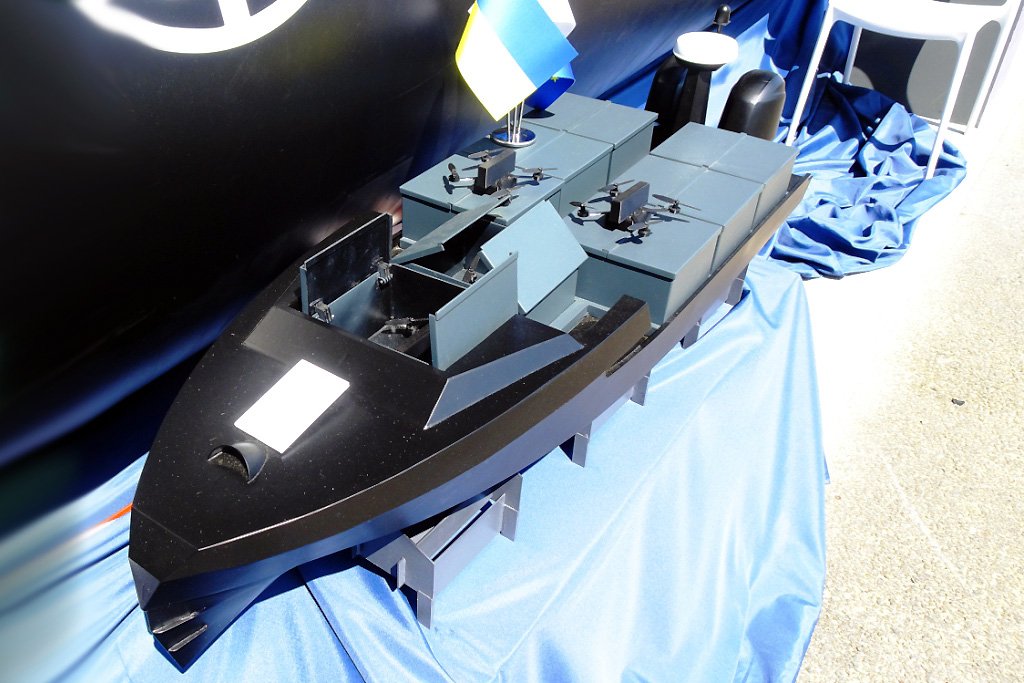
Ukrainian company Global Mark presented its multifunctional unmanned surface vehicle (USV) Triton on the Eurosatory open static display, together with a model of its new USV carrier for FPV drones
The Triton USV can carry a variety of payloads. Specifically, the USV can be equipped with a remotely controlled launcher with two AIM-9 (R-73) guided missiles and a remotely controlled weapon station (RCWS) with a 12.7mm Browning machine gun, 500 rounds of ammunition, and an optical target acquisition and designation station.
For surveillance and navigation, the USV uses a 360-degree day/night camera system alongside a fixed forward-looking day/night camera. Its hull is constructed of high-density polyethylene. Communications are supported through a nose-mounted anti-jamming Starlink terminal backed by an aft-mounted secondary anti-jamming communications station.
In the event of enemy capture, the USV is equipped with a hull self-destruct system, which includes a 7.5 kg warhead and a self-destruct mechanism.
According to specifications, the Triton USV measures 7.949 meters in length and 2.545 meters in width, with a waterline length of 6.9 meters. The platform has a light displacement of 1,971 kg and a full load displacement of 4,000 kg.
The USV is powered by either two Suzuki DF200 AP-2 engines or two Suzuki DF325 APX engines. It has a reported range of 600 nautical miles (1,110 km), a cruising speed of 22 knots (40 km/h), and a maximum speed of 40 knots (74 km/h). The system combines battery power capable of supporting up to 120 hours of autonomous operation with a 1,700-liter gasoline fuel tank.
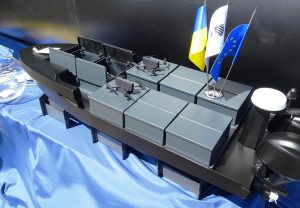
In addition to information about the Triton, the company presented the model of a new USV carrying FPV drones. This USV, which can be considered a further development of the basic Triton vessel, is a fully autonomous surface platform designed to deliver a tactical group of FPV drones to long-range maritime operations. The hull configuration of the new USV mockup differs from the hull configuration of the Triton USV, especially in the bow section, where the stabilizers are visible.
As explained to EDR On-Line at the company’s booth, the new USV is capable of delivering a swarm of VTOL FPV drones to a designated maritime area for various operations. This is achieved through the vehicle’s design, which includes eight box-shaped launch containers on the upper surface of its hull, each with two hinged flaps. Six containers are located in the aft section of the hull, with three containers on each side. Two more containers are arranged in tandem in the central section of the hull. Each container can accommodate four FPV drones, which are positioned one above the other and are retracted by a special mechanism for subsequent launch. The USV carrier can launch a tactical group of 32 FPV drones. No details were provided about FPV drones, models showing a quadcopter architecture; Global Marks portfolio includes two such FPVs, the Photon and the Vortex.
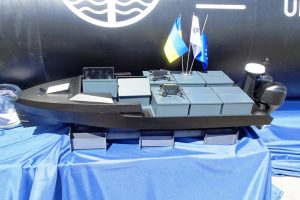
The USV’s stealthy hull is made of high-density polyethylene and features a small radar cross-section (RCS) from the front, rear, and side angles.
A flat, anti-jamming Starlink satellite antenna is mounted in the bow of the USV. Another backup, toroidal, anti-jamming antenna is mounted on a special bracket in the stern, where two outboard motors are also located.
Global Mark plans to implement a swarm control system on the new USV carrier for FPV drones. This is an advanced control architecture that allows multiple unmanned platforms or an entire tactical group of drones to operate as a single, coordinated unit. Each drone operates autonomously, constantly exchanging data with the others, forming a distributed intelligent network. According to a company representative, the FPV-drone carrier can be used for maritime surveillance, reconnaissance and information gathering, coordinated strikes, monitoring of required areas, and infrastructure protection operations.
Graphics courtesy Global Mark, photos by N. Novichkov
