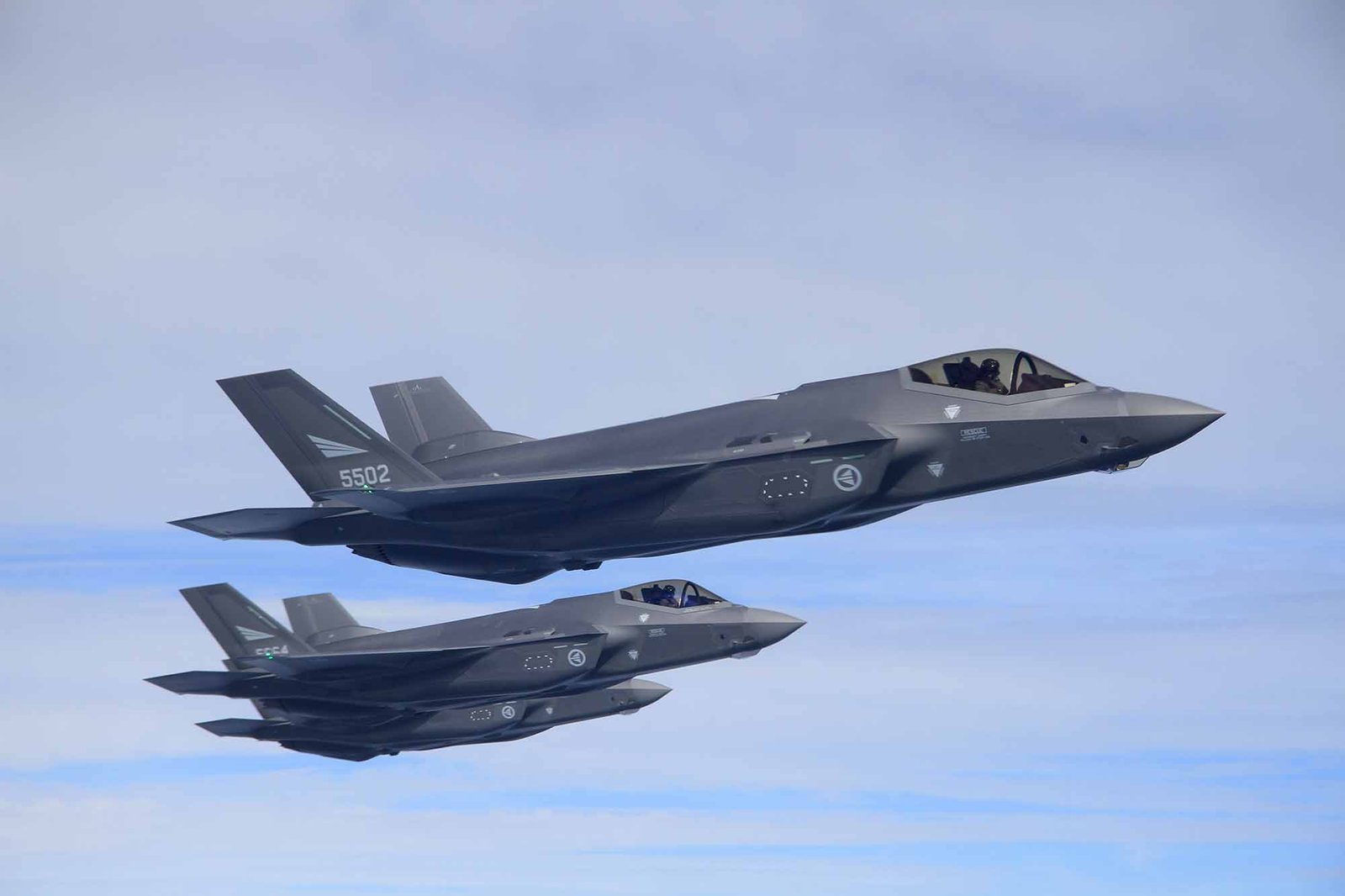
Contents Since the beginning of the full-scale war in Ukraine in February 2022, several European countries, including Czechia, Germany and Switzerland, spurred on by the possibility of closer integration and security ties with the US, have signed contracts for the F-35A. While Denmark increased its order by 17 to 43. That means there will be 19 foreign operators: Australia, Belgium, Canada, Czechia, Denmark, Finland, Germany, Greece, Italy, the Netherlands, Norway, Israel, Japan, Poland, Romania, Singapore, South Korea, Switzerland and the UK. Only five of these air forces are not part of NATO, but Israel, Japan, Singapore, South Korea are very close allies of the US.
Of the above; the US, Australia, Germany, Greece, Italy, Israel, Japan, Poland, Singapore, South Korea and the UK will operate the F-35s alongside another type that we generally call Generation 4/4.5 fighters. Most of these air forces will integrate their existing fleets of fighters with the cutting edge-F-35s. This will make operations a lot cheaper, so it’s imperative they have common systems that can communicate to each other. Exercises take place worldwide, practising this because should the unthinkable happen and war break out with the likes of China and Russia, both NATO and Asian allies will be counted on to support their US partner.
During these operations, F-35s will generally fly deep into enemy territory using their multiple sensors, and switch roles seamlessly. Data-linking this back to joint headquarters, or the CAOC (Combined Air Operations Centre) or to Generation 4/4.5 fighters such as the Eurofighter, F-16, F/A-18 Super Hornet, Rafale, Gripen is important.
While many US allies have procured F-35s, that has not been the case in the Middle East, much to the frustration of Saudi Arabia and the UAE. Strict US laws ensure Israel maintains a Qualitative Military Edge (QME) over any regional state. Should all the Middle Eastern nations sign up to the Abraham Accords, as the US might wish, initiated in 2020 to normalise diplomatic, economic and security relations between Israel and Muslim-majority nations, then the F-35 could very well end up operating in the Middle East.
Other major obstacles for potential F-35 purchasers are US concerns over the compromising of cutting-edge technology, the risk of foreign adversaries (such as China and Russia) gaining access to the aircraft’s data, and restrictive end-use monitoring.
Capital costs, operational costs, ITAR (International Traffic in Arms Regulations) and political differences can also stop countries from selecting the F-35. Türkiye has been expelled from the programme, because of their purchase of Russian-made S-400 Triumf (NATO reporting name: SA-21 Growler) surface-to-air missile system. It was argued, justifiably by the US, that the F-35 working with a highly advanced Russian SAM system within NATO would compromise some of its secrets, with the likes of Russia.
Back to top ↑
Other Advanced Tactical Fighters Two new fighters currently under development are South Korea’s KF-21 Boramae and Türkiye’s Kaan. Both nations are looking for export sales to offset the huge cost of developing such an aircraft. Indonesia has shown interest in both aircraft. That would diversify even further its large variety of fighters, that include the F-16 Block 50s, Sukhoi Su-27s/Su-30s and Rafales will be joined by Chengdu J-10CEs within two years, US rivals include Russia, which is selling the Sukhoi Su-35 “Flanker” and Su-57 “Felon”, while China has successfully exported the Chengdu J-10CE to Pakistan and marketed it to other potential buyers, and the JF-17C Thunder Block III—produced in a joint programme with Pakistan—which has been exported to Azerbaijan. Myanmar and Nigeria have acquired earlier JF-17Cs that do not house the Block III’s Chinese KLJ-7A Active Electronically Scanned Array (AESA) radar. China will not export the fifth-gen J-20.
Eurofighter More than 32 years after making its first flight on 27 March 1994 the Eurofighter is still a good option. All four partner nations, Germany, Italy, Spain and the UK accepted their first examples in 2003/04. These fighters are now over 20 years old, and the 148 early Tranche 1s, through their outdated software systems, cannot realistically be upgraded. The remaining 450+ Block 2/3s can, however be upgraded with new software allowing them to include AESA radar and new weapons through software, avionics tweaks.
The German Air Force has 58 new Eurofighters on order all of which are expected to be upgraded with the ECRS Mk1 radar. (Image: Alan Warnes) Today, the jet is undergoing another massive modernisation push to ensure it remains a premier combat aircraft for NATO, European air forces and the Middle East. Current enhancements under the Long-Term Evolution (LTE) and Phase 4 Enhancement (P4E) focus on upgrading the radar, electronic warfare systems and cockpit avionics. The LTE, a major midlife upgrade, signed in December 2024 will see several major improvements that should keep the Eurofighter at the cutting edge of technologies into the 2060s. This will also allow an easier transition to the UK/Italy and Japan backed Global Combat Air Programme (GCAP), or whatever arises in France, Germany and Spain after the end of FCAS/SCAF.
Upgraded mission computers and high-speed data networks will handle massive amounts of digital data, allowing the aircraft to fuse data from advanced, multi-spectral sensors like the F-35 in real time, greatly reducing pilot workload. There will be large area displays in a modernised cockpit, enhancements to the Praetorian Defensive Aids Sub System (DASS), upgrades to the EJ 200 engine to boost the thrust, bringing not just an increase in power and cooling capabilities but the integration of heavier, highly advanced weapons such as long-range strike weapons, anti-shipping missiles and others for the SEAD/DEAD (Suppression of Enemy Air Defence/Destruction of Enemy Air Defence) missions. To improve manoeuvrability when carrying heavy loads, like the AARGM (Advanced Anti-Radiation Guided Missile), Eurofighter GmbH has developed the Aerodynamic Modification Kit (AMK) to boost wing lift and low-speed handling.
Transitioning to modern AESA family of radars will continue to improve the Eurofighter’s prowess. German and Spanish Eurofighters will house the ECRS (European Common Radar System) Mk1, while the UK and Italy are developing the advanced ECRS Mk2 to equip the RAF and Italian jets with superior electronic attack capabilities. The ECRS Mk1 is a next-generation multichannel AESA radar developed jointly by Germany’s Hensoldt and Spain’s Indra to provide German and Spanish Eurofighter fleets with upgraded air to air modes, high-resolution SAR (Synthetic Aperture Radar) imagery and electronic warfare capabilities.
In Germany, the new radar is to be integrated into the 38 new Tranche 4 Quadriga aircraft and 20 recently ordered Tranche 5s, as well as retrofitting older Tranche 2/3 aircraft. The Spanish Air Force is integrating the ECRS Mk1 into 20 new Tranche 4s (to be based in the Canary Islands) under the Halcon I programme, and into 26 Tranche 4 aircraft under Halcon II.
The ECRS Mk2 significantly enhances targeting capabilities and incorporates advanced electronic warfare and electronic attack functions. The UK and Italy are collaborating on the ECRS Mk2 roll-out through Leonardo, and BAE Systems. This will equip the RAF’s fleet of 40 existing Tranche 3s and Italy’s 24 new Eurofighter Typhoons to the ‘Next Generation’ (NG) standard. The first RAF production-standard radars for the RAF Typhoons will be rolled out in 2028 and full integration across the fleet completed by 2030. A £453.5 million contract was awarded by the UK government to BAE Systems for the production of the ECRS Mk2 radars for the RAF, that will cover 38 new radar sets and the refurbishment of two test-beds.
These new radars will not just introduce advanced electronic warfare and electronic attack (in the ECRS Mk2, instead of relying on support aircraft), but enhanced target detection and tracking and to extend guidance ranges of modern air to air weapons.
Two other Eurofighter customers, Qatar (24 aircraft) and Kuwait (20) have acquired the earlier ECRS Mk 0 also known as Captor-E, providing both nations with increased tracking, bandwidth and electronic warfare needs.
In October last year, Türkiye ordered 20 new Eurofighters in a contract valued at £5.4 billion which includes advanced weaponry such as Brimstone and Meteor BVRAAMs, training simulators and BAE Systems support. Additionally, 24 second- hand examples from Qatar and Oman are being acquired, originally supplied by BAE Systems. The deal plugs a capability gap between retiring F-16s and the introduction of Türkiye’s Kaan fifth-generation fighter (see later) caused by Ankara being expelled from the F-35 acquisition programme.
The Eurofighter has 13 external hardpoints that can carry 9,000 kgs (19,800 Ibs) of weaponry. Air-to-air missiles cover Meteor BVRAAM, AIM-120 AMRAAM, AIM-132 ASRAAM, IRIS-T. When it comes to air-to-surface weaponry there is the Storm Shadow cruise missile, Taurus KEPD 350 cruise missile (on German Typhoons only), Brimstone/Brimstone 2 dual mode anti-armour missiles, Paveway IV 500Ib GPS/laser PGM, GBU-48/-54 laser guided munitions and most recently the APKWS (Advanced Precision Kill Weapon System) in use by RAF Typhoons as a laser-guided counter-unmanned aerial system. The Marte-ER anti-ship missile is integrated on Italian Air Force Eurofighters.
Eurofighter Customers Austria (15), (Germany (181, plus 58 on order), Italy (95+24 on order), Kuwait (21, out of 28 on order), Oman (12, but selling them to Türkiye), Qatar (24 plus 12 on order and 12 being transferred to Türkiye), Saudi Arabia (72), Spain (70+45 on order), Türkiye (40, plus 23 from Qatar and Oman), and the UK (160)
Back to top ↑
Dassault Rafale The Rafale C made its first flight on 19 May 1991 followed by the carrier-based Rafale-M on 12 December 1991 and dual-seat Rafale B on 30 April 1993. The first Rafale to be delivered was the French Navy’s Rafale M in 2004 and a Rafale C to the French Air Force in 2006. Similar time-lines to the Eurofighter, but of course Dassault was working on three different versions.
The Dassault Rafale has seen phenomenal sales success over the past ten years, having gained eight export customers during that time. (Image: US Air Force) The French jet was the first fighter in Europe to be equipped with an operational AESA radar, the Thales RBE 2. Connectivity with other assets and sensors has been one of the driving forces behind the fighter’s development. Thales has played a significant role in this, as you might expect for a fighter that delivers effects through its sensors – it was once termed ‘Omnirole’ before network integration was popular.
Three advanced systems provide the key to this – the Talios automatic targeting targeting pod, Front Sector Optronics (FSO) with the IRST (Infra Red Search and Track) enabling long-range threat detection and EVS (Enhanced Vision System) ensuring superior visibility in challenging environments. Thales believes that together they represent the pinnacle of electro-optical technology, enhancing combat efficiency and flight safety. The French company also supplies the SPECTRA (Self Protection Equipment Countering Threats to Rafale Aircraft) electronic warfare suite which is totally integrated into the Rafale. While Thales boasts ‘it is the basis of survivability in the face of the latest generation of air-to-air and air-to-ground missiles’, the Rafale did not fare so well when it was confronted by Pakistan Air Force J-10CEs with the very capable Chinese PL- 15E very long-range air-to-air missile in May 2025. The loss of Indian aircraft saw Thales admitting the SPECTRA protection will only function properly if the pilots are trained how to use the system properly. Thales is now upgrading SPECTRA.
Today, the Rafale is further evolving into what is termed the F4 standard upgrade with its hyper-connected combat ecosystem. Key upgrades in the latest F4 and F4.1 standard include the Thales Scorpion helmet mounted display, AI-assisted automatic target recognition in the Talios targeting pod and integration of the Mica NG air-to-air missile. The F5 Rafale that Dassault claims is fifth-generation standard is tailored to bridge the gap towards sixth-generation platforms. Features include the Safran M88 TRX engine that is expected to yield 20% more power, upgraded AESA radars, and the capability to field the new ASN 4G hypersonic nuclear missile. The Rafale is equipped with up to 14 hard points and supports up to 9,500 kg (20,900lbs) of external payload. It has been cleared to operate the Meteor BVRAAM, Mica RF, Mica IR in the BVR and WVR intercepts, 250 kg and 1,000 kg Hammer (Highly Agile and Manoeuvrable Munition Extended Range) rocket-boosted air-to-ground precision guided weapons fitted with INS/GPS, INS/GPS/IIR (imaging infra-red) or INS/GPS/laser guidance kits at the front, and with a range augmentation kit at the rear. There is also the SCALP cruise missile, AM 39 Exocet anti-ship missile, various laser guided bombs, non-guided classic bombs and the Nexter 39N791 30 mm internal cannon.
Rafale Customers Croatia (12), Egypt (55, 42 delivered to date), France (234, 160 delivered), Greece (24), India (62, 36 delivered and 26 Navy versions outstanding), Indonesia (42, six delivered), Qatar (36), Serbia (12, none delivered yet), United Arab Emirates (80, none delivered yet).
Back to top ↑
Saab Gripen The first Saab Gripen flew on 9 December 1988 and entered operational service with the Swedish Air Force on 9 June 1996. Initially, they were Gripen A/Bs, then came the Gripen C/Ds with an air-to-air refuelling capability, making its first flight on 14 August 2002.
Saab has set out an operational roadmap for the C/D up to 2050, which will include two significant radar enhancements – the PS-05/A Mk 4 radar and later Saab’s own Mk 5 [AESA] radar. The Mk 4 antennae can be switched to AESA in the future with the current hardware, but both the Swedish Air Force and Hungarian Air Force prefer the longer-range detection, which you get today with the performance of the Mark 4 radar. The Mk 4 is a huge step forward – there is a specifically increased detection capability to find low radar cross section (stealthy) aircraft. There is also an improved suppression of air defence (SEAD) mode. SEAD is a major part of Gripen’s evolution, with the SwAF now looking at long range stand-off munitions (like the Taurus KEPD 350) and an increase in recce capability is a future upgrade.
Gripen Cs serve the air forces of Czechia (seen here), Hungary, South Africa, Sweden, and Thailand. (Image: Alan Warnes) Saab does have a roadmap beyond its Mk 4 with work already undertaken on an AESA fighter radar known as Mk 5. Saab sees great possibilities, and its modular, adaptable and scalable design means it can be used for a range of other applications.
The announcement that Sweden would operate the Gripen C/D until 2036 was embraced by the Hungarian Air Force, which now intends to keep the Gripen in service until 2036 too. Its Gripens are being upgraded with the PS-05/A Mk 4 extended range radar, and with the updated software new weapons will be implemented like the Diehl IRIS-T short-range air-to-air missile, Meteor BVRAAM and GBU-49 Enhanced Paveway II. Hungary has also acquired four additional Gripens with two delivered in early May, that will eventually increase the total to 18. Czechia has ordered 24 F-35As that should be operational in 2031 but will work alongside the 12 CzAF Gripens until 2036 when the F-35As are fully operational.
Gripen Customers The Swedish Air Force operates 100 Gripen C/Ds, delivered between 2004 and 2015. They have also been exported to Czechia (14), Hungary (16, two to be delivered imminently), South Africa (26) and Thailand (8).
Gripen E Just as Gripen C/D production was getting underway, Saab understood a need for a longer-term solution, the Gripen E/F. When compared to the earlier Gripen C/D, the single-seat Gripen E and dual-seat Gripen F has a completely new set of avionics and passive sensors. The system is built with no architectural constraints between the hardware and software. Its integrated sensor system utilises artificial intelligence, that can detect stealth aircraft from hundreds of miles away. Leonardo will supply the Raven ES-05 AESA radar and the Skyward IRST, Saab will bring the Arexis EW suite and Electonic Attack Jammer pod.
The objective is to continuously modify the Gripen E so that whenever new challenges arise it can be adapted, this can mean contracts are tweaked to meet new requirements without jeopardising delivery. The Brazilian Air Force has ordered 36, made up of 28 single-seat Gripen Es and eight dual-seat Gripen Fs. A Gripen E production line has been set up at Gaviao Peixoto in Brazil, with 15 of the initial Gripen E order to be built there. To date, one was delivered in March 2026 to the Brazilian Air Force, joining ten Gripen Es built at Saab’s facility in Sweden. Sweden will build 13 Gripen Es and all eight Gripen Fs.
Gripen Es have been ordered by Sweden, Brazil (one of the two-ship seen here) and Thailand. (Image: Saab) Gripen Weapons IRIS-T (Known locally as Rb98), AIM-9/Rb-74 Sidewinder and A-Darter, GBU-12 Paveway II laser guided bombs, Mark 82 bombs, GBU-39 Small Diameter Bombs, SPEAR-EW (currently under development), Rbs-15 anti-shipping missile with a newer development, RBS-15 Mk4 that will have a range of over 300 km, while the KEPD350 is also being integrated.
Gripen E Customers Sweden (60, two delivered), Brazil (28 Es, 8 Fs with a requirement for 66. 11 Es delivered so far), Thailand (3 Es, 1 F to be delivered by 2030).
Back to top ↑
F-16 Block 70/72 This model, the most advanced version of the F-16, with over 4,500 sold worldwide, was first announced at Singapore Airshow in February 2012. Improvements over the earlier F-16s include a Northrop Grumman APG-83 Scalable Agile Beam Radar (SABR) AESA radar, derived from both the F-35’s AN/APG-81 and F-22’s AN/APG-77. Other areas of modernisation include a new modular mission computer, cockpit enhancements like the large centre pedestal display and the L3 Harris AN/ALQ-254 Viper Shield electronic warfare suite. The latter acts as digital armour, providing pilots with instantaneous threat detection and automated jamming to disrupt adversarial radar systems and surface-to-air or air-to-air threats. The first F-16V as the original concept was labelled, made its first flight on 16 October 2015. Air forces can buy the new F-16 or upgrade existing F-16C/D Block 50/52s as Poland will. Block 70s are powered by the General Electric F110 powerplant, and the Block 72 by the Pratt&Whitney F100.
The Martin Baker US 18E ejection seat was selected by Lockheed Martin for the new F-16 in November 2020. With the first one appearing on the lead ship of the 66 RoCAF (Republic of China Air Force) F-16 Block 70 acquisition in December 2025. The Peruvian government announced on 23 April that it intended to the purchase 12 new F-16 Block 70s, and contract negotiations are now underway.
Weapons include AIM-9X Sidewinder, AIM-120C AMRAAM; AGM- 154 Joint Stand-Off Weapons, AGM-84 Harpoon anti-ship missiles and AGM-88 High-Speed Anti-Radiation Missiles (HARMs).
F-16 Block 70/72 Customers Bahrain (16 Block 70s), Slovakia (14 Block 70s), Bulgaria (16 Block 70s, eight delivered), Taiwan (66 Block 70s), Morocco (24 Block 72s and upgrading 23 existing Block 52+), Jordan (12 Block 70s) Poland (48 Block 72 upgrades), Greece (84 Block 52 to be upgraded to Block 72 by Hellenic Aerospace Industries, 50 upgraded so far), South Korea (134 KF-16s being upgraded by Korean Aerospace Industries, and known locally as KF-16U), Türkiye (cancelled the upgrade of 79 F-16Cs and the purchase of 40 new Block 70s, instead opting for the OZGUR II upgrade).
Back to top ↑
Korean Aerospace Industries KF-21 The twin-engined Generation 4.5 KF-21 Boramae fighter with semi-stealth capabilities made its first flight on 19 July 2022 with serial production starting in July 2024. Most of the technologies are Korean (around 66%). Lockheed Martin did agree to transfer 25 technologies linked to the purchase of 40 F-35As for the ROKAF but pulled back from the transfer of technologies for an AESA radar, electro-optical targeting pod, radio frequency jammer (RF-J) and infrared search and track (IRST). This has left KAI to develop these capabilities.
While the KF-21 engineering and manufacturing development phase was completed in December 2025, the six prototypes continue to play their part, with the aircraft being certified in March. The first examples are set to be handed over to the Republic of Korea (ROKAF) on 1 September 2026. The ROKAF has ordered 40 Block 1 KF-21s to date but has a longer-term goal to acquire 120 by 2032. Under its spiral development approach there has been a significant upfront investment in design, that will see initial Block 1s engineered with the goal of implementing future upgrades.
At the World Defense Show in Saudi Arabia earlier this year, KAI showed models of many of the weapons that could equip the KF-21. These included the LIG L-MCM (Korean Multi-Purposer Cruise Missile), Sky Dragon KALCM (Korean Air-Launched Cruise Missile), KGGB (Korean Ground GPS Bomb) and SRAAM (Short-Range Air-to-Air missile). By February 2026, the Boramae had accumulated nearly 1,650 flying hours. With both the MBDA Meteor and Diehl IRIS-T air-to-air missiles now ready for operations on the KF-21, the focus now appears to be shifting to air-to-ground weapons. With the KGGB and the KALCM will be among the first.
There are currently six KF-21 prototypes flying with KAI. The first serial production aircraft should be handed over to the Republic of Korea Air Force by the end of this year. (Image: KAI) Next generation manned-unmanned teaming will play a major part in the aircraft’s development. The aircraft’s advanced data-link capabilities and data-fusion means the KF-21 can delegate such tasks as SEAD, EW and forward reconnaisance to the “Loyal Wingman”.A tandem seat KF-21 variant is being developed to allow the back seater to concentrate on being a dedicated mission commander for the unmanned swarm. This was shown for the first time in mock up form at Dubai Air show 2025. On 15 April 2026, the first mass-produced KF-21 Boramae successfully completed its maiden production test flight at the 3rd Training Wing in Sacheon, just 21 days after its official rollout ceremony.Indonesia has always had plans to partner on the KF-21, and despite an on-off relationship looks set to become involved once Jakarta has completed its 600 million Won contribution set for June 2026. This will see a KF-21 prototype being transferred to Indonesia. There was an initial requirement for 48 localised variants but Indonesian intentions remain unclear.On 28 January 2026, a high-level delegation led by Prince Turki bin Bandar bin Abdulaziz Al Saud, Commander of the Royal Saudi Air Force (RSAF), visited the KAI headquarters in Sacheon to discuss strategic cooperation in the aerospace and defence sectors. The UAE is also reportedly keen to join the KF-21 programme, with the UAE considering a major strategic investment that will enhance the UAE’s aerospace industry while at the same time providing the basis for developing the aircraft to its own requirements. Boromae weapons include: Meteor, IRIS-T, AIM-120 and AIM-9X and Korean developed systems.KF-21 Customers The Republic of Korea Air Force has a stated requirement for 120 KF-21s – 40 Block 1s and 80 Block 2s to replace F-4, F-5s and eventually F-15EKs and F-16s.
Back to top ↑
Turkish Aerospace Industries Kaan One aircraft unlikely to work with the F-35 is the Turkish Aerospace Industries KaanTürkiye enjoys a turbulent relationship with the US, with Ankara expelled from the F-35 programme and Türkiye later abandoning its huge F-16V upgrade programme. Kaan will eventually be an ITAR-free fifth generation fighter, free of restrictions from the US.
The Kaan development aircraft made its first of two flights on 21 February 2024, before being grounded. TAI’s claim is that flight testing gleaned the targeted data during earlier test flights that is being incorporated into the three ptototype aircraft. The Kaan prototypes are currently in production and the first is expected to conduct its maiden flight in June, while the second is expected to fly towards the end of this year or early next year and the third after that. The first serial production jet should be delivered in 2029. The company says it is now working towards sixth-generation concept and will be among the pioneers shaping that future.
In terms of the Kaan’s market potential, the Turkish Air Force has an initial requirement to acquire 100 aircraft to replace its fleet of F-4E Phantoms and some F-16s. The prototypes and initial serial production aircraft are being powered by the GE F110 afterburning turbofan, but plans are it will eventually rely on a Turkish engine, within five years.
An export agreement with Indonesia was concluded at Türkiye’s IDEF exhibition in July 2025 for 48 aircraft, to be delivered with an indigenous engine but according to Indonesian sources this was more of a political gesture. Regardless, the company believes Kaan will form the backbone of the air forces of at least two countries in the next five to ten years.
The Turkish fifth-generation fighter, Kaan could be in big demand, not just by Türkiye, but by customers like Saudi and UAE who will want big numbers. (Image: TAI) While the first two serial production batches, Block 10 and 20 will be powered by the F-16’s F110, the new Turkish engine should be ready for the third tranche, Block 30. There will be no difference between Block 10 and 20 in terms of capabilities, but the Block 20s will enter service with newer software and enhanced systems readiness that will find their way into Block 10. The first weapons will be Turkish, from Roketsan, SAGE and Aselsan plus any other foreign weapons that are operational.
The Kaan will not work with F-16s, instead the Turkish Air Force is focusing on manned-unmanned teaming. Kaan will replace the entire fleet of 240 Turkish Air Force F-16s by the mid-2030s with manned-unmanned teaming developments in place, which will include both the Anka-III, Aksungar UCAS and Super Simsek subsonic multi-mission UAS.
This fifth-gen fighter is seeing some keen interest from the two biggest military spenders in the Middle East – Saudi and the UAE. In late 2024, a visit by Royal Saudi Air Force Commander, Prince Turki bin Bandar al Saud brought reports that Saudi was keen on the Kaan.
While the US continues to deny the export of the F-35A to Saudi and the UAE, due to concerns from Israel, Kaan could be a very good option. Both have burgeoning indigenous defence industries, and the Kaan could bring a lot of technology transfer, if both countries wanted enough numbers of the Kaan.
Türkiye has a requirement for around 250 of the new jet, and Saudi has a need for around 100 to replace the older Boeing F-15s and Tornado aircraft, while the UAE seeks a successor to its 80 F-16 Block 60s. UAE has been looking for a fifth-generation fighter for several years, having agreed to purchase 50 F-35As during the first Trump administration in 2020. The US apparently pulled out during Joe Biden’s term in office due to pre-conditions over UAE’s relationship with China.
The first deliveries to Türkiye will be the 20 basic Block 10s in 2028/29, then 20 Block 20s (no difference In terms of structures, but in software and systems readiness) and the Block 30s with the new Turkish engines should be available in six to seven years. All the aircraft will be upgraded to Block 30 and exports are unlikley to take place before the early 2030s
Author: Alan Warnes
Click here to read the latest issue of ESD.