

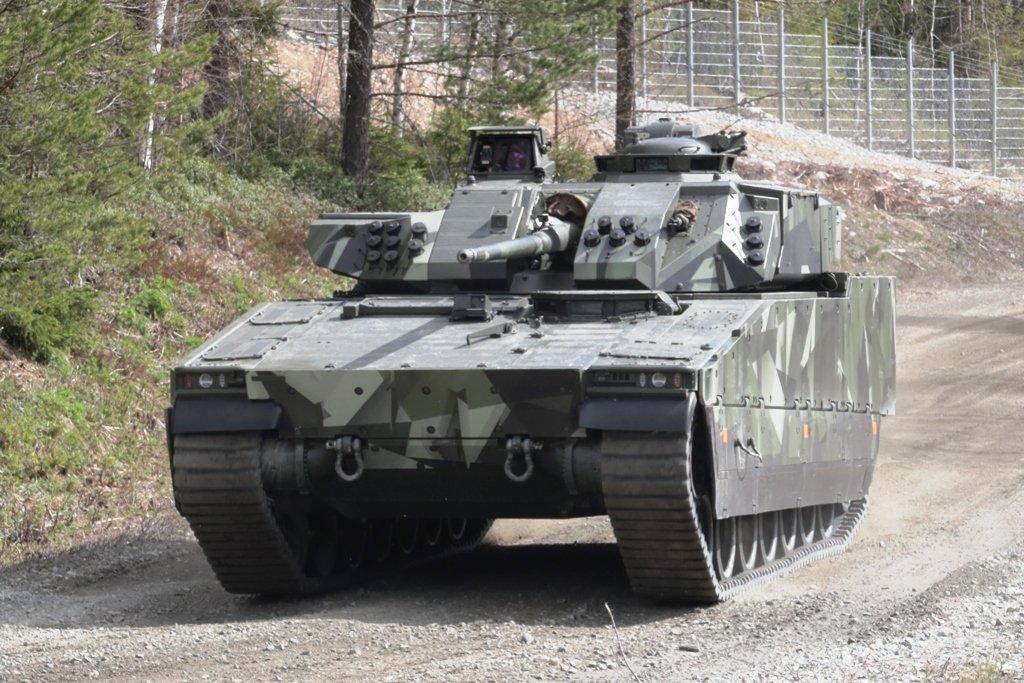
BAE Systems Hägglunds CV90 infantry fighting vehicle as well as the all terrain vehicle, the latter in the BVs10 armoured version and the Beowulf soft skin version, are being produced at full steam at the Örnsköldsvik plant, in northern Sweden, and not only
Starting from the heaver vehicle, the 36 tonnes CV90, its production is based on a distributed industry model that sees Norway, Finland, the Netherlands, Denmark, Slovakia, Switzerland and the Czech Republic all involved in turret production, some of them in chassis production, as well as in upgrade programmes. This production capacity to be added to that in Sweden, where usually a pilot series is produced before switching production to a partner nation.
This is a strong indication of the importance that customers have for the Swedish company, and of the close relationship that has been created between BAE Systems Hägglunds, its partner industries and customer armed forces, which led to the creation of the CV90 Club, a platform for the exchange of lessons learned, new needs, and operational experiences.
An example of how much the development of the product is integrated with the requirements definition by customers is the CV90 MkIV, the latest iteration of the armoured fighting vehicle developed between the 1980s and 1990s by the companies Hägglund & Söner and Bofors, today both part of the BAE Systems group, together with the Försvarets materielverk (FMV), the Swedish Defence Materiel Administration.
The Mk IV was developed hands in hands with the Koninklijke Landmacht, the Royal Netherlands Army. “It is the close work with customers that actually makes the vehicle successful,” Tarkan Turkcan, Director of the CV90 Platform at BAE Systems Hägglunds stated during a briefing provided at the company Test and Verification centre. Himself serving in the Royal Netherlands Army armoured corps for three decades, he closely followed the requirements drafted by that nation for the upgrade of its CV90 fleet, which in fact saw the design of a brand new digital turret. “We ran cognitive tests with crews. We used a Dutch platoon, put them into a high fidelity simulator, gave them a World War III scenario for a couple of hours, in order to see where the human being started to switch off,” he explained, this extending to ergonomic considerations. That programme added new capabilities to the combat platform, such as the Iron Fist active protection system (APS) by Elbit Systems and the Spike LR2 antitank missile by Rafael, while retaining the original gun. These and other improvements set the standard for the CV90 MkIV configuration.
In December 2022 the Slovak Republic filed an order worth 1.37 billion US$ for 152 CV90 MkIV35, the Czech Republic followed in May 2023 for 246 CV90 MkIV30 for 2.2 billion US$, the last order being the one from Denmark and Sweden, respectively for 115 CV90 and 50 MkIIIC, to which 40 more vehicle are added aimed at Ukraine, for a total of 2.5 billion US$.
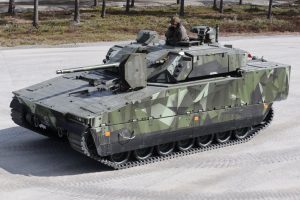
Improvements over the Dutch version were added, a key one being the adoption by Slovakia of the 35 mm Northrop Grumman gun fitted with a programmer allowing the use of that same company 30×173 mm ABM PMD428 ABM/KETF [1]. The coaxial machine gun was moved outside the turret allowing for a higher number of ready rounds, avoiding toxic gases inside the turret, as well as the ballistic hole in the armour. All new CV90s come with rubber tracks, that considerably reduce vibrations, not only for humans comfort but also for all vetronics and communications equipment. The drivers wheel has become similar to that of a Formula 1 car, the smoke grenade discharger command being now a red button in the middle of the steering handle, while all buttons can be reached without taking off the hands from the wheel, a key factor when driving at speed over uneven terrain.
November 2025 saw the signature of the Technical Agreement for the Nordic Programme, which is led by Sweden, with Norway, Finland, the Netherlands and Lithuania, the signature of the actual contract being expected before year end. EDR On-Line understood that the Slovak standard will be the baseline vehicle for that programme, which will help in speeding-up production if only minor changing will be required.
Beside vehicles production, spare parts are also being generated at a higher pace, as nations are considering increasing their logistics to war-level stocks.
Tarkan Turkcan detailed how BAE Systems Hägglunds dealt with the production capacity increase. Personnel first, the company started a Welding School, taking people out of school who are interested to work in that field, training and certifying them and giving them immediately a job. The Hägglunds Academy was created to allow young employees to grow up within the company.
As for infrastructures satellite offices were created throughout Sweden, expanding the Örnsköldsvik facility as well as the Test and Verification facility. “Here we built a 135 metres long and 40 metres wide building, and since it became operational we knew we were going to need a second one, which is almost ready now,” he explained adding that several temporary facilities were used in the surroundings awaiting for it to become operational.
C-UAS has become a key element of the protection suite. Soft-kill systems as jammers as well as hard-kill as APS, which proved to be effective against loitering munitions and drones, are among the solutions, together with KETF rounds when available, remembering that the CV90 fire control system was originally developed for anti-air missions mostly against helicopters, so it is fully capable to deal with new threats.

Of course the company is ready to integrate new C-UAS solutions, such as interceptor drones, should customers require it. While the platform itself might have reached the maximum of its development, being quite a different vehicle from the one which entered service in the mid-1990s, inserting new technologies will remain a constant, stimulated by requirements coming from the CV90 Users Group.
Two new versions are in the pipeline. One is a comeback, the CV90120, the light tank version of the IFV, the “Old Lady” as Tarkan Turkcan defined it. “Right now we are putting it through a modernisation programme; at DSEI 2025 we signed a partnering agreement with Rheinmetall on the L44A1 high pressure barrel, which will allow our vehicle to fire the same ammunition used in the Leopard 2A8, including programmable ones. We have also designed an autoloader, superfast, hosting 16 rounds, 14 more to be stowed in the vehicle. Beside the crew, we also keep two extra seats at the back, as in the future they might be needed to monitor UGVs, UAVs, loitering munitions and so on. The autoloader was built by a Slovak company, and it is now here in Örnsköldsvik as we have to integrate t with the gun and turret.” The CV90 Platform director underlined that the company aims at maintaining the combat mass under 40 tonnes, to allow the CV90120 to move swiftly even in areas were bridges have limited capacity. Sweden and Brazil seem to be interested, although no RfQ still emerged, so for the time being the programme is continuing as an Internal R&D project.
The other ongoing development is the integration of the Mjölner twin-barrel, muzzle-loaded turret on the CV90 MkIV, the aim being modernising the GRKPBV90 as the system is known in the Swedish Army. With 600 vehicles in the order book and more to come, the evolution of the CV90 is far from being finished, priority being now to satisfy orders, rather than promoting a new platform.

Coming to the BvS10 and Beowulf, here too production is the priority, BAE Systems Hägglunds being engaged in two main programmes, the CATV (Collaborative All-Terrain Vehicle)and the CATV US (Cold Weather All-Terrain Vehicle). The first sees Sweden, the UK and Germany acquiring a standardised BVs10 platform; 663 vehicles in six variants are on order, with 469 vehicles as option. The second is a framework contract for unprotected Beowulf platforms, with 128 vehicles on order and further orders expected in the coming years.
Darren Restarick, Director Product Strategy All-Terrain Vehicles and Business Development Director Asia-Pacific at BAE Systems Hägglunds, with a long career in the British Navy Royal Marines, highlighted the qualities of the platform for operations in the Arctic, a region which importance has been increasing in the last few years, letting understanding that the company strongly believes in the two-wagons formula. Designed not only for tactical but also for strategic mobility, the BVs10 was seen operating in Afghanistan, in the jungle and in Mali, as it can withstand temperatures ranging from -46°C up to +49°C. At the event organised by BAE Systems Hägglunds it was possible to see and drive a BVs10 EVO; this is the version manufactured under license in India which is fitted with a Cummins 360 hp engine, versus the 285 hp of the standard vehicle, the two engines having the same form factor no major changing was required; the excess power allows to cope with the typical output reduction due to altitude, the EVO having demonstrated the capability to operate at 5,500 metres, a must for the Indian Army involved since 1984 in a confrontation with Pakistan that sees troops deployed up to over 6,500 metres altitude. The Allison transmission proved to be sufficient to deal with the extra power, a new turbine being installed on the engine.
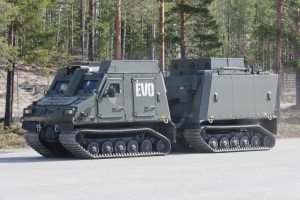
The company is looking at new technology insertions to cope with the ever increasing power requirement, due to the addition of new power-hungry systems. Remote operations capacity as well as autonomy are being considered, as well as the adoption of a hybrid drive system. In perspective this might see the rear wagon with an integral powertrain, based on electric motors powered by current provided by the front wagon, but with no mechanical power transfer between the two wagons. But here too, for the time being the buzzword is delivering!
[1] ABM/KETF, for Air Burst Munition/Kinetic Energy Time Fused. The PDM428 KETF round is fitted tit a time fuse that is programmed at the muzzle with the time interval when the very small ejection charge will be initiated opening the round an letting over 400 tungsten-alloy cylinders spread in front of the target. Their dimensions and mass make them effective against light protected vehicles, infantry in the open as well as against UAS.
Photos by P. Valpolini
