

When the link with motherland is severed due to a crisis receiving spares downrange might become an issue. Should advanced spare stocks be depleted in some areas, platform fleet availability would decrease, generating operational problems. To supplement the standard logistic supply chain BAE Systems Hägglunds started providing the Swedish Defence Administration with its Microfactory, a hardware and software solution that allows producing on site qualified and certified spare parts
“It started here in BAE Systems Hägglunds with additive manufacturing but now we are turning it into advanced manufacturing, which is a wider view as it includes a lot of techniques and functionalities, for example we also have post-processing and several other techniques that we want to use now,” Björn Hellholm, Chief Innovation Officer at the company told EDR On-Line.
The aim is to ensure platforms availability downrange even when the supply chain is broken, during a crisis or a war, by allowing forces to produce themselves the spares needed directly on the field. This will not replace spare stocks, which will remain, either at industry or military level, but will allow flexible production of spares directly in theatre when delivery of those spares becomes impossible. It will also allow repairing a platform should a spare be unavailable in theatre and the delivery cycle would take too long to get it, thus increasing fleet availability.
The concept is to equip the forces with appropriate hardware, train personnel into the skills needed to produce spares with advanced manufacturing systems and provide them with what the company defines as “Technical Data Packs”, which means the computer files to be fed into the hardware and the instructions needed to obtain a qualified and certified spare part. This means that BAE Systems Hägglunds as the OEM develops a Technical Data Pack for each spare that can be produced.
“What we do is to transfer the recipe to allow our customers to print and manufacture the parts by themselves. It is a complete package for telling the manipulator, the robot, to do what it should do, as well as the post-processing machine. The unique thing here is taking responsibility for a qualified, certified recipe, which includes both additive manufacturing and post-processing,” Mr. Hellholm underlines, adding that BAE Systems Hägglunds is working together with customers and with NATO [1] to create a database that can be used to prove those recipes to the customers, this database being known as RAPID-e, Repository for Additively manufactured Products in a Digital environment.
“This NATO-based environment allows us to provide customers with technical data packs. Several industries are printing parts, however we at BAE Systems Hägglunds want to provide customers with eliable recipes that are qualified from us with our IP,” thus generating spares that fully coper with the performances provided by the original partnumber.

The work on this project started in Örnsköldsvik 10 years ago. “We started to work with additive manufacturing and very soon we joined forces with universities, the first verified spare part being produced in 2023,” Björn Hellholm told EDR On-Line. The company quickly understood that to convince customers it would be better to cooperate with other entities, therefore cooperation started with Saab on this issue, which led to the delivery of the first joint Microfactory solution to the Swedish customer in Q1 2026, the system being now tested by the military, with full cooperation from the company.
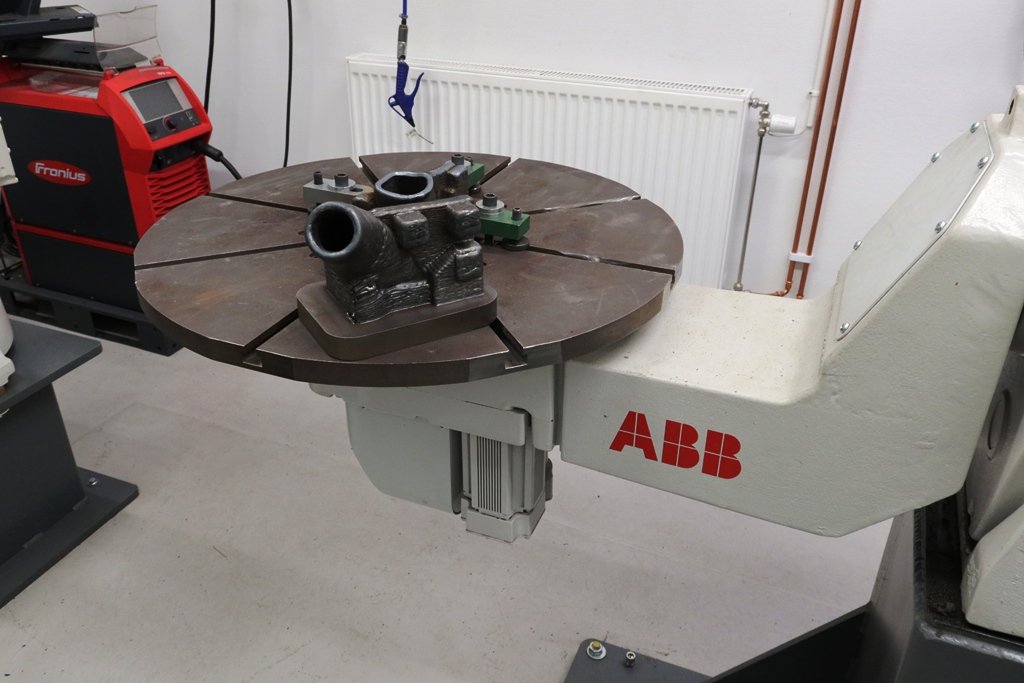
In the Örnsköldsvik facility it was possible to visit the laboratory where the project was developed, and see the Wire Arc Additive Manufacturing (WAAM) used to produce the components; a six-axis machine it, is fitted with a two-axis turntable, this combination allowing to produce pieces of very difficult shapes.
A five-axis machine is then used in the post-processing phase, which allows to bring the WAAM-produced piece within design tolerances and surface finishing. These two machines identical to those used in the Microfactory, the additive manufacturing element being installed on what is dubbed the WAAM palette, which can be easily installed in any structure, providing power and compressed air are available.
In the current configuration the machinery can produce an item around 1 metre long with a mass of 300 kg. “The machine can lay down 2.5-5 kg per hour, and was the ground breaking result of close cooperation between BAE Systems Hägglunds, Saab, and Försvarets MaterielVerk, FMV in short, the Swedish Defence Materiel Administration. The core technology was developed in a really short time, around one year, the key player being Högskolan Väst, the University West based in Trollhättan,” Mr. Hellholm pointed out.
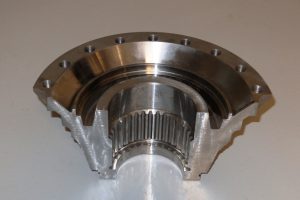
Visiting the BAE Systems Hägglunds test centre, we could see the hub to the final gear of a CV90, an around 25 kg piece that was printed and post-produced and is now running on a Swedish Army vehicle; “Currently a Swedish Army vehicle is running with one component manufactured in the traditional way and the other printed in the Microfactory, tests being ongoing now,” the company CIO explained, which will allow comparisons.
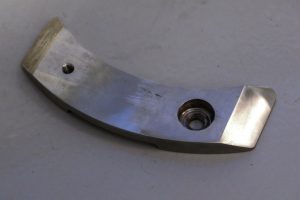
A smaller component for the BvS10 and the Beowulf was also showcased; its peculiarity was that it was made of two different materials, which allows to optimise mechanical performances and surface coating, something that cannot be done with traditional methods, eventually also allowing mass saving.
“It took some time to develop those items, but it was more about the process rather than the items themselves, so now that the process is developed time to finalise new Technical Data Pack will be much shorter,” EDR On-Line was told.

Another component produced with advanced manufacturing technologies was a hinge, made of an arm and a bracket. The arm required 14 hours print time, of which 5 hours active the other being cooling time, and 4 hours machining time, of which 2 hours active. After printing the mass was 8.75 kg, machining bringing it to a 3.5 kg finish mass. The bracket took 8 hours for printing, 2.25 hours active, 2 hours machining, and mass was 3.7 kg after printing and 1.5 kg finished. Starting from a block using traditional manufacturing would have taken longer machining hours with a higher percent of scrap material.
When designed for field operations the Microfactory is based on 20’ HC containers, for High Cube, which inside height is 2,698 mm versus 2,390 mm of standard ones. The number of containers depends on customers’ needs, and can range from a single one to multiple containers linked between them. Of course the WAAM cell as well as the post-processing machine can be hosted in hangars or buildings, which makes the Microfactory a pretty flexible tool.
While components that are currently being produced are aimed at replacing same part numbers manufactured with traditional methods, future platforms will certainly take into consideration additive manufacturing since inception; DFAM, for Design For Advanced Manufacturing is becoming common use, and it not only will allow easier production with WAAM and similar technologies, but it will also consider these for standard components, when advanced manufacturing will allow to obtain better performances, mass savings and cost reductions. One of the key points is that when using WAAM the amount of material used to produce some pieces will be lesser than adopting traditional techniques, as when using subtractive manufacturing you start from a solid piece of material, usually of non-trivial cost, generating a large quantity of waste material. Even if this goes beyond the concept of microfactory, it shows well the potential of new forms of production which in some cases can even effectively replace traditional ones.
Photos by P. Valpolini
[1] In December 2024 the NATO Support and Procurement Agency (NSPA) announced it was starting to support NATO with additive manufacturing capabilities. To do so it developed a digital collaboration platform to securely store, publish, share, request and consume Technical Data Packages associated with parts production through additive manufacturing. This platform ensures interoperability and improves collaboration in the additive manufacturing domain amongst NATO nations and their partners.
