

The intense humidity and radiating heat were oppressive and stifling. From his cramped observation post dug into the Luzon coastline a platoon leader watched the heat shimmer rise from the sand. His platoon was down to their last case of MREs, the prepackaged meals the soldiers had been living on since establishing the site, and their supply of iodine tablets for water purification was nearing critical levels. Issued solar panels were damaged beyond repair and radios were critically low on batteries. Ammunition resupply to the platoon was becoming increasingly irregular given the observation post’s separation from the rest of the battalion. The only thing keeping his platoon protected from enemy fixed- and rotary-wing assets was the Patriot battery hidden in the jungle two kilometers inland. His platoon was assigned to defend the battery; he and his soldiers depended on the battery for survival and that battery was down to its last two interceptors.
The platoon had limited options with the surrounding airspace around it resembling a hornet’s nest. Enemy drones, from small quadcopters to larger, persistent reconnaissance platforms, crisscrossed the sky, their sensors hungry for any sign of movement. The platoon had expended its man-portable surface-to-air systems in the first forty-eight hours of their employment. A traditional C-130 airdrop to resupply the platoon was suicide. A conventional landing craft would be spotted and sunk miles from shore. The soldiers were, in the classic military sense, on the verge of culmination, their combat power bleeding away not from enemy fire, but from the tyranny of distance so often discussed before the outbreak of hostilities in the Indo-Pacific region.
The Patriot battery and rifle platoon’s plight was not unnoticed; a logistics chief warrant officer’s screen came to life. A data burst, encrypted and compressed, flowed into his optic overlay. It was time. A new menu materialized in his vision, a three-dimensional map of the operational area teeming with icons. His first command was a simple digital authorization. Far to the east of the beleaguered platoon, in the deeper waters of the Philippine Sea, two sleek, unmanned surface vessels sprang to life. They weren’t stealthy. Their engines roared, their radar and sonar signatures intentionally screaming across the electromagnetic spectrum as they made a hard turn toward a different island in the archipelago. Simultaneously, the warrant launched a swarm of ten small, jet-powered decoy drones from a mother ship loitering at forty thousand feet. They flew a high, fast, and in an obvious profile directly toward a known enemy surface-to-air missile site.
The enemy forces took the bait. Red triangles, representing enemy long-range coastal defense missiles, began tracking the decoy vessels skimming across the sea’s surface. Flashing circles indicated their air defense radars locking onto the decoy drones. Within minutes, the sky was streaked with the fiery trails of interceptors. The decoys, having served their purpose, were obliterated in silent, distant flashes compelling the adversary to displace critical assets and to resupply them with munitions.
The distraction served its purpose—concealing the real mission. A “Poseidon-4,” a low-profile, semisubmersible autonomous vessel, detached from its own mothership. It was little more than a shadow on the waves, its hybrid-electric engine barely a whisper. On the logistician’s map, its icon made steady progress as it began its slow and methodical journey toward the coast. It was carrying the most precious cargo in the theater: six Patriot PAC-3 missile canisters. The warrant watched its path, a nerve-wracking crawl through a network of known enemy sea-drone patrol routes. The AI pilot was handling the microdecisions, but he was the final human in the loop, ready to intervene.
At the same time, he initiated “Shepherd-2.” From a discreet, makeshift runway on a friendly island over three hundred miles away, a fixed-wing cargo drone lifted into the sky. Unlike the high-flying decoys, Shepherd-2 dropped to a hundred feet, its advanced terrain-following radar guiding it through the island chains. This drone’s belly was full of water, batteries, ammunition, and medical supplies for the stranded rifle platoon. Its icon on his map was a fast-moving green arrow as it threaded a needle between two enemy radar zones.
The next twenty minutes felt like hours. Soldiers from the theater sustainment command operations center watched the blue icon of Posiedon-4 pause, its sensors detecting a patrol boat before silently altering course to pass behind a small islet. They tracked the green arrow of Shepherd-2 jink left, then right, spoofing an enemy sensor before accelerating over a ridge. As the Shepherd-2 had reached the drop point, five GPS-guided pods detached from its fuselage, their small parachutes deploying perfectly. The pods confirmed they had landed within a ten-meter circle, three hundred meters from the rifle platoon’s position. Minutes later, Posiedon-4’s icon turned green. It had reached the shoreline. A ramp lowered, and six-wheeled unmanned ground vehicles, laden with the missile canisters, rolled onto the sand and began their own automated journey to the Patriot battery’s hidden reload point.
A wave of relief washed over the warrant officer and his team. They had threaded the needle through a modern antiaccess / area-denial network using a symphony of unmanned systems, decoys, and predictive routing. The holographic displays from the operation dissolved, the Philippine coastline and surrounding area replaced by the cool, sterile air of a climate-controlled room. The warrant office and other logisticians weren’t operating on the island of Luzon, or even in the Philippines. From their logistics and operations center in Darwin, Australia, thousands of miles from the front, they prepared to orient assets and vital support to other units inside and outside the first island chain.
Of all the hard facts of war, logistics is the hardest. While strategy may be the art of the possible, what is possible is determined first and foremost by the sinews of supply. The ongoing war in Ukraine has provided a stark and brutal reminder of this timeless principle. We have witnessed a forty-mile-long convoy stalled by mechanical failures and fuel shortages. We watched as Russia’s initial campaign nearly culminated due to a lack of critical supplies. Current support zones for tactical units on the front lines extend well beyond the planning of US Army doctrine in how divisions fight. As seen in the war in Ukraine, the challenges of sustainment and logistics underscore a critical vulnerability for any modern military force. For the US Army, as it pivots from counterinsurgency to preparing for large-scale combat operations against peer adversaries, these lessons are a dire warning. The future operational environment will be defined by a “contested logistics environment,” where no domain is safe and sustainment itself is a primary target.
To fight and win in large-scale combat operations, the Army can no longer rely on the static, centralized, and relatively secure logistics models of the past two decades. Victory will demand a fundamental revolution in sustainment, as depicted in the fictional scenario above, moving from a reactive to a proactive and resilient enterprise. This transformation hinges on the aggressive integration of a technological trinity: autonomous systems, advanced robotics, and AI-powered predictive analytics. By embracing this trifecta, the Army can build a logistics network that is not only efficient but also survivable, agile, and intelligent enough to sustain the force at the speed of modern warfare.
The concept of a safe rear area is a relic of a bygone era. In future large-scale combat operations, adversaries will possess the capability to target logistics operations, facilities, and activities from the American homeland to the forward line of troops. This contested environment, characterized by a transparent and lethal battlefield, renders traditional, large-footprint logistics nodes as nothing more than lucrative targets. The Army’s current sustainment architecture, largely a product of counterinsurgency operations where the United States maintained domain superiority, is ill-equipped for this reality. The Army’s response to this challenge is multidomain operations, an operating concept that seeks to leverage cross-domain capabilities to defeat enemy defenses.
However, the success of multidomain operations is inextricably linked to the feasibility of its sustainment. Without a resilient and responsive logistics network, maneuver forces risk culmination, and the entire operational concept is placed in jeopardy. The solution lies in transforming the logistics enterprise into one that can deliver what Lieutenant General Christopher O. Mohan calls “predictive logistics,” a proactive, data-driven approach that ensures the right resources are in the right place at the right time. This vision can only be realized through the deliberate integration of autonomous systems, robotics, and predictive analytics.
In a contested environment where personnel are at constant risk, the ability to move supplies without a human crew is a game-changing capability. Autonomous systems—on the ground, in the air, and at sea—are the key to unlocking this potential, reducing risk to soldiers while increasing tempo and throughput. The Army is already making significant strides in autonomous ground resupply. The Autonomous Transport Vehicle System program aims to equip logistics trucks with autonomy suites, with the goal of increasing the sustained throughput of a divisional truck company by 50 percent. Companies like Carnegie Robotics and Forterra are actively developing prototypes for this initiative, which will enable unmanned convoys to navigate complex routes, maintaining continuous movement even in unpredictable conditions. This not only removes soldiers from the most dangerous missions but also alters the risk calculus for commanders, who can take greater chances with machines than with human lives.
The logistics challenge is not limited to the ground. In vast theaters like the Indo-Pacific, aerial and maritime resupply are critical. Recognizing this, the Army is funding programs to retrofit UH-60L Black Hawk helicopters with autonomy kits, creating a platform capable of 24/7 uncrewed logistics missions, even in GPS- and communications-denied environments. This effort, led by companies like Near Earth Autonomy and Honeywell, is complemented by the development of larger, long-range cargo drones capable of moving significant payloads.
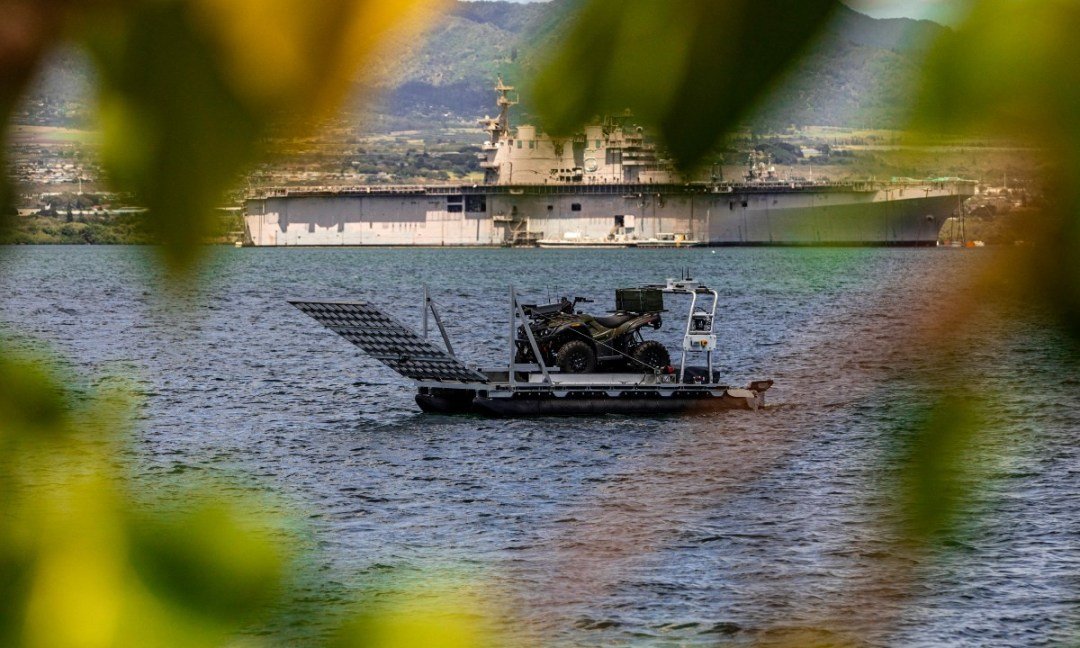
Furthermore, the Army’s Project Convergence Capstone 5 experiment showcased a breakthrough in autonomous ship-to-shore resupply. Unmanned surface vessels were used to transport a supply-laden unmanned ground vehicle to a contested port, demonstrating a seamless, cross-domain logistics chain operated from thousands of miles away. This machine-based logistics model transforms the challenge of distance into a survivability advantage, dispersing critical supplies and minimizing the vulnerability of static ports. By creating a distributed network of smaller, autonomous air and sea platforms, the Army presents a complex dilemma for adversaries, making it difficult to identify and target critical supply lines.
Beyond autonomous transport, robotics offers a suite of solutions to enhance efficiency, reduce the physical and cognitive load on soldiers, and perform tasks in high-risk environments. From the factory to the foxhole, robots are set to become indispensable partners in the sustainment enterprise. At the tactical edge, the burden on the individual soldier is immense, with a typical combat load exceeding sixty pounds. Robotic quadrupeds are being tested to serve as automated pack mules, carrying essential supplies like ammunition and rations, thereby reducing fatigue and increasing soldier endurance. These platforms, such as the Ghost Robotics Vision 60, can traverse difficult terrain that would challenge wheeled vehicles, making them ideal for resupplying dispersed infantry units.
In the sustainment nodes themselves, robotics and intelligent automation can revolutionize how supplies are managed. The use of robotics in warehouses for sorting, packing, and moving material, a common practice in the commercial sector, can be adapted for military logistics to accelerate the production and distribution of supplies. This includes the use of additive manufacturing, or 3D printing, which allows for the on-demand production of critical repair parts at the point of need, reducing reliance on a long and vulnerable supply chain. The integration of robotics extends to battlefield maintenance and recovery. Unmanned ground vehicles can be deployed for reconnaissance, for explosive ordnance disposal, and even to provide security for logistics convoys, further reducing the number of personnel exposed to direct threats. By networking these robotic platforms, they can become an integrated part of the team, sharing data in real time with operators and commanders, and streamlining decision-making.
If autonomy and robotics are the muscles of the future logistics system, then artificial intelligence and predictive analytics are its brain. In an environment saturated with data from sensors, drones, and interconnected systems, the ability to translate that data into actionable intelligence is paramount. The corporate sector has long used predictive analytics to forecast demand and optimize supply chains, and the military is now adopting these practices. By analyzing historical data, current consumption rates, and mission parameters, AI-powered algorithms can forecast future sustainment needs with remarkable accuracy. This allows the Army to shift from a just-in-case model of stockpiling to a just-in-time and just-enough model of precision sustainment.
Predictive analytics also extends to equipment readiness. By monitoring equipment health, usage patterns, and environmental factors, the Army can anticipate failures before they happen and schedule proactive maintenance. This minimizes downtime, extends the life of critical platforms, and ensures maximum operational availability, a crucial advantage in large-scale combat operations. Finally, AI is the critical enabler that orchestrates the entire autonomous enterprise. AI-driven systems can manage fleets of unmanned vehicles, automatically rerouting supplies in response to threats or changing priorities and optimizing distribution to ensure critical resources are delivered where they are needed most. This creates an adaptive, resilient, and self-healing supply network capable of operating under the immense pressures of the future battlefield.

The character of war is changing, and logistics must change with it. The days of uncontested supply lines and secure, sprawling support areas are over. The future of warfare demands a sustainment enterprise that is as dynamic, intelligent, and resilient as the maneuver forces it supports. An overreliance on unproven technology is not a strategy, but a failure to adapt is a guarantee of defeat. The US Army stands at a pivotal moment. By fully embracing the transformative power of autonomous systems, advanced robotics, and predictive analytics, it can forge a new paradigm of sustainment that keeps pace with combat units’ requirements and keep them in the fight. An Army that can anticipate its needs, deliver supplies without risking its soldiers, and adapt its logistics in real-time is an Army that can sustain the fight and win.
Major Charlie Phelps is a Special Forces officer and currently serves as a company commander in 10th Special Forces Group (Airborne).
The views expressed are those of the author and do not reflect the official position of the United States Military Academy, Department of the Army, or Department of Defense.
Image: An unmanned surface vessel prepares for an autonomous ship-to-shore resupply mission with the autonomous offloading of an unmanned ground vehicle full of supplies, April 2025. (credit: Sgt. Matthew Wantroba, US Army)
