

In central Havana, a giant mound of sand-colored rubble fills an entire city block. It is all that remains of the Superior Institute of Industrial Design—a stately building that in its 166 years housed a Spanish officers’ club, U.S. occupation forces after 1898, Cuba’s health ministry, and, finally, the design school. Declared uninhabitable years ago, it suffered two partial collapses in 2025. The state never sent anyone to fix it. This past February, what remained suddenly fell, entombing several squatters. When I visited in June, skinny men scaled the craggy surface, prying loose bits of brick that they carted off to build makeshift houses.
Cuba, on its current trajectory, is headed for the fate of the design school: what lies ahead is an accelerating collapse of the state and economy. Unless this course is reversed soon, rebuilding the island as a stable, prosperous, and democratic place could become virtually impossible.
A few months ago, a slow unraveling was not what most observers expected. Because of the tariff threat in place since February against countries supplying oil to Cuba, President Donald Trump’s warnings of military action, and reports of secret talks between Havana and Washington, many believed that either a power-sharing deal or a Venezuela-style military operation was imminent.
By late May, that looked less likely. By then, according to the Miami Herald, the backchannel talks had collapsed amid opposition from Florida Republicans and Havana’s rejection of Washington’s offer: U.S. investment and petroleum in exchange for President Miguel Díaz-Canel’s removal and the privatization of Cuba’s state oil company. Havana enacted 176 economic reforms in June, which expanded space for the private sector, but this did not satisfy Washington. While allowing limited U.S. fuel and food to reach the island through private distributors, the Trump administration added new sanctions against state companies and regime officials. In August, Secretary of State Marco Rubio told Axios that the policy’s timeline had shifted, saying that it would take “patience and persistence” and that the regime could survive into 2028 or beyond.
There are a few ways to read Rubio’s comments. One is that the administration is bluffing. It is threatening to maintain the current extraordinary sanctions pressure either to restart the stalled negotiations or to misdirect the regime ahead of a military operation. Another is that, with the United States entangled in Iran and busy managing Venezuela, Cuba has simply been demoted as a priority. The administration has put the island on life support, with just enough U.S. fuel and food allowed to reach private firms to prevent societal breakdown, but otherwise it has no new plan. Cuba policy has been set to autopilot. A third is that the administration has concluded that waiting for the one-party system to implode from within is the only viable path to regime change, even if it is long, tortuous, and uncertain.
Regardless, what is not widely appreciated outside Cuba is how economic and state collapse—triggered by the regime’s unwillingness to reform and hastened by U.S. sanctions—is already remaking the island. The state, aside from its capacity for political repression, is rapidly weakening. The economy is contracting and growing more unequal, leaving a large underclass too poor to participate meaningfully in the new private sector. Social cohesion is fraying, and crime is rising, while plunging birth rates and emigration warp Cuba’s demographics.
All these trends predate the foreign oil cutoff and the newest sanctions by years, if not decades, but each now appears to be accelerating. The danger is that the longer the impasse lasts, the more they will calcify into the baseline conditions for any future transition, narrowing the chances that Cuba ever becomes a well-governed country—and increasing the likelihood of an even more dysfunctional, chaotic future instead. If nothing changes soon, a transitional government could one day find itself in the same impossible position as the men atop the ruins of the design institute: trying to build something safe, habitable, and lasting out of rubble.
AUTHORITARIAN ANARCHY
In Havana, I heard a joke. “Only two things work in this country: the state security apparatus and the hospitals.” It was too generous to the hospitals. About state security, it was true. Repression is the only thing the Cuban state still does well. This owes less to any apparent abundance of resources than to the leadership’s entirely rational unity. The headquarters of the Directorate of Penal Institutions, which administers the country’s prison system, is as decrepit as any building in central Havana, with cardboard filling broken windows. But the generals and spy chiefs know how much they would lose from political liberalization. If the Trump administration has tried to convince some of them that there are off-ramps, it does not appear to have succeeded. So they stick together, and the state’s capacity for repression remains intact.
Although Cubans I met were astonishingly willing to criticize the regime on street corners or within earshot of neighbors, and almost all did, none said that they would join a public protest, a near-certain route to detention. In case anyone forgot, police cars sat parked outside the family homes of detained protest leaders as ominous reminders; with fuel so scarce, it is telling that the regime can still find the gasoline to dispatch them.
On every other dimension, however, the Cuban state is weaker than most foreign observers realize—both those on the right, who imagine an anti-American leviathan, and those on the left, who cling to the fiction of functional schools and hospitals. A better description came from a European diplomat in Havana: “authoritarian anarchy,” a state that can still stifle political expression but is increasingly unable to provide public services or to prevent disorder.
Repression is the only thing the Cuban state still does well.
Take public health, long one of the Cuban state’s proudest achievements. Access to the best clinics always depended on connections. But through the early 2010s, Cuba’s population-level health indicators, underpinned by well-trained doctors and generous public investment, were among Latin America’s strongest. Today, most hospitals lack essential supplies and medicines, forcing patients to buy everything from antibiotics to amputation saws on the black market. Although many doctors do their best under the circumstances, unlivable public salaries have made bribe-taking increasingly common. Graduating medical students pursue unrelated work in the emerging private sector or emigrate. The results are stark: infant mortality, once among the lowest in the region, has more than doubled since 2018, and mosquito-borne illnesses that the state had previously contained are back. Chikungunya alone infected up to a third of the population in 2025; cases of dengue and Zika have also surged.
Violent crime, once almost unknown on the island, is rising sharply—another sign of the state’s haphazard retreat. Although the lack of reliable official statistics makes this hard to confirm, and although Cuba still endures far less violence than several of its neighbors, fear of robbery and assault has altered many Cubans’ daily routines. Residents of Cárdenas, a small city two hours east of Havana, stay off the streets at night. Vigilantes are allegedly behind a growing number of killings of criminal suspects there and in the city of Guantánamo (not to be confused with the nearby U.S. military base of the same name).
In Havana, stories of break-ins to steal solar panels and water tanks have become common, and there is a widespread perception that police are ever more absent or bribable. Although crime is disorganized for now—driven by abject need or addiction to the cheap synthetic cannabinoid known as el químico, now everywhere on the island—it could easily cohere into something more organized.
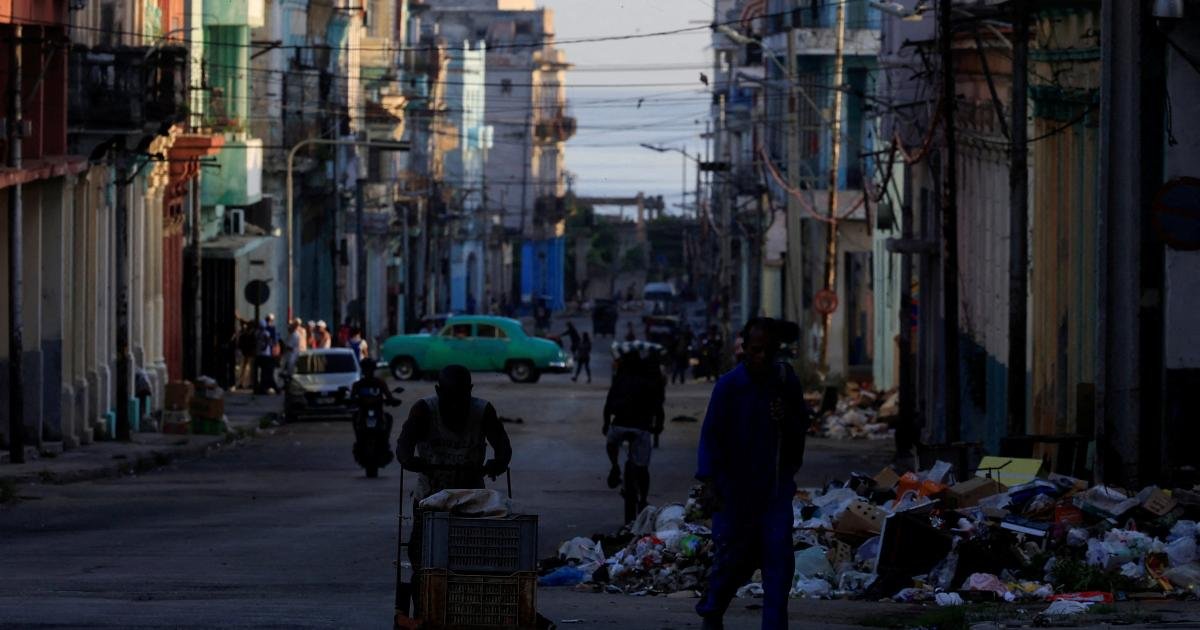
Crumbling power plants, a shortened school year, the holes Havana residents have cut into the streets to siphon off scarce public water for resale or private consumption—the hollowing of the state is visible everywhere. The long-term effects of the embargo are partly to blame, as is the cutoff of foreign oil since February. But no one forced Cuba’s leaders to devote, by 2024, 37 times as much public capital investment to tourism, real estate, and hospitality as to health and education. That was a profit-seeking gamble by a small clique of insiders, and it failed. The question now is whether the state will be able to do anything at all, including maintain public order, after several more years of breakdown.
THE LONGEST ROAD
The second transformation remaking Cuba, and creating dilemmas for a future transition, is economic. The economy is shrinking: it has contracted by at least 15 percent since 2020, as tourism cratered and foreign investors fled for fear of new U.S. secondary sanctions. In response, the regime has grudgingly opened space for private enterprise—not because most officials favor markets but because they have concluded that some market activity is the only way to keep the island from starving or rebelling. Since the 2021 legalization of micro, small, and medium-sized enterprises, known in Spanish as MIPYMEs, these firms have come to number more than 10,000, accounting for an estimated 65 percent of all retail sales and 40 percent of total employment. June’s reforms formally expanded what private activity is permitted, although U.S. sanctions, the regime’s lack of credibility with domestic and foreign investors, and its internal divisions will likely limit their implementation.
The growth of the private sector has been positive and necessary, keeping at least some shelves stocked amid the crisis and making at least part of the population less beholden to public salaries, a source of leverage for the regime. The 2021 currency unification was another necessary step. Despite its disastrous implementation, which shredded most Cubans’ purchasing power, it ended a dual-currency system that had distorted prices and masked state enterprises’ underperformance.
But the specific way markets are taking root—with much of the population too poor to participate meaningfully, with no rule of law, and with the gap between winners and losers steadily widening—is pernicious for the country’s future. Several Cubans I met said they felt as if they were living through Russia’s 1990s: a period of murky deals and rigged competition that led not to broad-based prosperity but to oligarchs and mass immiseration. The word they repeated most was reparto—a divvying up of the country. Regime insiders are positioned to gain the most, and MIPYME owners have a foot in the door. Meanwhile, the young, the old, public-sector workers, and many Afro-Cubans are increasingly struggling just to eat. As one Cuban woman put it to me, “We took the longest, most painful road to Latin American capitalism.”
Cuba is reproducing the worst defects of certain Central American economies—rigid class differences, cronyism, remittance dependence, and low productivity—only without their comparatively stronger growth. The widening inequality is hard to miss: even now, with blackouts regularly stretching two to three days, better-off neighborhoods have new restaurants with generators humming, lights on, live DJs, and full tables. Around them stand darkened houses, and uncollected trash piles up on the street. It didn’t have to be this way. Cuba’s population remains highly educated, even as the wages MIPYMEs can pay pull skilled professionals away from their fields. A transition today could still put a dynamic and fair market economy within reach. In two or three more years, it might not.
THOSE WHO STAY
The last dimension of Cuba’s collapse is the hardest to measure, but the one many Cubans told me they worry about most: what several described as “social decay.” The interlocking effects of mass emigration, rapid aging, and a growing generational divide pose enormous challenges for Cuba’s future.
Since 2020, Cuba’s population has fallen by an estimated 13 to 24 percent, driven largely by an unprecedented emigration wave. Because those who left were disproportionately women of reproductive age, Cuba’s already rapid aging has accelerated. By 2050, authorities forecast, one in three Cubans will be over the age of 60, up from one in four today. That would be a significant challenge even for a country with a strong economy and a functional pension system. For Cuba, it could become an insurmountable one.
Emigration has also hollowed out entire professions, emptying hospitals of health workers, schools of teachers, and even churches of priests and pastors, on a scale that Cubans have never seen before. Several middle-aged Cubans drew a contrast with the 1990s Special Period, when the loss of Soviet aid and trade shrank the economy by about 35 percent but far fewer doctors and teachers left. The island was broke then, yet hospitals and schools kept functioning. That is no longer the case. A divide has also grown between Cubans who have family abroad (and remittances with which to start businesses) and those with no such connections, disproportionately Afro-Cubans.
Living without sufficient food, energy, or medicine is exacting a psychological toll as well. The young are paying the highest price, especially those whose parents are abroad and who are growing up hungrier and more excluded than earlier generations. But the cost is generalized. “This is not resilience,” a man told me in Havana, referring to the cliché that Cubans are uniquely gifted at enduring hardship. “People can adapt to anything. We transform ourselves to manage to survive this process, but it is a degradation.”
THE PRICE OF DELAY
When Cuba’s Caribbean and Central American neighbors began their transitions to democracy 40 to 50 years ago, few expected them to succeed. Most were far poorer, more economically dysfunctional, and more unequal than they are today. And yet they proved that unfavorable starting conditions are not destiny: most democratized and saw their economies grow and stabilize. Cuba could, too.
But the longer the current stalemate lasts, the dimmer that prospect grows. Sustaining the current level of pressure may cause the regime to implode, or it may not. What it will certainly do, if it persists for another year or more, is make Cuba increasingly ungovernable—by anyone.
The Trump administration may not have weighed that danger or may have judged it an acceptable cost of forcing a political opening. Strikingly, some ordinary Cubans have made the same calculation. Many I met did not believe that U.S. sanctions were primarily to blame for the current crisis. To them, whether sanctions stayed or went mattered far less than whether the regime did, since in their view it bore greater responsibility for the ruined economy. A new nationally representative survey by AmericasBarometer shows something similar: 74 percent of respondents blamed the Cuban government for the current crisis, while just 16 percent blamed the United States.
All this said, the risks of sustaining the current pressure indefinitely are immense. For both countries, arguably nothing would be worse than a spiral into criminal violence and chaotic ungovernability on the island. Prolonged maximum pressure also raises the price of eventual repair, and a post-transition Cuba will have limited means of financing reconstruction. Rebuilding Cuba’s electric grid alone, degraded further with each additional blackout, will cost an estimated $8 billion. It might take the country years to regain access to financing from the International Monetary Fund, the World Bank, and other multilateral institutions. Given the U.S. public’s fatigue with nation building abroad, Congress is unlikely to step in to fill the gap in the meantime.
The opposite course carries costs of its own. Those who propose normalization and the lifting of the embargo without meaningful political change need to be honest about what this means: accepting that Cubans, against their will, would go on living under a regime that enriches itself while keeping citizens poor enough to control. They should have no illusions that Cuba’s leaders, with fewer sanctions, will be able to rebuild state institutions, lower inequality, or restore social cohesion. The leadership’s objective is to remain in power.
A third way may still be possible: a new offer of targeted sanctions relief, focused on alleviating the humanitarian crisis, in exchange for specific political and economic reforms that could weaken the regime’s control. Even if Havana has rejected such deals before, it is worth attempting. But whatever path Washington chooses, it must consider the costs of delay—already high and only rising.
Loading…
