

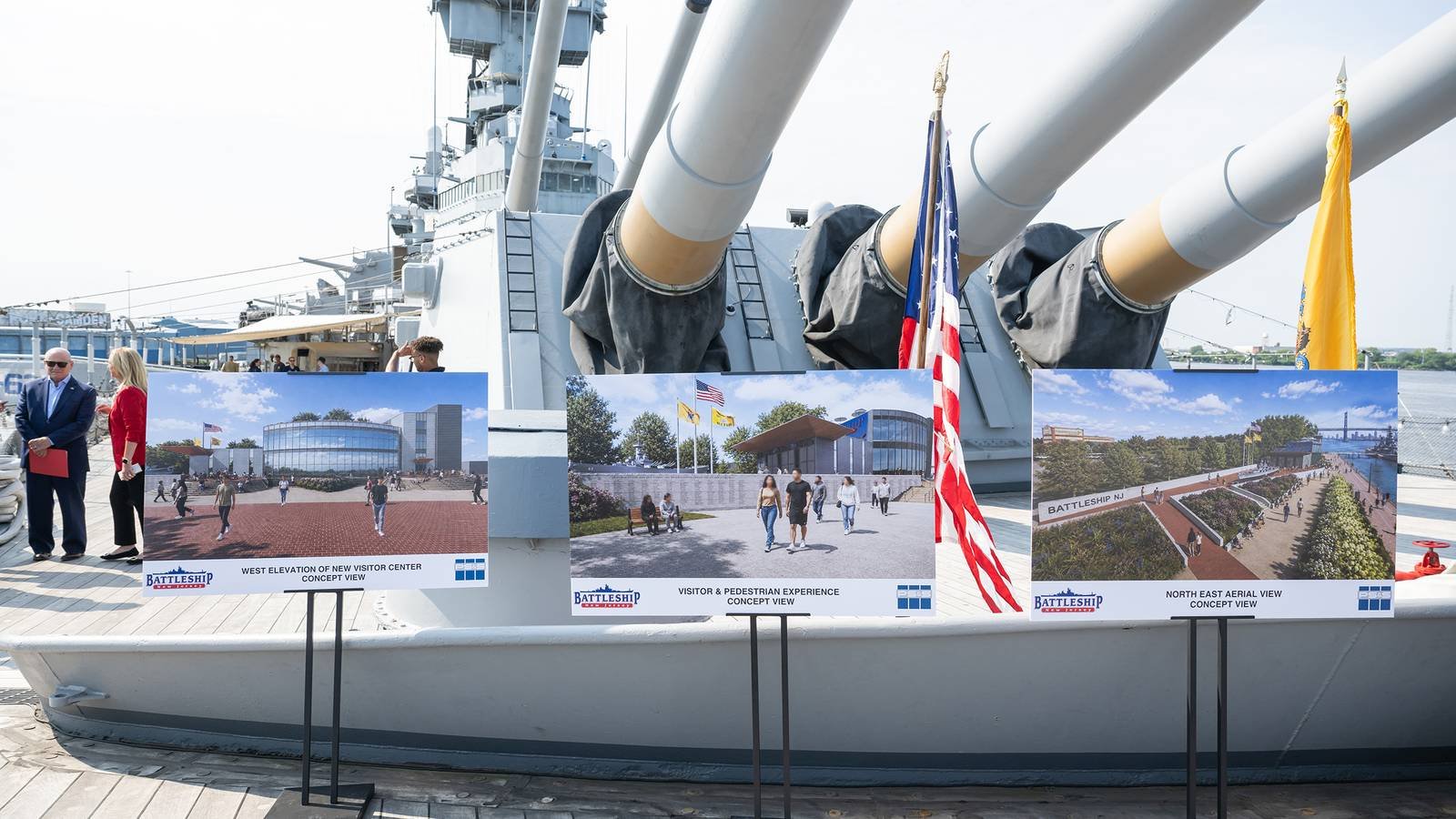
Battleship New Jersey Museum & Memorial is undergoing its “largest undertaking” since it opened its doors in October 2001, CEO Marshall Spevak told Military.com.
One of The Garden State’s most recognizable landmarks recently announced a $24.25 million expansion and improvement project after being selected for $19.9 million in tax credits through the New Jersey Economic Development Authority’s (NJEDA) Cultural Arts Facilities Expansion (CAFE) program. The credit award is for up to 100% of eligible project costs, not to exceed $19.9 million.
The Battleship New Jersey Redevelopment Project will feature a new three-floor visitor center that includes a lobby area, ticketing space, artifact displays, a small café and gift shop, landscaping improvements, administrative support areas, and various security improvements and renovations.
The site is located at 100 Clinton Street in Camden and unaffiliated directly with the state of New Jersey, the U.S. Navy or other military entities.
“This is the largest undertaking we’ve done since the battleship opened as a museum in 2001,” Spevak, who’s been CEO for roughly three years, told Military.com. “That includes in 2024, [when] we actually dry docked a ship, which was about a $10 million project.
“This $24.25 million project is the largest capital investment in the history of our organization since we’ve opened as a museum. There were large-scale plans back in 2000-2001 for what the visitor experience would look like. Ultimately, that those all didn’t exactly pan out, and now, thanks to the state of New Jersey, we’re able to really sort of overhaul that guest experience.”
The Iowa-class NEW JERSEY BB-62 was built at the Philadelphia Naval Shipyard, and launched Dec. 7, 1942, one year after the Pearl Harbor attack brought America into WWII. It was decommissioned for the fourth and final time on Feb. 8, 1991, in Long Beach, Calif., and later towed to Bremerton, Washington, before its current resting place.
New Jersey’s CAFE Program Opens Door to Positive Change
The New Jersey Economic Development Authority (NJEDA) serves as the state’s principal agency for driving stable, economic growth in the form of building strong and dynamic communities and creating good jobs for New Jersey residents.
For Elizabeth Limbrick, a director in real estate tax incentives at NJEDA, the CAFE program has “been my world for almost two years now.” CAFE was established in the state of New Jersey to harness the power of cultural arts institutions and use them as catalysts for broad economic development.
“The Legislature had recognized that facilities like this that are dedicated to cultural arts and arts education provide immeasurable and inherent benefits from attracting visitors and businesses, revitalizing neighborhoods, and really strengthening community identity and being that amenity that makes a place a great place to live,” Limbrick told Military.com.
By offering such tax credits, CAFE is able to develop major cultural arts projects that wouldn’t be possible through traditional real estate programs alone.
It’s viewed as an intentional approach that comes from the top, with New Jersey Gov. Mikie Sherrill, a Navy veteran, supporting the mission.
“As a Navy veteran, I know Battleship New Jersey stands as an enduring testament to the service and sacrifice of generations of Americans,” Sherrill said in a statement shared with Military.com. “This investment will preserve that legacy and strengthen one of New Jersey’s most treasured historic destinations.
“It will also bring more visitors to Camden and create new activity along the waterfront, supporting the surrounding community. Future generations deserve the opportunity to experience this extraordinary ship and understand what it represents.”

Without CAFE, Spevak isn’t sure how this massive endeavor would have even been possible.
“I knew we had to take advantage of this,” he said. “I don’t say this often because I think this this term is overused, but it is a game-changing, transformational program for the battleship.
“I mean, we would simply never be able to afford what we’re doing here—the visitor center, the parking garage, much of what’s happening on the ship itself. We just simply would never be able to afford it.”
How the Tax Credits Work For This Project
Battleship New Jersey, upon CAFE’s launch and realizing the strategic opportunity propagated to support its renovation goals, submitted an application in June 2025.
Limbrick said the application had a strong vision for preserving military history and expanding the community impact. Roughly 80,000 visitors annually visit the museum, described as a diverse group that includes students, military veterans, families and tourists exploring the Camden and Philadelphia region.
On the financial end of this project, Limbrick described tax credits as “a unique financing tool” that, instead of providing direct grants, gives a successful applicant the ability to sell that tax credit to an investor or business—which would then use that tax credit to reduce the amount of taxes that they owe to the state.
“That money that they get from selling it, they can use for the renovations and improvements,” she said. “The little catch is, you don’t get the tax credit until you’ve completed the project. So, what you need to do is bridge that with a loan or something similar.
“So, with the battleship, what they’re doing is they’re working with the Camden County Improvement Authority, who’s going to issue bonds to cover those upfront costs. Essentially, it’s like a loan. When the battleship receives and sells their tax credits after the construction is complete, they’re going to use the proceeds from those sales to be able to pay back those bonds that the county is issuing for them.”

Spevak added that when the museum sells those tax credits, they’re hoping to get between 90 and 93 cents on the dollar, then pay down the debt service over the course of the next 20 years.
“That allows us to not, frankly, piecemeal this project,” he said. “It allows us to pay for it all upfront, utilize the tax credits, sell the tax credits, pay down the debt service.”
Since the tax credits don’t cover all project costs, the museum is incorporating other sources of funding, including grants.
Project Intent and Features
The project encompasses a lot considering the age of the battleship and what it necessitates.
The cost of maintaining a 1940s Iowa-class battleship is “significant,” Spevak notes, with intentions for the project to aid with monthly yearly maintenance costs as well.
“Things like completely overhauling and replacing the ship’s chillers and cooling towers. These things are decades past the end of life,” he said. “They’re not sexy causes; nobody wants to give a million dollars to replace an HVAC system, right? So, this program allows us to do these transformational things.”
Money can also help dredge a ship that hasn’t been done in 25 years, as the Army Corps has the jurisdiction to come in and actually dredge it but don’t want to pay for what it would cost to temporarily move the ship. Money is incorporated for that.
Having a visitor center of this magnitude “really puts us out on a different level,” he said.
“One of the main reasons that we wanted to do this program is, we sort of suffer from a lot of different entrances to our little campus,” he said, “so depending on where you know you put in your GPS [pin]…you could end up in a variety of different places.
“What I’m excited about for the parking garage is not only to have a great parking garage and ample space for our visitors, but that will really become sort of the front door to the ship’s campus. All visitors will park in the parking garage, and then come down to to the new visitor center, where we’re going to have a store, we’re going to have a cafe, we’re going to have a little screening room.”

There, they want to show a brief video to prep guests on the history of the battleship and, more broadly, Iowa-class battleships, as well as the local history.
“I think for me, the highlight of my career has been getting the Battleship New Jersey underway again,” he said. “Obviously, we’re not doing that under our own power. We’re being taken by tugboats, but to get the ship underway and to get her down the river, which we expect to do again at some point over this project during the dredge period, just excites me to no end.”
How Long the Project Will Take
Last year, Battleship saw a record number of school groups and students, at more than 15,000. An overnight encampment program, in which children come and sleep in bunks as if they are sailors, drew over 10,000 kids. Camden-based students get free admission.
“This project is a major investment into an iconic New Jersey institution that is going to bring visitors to the city of Camden and keep the economy moving forward,” Limbrick said. “It’s a living reminder of our nation’s history and the sacrifices of those who have served. … The museum’s programs inspire that pride and respect for military service.”
She said that officials have been told by parents, following tours of the ship, that their children have become deeply inspired. Some have even become “obsessed” with the Navy.
The battleship—it’s not just about preserving history; it’s sparking that curiosity, that patriotism, the respect for service, and helping to nurture that next generation of Americans who may one day serve our country.
Construction is slated to begin in early 2027, and it’s going to take about two years to complete.
While the project’s finished product may seem like a long wait, Spevak believes it will transform the community and the state itself.
“The response has been really gratifying, it’s really incredible,” he said. “I’ve had a lot of friends and colleagues and people in our network here reach out. There’s a lot of love for the battleship.
“There’s a lot of nostalgia nationally for battleships in general, and we try to feed into that.”
