

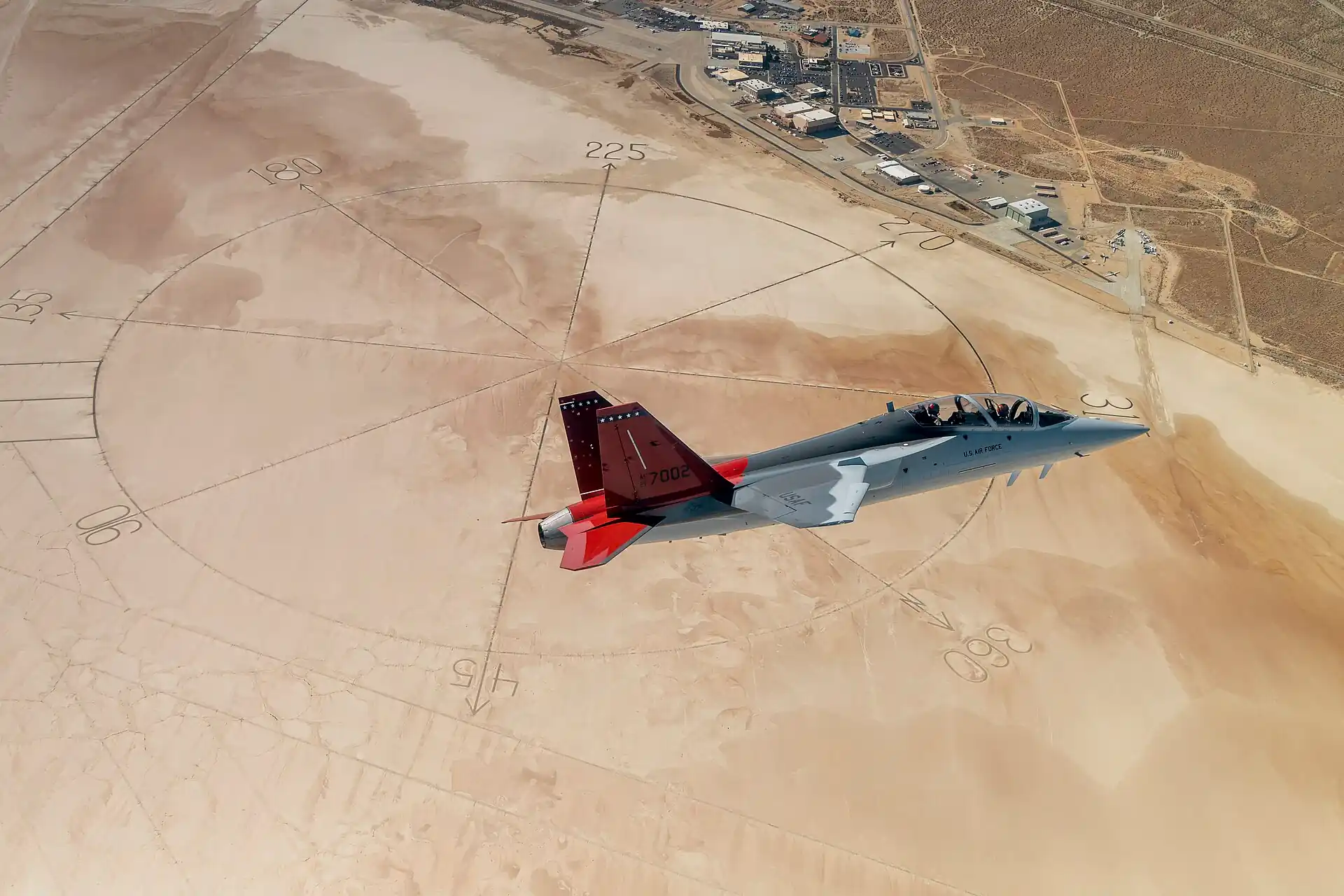
A fighter pilot may spend thousands of hours preparing for a mission that lasts only a few minutes. Before climbing into a front-line F-35, Rafale, Eurofighter Typhoon, or another modern combat aircraft, pilots first have to master something less glamorous: the trainer.
That’s where the best military trainer aircraft earn their keep.
Modern trainers are no longer just inexpensive aircraft with two seats and forgiving handling. The leading examples are flying classrooms packed with digital displays, flight-control computers, simulated sensors, tactical data, and mission-training systems.
Some can reproduce the workload of a modern fighter so convincingly that the pilot can practice radar operations, weapons employment, electronic warfare scenarios, and tactical decision-making without burning precious hours in an operational aircraft.
But there’s an interesting catch. The fastest trainer isn’t automatically the most effective one.
A supersonic aircraft such as the KAI T-50 Golden Eagle brings fighter-like speed and handling to pilot training, while the Leonardo M-346 Master focuses heavily on integrated simulation and tactical instruction.
The Boeing T-7A Red Hawk takes another route, combining advanced digital engineering with a training system designed around modern fighter requirements. Meanwhile, the BAE Hawk shows how a mature design can remain relevant through modernization, and the turboprop Pilatus PC-21 demonstrates that serious pilot preparation doesn’t always require a jet engine.
So, what actually separates an ordinary trainer from an exceptional one?
In this post, we’ll examine five of the most capable military trainer aircraft and look beyond headline specifications. Speed, avionics, cockpit workload, simulation, operating efficiency, and the ability to prepare pilots for increasingly sophisticated combat aircraft all matter.
What Makes a Military Trainer Aircraft Effective?
A military trainer does not need to win a dogfight. It needs to teach the pilot how to survive one. That difference changes how these aircraft should be judged.
Raw speed is useful, but it is only one piece of the puzzle. A capable advanced trainer should reproduce the physical and mental demands pilots will face later in an operational fighter. That includes high-G maneuvering, cockpit workload, situational awareness, and increasingly, the use of digital sensors and simulated weapons.
Fighter-like handling matters
Modern trainers such as the T-7A are designed around fighter-like characteristics, including high angle of attack, turn performance, and high-G flight. Boeing lists an expected maximum of 8 G and 30 degrees of angle of attack for the T-7A.
That gives students a chance to experience demanding flight conditions before they transition to frontline aircraft.
Avionics can be just as important as aerodynamics
A trainer with an old-fashioned cockpit can teach basic flying perfectly well, but it may leave pilots facing a steep learning curve when they enter a modern fighter.
That is why newer designs emphasize digital cockpits, fly-by-wire controls, configurable displays, and open architectures. The T-7A, for example, was designed with digital fly-by-wire controls and an open architecture intended to accommodate changing training requirements.
Simulation changes the economics of training
Here is where things get particularly interesting. Modern military training aircraft can simulate sensors, weapons, threats, and tactical environments without requiring every training scenario to involve actual weapons or operational aircraft.
The M-346 incorporates an Embedded Tactical Training System and connects with ground-based simulators and Live, Virtual, and Constructive training environments. The T-7A follows a similar systems approach, combining embedded training with ground-based simulation.
So the real measure of an effective trainer isn’t simply how fast can it fly?
It is how much useful pilot training can the entire system deliver from every sortie, simulator session, and debrief?
1. Boeing T-7A Red Hawk
The Boeing T-7A Red Hawk is designed around a simple but important idea: a trainer should behave and feel enough like a modern fighter that pilots arrive at their operational squadrons with fewer surprises.
Developed by Boeing and Saab for the U.S. Air Force, the T-7A is replacing the aging T-38 Talon in the advanced pilot-training pipeline. Unlike the T-38, which first flew in the 1950s, the T-7A was conceived in the digital era, with its development making extensive use of model-based engineering and digital design.
That matters inside the cockpit.
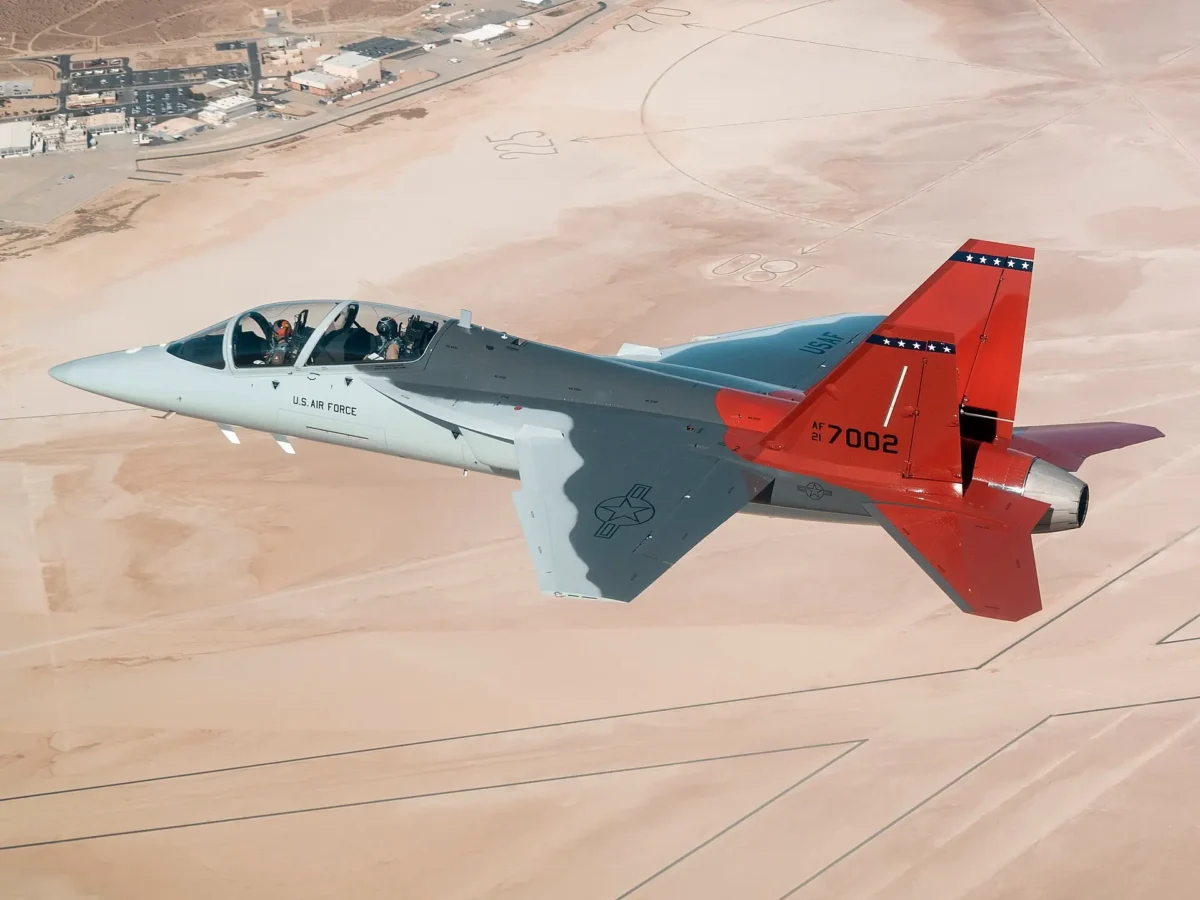
The aircraft features a digital cockpit, fly-by-wire flight controls, and a large-area display intended to familiarize students with the information-management demands of contemporary fighters. Boeing lists a maximum speed above Mach 1 and a design capable of handling up to 8 G.
But speed and G-loading aren’t the most interesting part of the T-7A. Its real strength is the training system surrounding the aircraft.
The T-7A incorporates embedded training capabilities and is designed to connect with ground-based simulators and other synthetic environments. A student can therefore practice tactical scenarios without every lesson requiring the use of a frontline fighter.
| Feature | T-7A Red Hawk |
| Role | Advanced jet trainer |
| Crew | 2 |
| Engine | General Electric F404 |
| Maximum speed | Mach 1+ |
| Flight controls | Digital fly-by-wire |
| Primary customer | U.S. Air Force |
| Main strength | Digital, fighter-oriented training |
The first T-7A was formally inducted into U.S. Air Force training service at Joint Base San Antonio-Randolph in January 2026.
That makes the Red Hawk particularly notable: it isn’t simply a faster replacement for an old trainer. It represents a shift toward digitally connected pilot training, where aircraft, software and simulators work together as one system.
2. Leonardo M-346 Master
If the T-7A represents the digital generation of military trainers, the Leonardo M-346 Master takes the idea of a flying classroom even further. Its most interesting feature isn’t simply the twin-engine layout or its ability to approach the speed of sound. It is the way the aircraft connects with the rest of the training environment.

The M-346 was designed specifically as an advanced jet trainer and Lead-In Fighter Trainer. Its twin Honeywell F124 engines produce 6,280 pounds of thrust each, while the aircraft can reach about 590 knots at low altitude and sustain loads of up to 8 G. Leonardo also lists a service ceiling of 45,000 feet.
But here’s where the aircraft gets particularly clever.
Its Embedded Tactical Training System (ETTS) can create simulated tactical scenarios involving threats, targets, sensors and weapons. That means a student can practice the mental side of combat aviation while actually flying the aircraft, rather than simply learning maneuvering skills.
The M-346 can also connect with ground-based simulators through a broader Integrated Training System using Live, Virtual and Constructive training.
| Feature | M-346 Master |
| Role | Advanced jet/LIFT trainer |
| Engines | 2 × Honeywell F124 |
| Maximum speed | About 590 knots |
| Service ceiling | 45,000 ft |
| Maximum load factor | +8 G |
| Key feature | Embedded Tactical Training System |
| Training approach | Live, Virtual and Constructive |
That combination makes the M-346 less like a conventional trainer and more like a networked training platform.
The Italian Air Force uses its T-346A designation for training pilots destined for fourth- and fifth-generation fighters, with the aircraft forming part of a wider ground-and-air training system.
And there’s a useful real-world example of its continuing relevance: in July 2026, Indonesia signed a contract for 12 M-346 F Block 20 aircraft, with deliveries expected to begin in 2030.
For modern pilot training, that systems approach may be just as important as the aircraft’s performance.
3. KAI T-50 Golden Eagle
The KAI T-50 Golden Eagle takes a more straightforward approach to advanced pilot training: make the trainer feel as much like a fighter as practical. It is a supersonic aircraft, after all, not something designed merely to teach the basics and then send the student elsewhere.

Developed by Korea Aerospace Industries with Lockheed Martin involvement, the T-50 was built as an advanced jet trainer for the Republic of Korea Air Force.
KAI lists a maximum speed of Mach 1.5, a two-person crew, and 17,700 pounds of engine thrust. The company describes it as a platform for training pilots who will eventually operate next-generation fighters.
That performance gives the T-50 an unusual advantage in the training world. A pilot can experience supersonic flight, high-energy maneuvering, and fighter-style cockpit workload without immediately moving into a front-line combat aircraft.
| Feature | T-50 Golden Eagle |
| Role | Advanced supersonic jet trainer |
| Crew | 2 |
| Engine | General Electric F404 |
| Maximum speed | Mach 1.5 |
| Maximum takeoff weight | 23,638 lb |
| Primary strength | Fighter-like performance |
| Related variant | TA-50 LIFT |
The T-50 family also illustrates how a trainer can evolve alongside a pilot. Its TA-50 Lead-In Fighter Trainer adds radar and weapons systems for tactical instruction after the advanced training stage.
KAI says the TA-50 is intended for air-to-air and air-to-ground training, effectively moving the student another step toward operational fighter missions.
That family approach is important. Instead of treating training aircraft as disposable stepping stones, the T-50 program creates a progression from advanced flying to tactical instruction and, in the broader family, light combat roles.
The result is a trainer where speed is not the entire story. Its value comes from combining supersonic performance, fighter-like handling, modern avionics, and a pathway into more advanced tactical training.
For a student pilot, that can make the eventual jump to a frontline fighter feel less like stepping onto a moving train, and more like taking the next stop on a route already familiar.
4. BAE Hawk
Some aircraft become famous because they are revolutionary. The BAE Hawk took a different route: it stayed useful by evolving.
The Hawk first flew in 1974 and entered Royal Air Force service two years later. More than five decades on, BAE Systems says the global Hawk fleet has grown to more than 650 aircraft across 16 countries, with more than 25,000 pilots trained.

Those numbers matter because military training is not just about designing a capable aircraft. Air forces also need something they can operate, maintain, upgrade, and integrate into an existing training pipeline for years.
The current Hawk combines a relatively straightforward single-engine airframe with modern cockpit and simulation technology. BAE Systems lists a maximum speed of about 630 mph at altitude, a service ceiling of 44,500 feet, and a Rolls-Royce Adour Mk 951 turbofan producing 6,500 pounds of thrust.
| Feature | BAE Hawk |
| Role | Advanced jet trainer |
| Crew | 2 |
| Engine | Rolls-Royce Adour Mk 951 |
| Maximum speed | ~630 mph |
| Service ceiling | 44,500 ft |
| Global fleet | 650+ aircraft |
| Pilots trained | 25,000+ |
| Key strength | Mature airframe with modern simulation |
But the numbers only tell part of the story.
The Hawk’s cockpit and training architecture can simulate radar, weapons, defensive aids, and other mission systems, allowing students to practice tactical decision-making while airborne. Its wider training system also incorporates simulators, mission-planning tools, computer-based instruction, and briefing/debriefing systems.
That is arguably the Hawk’s most important lesson: an aircraft doesn’t have to be brand-new to remain relevant. Its value can come from the ability to keep updating the training experience around a proven airframe.
For an aircraft introduced in the 1970s, that’s quite a trick. The Hawk’s longevity shows that in military pilot training, adaptability can sometimes matter nearly as much as novelty.
5. Pilatus PC-21
At first glance, the Pilatus PC-21 looks like the odd aircraft in this group. The other four are jet trainers; the PC-21 uses a single 1,600-shp Pratt & Whitney PT6A-68B turboprop. Yet that difference is exactly what makes it worth watching.

The PC-21 was designed around a slightly different question: how much advanced fighter training can be moved into a more economical aircraft?
The answer is surprisingly large.
Pilatus lists a maximum operating speed of 370 knots (685 km/h), a climb rate of more than 4,000 feet per minute, and an aerobatic load limit of +8/-4 G. Those figures put the PC-21 well beyond the image of a slow, basic propeller trainer.
| Feature | Pilatus PC-21 |
| Role | Basic-to-advanced military trainer |
| Engine | Pratt & Whitney PT6A-68B |
| Power | 1,600 shp |
| Maximum operating speed | 370 knots |
| Maximum aerobatic load | +8/-4 G |
| Training focus | Basic, advanced and mission training |
| Key strength | Integrated training and efficiency |
The clever part is the training system around the aircraft. The PC-21 has a modern glass cockpit, open-architecture mission computer, embedded simulation, and ground-based training tools. Pilatus says the system can support basic, advanced and jet pilot training, allowing air forces to cover more stages with fewer aircraft types.
There is also a substantial real-world footprint. By October 2024, the global PC-21 fleet had accumulated more than 500,000 flight hours, with almost 250 aircraft in service at the time.
That makes the PC-21 an important reminder that the best military trainer aircraft aren’t necessarily the ones with the highest top speed. A trainer can be effective because it shifts appropriate work away from expensive frontline jets while still giving students realistic avionics, mission-management and tactical training.
The PC-21 doesn’t try to imitate a fighter in every respect. Instead, it asks which fighter-training tasks genuinely require a jet, and which ones can be taught just as effectively in a sophisticated turboprop. That’s a much more interesting question than simply asking which aircraft flies fastest.
How the Five Trainers Compare
Putting the five aircraft side by side reveals something easy to miss in a typical best military trainer aircraft list: there isn’t one specification that tells the whole story.
A trainer with the highest top speed may provide excellent exposure to fighter-like performance, but another aircraft may deliver more sophisticated simulation or lower operating costs. A modern training program has to balance all of those factors.
| Aircraft | Propulsion | Approx. Top Speed | Distinctive Strength |
| T-7A Red Hawk | Single turbofan | Mach 1+ | Digital training architecture |
| M-346 Master | Twin turbofans | Mach 1.1 | Embedded tactical simulation |
| T-50 Golden Eagle | Single turbofan | Mach 1.5 | Supersonic, fighter-like performance |
| BAE Hawk | Single turbofan | Mach 0.84 | Mature global training platform |
| Pilatus PC-21 | Turboprop | 370 knots | Training efficiency and simulation |
The difference becomes clearer when you look beyond the specification sheet. A recent RUSI study of fast-jet pilot training identifies the PC-21, M-346A, T-7A and T-50/TA-50 among the principal modern options for replacing older training fleets. It also notes that each has different technical, financial and operational characteristics.
The PC-21 is particularly interesting because its turboprop engine makes it considerably different from the jet-powered group. RUSI notes that it can provide cost-effective advanced training, although moving directly from a turboprop to a frontline jet introduces additional transition considerations that instructors must manage.
The jet trainers, meanwhile, can provide a more fighter-like experience. RUSI specifically identifies the M-346A, T-7A and TA-50 as capable modern replacements for traditional lead-in fighter trainers, with more sophisticated simulated training than many legacy systems.
And that’s the key takeaway from the table: the best military trainer aircraft is ultimately defined by the training requirement, not by one headline number. Speed, avionics, simulation, operating economics and the aircraft students will eventually fly all influence the equation.
