

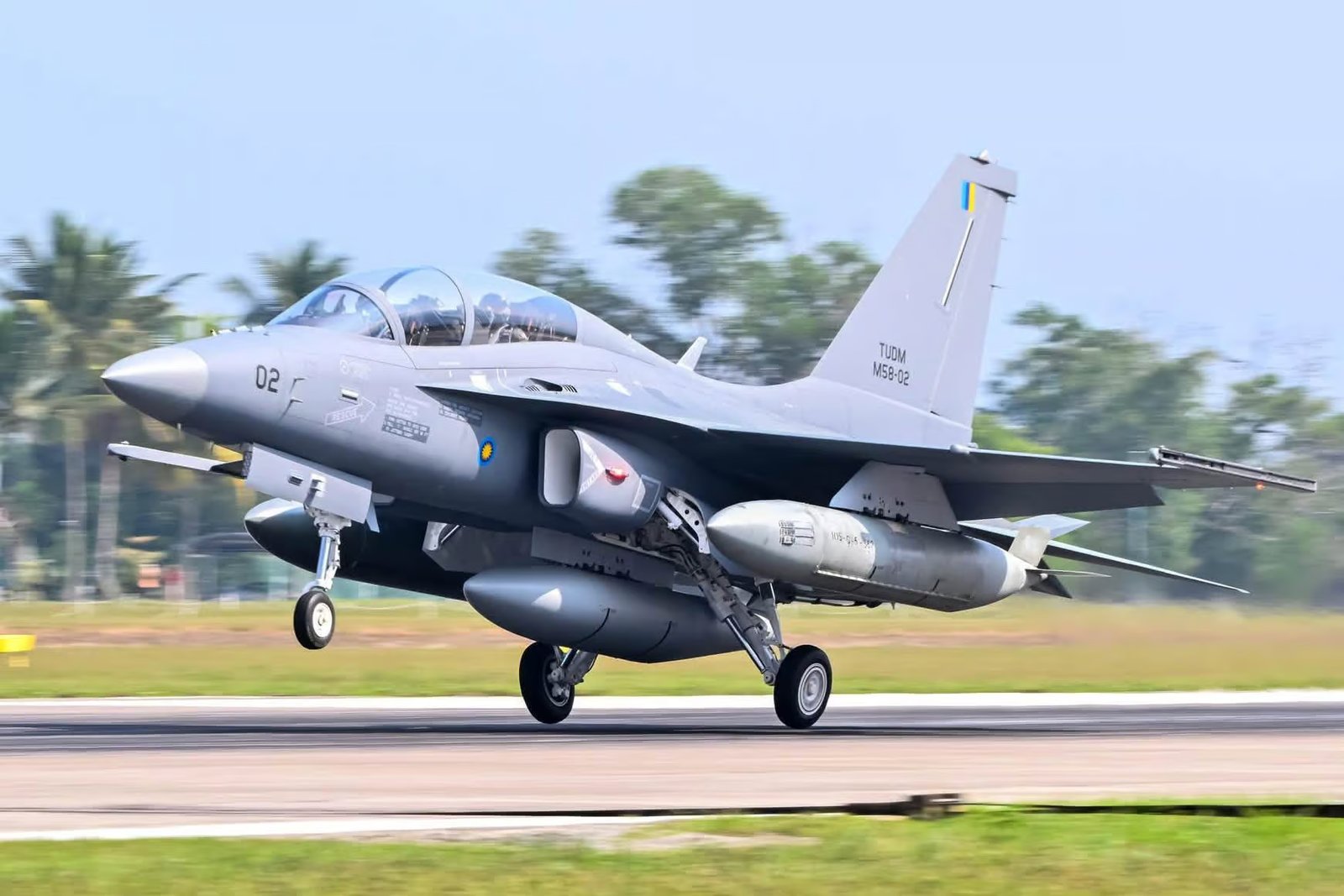
The first pair of Malaysia’s 18 Korea Aerospace Industries (KAI) FA-50M light combat aircraft, bearing tail numbers ‘M58-01’ and ‘M58-02’, arrived at their new home at Kuantan Air Base on 1 November 2026.
Their arrival marks the first addition of new fighter jets to the Royal Malaysian Air Force’s (RMAF) fleet in nearly two decades, following final deliveries of Sukhoi Su-30MKMs in the late 2000s.
This also makes Malaysia the fourth operator of KAI’s T-50/FA-50 family in Southeast Asia, following Indonesia, the Philippines and Thailand. However, the RMAF will operate the most advanced variant in the region to date.
Crewed by KAI pilots, both FA-50Ms departed from KAI’s Sacheon facility in South Korea on 29 October, making transit stops in Jeju and Laoag in the Philippines. A technical issue meant only ‘M58-01’ departed the Philippines on 30 October for the RMAF’s Labuan Air Base in East Malaysia
Just prior to their arrival, the aircraft were met by a pair each of BAE Systems Hawk 108 and 208 jets, Boeing F/A-18D Hornets and Su-30MKMs, with the aircraft then flying in formation over Labuan.
General Muhamad Norazlan Aris, the RMAF Chief, together with Minister of Defence Mohamed Khaled Nordin, were present at Labuan to witness the arrival of the FA-50M.
The other FA-50M arrived in Labuan on the morning of 1 November, with both aircraft departing for Kuantan that afternoon. For this final leg, the commanding officer and executive officer of No. 15 Squadron, the unit that will operate the aircraft, occupied the back seats of the respective aircraft.
Malaysia placed an order for the 18 FA-50Ms in February 2023 under a US$920 million contract to fulfil its Fighter Lead-In Trainer/Light Combat Aircraft (FLIT-LCA) requirement to replace ageing Hawk advanced trainer and light combat aircraft, as well as already retired Aermacchi MB-339CM trainers.
Other contenders in this competition included India’s Tejas, China’s JF-17, Turkey’s Hürjet and Russia’s Yak-130 and MiG-35D, although only the first two and the FA-50 were seriously considered.
The FA-50Ms are built to Block 20 standard, which incorporates Raytheon’s PhantomStrike active electronically scanned array radar, an aerial refuelling probe, upgraded avionics and an expanded weapons suite, including air-to-air missiles and precision-guided munitions.
KAI subsequently redesignated the Block 20 as the Block 70, although Malaysia’s acquisition programme continues to identify the FA-50M variant as the Block 20.

At the arrival ceremony in Labuan, Khaled said the RMAF was expected to receive a total of six FA-50M aircraft by April 2027, with the remaining units scheduled for delivery by early 2028.
He also indicated a second batch of FA-50Ms was being considered, although priority would be given to induction of the initial 18 aircraft, after which the RMAF would determine its future fighter requirements.
As outlined in the RMAF’s Capability Development Plan 2055, which was unveiled in 2018, the service plans to operate three squadrons of FLIT-LCAs as part of its long-term modernisation programme through till 2055.
The 13th Malaysia Plan, which sets the strategic direction for Malaysia’s economic and social development from 2026-30, also outlines the acquisition of a further 18 FLIT-LCA aircraft during this period.
Current plans call for the acquisition of a fifth-generation multirole combat aircraft under the subsequent Malaysia Plan from 2030 onwards. However, there are indications this programme could be prioritised over a second batch of FLIT-LCAs.
by Roy Choo
