

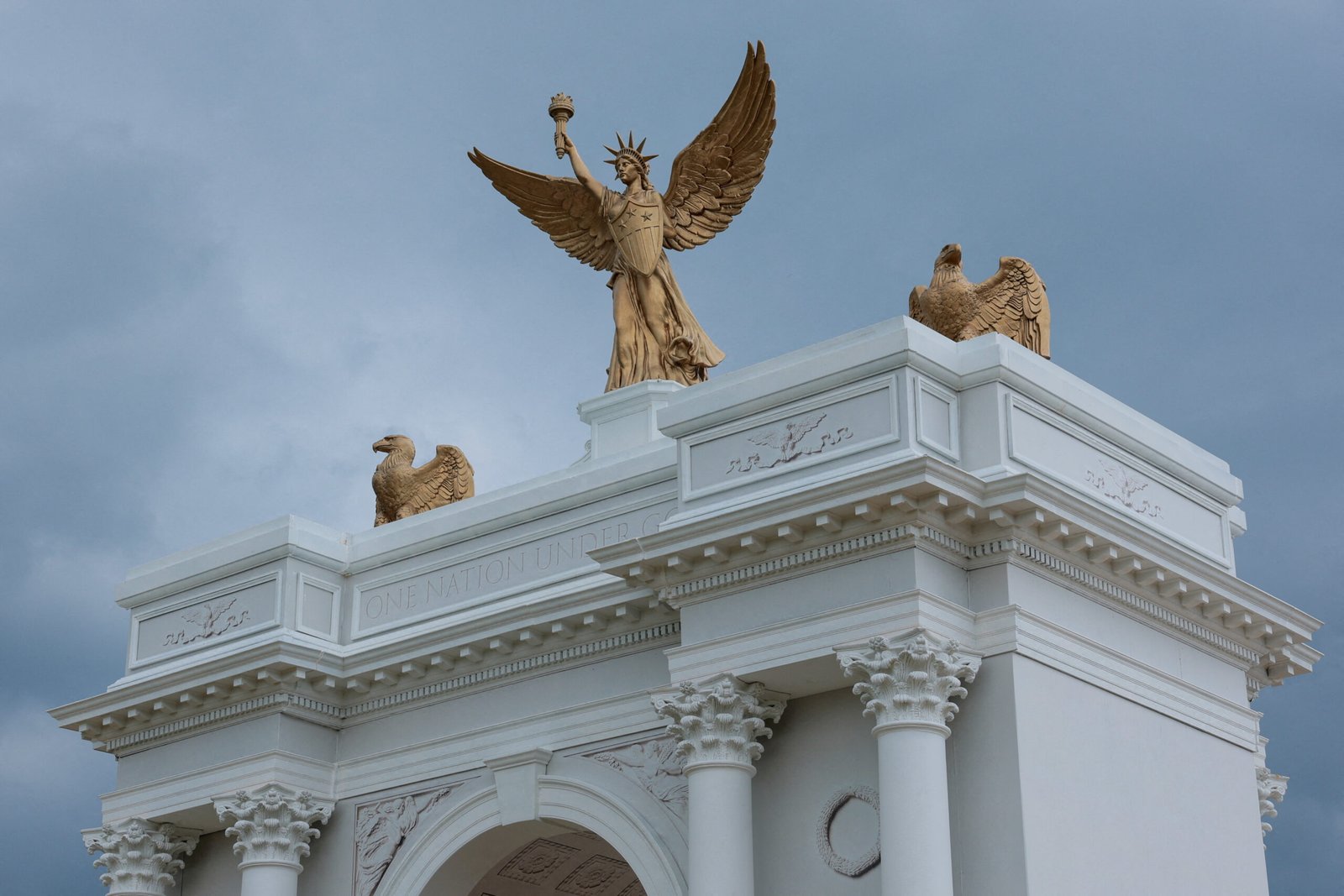
Within an hour after a federal commission approved construction of a 250-foot arch Thursday between the Lincoln Memorial in Washington, D.C., and Arlington National Cemetery in Virginia, a federal judge blocked any work from starting, siding with three Vietnam veterans and other plaintiffs who have sued to stop construction.
U.S. District Court Judge Tanya Chutkan cited harms to the environment, traffic and costs to the governments of Washington, D.C. and the state of Virginia, which joined the suit last week.
“The harm is certain,” Chutkan wrote. “Defendants initially notified the court that construction could begin as early as November 5, 2026, if the [National Capital Planning Commission, or NCPC] approves the project at its meeting that day and the Department of the Interior authorizes construction.”
The judge’s announcement followed a nine-hour hearing and vote on the project by the NCPC, a commission responsible for reviewing buildings, monuments and memorials in Washington.
During the hearing, 130 members of the public testified, more than 90% of whom opposed it, and 1,000 people submitted written statements. The group, which included veterans, lawmakers, architectural historians, preservationists and others, discussed the arch’s planned location, size, purpose and potential as a tourist attraction.
They expressed concern about the impact near Arlington National Cemetery, the burial ground of more than 400,000 service members, their families and public figures.
“Placing a gigantic tourist attraction directly along that historic corridor would be a desecration to the memory of our war dead,” speaker Meg Trumbull Cowan said during the public comment portion.
“If you approve this, you will have trivialized the objection of veterans who view Memorial Circle as the entry to the sacred Arlington National Cemetery rather than a tourist overlook for intrusive gawking or a perch for snipers,” local resident Meg Maguire said.
NCPC Chairman Mark Paoletta said the arch represented a “generational security opportunity” to protect Washington, D.C., referring to an announcement last month by the president that the facility would serve as a monument to the nation’s 250th anniversary but also would host snipers and store drones and ammunition.
“President Trump’s historic vision for a monumental arch at Memorial Circle would complete a project over a century in the making, and honor our nation and her veterans, and provide the sacred ground of Arlington National Cemetery with the monumental gateway it deserves,” Paoletta said.
Three-dimensional modeling shows that given its size, the arch would block a portion of the cemetery view from the Lincoln Memorial and cast shadows on thousands of graves, including President John F. Kennedy’s. It also would completely obstruct the view of the Lincoln Memorial from Arlington House, the former home of Confederate Gen. Robert E. Lee.
Kimberly Moyers, a Navy veteran from Texas, spoke in favor of the structure, saying she fully supports it for herself and fellow veterans.
“Let the shadow cast by the monument represent the never-ending burden we veterans carry. A shadow I wake up with every morning and lay down with every night,” Moyers said.
The National Park Service said the arch is appropriate as part of a plan for the Memorial Bridge corridor based on a 1924 plan for the site, which called for two 166-foot slender columns framing the vista between Arlington and the Lincoln Memorial. The NPS supported plans for the arch, saying it would honor “America’s founding principles.”
Commissioner Phil Mendelson sought clarity on the arch’s purpose before voting. Citing multiple responses, including that the arch would mark the 250th anniversary of the U.S.; celebrate veterans; serve as a military platform; give Washington an arch that it lacks; or a grand entrance to the city, Mendelson proposed delaying the vote.
“Clearly, we have not received a definitive statement of what the arch commemorates. Without specificity, I cannot judge whether the arch’s site, scale, and form fit its purpose,” Mendelson said.
The 12-member commission is made up of three persons appointed by President Donald Trump, three members of the executive branch, including Defense Secretary Pete Hegseth, two Republican members of Congress and four members of Washington’s governance, including two people appointed by city Mayor Muriel Bowser.
Chutkan conducted a hearing Friday to weigh testimony by the three Vietnam War veterans and an architectural historian who filed suit Feb. 19 seeking to stop construction of the arch.
Veterans Michael Lemmon, Shaun Byrnes and Jon Gundersen, joined by Calder Loth, former senior architectural historian for the state of Virginia, sued Trump on Feb. 19 to stop construction, arguing that the building lacked the congressional approval required and would destroy the viewshed between Arlington House across Memorial Bridge to the Lincoln Memorial — a sightline intentionally designed to symbolize the unification of the country following the Civil War.
During the hearing, Lemmon said he visits the Vietnam War Memorial and the Lincoln Memorial often, where he takes in the view of Arlington before going to the cemetery to visit the graves of fallen comrades. The arch, he said, would change the experience in a “profound way.”
“The pain is real. … The idea of having a tourist platform 250 feet up in the air, looking over burials… I find it disruptive and disrespectful. This is hallowed ground,” Lemmon said.
The arch – which has been called the Great Triumphal Arch, the Independence Arch and the New Monumental Arch — is one of several initiatives President Donald Trump has undertaken to alter the landscape of Washington, D.C.
The president has redecorated the Oval Office, demolished the East Wing of the White House to build a ballroom, renovated the Reflecting Pool between the Lincoln Memorial and the Washington Monument — an effort completed this week after poor workmanship resulted in a peeling liner and increased algae buildup — repaired fountains, added his name to the Kennedy Center for the Performing Arts, covered four bronze equestrian statues near the Lincoln Memorial in gold leaf and wants to turn a 104-year-old historic public golf course into a luxury facility.
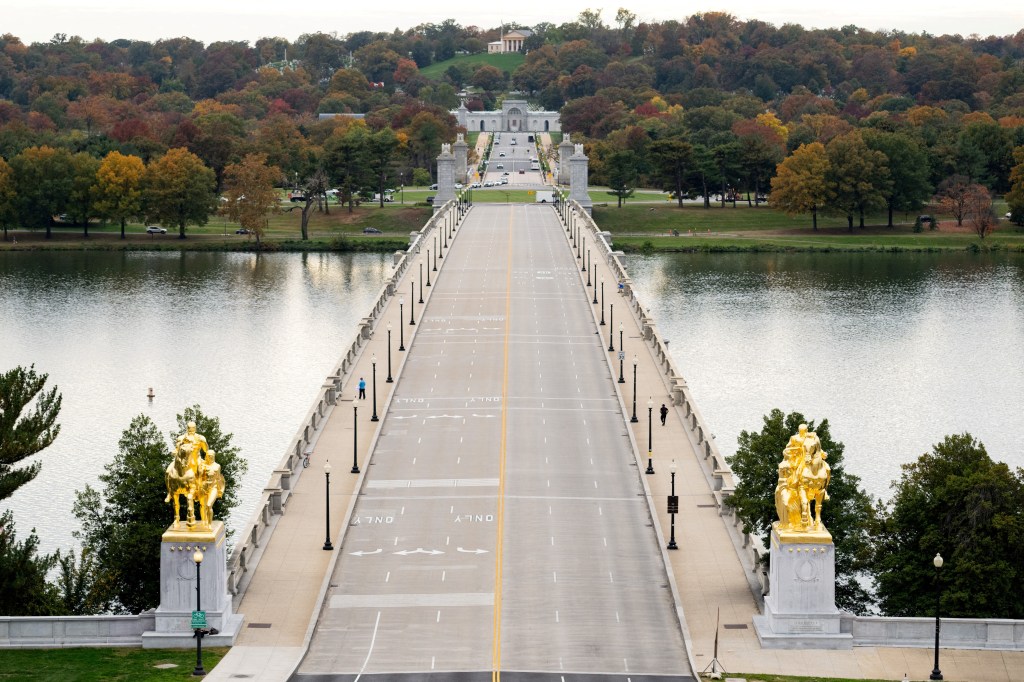
Lawsuits were filed to stop several of the initiatives, including the ballroom and the golf course. The U.S. Supreme Court ruled Aug. 31 that construction of the ballroom could continue because the plaintiffs in that case, led by the National Trust for Historic Preservation, contended the project was offensive because of its scale and height — an argument the justices said lacked standing.
The high court ruled that the government established it would be harmed if the above-ground portion of the ballroom was not built to the desired scale because it shielded the underground portion of the facility, which will include a national security bunker.
Three weeks after that ruling, Trump announced the arch also would serve as a national security complex, hosting snipers and storing drones and “large quantities of sniper ammunition,” according to a post on Truth Social.
During the hearing, Chutkan questioned the timing of the announcement as a military facility after the Supreme Court ruled on the White House ballroom.
“Ammunition and drones at a site that gets between 2,000 and 22,000 visitors a day [which also] stands in the path of aircraft? I think this is very serious,” Chutkan said. “If the military thing is real and not taking advantage of the SCOTUS ruling, they would have to start over again because that is not included in the current plans.”
The proposed plan calls for a granite-clad 12-story arch that features statues at its top, including a winged Lady Liberty holding an eternal flame. The structure would be twice the size of the Lincoln Memorial at the other side of Memorial Bridge and would have an observation deck that overlooks the cemetery.
A young veteran at the hearing said the observation deck would cause a “carnival-like atmosphere” near the cemetery and voiced concerns that it could attract veterans who sought to end their lives near their fallen comrades.
Deputy Assistant Attorney General Robert Stander said during the hearing that the request for the preliminary injunction should be denied and the case dismissed because the Supreme Court’s decision on the White House ballroom clearly noted that suits lack standing if they are based on a plaintiff’s argument that they find a building distasteful.
“It’s an easy case. It’s very clear it is about [the plaintiffs’] deep, philosophical offense and disgust to the arch,” Stander said, adding that the arch is a “high-priority project” for the administration.
Wendy Liu, the veterans’ attorney, said the arch suit was unlike the ballroom argument because it was not about aesthetics. An arch, with its visitors and view over military funerals and the graves of the fallen, would “degrade the entire experience” of visiting Arlington National Cemetery, she said.
“They use the cemetery to pay their respects. They use it in a way that is meaningful to them,” Liu said. “It reminds them of the sacrifices they made for their country… it reminds them of why they go visit their fallen friends.”
The government said that construction would begin as soon as the NCPC approved the project. Late last month, construction crews outlined placement for a planned construction fence on the grass at the site. During the hearing, Chutkan asked Stander, “What’s the rush?”
“What’s the harm to the government to wait three or four months?” Chutkan asked.
The three veteran plaintiffs said they hoped to be buried in Arlington National Cemetery, with at least one, Byrnes, saying he would reconsider if the arch is built. Lemmon served in the Army in the Vietnam War and later was the U.S. ambassador to Armenia. Byrnes served in the Navy and was a senior foreign service officer assigned to Moscow and Kosovo. Gundersen is an Army veteran who served as a charge d’affaires to Ukraine, Estonia, Iceland and Norway.
Before taking the stand, Byrnes told Military Times that he didn’t have a problem with the arch, he just thinks it should be located elsewhere.
“It’s inappropriate. It’s not the right place for it,” Byrnes said.
Many of those who spoke during the hearing agreed. Retired Army veteran Joel Mjolsness, a Bronze Star recipient who served in the Old Guard at Fort Myer, said the cemetery is simply not the place for the arch.
“When you stand at a gravesite and hand a folded American flag to a grieving family member, you understand deeply what these grounds mean. Arlington National Cemetery is the ultimate symbol of that solemnity, sacrifice and quiet dignity,” Mjolsness said. “A 250-foot arch at this location shatters that sacred dynamic.”
