

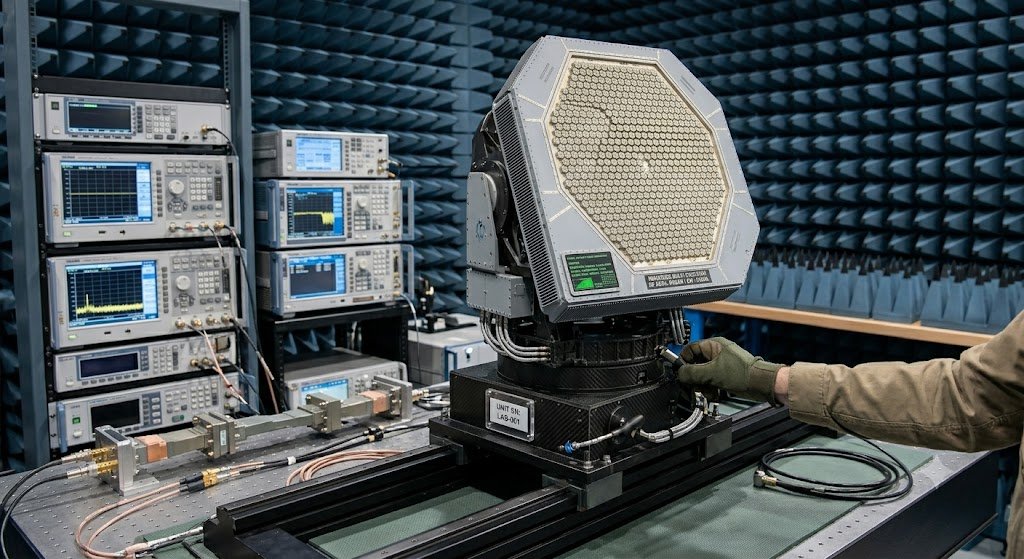

The European Defence Agency’s Sceptor initiative is helping to advance the development of multifunction radio frequency systems capable of performing radar, electronic warfare and communications tasks.
The European Defence Agency’s (EDA’s) Sceptor initiative commenced in 2024 and will have a four-year duration, according to EDA official documents. The initiative “seeks to combine radar, electronic warfare, and communication functions with adaptive cognitive features (to enhance) situational awareness across air, land, and sea domains” state the documents. Specifically, the “project will create modular and interoperable systems, establishing standardised hardware and software to boost operational flexibility while minimising electromagnetic spectrum consumption”.
Sceptor “will integrate advanced antennas and state-of-the-art technologies to meet strict requirements for size, weight, and power”. Additionally, “the programme will tackle challenges in thermal management and signal integrity to ensure dependable performance across different environments”. The project is expected to cost circa $40 million, with the European Union (EU) providing funding via the EDA. Companies and organisations from Estonia, France, Germany, Italy, Lithuania, the Netherlands, Poland, Spain and Sweden are involved with Sceptor. Indra of Spain is leading the project.
Indra representatives told Armada that Sceptor traces its ancestry to the EDA’s Combined Radar, Electronic Warfare and Communications Functions for Military Applications (CROWN) initiative. CROWN was launched in 2021. Sceptor takes CROWN’s output and addresses these “within a more ambitious and structured research framework”. The Indra officials continued that Sceptor will respond to operational needs for integrated Radio Frequency (RF) capabilities combining radar, electronic warfare and military communications functions within a single adaptable system applicable to land, sea and air domains.
Sceptor will produce hardware and software deliverables focusing “on the design and validation of a future European multifunction radio frequency system based on a shared active electronically scanned array architecture” the Indra officials continued. Hardware element addressed by Sceptor include antenna concepts and modular building blocks hosting multiple RF functions but using a single aperture. Realising this hardware calls for attention to be paid to size, weight, power consumption, thermal management and signal integrity. Sceptor will also develop “standardised and interoperable software components that enable the coordination and management of … different RF functions”. Developing this software will be imperative to ensure flexibility, scalability and adaptability to different operational situations.
Timelines
Another programme goal is to take these hardware and software elements and advance them to technological readiness levels which demonstrate the concept’s feasibility and successful integration at the system level. The first year of project will focus on “consolidating requirements, scenarios and architectural foundations”. During the second year, detailed design work will commence alongside the development of key hardware and software building blocks. System integration and validation will take place in the third year before consolidation, evaluation and final validation of the project’s results in the final twelve months. During that latter year the Sceptor reference architecture will be refined “capturing lessons learned and ensuring that the outcomes are mature, documented and suitable to inform future European defence capability development and follow-on activities”.
Outlook
Sceptor represents an important step towards the eventual development of true, multifunction RF systems capable of supporting electronic warfare, radar and communications sensing, long a ‘holy grail’ of RF engineers. Size, Weight, Power and Thermal (SWAPT) minimisation is a perennial concern when realising military capability. These priorities will only deepen in the coming years as the adoption by Europe’s militaries of an increasing number of uninhabited systems able to work in all domains continues.
Moreover, realising these multifunction RF systems in other SWAPT-constrained environments like missiles will increase the capabilities of such weapons not only to locate their targets, but also to protect themselves, and to network with other military assets. The latter is especially relevant to the North Atlantic Treaty Organisation’s multi-domain operations doctrine. Developing multifunction RF systems through European Union vehicles like the EDA also helps to preserve the continent’s defence innovations autonomy. The latter point is highly relevant given that traditional alliances like those between the EU and United States are fracturing. Such friction potentially negatively affects the ability of European nations to obtain advanced defence technology from Washington DC.
by Dr. Thomas Withington
