

A rifle can be beautifully engineered, packed with advanced technology, and still fail the one test that matters most: what happens when everything goes wrong?
Mud gets into the action. Magazines are dropped. Soldiers carry the weapon for hours through heat, rain, dust, and exhaustion. At that point, the label “best assault rifle” means more than impressive specifications on a product sheet. It means a weapon that continues to perform when conditions are anything but ideal.
That is why ranking the best assault rifles in the world is surprisingly difficult. One rifle may be exceptionally accurate, while another is famous for surviving abuse that would leave more refined designs struggling. A third might offer outstanding modularity, allowing troops to adapt it to different missions almost like changing tools in a well-equipped toolbox.
This list takes a broader view of what makes a modern military rifle stand out. Instead of judging these weapons by one feature alone, we’ll examine their reliability, accuracy, battlefield history, ergonomics, adaptability, and influence on infantry warfare.
The five rifles featured here represent different approaches to the same problem: how do you give an infantry soldier a dependable, effective weapon without making it too heavy, complicated, or difficult to maintain?
Some choices will be familiar. Others may spark debate, and that’s part of the fun. There is no single universal answer to the question of which rifle is the best assault rifle. The right choice often depends on the mission, environment, logistics, and the people expected to carry it.
So, which five deserve the spotlight? Let’s look beyond the famous names and examine what truly makes each one stand out.
How We Ranked These Assault Rifles
There’s a problem with most “best assault rifle” lists: they often treat the ranking like a beauty contest. Bigger caliber? Higher rate of fire? More famous name? That’s not enough.
A military rifle is part of a much larger system. It has to be carried, maintained, supplied, repaired, adapted, and used by people who may be tired, cold, wet, or operating in terrible conditions. A rifle that looks perfect on paper can become a headache in the field.
For this ranking of the best assault rifles in the world, six factors matter most:
| Ranking Factor | Why It Matters |
| Reliability | The rifle must function consistently in difficult conditions |
| Accuracy | Practical accuracy affects effectiveness at realistic combat distances |
| Durability | Military weapons face hard use, transport, weather, and neglect |
| Ergonomics | Controls, weight, balance, and handling influence real-world usability |
| Modularity | Modern missions often require optics, accessories, and configuration changes |
| Military Record | Long-term service and combat experience reveal strengths that specifications cannot |
Combat history also deserves special attention. A rifle that has served across decades and environments has been exposed to a kind of long-term testing that no laboratory can fully replicate.
That doesn’t mean the oldest rifle automatically wins. Technology matters. So does design philosophy. The best modern assault rifles increasingly combine reliability with better optics integration, improved controls, and greater adaptability.
In the end, this list asks a simple question: which rifles deliver the strongest overall balance between performance, dependability, and practical military value?
That approach produces a more useful answer than simply asking which rifle has the most impressive specification sheet.
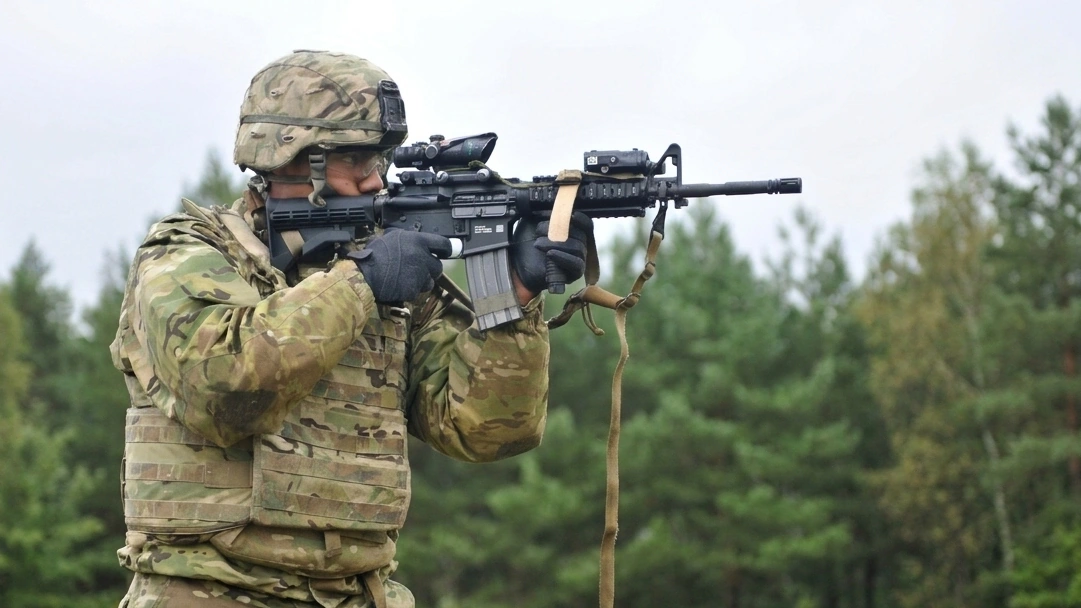
1. M4/M16 Family (United States)
When people debate the best assault rifle, one name almost always enters the conversation first: the M4/M16 family. Whether praised for its precision or criticized for its early growing pains, this rifle platform has become one of the most influential military firearms ever developed.

Introduced during the Vietnam War as the M16 and later refined into the shorter M4 Carbine, the platform has continuously evolved for more than six decades.
Today, it remains the standard service rifle for the U.S. military and is used by more than 80 countries in various forms, making it one of the most widely adopted military assault rifles in history.
Key Specifications
| Specification | Details |
| Country of Origin | United States |
| Cartridge | 5.56×45mm NATO |
| Operating System | Direct impingement (most variants) |
| Fire Modes | Semi-automatic and select-fire |
| Effective Range | Around 500–600 meters |
| Standard Magazine | 30-round detachable STANAG magazine |
What truly sets the M4/M16 platform apart isn’t raw firepower, it’s adaptability. Modern versions can be configured for close-quarters combat, designated marksman roles, or general infantry use by simply changing optics, barrels, stocks, or accessories. Few rifle families have proven as modular.
Accuracy is another defining strength. The lightweight, high-velocity 5.56 NATO cartridge produces relatively low recoil, allowing soldiers to fire rapid, controlled follow-up shots. Combined with a free-floating barrel on many modern variants and widespread use of optical sights, the platform consistently delivers excellent practical accuracy.
Of course, no rifle is perfect. The original M16 earned a poor reputation in Vietnam due to ammunition changes, inadequate cleaning equipment, and maintenance misconceptions. Those issues were largely corrected through engineering improvements, chrome-lined chambers, revised training, and better logistics. Today’s M4 is considered a highly dependable combat rifle when properly maintained.
Its long service record, from dense jungles and Middle Eastern deserts to urban battlefields and arctic environments, demonstrates why the M4/M16 family continues to rank among the best assault rifles in the world.
Rather than relying on one standout feature, it succeeds through balance: precision, modularity, lightweight handling, and decades of continuous refinement.
2. AK-47/AKM Series (Soviet Union/Russia)
If the M4/M16 family represents refinement and modularity, the AK-47 represents something more elemental: a rifle designed to keep working when the world around it becomes a mess.
Few assault rifles have achieved the cultural reach of the AK platform. Its descendants have appeared in conflicts across nearly every region of the world, serving with regular armies, insurgent groups, and security forces. That widespread use is part of its story, but not the whole story.
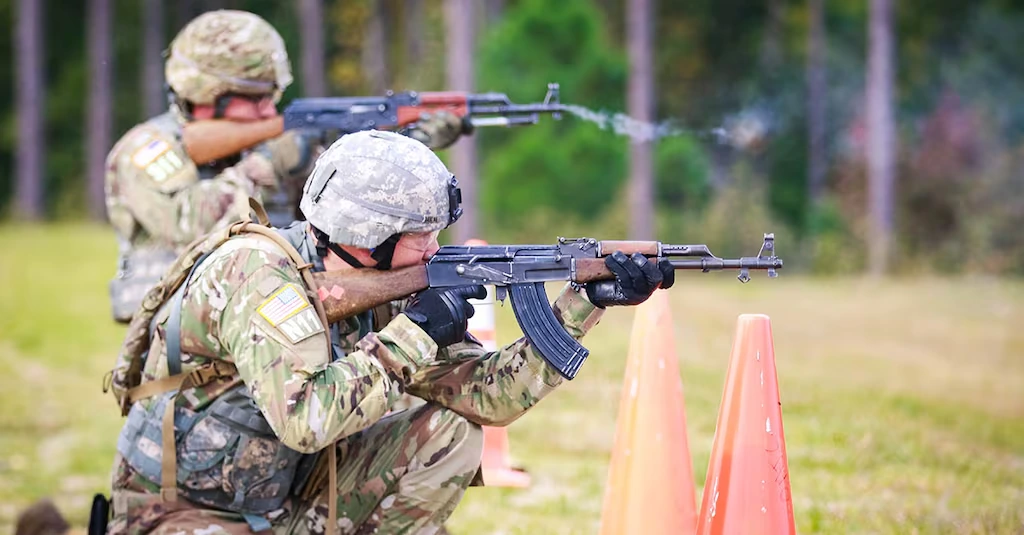
The original AK-47 was developed in the Soviet Union after World War II, while the later AKM became the lighter, more widely produced version that helped establish the platform’s global reputation.
Both fire the 7.62×39mm cartridge, which offers more power than the 5.56×45mm NATO round used by rifles such as the M4, though with greater recoil and heavier ammunition.
Key Specifications
| Specification | Details |
| Country of Origin | Soviet Union |
| Cartridge | 7.62×39mm |
| Operating System | Long-stroke gas piston |
| Fire Modes | Semi-automatic and automatic |
| Magazine | 30-round detachable magazine |
| Design Era | Late 1940s onward |
The AK’s most famous advantage is its tolerance for harsh conditions. Its long-stroke piston system and generous operating clearances help it continue functioning despite dust, dirt, and rough handling. That doesn’t make it magical, maintenance still matters, but the platform has earned a reputation for being unusually forgiving.
The trade-off is equally important. Compared with many 5.56mm rifles, the 7.62×39mm cartridge produces more recoil and creates a heavier ammunition load. The rifle can also feel less refined in ergonomics and precision than newer designs.
Still, the AK platform’s influence is difficult to overstate. Its design philosophy is brutally simple: make a reliable weapon, keep it practical, and avoid unnecessary complexity.
That combination explains why the AK-47 and AKM remain central to any serious discussion about the best assault rifle ever developed. Sometimes, engineering brilliance is not about adding more. It’s about knowing what you can safely leave out.
3. HK416 (Germany)
The HK416 is what happens when a familiar rifle concept is reworked with a different engineering priority: make the operating system more resistant to the kind of fouling and heat that can complicate sustained use.
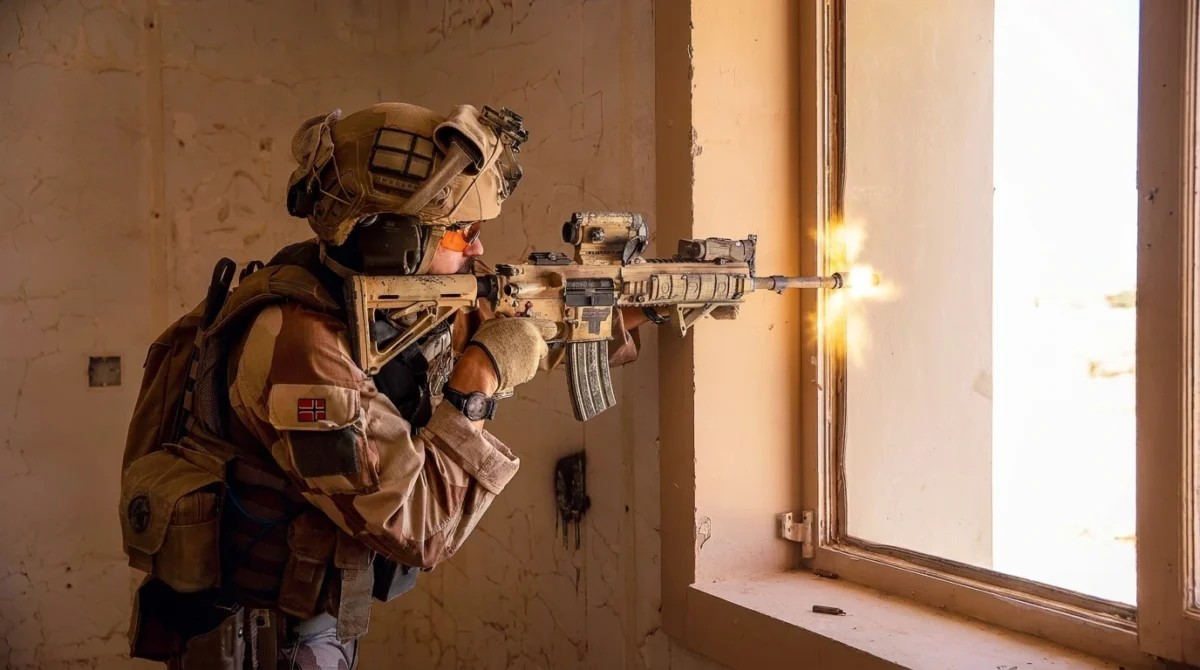
Developed by Heckler & Koch, the HK416 is closely related to the AR-15/M16 family in its controls and general handling. That familiarity is a major advantage. Soldiers already accustomed to the M4 platform can transition to the rifle without learning an entirely new manual of arms.
Its biggest mechanical distinction is the use of a short-stroke gas piston system rather than the traditional direct-impingement arrangement found on most M16 and M4 variants.
The design keeps hot propellant gases and much of the resulting fouling away from the receiver, which can help reduce heat and carbon buildup during demanding firing schedules.
Key Specifications
| Specification | Details |
| Country of Origin | Germany |
| Cartridge | 5.56×45mm NATO |
| Operating System | Short-stroke gas piston |
| Fire Modes | Semi-automatic and select-fire |
| Magazine | 30-round detachable magazine |
| Design Family | AR-15/M16-based |
The HK416’s reputation grew significantly through adoption by military and special operations units, including France’s armed forces, which selected the platform for its standard infantry rifle program.
That kind of institutional adoption matters because a military does not choose a new service rifle based solely on how impressive it looks in a brochure. Training, maintenance, logistics, and long-term support all enter the equation.
The rifle also benefits from modern ergonomics and accessory compatibility. Optics, suppressors, lasers, and other mission equipment can be integrated without turning the platform into an awkward collection of add-ons.
Is it the perfect best assault rifle? Not necessarily. The piston system can add weight and complexity compared with simpler direct-impingement designs, and the rifle is generally more expensive than many conventional service rifles.
Still, the HK416’s blend of familiar controls, modern engineering, durability, and elite military adoption makes it one of the strongest contenders among today’s best assault rifles in the world.
4. FN SCAR-L (Belgium)
The FN SCAR-L takes a different approach to the question of what makes the best assault rifle. Instead of trying to be everything to everyone, it was designed from the beginning as a flexible platform for modern military operations.
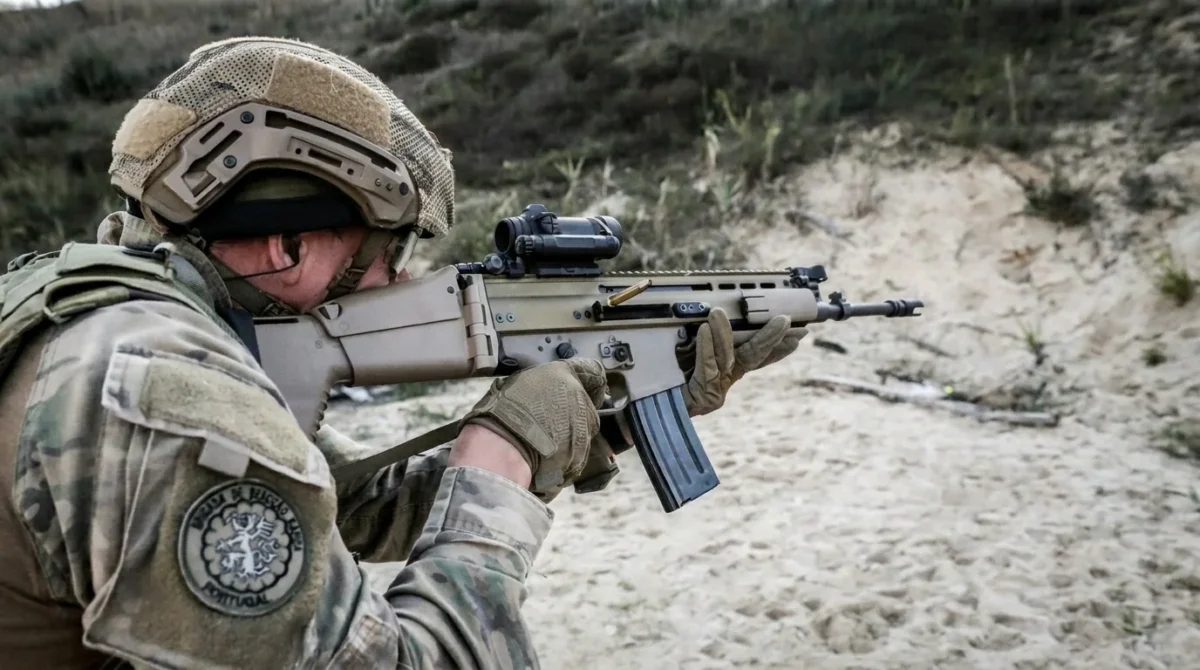
Developed by FN Herstal for the U.S. Special Operations Command’s SCAR program, the rifle was built around modularity. Its design allows soldiers to adapt the platform to different missions, configurations, and accessories without abandoning the core weapon system.
Key Specifications
| Specification | Details |
| Country of Origin | Belgium |
| Cartridge | 5.56×45mm NATO |
| Operating System | Short-stroke gas piston |
| Fire Modes | Semi-automatic and select-fire |
| Magazine | 30-round detachable magazine |
| Design Feature | Modular rail and adjustable configuration |
One of the SCAR-L’s most recognizable features is its folding, adjustable stock. That may sound like a small detail, but rifle ergonomics become much more important when soldiers wear body armor, night-vision equipment, or other bulky gear. A weapon that can be adjusted to the user is simply easier to manage over long missions.
The rifle also uses a short-stroke gas piston system and a robust receiver design intended for demanding service conditions. Its extensive accessory mounting options allow it to accommodate modern optics and other equipment, reflecting a broader shift in infantry warfare: the rifle is increasingly a platform rather than a standalone weapon.
The SCAR-L is not without criticism. Its design can be more expensive and, depending on configuration, heavier than simpler rifles. It also faces intense competition from mature platforms such as the M4 and newer modular designs.
Still, the SCAR-L remains a fascinating entry among the best assault rifles in the world because it was designed with adaptability at its core. Its real strength is not one spectacular specification. It’s the ability to change shape around the mission, an important advantage in a battlefield where “standard” rarely stays standard for long.
5. Steyr AUG (Austria)
The Steyr AUG looks different from the moment you see it. Its bullpup layout places the magazine and action behind the trigger, allowing the rifle to maintain a relatively long barrel while keeping the overall weapon compact. That unusual arrangement is more than a visual signature, it is the central idea behind the rifle’s design.
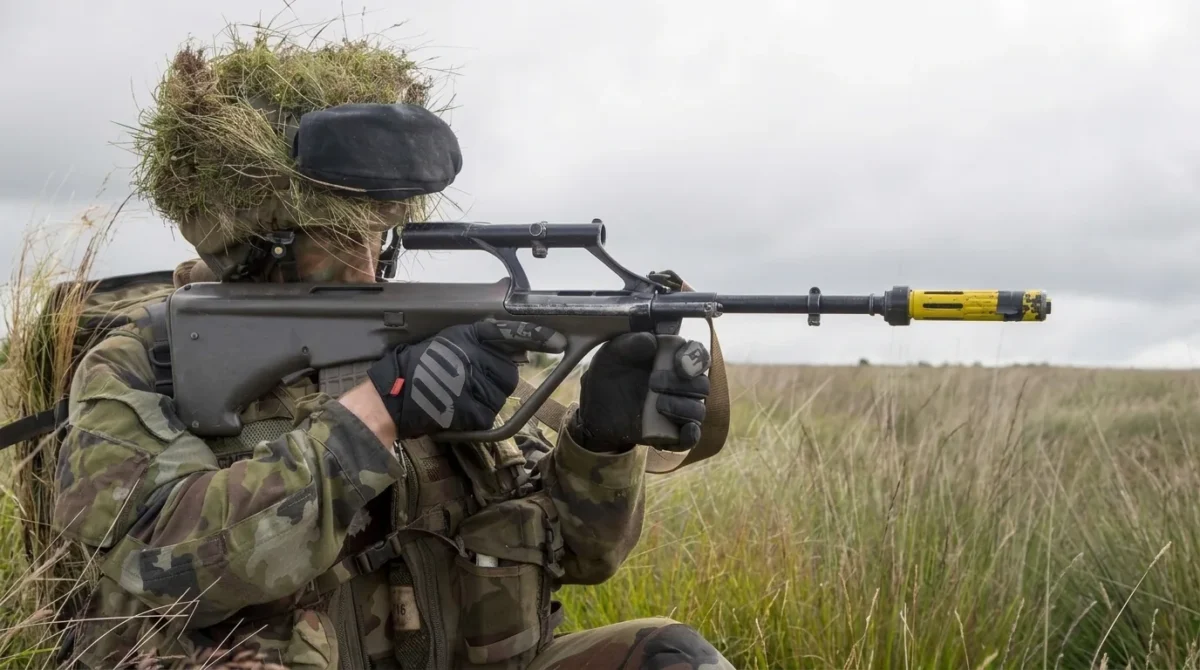
Developed in Austria in the 1970s, the AUG became one of the earliest widely recognized military rifles to combine a bullpup configuration with extensive use of modern materials and an integrated optical sight. It was a bold departure from the conventional rifle layout of its era.
Key Specifications
| Specification | Details |
| Country of Origin | Austria |
| Cartridge | 5.56×45mm NATO |
| Operating System | Short-stroke gas piston |
| Fire Modes | Semi-automatic and select-fire |
| Configuration | Bullpup |
| Magazine | Detachable box magazine |
The main advantage is compactness. A bullpup rifle can offer a useful barrel length without becoming as long as a conventional rifle with the same barrel. That can be particularly valuable in urban environments, vehicles, and other confined spaces where every extra centimeter starts to matter.
The AUG also benefits from a modular construction philosophy. Several components can be replaced or reconfigured, and the platform has been adapted into multiple versions over the decades. Its distinctive integrated optic on early models was especially forward-looking at a time when most standard infantry rifles were still commonly equipped with conventional iron sights.
There are trade-offs, naturally. Bullpup rifles can have a different balance and manual of arms compared with traditional designs. Magazine changes may also feel less intuitive to users trained exclusively on conventional layouts. The location of the action can create additional design challenges, particularly when adapting the rifle for different users.
Yet the AUG’s longevity says plenty. It remains one of the most recognizable military assault rifles ever developed and a strong contender among the best assault rifles in the world. Its enduring appeal comes from a simple idea executed with unusual confidence: make the rifle shorter without giving up the barrel length needed for effective performance.
What Makes a Great Assault Rifle?
The easiest way to judge a rifle is to focus on the numbers. Caliber. Weight. Rate of fire. Effective range. Those figures are useful, but they only tell part of the story.
A truly great assault rifle has to work as a complete system. Imagine handing a soldier a rifle that is incredibly accurate but too heavy to carry comfortably for an entire day. Or a weapon with excellent firepower that is difficult to maintain in the field.
On paper, it might look impressive. In practice, the compromises quickly become obvious.
Reliability Comes First
A rifle that fails at the wrong moment is a serious liability. This is why reliability remains one of the most important factors separating the best assault rifles in the world from merely capable designs.
Accuracy Must Be Practical
Military accuracy is not about winning a bench-rest competition. It is about putting effective fire on target under realistic conditions, often while wearing equipment, moving, or operating in poor visibility.
Weight Changes Everything
A few hundred grams may seem insignificant in a specification table. Carry that extra weight alongside ammunition, body armor, water, medical equipment, and communications gear, though, and the difference becomes much more noticeable.
Modularity Adds Long-Term Value
Modern infantry operations rarely look identical. Optics, suppressors, aiming devices, and other accessories can change how a rifle is used. A modular platform can adapt instead of becoming obsolete every time requirements change.
Ergonomics Are Easy to Underestimate
Controls that are intuitive, a comfortable stock, good balance, and easy maintenance can matter just as much as mechanical performance. These are the details soldiers interact with constantly.
That is the real secret behind the best assault rifle designs: balance. No rifle wins every category.
The strongest platforms are the ones that make their compromises intelligently, giving users a weapon that remains useful, dependable, and manageable when the situation gets complicated.
