

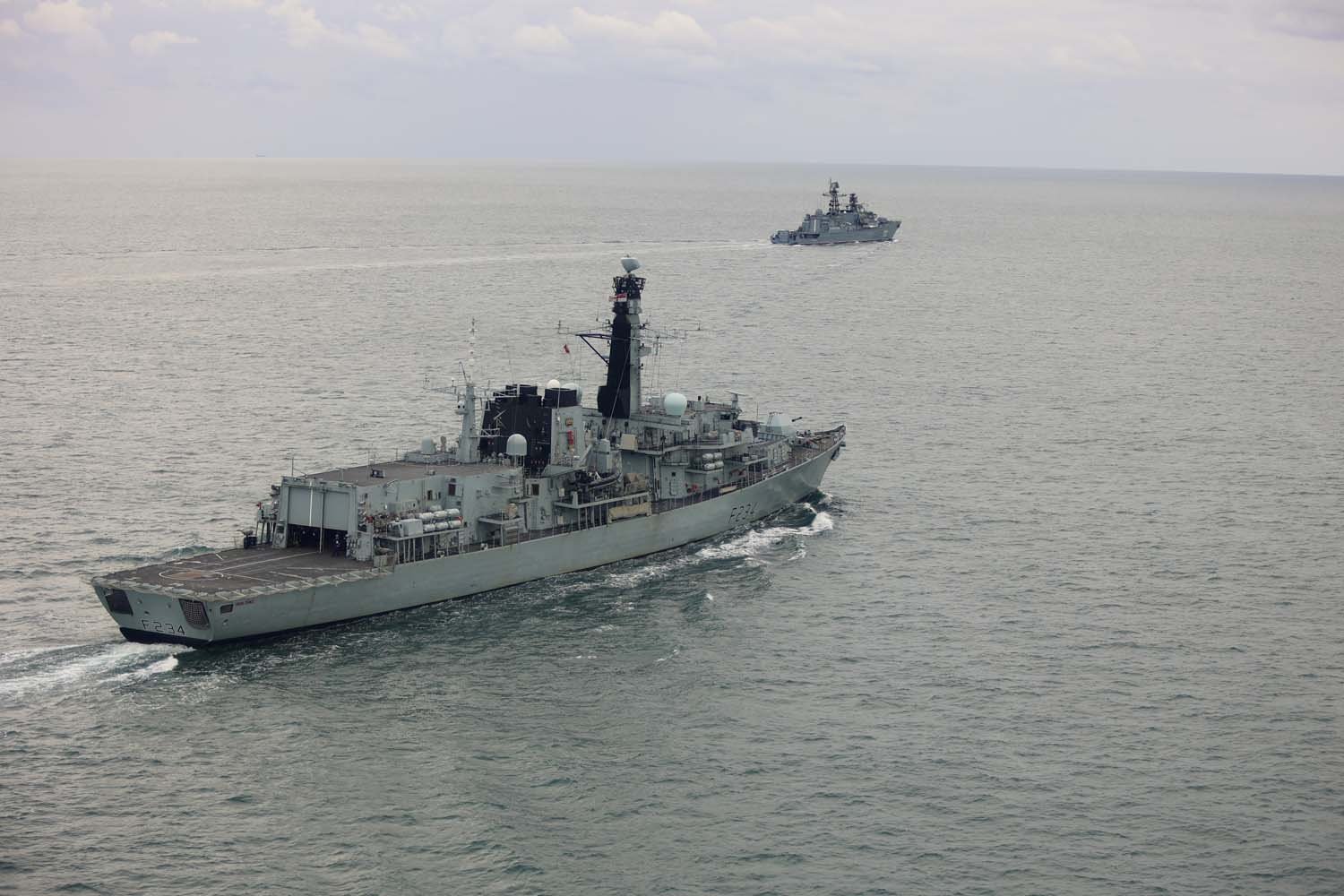

A Russian Federation Navy frigate has conducted a live-firing exercise in the English Channel, according to media reports.
While sailing in international waters around 45 miles south of Plymouth on 20 July, the Russian frigate Neustrashimiy conducted live gunnery drills, the BBC reported.
The BBC said the Russian Project 11540 frigate had notified HMS Tyne – the UK Royal Navy (RN) River-class offshore patrol vessel that had been shadowing it – of its intention to carry out the activity. Tyne had watched the Russian ship for several days as it sailed south from the North Sea. During the firing, Tyne maintained safe distance, following the Russian ship’s request to do so. At that time, the Russian ship was also being monitored by a French military aircraft.
Plymouth is home to one of the RN’s three fleet bases, with the others located in Portsmouth and Faslane.
The drill also occurred on the day the UK’s new prime minister took office. According to the BBC, the Kremlin stated there was no signalling being carried out through the exercise, and that the live firing adhered to international and maritime law.
The BBC report added that the UK’s new defence secretary, Wes Streeting, stated Russia “should be in no doubt about the [UK’s] resolve” regarding its support for NATO allies and for partners like Ukraine.
During a media briefing, Streeting highlighted a consistent pattern of behaviour similar to that of Russia.
Within a broader trend of a 30% rise in Russian naval activity around UK waters over the past two years, as reported by the UK government early in 2026, the English Channel has become a regular route for Russian ships, often accompanied by RN escorts. Since Russia lost ashore basing access in Syria when the Assad regime collapsed in late 2024, its ongoing need to maintain a strategic presence in the Eastern Mediterranean is largely supported by vessel return transits from Russia’s Baltic and Northern fleets.
Other recent notable incidents in the Channel involving Russia include: in June, the UK conducting its first boarding of a Russian ‘shadow fleet’ ship, MV Smyrtos, which was then secured in waters off Portland; and, also in June, the Russian frigate Admiral Grigorovich firing warning shots with small arms ahead of a private yacht that may have sailed too close.
In the latter case, the Russian frigate was in international waters. It should also be noted that all naval ships have self-protection protocols.
The Neustrashimiy live-firing incident happened after the RN revealed in late June that several of its ships had spent a considerable amount of time over the past three months monitoring various Russian vessels in and around UK waters.
The RN’s list included various assets spending a total of 25 days in May shadowing Admiral Grigorovich. The RN report added that the frigate may have conducted resupply at sea (RAS) off the UK’s east coast, via another Russian vessel, an Amur-class resupply ship. Such RAS would help the frigate remain on station where needed. According to the report, the RAS occurred close to a UK at-sea windfarm. The report also noted that Admiral Grigorovich had been operating near UK waters from April through May and into June.
Furthermore, the report continued, the Type 23 frigate HMS Somerset was deployed on two separate occasions to track the movements of two different Russian platforms – an intelligence-gathering vessel and an amphibious ship.
In recent years, Russian intelligence vessels have frequently been spotted near seabed critical infrastructure sites within UK waters.
Neustrashimiy’s own activity – the live firing – may or may not have been connected to its location off Plymouth or the UK prime minister handing over. However, similar activities have been carried out by other navies in different contexts. For example, in 2025, a small flotilla of China’s People’s Liberation Army Navy (PLAN) ships conducted several live-firing drills in waters including the Tasman Sea, while maintaining a sustained deployment around Australia.
by Dr. Lee Willett
