

A decade ago, “cloud first” was something cool and different. Agencies were trying to prove they could move workloads out of legacy environments and into something more flexible, more modern. The conversation centered on the technology itself: What could go to the cloud, and how fast?
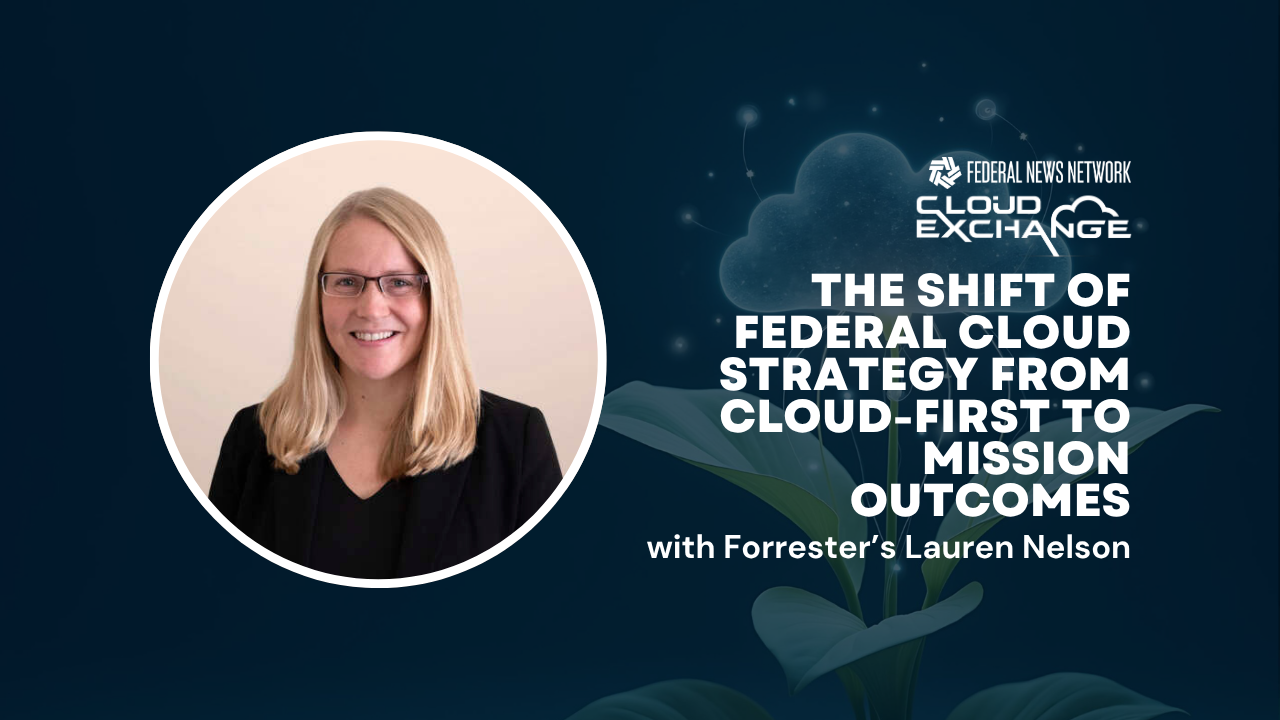
Lauren Nelson, vice president and senior research director at Forrester, remembers that era as one defined by experimentation and, at times, overreach.
Developers were handed a new set of building blocks and told to innovate. But too often, they spent their time rearranging those blocks rather than building something that served the mission, Nelson said during Federal News Network’s Cloud Exchange 2026.
The metaphor was simple: a box of Legos with no clear design. Teams swapped pieces in and out, tinkering with the structure instead of focusing on what they were trying to create, she shared.
From cloud-first to mission-first
The federal technology conversation today is about what systems deliver, not where they run. Agencies are now organizing around mission outcomes and only then deciding how technology supports that goal. That shift has reshaped how systems are designed and deployed, Nelson said.
Instead of building bespoke environments tied to a single platform, agencies are moving toward portable products, capabilities that can travel. Containerization has become a foundational approach because it solves a practical problem, she said, and because it allows applications to run wherever they make the most sense.
That “where” is increasingly fluid. Workloads may live in the cloud, on premise, or at the edge, depending on performance, timing or mission need. The decision isn’t locked in at the start. Instead, it evolves along with the mission and the technology, Nelson said.
The need for portability changes the posture of federal IT. Instead of committing early to a particular vendor or environment, agencies can design systems that adapt as requirements change. They’re shifting away from fixed architecture toward something built to scale and adjust over time.
The harder part: Making it work
In that sense, cloud is no longer the strategy. It’s one option in a broader system designed to deliver outcomes, Nelson noted. But as the architecture is getting more flexible, execution is also getting more demanding, she said.
The first pressure point is leadership. Nelson said agencies need leaders who can think of capabilities not as one-time projects but as products that evolve. That means managing lifecycles, investing continuously and, just as important, knowing when to walk away. Divesting from underperforming efforts becomes part of the discipline, freeing up resources for the next round of innovation, she advised.
The second challenge is governance. Federal systems are governed by layers of policy, oversight and risk management that were built for a different era. Those controls have to change shape for the modern environment.
Nelson described the emerging model as “wide streets and high curbs.” The idea is simple: Create space for teams to move quickly and experiment but make it difficult to step outside safe boundaries. That balance allows creativity without sacrificing control, she said.
In practice, it also means standardizing more of the underlying platform. Developers shouldn’t be rebuilding foundational components every time they start a new project. Those pieces should be reusable, stable and governed, freeing teams to focus on what actually advances the mission, Nelson said.
The third challenge is contracting. Speed matters, and procurement timelines have not always kept pace with the need to move from pilot to production.
Nelson described both the challenge and the solution. “We’re starting to see much more streamlined ways of thinking about technology procurement and use, which is challenging,” she said. “We have a lot of governance and silos in different groups, making it a really difficult challenge to get away from that modular approach, away from those technology-specific decisions to start thinking about it more as scaling our innovation practice with efficiency.”
And then there’s cost.
Managing cloud and AI costs in federal IT
Cost control has become more complicated as architectures have become more distributed and as artificial intelligence enters the picture.
“One of the challenges with AI is it is cost introduced at every layer. It is in an enterprise app, in licensing fees, it is in workplace productivity, it is using the actual models yourselves and having to do token management,” Nelson said. “It is building models and using them atop your public cloud platforms, it is everywhere, and so it is such a multidimensional problem to manage.”
That creates a moving target for budgeting and forecasting. Agencies are responding by strengthening financial oversight practices, she said. But even with those tools, surprises happen. Usage can spike quickly. Pricing models can shift. Costs can cascade across systems in ways that are difficult to predict.
That’s why governance and cost management are increasingly linked. The same “high curbs” that shape technical decisions are also being used to set boundaries on usage by limiting exposure and preventing unintended consequences before they scale, Nelson said.
What federal IT leaders should do now
For agencies navigating these decisions, Nelson offered four key pieces of practical advice.
- Start with outcomes: “Before you even talk about cloud, start with your outcomes or start with your mission that you’re trying to achieve. It is about that. It will always be about that.”
- Design for scale and sustainability: One-off innovations won’t hold up under operational demands. Building shared platforms and reusable capabilities is the only way to move quickly without creating fragmentation.
- Create room for creativity: Innovation doesn’t happen in tightly constrained environments. Leaders have to make space for experimentation while still maintaining guardrails that keep efforts aligned and controlled.
- And ask for help: “You’re not going at this alone. There is higher art, there are other organizations that are going through this. You can lean on others in the community to help make some of those drives forward.”
The shift underway is as much cultural as it is technical, Nelson pointed out. That means leaders must be able to manage products over time, balance risk and speed, and recognize when to redirect effort. It also requires environments where teams feel empowered to challenge assumptions and improve systems as they go.
Discover more articles and videos now on the Cloud Exchange event page.
Copyright
© 2026 Federal News Network. All rights reserved. This website is not intended for users located within the European Economic Area.
