

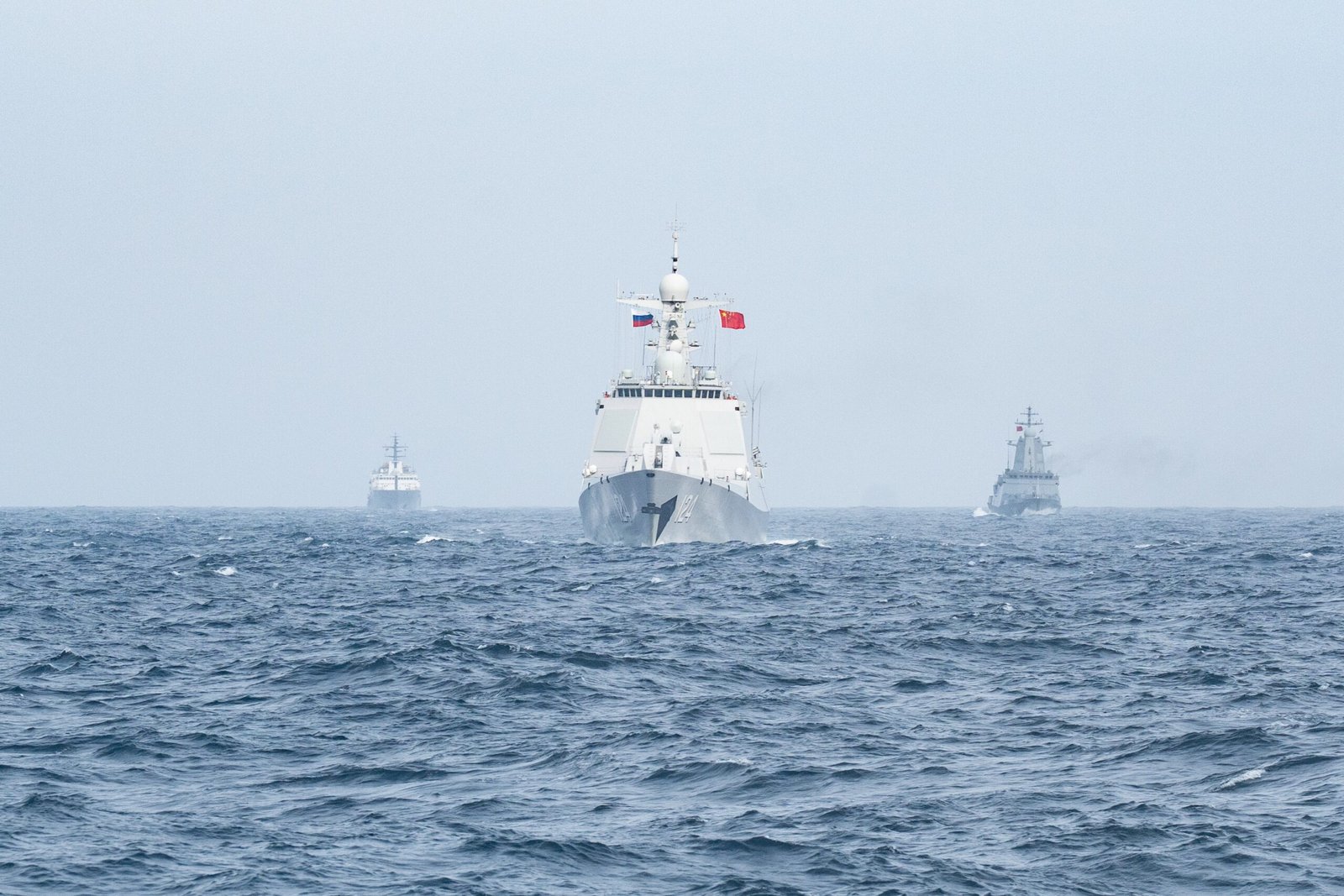
NEW TAIPEI CITY, Taiwan — In early November, Taiwan’s National Security Council secretary-general tracked more than 100 Chinese military-linked vessels near his island.
But given its scale, the massive flotilla that included coast guard vessels alongside navy warships may have had Taiwan’s maritime neighbor Japan in its sights, military experts say.
They say China has sent an outsized number of its far-seas naval deployments to near Japan’s southernmost islands and nearby waters since a political dispute that erupted in November 2025 over a remark by Japanese Prime Minister Sanae Takaichi.
Takaichi told a Japanese House of Representatives committee session that month that a Chinese naval blockade or armed conflict involving Taiwan could constitute a “survival-threatening situation” for her own country not far away. China claims self-ruled Taiwan as its own and has not ruled out the use of force to take it.
“There is a direct link between Takaichi’s statement and the quality and quantity of deployments,” said Stephen Nagy, a visiting fellow with the Japan Institute for International Affairs think tank in Tokyo. “(China) is also sending a signal to Tokyo that if it continues its current position vis-a-vis Taiwan that Beijing will continue these activities.”
China is using the deployments, including live-fire drills, uncrewed drone missions and voyages by entire aircraft carrier groups, to exert an unrelenting, long-term pressure on Japan without violating international maritime laws, analysts said.
“By repeatedly transiting waters around the (southwestern) Islands, China is gradually normalizing PLA Navy activity within the first island chain, expanding its operational experience and creating a pattern of accepted presence,” said Katsuya Yamamoto, director of the Tokyo-based Sasakawa Peace Foundation’s strategy and deterrence program.
The first island chain includes Japan, Taiwan and the Philippines.
“In other words, it is establishing facts on the ground, or rather at sea, that broaden its future freedom of action,” Yamamoto said.
In the seven weeks after Takaichi’s comment, the U.S. think tank Center for Strategic and International Studies logged a spike in “notable” PLA escalatory moves. Over 2025 overall, it said, China showed just a “slight increase” in the number of PLA naval vessels reported operating in waters around Japan, including an increase in the number of Chinese ships within the contiguous zone of the disputed Senkaku Islands, which China calls the Diaoyu.
Deployments near the uninhabited, Japanese-controlled Senkakus have “remained at very high levels” over the past year as before, while joint Sino-Russian missions around Japan and Chinese naval activity near the outlying Japanese islets around the Miyako Island “seem to have increased”, said Jeffrey Kingston, a professor specializing in Asian studies and history at Temple University, Japan Campus.
Chinese and Russian aircraft patrolled in June over the Sea of Japan, followed by a joint naval passage in July in the Miyako Strait near outlying Japanese islets. Chinese and Russian surveillance aircraft did five separate flights near Japan in October.
Spokespeople for the Chinese ministries of foreign affairs and national defense have called China’s military actions fair, valid and peaceful.
China is probably using military moves as one in a series of measures – some economic – to get back at Takaichi for her November 2025 remarks, Kingston said. “They haven’t forgotten, that’s for sure,” he said. “They are in various ways trying to put the screws on her.”
Officials in Beijing still want a retraction of the prime minister’s November 2025 comments but it’s unlikely, Kingston believes.
The Japanese government has verbally protested against Chinese military moves, tracked Chinese ships with its own, and scrambled fighter jets.
Tokyo is now considering a 70 trillion to 80 trillion yen (as high as $508 billion) defense spending plan for the five-year period beginning in April 2027, up from 43 trillion yen in the previous half-decade span, Japanese media outlets have reported.
“As the security environment becomes increasingly severe, cooperation with the ally and like-minded countries is indispensable to peace and stability in the region,” Japan’s Ministry of Defense said in an Oct. 29 statement after a meeting with defense officials from Australia, the Philippines and the United States.
The ministry, it said, “will continue to take advantage of various opportunities to further strengthen such cooperation.”
