

According to CNN reporting, Joint Chiefs Chairman Gen. Dan Caine recently asked his top lawyer: “How should a military commander respond if they determine they have received an unlawful order?” The lawyer’s answer was reportedly unequivocal: “Request to retire — and refrain from resigning in protest, which could be seen as a political act, or picking a fight to get fired.” In other words, when given an unlawful order, the commander should resign quietly.
That advice, if given as reported, misapplies the idea of quiet resignation in multiple ways. (And I have grave doubts about the accuracy of this reporting.) Indeed, it is emblematic of a broader pattern in which the idea of the “quiet resignation” solution is misunderstood, misapplied, and overstated. Quiet resignation addresses the problem of what officers should do when faced with an order that they believe is beyond the pale, whether because it is immoral, violates professional ethics, or risks catastrophe. The two obvious responses to these types of orders are unsatisfactory. Disobey, and a servicemember can land in a court-martial. Resign in protest, and the act can undermine civilian control of the military. Quiet resignation seems to be the escape hatch: A third way that avoids both pitfalls. By resigning, the officer avoids carrying out the order. By resigning quietly, the officer leaves the troubling order unimpeded because the replacement can receive the same order and choose to comply. Former Secretary of Defense James Mattis has described resignation as an option in such circumstances. Gen. (ret.) Carter F. Ham has advised officers to “resign your commission and find another career path.” Former Defense Department Inspector General Joseph Schmitz told sailors and marines: “Your choices are simple: If you disagree with a lawful order of the President, it’s either ‘Aye, aye, Sir,’ or resign.”
Quiet resignation is the orthodox line in the military. Although the line exists mostly as a matter of professional culture, the objections to resigning in protest are best developed in the work of Peter Feaver, perhaps the most influential thinker of civil-military relations. His influence reaches far beyond academia and into the military itself, and he has developed his ideas on resignation in a long-running debate with critics that appeared in multiple venues. Feaver’s arguments serve as a touchstone for the reasoning behind the orthodox line. For present purposes, I begin from the premise that the orthodox line, which rules out disobedience and resignation in protest, is the correct one.
(Feaver’s thinking, however, is evolving. In a recent article coauthored with Heidi Urben, he has distanced himself from quiet resignation because the military needs its best officers in a newly complex security environment. He has also expressed some openness to relaxing the norm against resignation in protest because the assumption that Congress will hold civilian leaders accountable may no longer hold.)
The orthodox account does not support the enthusiasm for quiet resignation. Indeed, it offers ample resources for a critique of that enthusiasm. That account has recently been stretched to fit contexts beyond its intended limits. After reviewing the common line in favor of quiet resignation, I identify three ways the argument has been overstated: First, it does not apply to illegal orders. Second, it does not apply to anyone below the high rank of a flag officer (a general or admiral). And finally, resignation is not a realistic option for many servicemembers. These limits explain why the advice reportedly given to Caine, that a commander should resign quietly when given an unlawful order, was wrong, and why quiet resignation is a narrower idea than its current admirers often assume.
The Problem
Servicemembers should obey orders. That is the starting point, and it should remain a heavy presumption throughout this discussion. The military is not a debating society. Disobeying orders gets people killed, and it undermines the ability of the armed forces to fight and win the nation’s wars. It also undermines civilian control of the military. Orders derive their legitimacy from a chain of command that runs up to the commander-in-chief — the president of the United States, who is democratically elected. Disobedience by the military shifts power to unelected people with guns, and the military’s unique access to force makes it a potent threat to civilian rule. If an officer has doubts, the first steps are internal: Consult the Judge Advocate General’s Corps, elevate concerns through the chain of command, and document the basis for the objection. In other words, officers should speak up to their superiors but not speak out to the public.
But what happens when those internal steps fail and the order still stands? How then should an officer respond to an extraordinarily objectionable order?
The appeal of quiet resignation comes from the shortcomings of the two obvious alternatives. The first alternative is to disobey. But when the order is lawful, disobedience risks the institutional harms just described: It undermines battlefield effectiveness and civilian control of the military. Disobedience to a lawful order also carries a more personal risk: conviction at a court-martial. The heaviest charge would be Article 90, “willfully disobeying a superior commissioned officer.” In peacetime, the maximum punishment is confinement for five years, a dishonorable discharge, and forfeiture of all pay and allowances. In wartime, the maximum penalty is death.
The other alternative is to resign in protest. In this noisy resignation, the servicemember states his or her objections publicly so that the public can judge the dispute and pressure civilian leaders to reverse course. A resignation in protest is not illegal and thus may avoid a court-martial for disobedience. But Feaver argues that it still undermines civilian control. A resignation in protest would create public controversy, headlines, and viral clips that will force civilians to “bend to the will of the military,” which he argues is an “evil because it has as its explicit purpose the undermining of the democratic order.” The damage to civilian control, on this view, is so severe that Feaver says that unless the order is to launch an unjustified nuclear war, resignation in protest is a “cure worse than the disease.”
Quiet resignation is offered as a third way that avoids these pitfalls. In a quiet resignation, the officer conceals the true reason for retirement. The resignation letter gives vague reasons, cites banal justifications, such as spending more time with family, or offers no explanation at all. The advantage is that resignation is not disobedience. An officer cannot be court-martialed for it. And while a noisy resignation can pressure civilians to change policy, a quiet resignation leaves civilians free to pursue their policy preferences with the officer’s replacement.
Quiet resignation has a strong case, but only within a narrow domain. The problem is that it has recently been stretched well beyond that domain.
Unlawful Orders
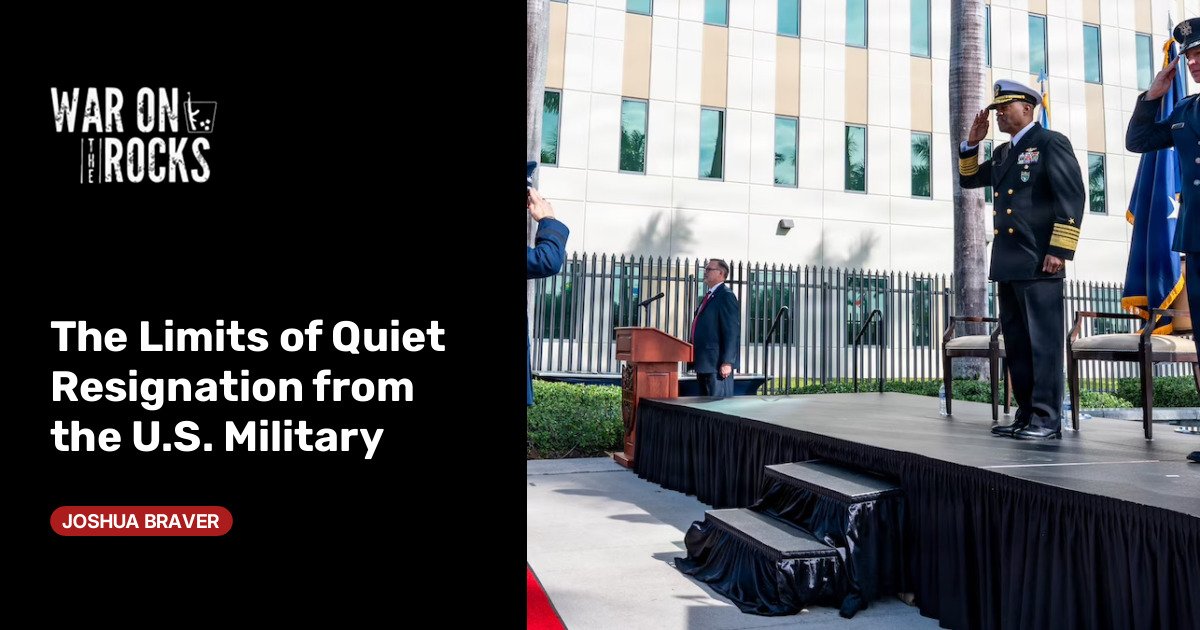
Adm. (ret.) Alvin Holsey, the former head of United States Southern Command, may well have acted on the same reasoning. He decided to retire less than a year into the command. That is highly unusual. It is “typically a three-year job,” and he was “in the midst of the biggest operation in his 37-year career.” We do not know his reasons for certain. His resignation letter offered none. It simply said it was an honor to serve as head of United States Southern Command and expressed “confidence” that the command would “forge ahead.”
Some reports, however, suggest that Holsey had concerns about the legality of strikes on boats in the Caribbean carrying drugs. Perhaps he retired quietly rather than stir up conflict. If so, his choice tracks the advice given by the top lawyer for the Joint Chiefs of Staff about how to respond to an illegal order: “request to retire — and refrain from resigning in protest.” (To be clear, Holsey may have faced an especially difficult decision given reports of conflicting legal advice over the strikes’ legality between Southern Command’s senior military lawyer and an interagency working group that included Joint Staff judge advocate generals).
This advice distorts the very position it likely is trying to follow, that developed by Peter Feaver. For Feaver, the first of his “scope conditions” for quiet resignation is that “this debate does not concern illegal orders.” Indeed, when an officer receives an illegal order, according to Feaver, they have an “obligat[ion]” to “resist the order up to the point of resigning in public protest.” And on this point, Feaver sees no room for disagreement. Feaver states that “Every expert I know who writes or comments on this topic would agree with that. All of the debate is about orders that are legal but otherwise problematic.”
To be sure, it can be very difficult to know whether an order is in fact lawful. Sometimes, the question is complicated, and it may also lack a clear answer. And most servicemembers are not lawyers. But there are two points to bear in mind. First, if a servicemember is uncertain about the lawfulness of an order, they should consult a judge advocate general lawyer for advice. Second, most military lawyers believe that the objective duty to disobey applies to “patently” unlawful orders. These are orders that are often described as egregiously, obviously, manifestly, or palpably unlawful. Still, there will be cases where it is difficult to obtain legal advice in time or to determine whether an order is patently unlawful. But these two considerations greatly ease the burden members face in judging whether an order is lawful.
Military leaders must not undermine civilian authority, but that authority is rooted in law. When an official gives a lawful order, it carries the authority of the office. A lawful order from Donald Trump is an order from the president of the United States, the commander-in-chief. A patently unlawful order lacks that authority. It is nothing more than an instruction from a private individual, not an order backed by the chain of command. Civilians grasp the distinction intuitively: When your boss schedules a meeting during the workday, you attend. When he tells you to do his laundry while you are on your vacation, you are outraged because you know the task is not your job.
Junior Officers
A second “scope condition” in Feaver’s argument against resigning in protest is rank. On his account, quiet resignation is tailored to senior military leaders, the only officers with enough prestige to generate public pressure that can distort civilian policymaking. The argument has less bite the lower one goes in the ranks. As Feaver puts it, “the more junior the rank, the less the cost.” Feaver does not offer a cutoff below which a resignation in protest is unlikely to undermine civilian control in any meaningful way.
But Feaver does offer guidance. “[I]n practice,” he suggests, “a resignation in protest by anyone of less than flag or general officer rank is unlikely to generate the attention that would warrant much debate among civil-military relations theorists.” A rough rule of thumb follows: An officer without a star is, at least on Feaver’s logic, a plausible candidate for resignation in protest.
The Law of Resignation
Less than a year ago, I wrote about the dilemma of whether a military officer should comply with a lawful order to deploy domestically to disrupt peaceful protests. Several officers emailed me to say the dilemma was a false one: You can always resign.
Again, this is a misunderstanding. Under the law, resignation will often, and perhaps most of the time, not be an option.
The availability of resignation depends in part on the nature of the order. Under the Manual for Courts-Martial Article 90, when an order requires “immediate compliance,” anything short of it can support a charge of disobeying orders. The manual is strict on this point: When such orders are given, “the failure to make any move to comply constitutes disobedience.” It goes further: Even a statement conveying an “intent not to obey” can itself be a violation. Resignation is no safe harbor for orders that demand immediate compliance.
Even when an order does not require immediate compliance, resignation is often unavailable because of the regulations that govern it. Those rules vary by service, so I will use the Army, and commissioned officers in particular, to illustrate the point. There are four reasons Army regulations will often forbid a quiet resignation in lieu of carrying out an order.
First, many officers cannot resign because they are bound by an active-duty service obligation (ADSO). An ADSO is the mandatory service commitment incurred upon commissioning as an officer. It typically runs three to five years, and additional obligations frequently attach for Army-funded graduate education, specialized training, or each permanent change of station. A permanent change of station usually happens around every two to three years and typically adds one additional year of ADSO. A conservative floor for the percentage of officers with ADSO is 26.8 percent.
Second, no officer has a right to resign. They must apply, and acceptance is not guaranteed. Approval is dependent on the needs of the service, and during personnel shortages, as occurred in Iraq, it was common to deny resignation requests for high-need specialties. One should not overemphasize this point, as the established pathways for voluntary separation or retirement are normally a predictable bureaucratic process. However, it is unclear how it would function if the disobedience was over a high-profile, sensitive issue or if it was widespread. Furthermore, “stop-loss” authority permits the president, secretary of defense, or service secretary, under conditions that in practice are easy to meet and have been fulfilled since 2001, to suspend any statute that would otherwise let a member retire, resign, or separate.
Third, the military typically takes nine to 12 months to process and approve a resignation request, making it nearly impossible to time a departure to avoid carrying out a specific order. Lastly, when adverse action is pending — e.g., when an officer is under a suspension of favorable actions, pending investigation, or under charges — the officer may not tender an unqualified resignation.
Conclusion
Quiet resignation is a genuine solution to a genuine problem. But it is a narrow one, whose boundaries were crossed in the reported advice given to Caine and in the resignation of Holsey. The solution of quiet resignation was never meant to cover illegal orders, never designed with ranks below flag officers in mind, and never reckoned with the legal reality that many servicemembers simply cannot resign when they want to. Beyond those boundaries, quiet resignation is not required and often not available.
Joshua Braver is a visiting senior fellow at the American Enterprise Institute and an associate professor at the University of Wisconsin Law School. His scholarship focuses on civil-military relations, particularly when military officers should disobey orders and the domestic deployment of the military.
Image: Air Force Staff Sergeant Christopher Bermudez via U.S. Southern Command
