

Recent headlines and analyses underscore how unmanned aerial systems (UAS) – large and small, long-range and short, reconnaissance and strike – are changing tactical norms on today’s battlefield, and beyond. In January 2026, Ukraine’s Defence Ministry stated that 80% of enemy targets destroyed were now caused by drones. That same month, Latvian intelligence sources independently reported that 70-80% of casualties on both sides of the Ukraine War result from unmanned systems. And in February 2026, the Wall Street Journal reported that a 10-person team of Ukrainian drone operators, acting as an OPFOR unit during the March 2025 Hedgehog Exercise in Estonia, achieved simulated kills against 17 NATO tanks, as well as 30 other targets during a single day, effectively incapacitating two battalions. While these reports highlight only one aspect of modern warfare, and should not lead to a ‘target fixation’ on the drone threat, they do underscore the need for enhanced counter-drone capabilities at both the static and manoeuvre warfare level.
The Ukraine War also underscores the need to secure domestic military, industrial and critical public infrastructure from reconnaissance and strike drones, whether launched on long-range cross-border missions or deployed at close range to the target by infiltration teams. While there have been no documented attacks outside the two warring parties, European nations and the United States alike have recorded a significant number of incursions by unidentified UAS which are widely believed to reflect efforts to test defences and reconnoitre targets.
ESD recently discussed counter-UAS (C-UAS) options for dismounted infantry (Issue 03/2026). This article will focus on options for securing fixed sites and for deployment on mobile tactical platforms.
Detection, Tracking and Intercept Networks
The first step in UAS defence is detection of incoming threats, along with tracking and targeting solutions for whichever countermeasures are available. Multilayered defences are particularly feasible for securing area targets and high-value infrastructure targets in the homeland setting. Networks include electromagnetic (EM) spectrum sensors and radars, with interceptor options spanning the gamut from EM jammers to short-and-long range missiles to guns. The greater the number of layered components – both sensors and interceptors – the stronger the system will be.
One major challenge is the need to differentiate between hostile, potentially hostile, and legitimate or friendly UAS sharing the same airspace. The proliferation of commercial, recreational and own-government unmanned aircraft over domestic airspace significantly limits the deployment of radio-frequency (RF) countermeasures; explosive-laden or long-range kinetic interceptors risk civilian personnel and infrastructure casualties and are also generally contraindicated, limiting intercept options.
Golden Dome
The Golden Dome for America integrated air and missile defence system being developed for the United States is currently focused on countering the spectrum of missile threats and other advanced aerial attacks. There are suggestions to expand this to include networked C-UAS capability for critical infrastructure and public venues. AeroVironment (AV) is one firm openly touting this approach. In October 2025, the firm announced an expanded collaboration with GrandSKY, a commercial UAS business and aviation park located on the grounds of Grand Forks Air Force Base (North Dakota) “to establish the foundation of its Golden Dome for America limited area defence architecture” at the base. AV will deploy its inner layer distributed C-UAS capabilities which the firm describes as the backbone of a layered defence architecture. This deployment will integrate AV’s Titan and Titan-SV RF-based platforms for long-range detection and identification of unmanned aircraft.
The AV_Halo COMMAND software platform will fuse the sensor and surveillance data into a unified operating picture for C-UAS and Beyond Visual Line of Sight (BVLOS) airspace awareness, the firm stated in the October release.
“We’re deploying technologies that deliver unmatched situational awareness to Grand Forks AFB while providing a road map to expand these limited area defence capabilities at critical sites throughout the nation in support of Golden Dome for America,” said Wahid Nawabi, President and CEO of AV. Notably, for the moment AV’s demonstration at Grand Forks is limited to detection and identification technology, demonstrating the essential capability to discriminate between hostile and friendly aircraft over domestic zones.
JIATF 401
As expected, the Pentagon itself is focused on neutralising drone threats over military installations and forces. The goal is for each installation to have a self-sufficient C-UAS capability. In August 2025, the US Secretary of War directed the establishment of Joint Interagency Task Force 401 (JIATF 401) “to better align authorities and resources to rapidly deliver Joint C-sUAS (Counter small UAS) capabilities to America’s warfighters, defeat adversary threats, and promote sovereignty over national airspace.” JIATF 401 assesses threat levels and gaps at individual locations and regions, devises mitigation plans, provides training for installation personnel and for civilian agency personnel at all levels of government, and facilitates procurement of C-UAS technology.
The latter mission includes rapid integration, testing and delivery of C-UAS capabilities. On 24 February 2026, the Pentagon announced that JIATF 401 had declared ‘initial operational capability’ for the C-UAS Marketplace. Described by a task force spokesperson as “an Amazon-like marketplace for the procurement of counter-drone technology and equipment where people can go online, look for capabilities and user feedback,” the online catalogue currently hosts more than 1,600 pre-approved components including sensors, C2 elements, software, power systems, accessories and training systems, as well as effectors. Authoritative performance data on each system is provided, says JIATF 401 director Brigadier General Matt Ross; this permits end-users, from military installations and federal agencies to local law enforcement, to select solutions suitable to their respective threat and operational environment and assemble them to a tailored system.
The task force is currently also working to harmonise the command-and-control of the disparate systems being used by the military and its civilian agency partners. “[We are going to] standardize the communications protocols on how we send and receive information so that every component of a counter- UAS system is plug and play,” Ross said.
Only a fraction of the marketplace catalogue’s inventory consists of actual interceptors. To date JIATF 401 has validated three interceptor systems. Validation verifies performance against Group 1-3 UAS in operationally representative environments, interoperability with the joint C-UAS architecture, and compliance with safety, airspace, and RF regulations. The three validated effectors cover the gamut of directed energy weapons, net capture systems, and kinetic intercept and include:
LOCUST
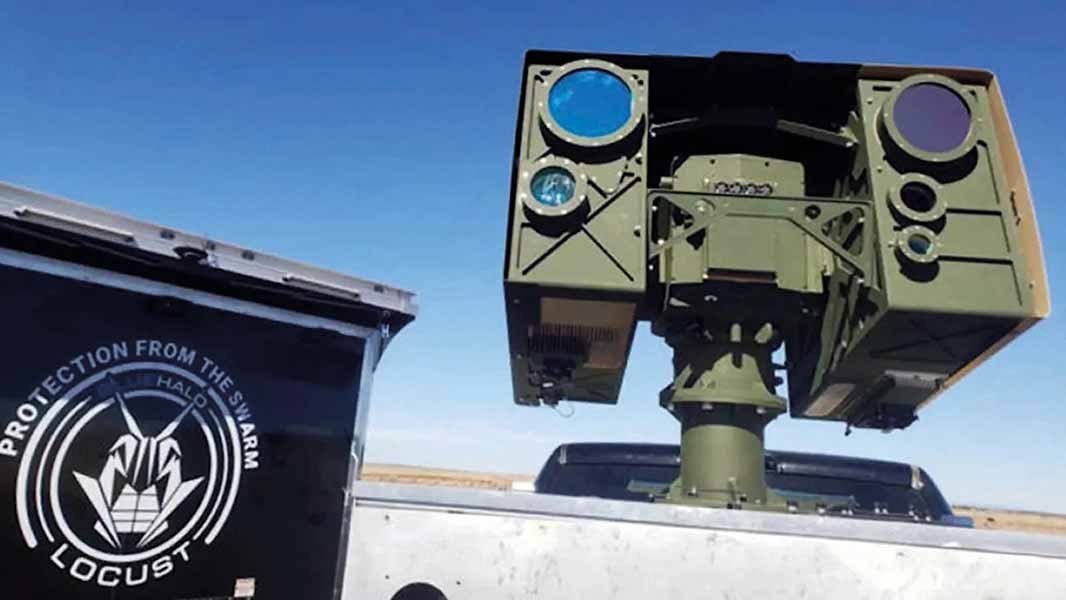
The Laser Optical Counter UAS System (LOCUST) 20 kw weapon system developed by AV can be mounted on light tactical vehicles for mobile defence of installations or manoeuvre forces, or pallet-mounted for fixed site defence (domestic or expeditionary). The system includes electro-optical and infrared cameras (EO/IR), gimbaled beam directors, rangefinders, and multi-band RF sensors for precise tracking; effective engagement range is classified but lasers of this energy category are considered short-range weapons. LOCUST has been deployed along the US-Mexico border, where the US military records more than 1,000 cartel-related UAS incursions monthly. In early February, concerns that the laser could endanger civilian aircraft led to a temporary shutdown of operations at the El Paso airport. Two weeks later, the laser downed a Customs and Border Patrol drone in a ‘friendly fire’ incident, emphasising the need to deconflict for safe C-UAS operations.

DroneHunter F700
In January 2026, JIATF 401 selected Fortem’s DroneHunter F700 interceptor for the Pentagon’s C-UAS portfolio. The reusable, AI-driven and radar supported F700 tracks targets in complex, cluttered environments; identifies even RF-silent drones via their radar and visual profile; and captures verified targets in a tethered net, minimising risk to infrastructure, aircraft or personnel. On 4 February, the firm announced the results of an internally conducted test, simultaneously pitting five F700s against five ‘hostile’ UAS flying autonomous, pre-programmed attack missions. As released by the firm, the interceptors were controlled by a single SkyDome system, Fortem’s AI-powered software platform for airspace awareness and drone engagement. “SkyDome autonomously planned, sequenced, and coordinated all five intercepts, with no human involvement,” the firm stated. The F700 system can also be utilised for installation defence or as part of a mobile package.
Bumblebee V2
In late January 2026, JIATF 401 awarded Perennial Autonomy a contract for the Bumblebee V2 counter-drone system. Considered a ‘next-generation’ first-person view (FPV) kinetic interceptor, the quadcopter destroys targets via direct collision. Both drones are destroyed, but the lack of a blast or fragmentation warhead designates the Bumblebee as a low collateral damage interceptor. The highly agile UAS can defeat manoeuvring, high-speed or low-altitude threats. Additional advantages include low cost and rapid fielding. It is suitable for homeland or expeditionary missions.
![The Bumblebee V2 kinetic interceptor is considered a cost-effective C-UAS solution. [Image: US Army]](https://euro-sd.com/wp-content/uploads/2026/04/Bumblebee-Kopie.jpg)
C-UAS Flyaway Kit
These localised C-UAS defences can be augmented by mobile systems such as the C-UAS flyaway kits operated by the joint US Northern Command (NORTHCOM). Combining multiple sensors and effectors, the ‘kits’ form a comprehensive system to detect, track, identify and neutralise hostile or suspicious UAS. They are operated by small specialist teams and deploy within 24 hours via C-130 to installations experiencing significant drone incursions. In its current configuration the kits consist of the following: the Heimdal mobile sensor trailer with a continuous 360-degree pan and tilt unit, thermal optics and a radar; the Pulsar electromagnetic warfare effector featuring radio frequency detect, track, classify and deny options; launch boxes with Anvil drone interceptors which neutralise targets through collision; and the AI-enabled Wisp wide-area infrared system that provides a 360-degree, full-motion operational picture.
![Components of NORTHCOM’s C-UAS Flyaway Kit poised to deploy for air base defence. Two Anvil interceptor launch boxes sit on the right. [Image: US DoW]](https://euro-sd.com/wp-content/uploads/2026/04/Drone-Defense-Air-Base-Kopie.jpg)
Drone Wall
In Europe, NATO and EU nations have agreed on the need for a so-called ‘drone wall’ along the circa 3,000 km communal eastern frontier. Not a physical barrier, the ‘wall’ will combine ground-based sensors, AI-supported reconnaissance drones, and mobile counter-drone platforms, all augmented by satellite surveillance data. Poland has begun implementing its own portion of the drone shield by awarding a January 2026 US$ 4.2 billion contract to Kongsberg Defence & Aerospace and Polish state-run defence group PGZ for a comprehensive border C-UAS system. First elements of this San C-UAS system are expected to be delivered before year’s end, with the entire system expected to be delivered within 24 months of contract signing. Polish deputy prime minister and defence minister Władysław Kosiniak-Kamysz stated that the contract will equip 18 anti-drone batteries encompassing 52 firing platoons, 18 command platoons and 703 vehicles based on the Jelcz truck and the Legwan light reconnaissance vehicle. PGZ said that 60% of the systems will be provided by the Polish consortium.
Kongsberg’s contribution will be based on the firm’s Protector family of weapons, including the Medium Caliber Turret (MCT30) and the Remote Weapon Station, mounting 35 mm, 30 mm and 12.7 mm guns as well as missiles and interceptor drones. Deliveries of the entire system are expected to be completed 24 months following the signing of the contract. The C-UAS system will be only one segment of a multi-faceted ‘East Shield’ defensive system to strengthen the nation’s eastern border.
Tactical Manoeuvre Force C-UAS
The second leg of C-UAS is designed to defend the expeditionary and manoeuvre force, both in camp and on the move/ in battle. Potential solutions include RF countermeasures as well as containerised and vehicle-mounted kinetic interceptor systems. Modularity and flexibility are key factors determining a system’s ultimate effectiveness.
Vampire
The L3Harris VAMPIRE (Vehicle-Agnostic Modular Palletized ISR Rocket Equipment) is a versatile, low-cost mobile C-UAS solution which has been combat-proven in Ukraine since 2023. It can be mounted on any military or civilian vehicle with a flatbed cargo bed. The modular design permits mounting on a new carrier within as little as two hours. More recent variants have been configured for deployment on unmanned surface vessels or on helicopters and light attack aircraft. WESCAM MX-series EO/IR cameras mounted on a telescopic mast provide advanced ISR and target acquisition capabilities including laser target designation. The primary interceptor is the laser guided 70 mm AGR-20 Advanced Precision Kill Weapon System (APKWS), equipped with an advanced proximity fuze developed by L3Harris. Additionally, the firm has now incorporated additional sensor capabilities, precision weapons (including the Thales 70 mm FZ275 laser-guided rocket), electronic jammers and non-kinetic effectors for enhanced versatility. The system uses Shield AI artificial intelligence and machine learning to more swiftly detect, engage and defeat small and elusive unmanned threats. New options include a containerised APKWS system for point defence of remote locations, an elevated turret mounting an automatic gun and non-kinetic effects, designed for drone defence of military bases and critical infrastructure, and a vehicle mounted system that eschews kinetic interceptors in favour of jammers, minimising the risk of collateral damage.
LIDS
The US Army’s Low, Slow, Small UAS Integrated Defeat System (LIDS) family of systems can be deployed in a palletised fixed-site variant (FS-LIDS) or as a vehicle-mounted mobile variant (M-LIDS). Several major contractors contribute to the system, including SRC Inc., Leonardo, Moog, Northrop Grumman and Raytheon/RTX.
LIDS integrates a suite of sophisticated mast-mounted sensors with kinetic and electronic warfare (EW) effectors to defeat Class 1-3 UAS (which would include Shahed drones). Major elements include the AN/TPQ-50 multi-mission radar (which can detect and track UAS at up to 35 km range), high-definition EO/IR cameras, and SRC’s Counter-Small Unmanned Aircraft Electronic Warfare System (CUAEWS) to classify and neutralise individual and swarm targets. Additional primary effectors are the jet-powered Coyote Block 2+ kinetic interceptor (effective range 15 km, altitude 9,000 m, airspeed – as reported by US DoD – up to 595 km/h), which destroys targets via a proximity-fuzed warhead, and the retrievable Coyote Block 3 non-kinetic interceptor which employs EW to neutralise single and swarming UAS. In addition to EW systems and the Coyote, the M-LIDS configuration also includes vehicle turrets mounting either a 30 mm chain gun and a 7.62 MG, or a 12.7 mm MG. LIDS has seen sustained operational deployment in the US Central Command area of responsibility. In 2022, Qatar became the first confirmed foreign purchaser of the system.
GARMR
Diehl Defence has significantly upgraded its highly mobile C-UAS system, presenting the new GARMR configuration (named for the heavenly guard dog of Norse mythology) during the February 2026 Enforce Tac trade fair on security and defence in Nürnberg. Mounted on a Caracal tactical vehicle. GARMR features additional high-performance interceptors and an AI-enhanced threat detection, prioritisation and engagement-decision framework. According to Diehl, GARMR’s sensors can detect UAS ranging from small quadcopters up to Class 3 UAS including the Shahed family. The system is equally suited for infrastructure or fixed site defence and for direct combat support of manoeuvre forces. Depending on the mission environment, GARMR can deploy with the Short-Range System (SRS) or the Medium Range System (MRS). The SRS utilises the tube-launched Cicada interceptor developed by Diehl; 15 vertical tubes can be secured in the Caracal’s bed.
The Cicada is configured for intercept of Class 1-2 drones at short range; target neutralisation is optionally accomplished via net capture or by a proximity-fuzed warhead. Diehl does not identify the intended effector for the medium-range system, simply stating that the MRS “neutralizes targets with innovative interceptor drones.” In addition to the two primary interceptors, further effectors can be integrated for both ranges to ensure optimal configurations for the operational situation. The firm added. While the precise intercept range for the SRS and MRS has not been formally confirmed by Diehl, some industry analysts have postulated likely range bands of 20 and 40 km, respectively. Th selection of sensors and effectors (augmented by a Gatling gun for close-in defence) provides GARMR considerably greater operational depth than most mobile C-UAS systems.
![The Diehl Defence GARMR mobile C-UAS system, a complete C-UAS solution. [Image: Diehl Defence]](https://euro-sd.com/wp-content/uploads/2026/04/GARMR.jpg)
Sidney E. Dean
Click here to read the latest issue of ESD.
